
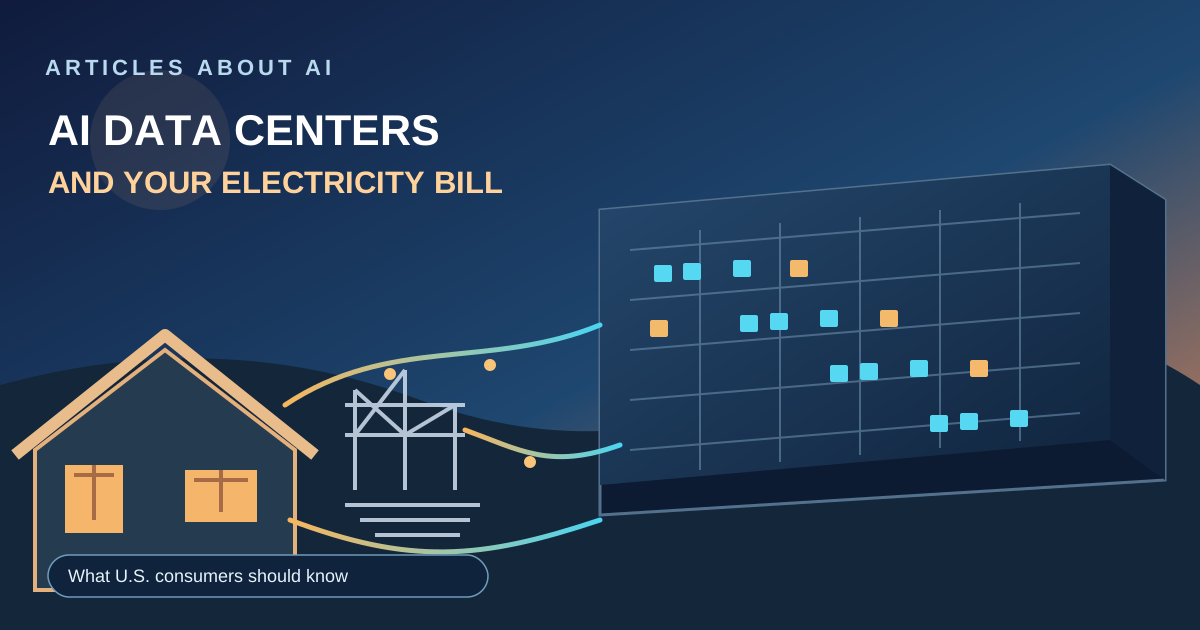
A new wave of artificial intelligence infrastructure is raising a practical question for U.S. households: could the electricity used by AI data centers make power bills more expensive? The answer is not a simple yes or no. Data centers can increase local electricity demand and require new grid infrastructure, but the effect on household bills depends on where a facility connects, how new power and transmission are funded, and whether regulators ensure that large customers pay the costs they cause.
The issue has become especially tangible in Texas. On September 30, 2026, the U.S. Department of Commerce and South Korea announced a partnership around Project Star, a planned energy and digital-infrastructure campus in Encinal, Texas, valued at more than $22 billion. Its developers say it would pair 6.47 gigawatts of natural-gas generation with an adjacent 5-gigawatt data center campus, with excess generation sent to the Texas grid. These are project plans, not evidence that the facility is already operating. Read the developers’ announcement.
Why AI Data Centers Need So Much Electricity
AI services run on servers housed in data centers. Training and running large models can require substantial computing capacity, while the equipment also needs cooling and supporting infrastructure. As AI use expands, operators are planning facilities that can draw power at a scale comparable to that of large industrial customers.
The U.S. Department of Energy’s 2024 summary of a Lawrence Berkeley National Laboratory report estimated that data centers used about 4.4% of U.S. electricity in 2023. That report projected a range of 6.7% to 12% by 2028, reflecting uncertainty about how quickly demand and efficiency would change. Those figures are projections from the 2024 report, not a measurement of today’s share. DOE’s report summary.
More electricity demand does not automatically translate into a matching increase in residential rates. New generation, storage, more efficient equipment, and better use of existing grid capacity can help meet demand. The crucial question is whether the costs of new power plants and grid upgrades are allocated fairly and transparently.
How Data Centers Could Affect Household Bills
There are several pathways through which a large data center could affect electricity customers.
1. New grid infrastructure
A utility may need to build or upgrade substations, transmission lines, and other equipment to serve a very large customer. If the costs are spread across other ratepayers rather than assigned to the customer that caused them, households could end up paying part of the bill. The risk is particularly important when infrastructure is built in anticipation of a project that is delayed, scaled back, or never opens.
2. Wholesale electricity prices and local capacity
A major new load can tighten supply in a constrained region, especially during periods of peak demand. That can put pressure on wholesale prices or the need for additional capacity. The impact varies by grid region, available generation, transmission constraints, and the timing of demand growth. It should not be assumed that every data center causes the same price effect in every state.
3. How the project obtains power
Some developers plan dedicated generation or long-term power arrangements to support their facilities. Project Star, for example, is planned around a large on-site natural-gas power campus, with surplus electricity intended for the Texas grid. A dedicated supply arrangement can change how a project interacts with the grid, but it does not by itself prove that nearby household bills will rise or fall. Actual outcomes depend on final agreements, construction, operating conditions, and applicable market rules.
What U.S. Regulators Are Doing
On June 18, 2026, the Federal Energy Regulatory Commission (FERC) announced actions directing the six regional grid operators under its jurisdiction to justify or reform rules for connecting data centers and other large electricity users. FERC said the effort is intended to speed integration while protecting reliability and affordability. The orders also emphasize cost allocation and transparency so regulators and customers can understand which grid costs are caused by large loads. Read FERC’s announcement.
These actions matter, but they should not be described as a guarantee that every household is protected from every cost. The details of tariffs, utility proceedings, project contracts, and state-level regulation still matter. Consumers should look for evidence about who is responsible for upgrades, what happens if a project fails to materialize, and whether those commitments are enforceable.
How to Check Whether Your Local Bills Are at Risk
If a data center is proposed near your community, use these practical checks instead of relying on a headline:
- Identify the utility and grid region. Electricity markets and rate rules differ by location.
- Look for a utility filing or regulator decision. Search your state public utility commission’s website for the project name, a large-load tariff, a rate case, or a transmission-upgrade request.
- Ask who pays for upgrades. Look for contracts, cost-recovery agreements, deposits, or other protections that assign project-related costs to the large customer.
- Separate a proposal from an operating facility. Announced investment totals and planned megawatts are not the same as completed construction or actual electricity consumption.
- Check the evidence behind claims about bills. A rate increase may have several causes. To attribute it to a data center, look for a regulator’s analysis, utility filing, or credible reporting that identifies the connection.
For a household, the most useful evidence is local: an approved rate change, a published cost-allocation decision, or a utility explanation that links a specific project to customer costs. National forecasts help explain why the issue matters, but they cannot determine the effect on an individual bill.
The Bottom Line
AI data centers are becoming large electricity customers, and their growth makes grid planning and cost allocation increasingly important. They can contribute to pressure on infrastructure or electricity prices in some regions, but the existence of a new data center is not proof that residential bills will increase. The result depends on local supply, grid constraints, project financing, and rules that determine who pays.
Project Star illustrates the scale of the new infrastructure being planned in the United States. The next questions to watch are whether it reaches construction and operation on schedule, how its power arrangements are finalized, and how regulators ensure that costs are allocated transparently. For consumers, the strongest signal is not a headline about AI’s energy appetite; it is a documented local decision showing how a project affects the grid and customer rates.
Sources
- U.S. Department of Commerce and NextEra Energy: Project Star announcement, September 30, 2026
- U.S. Department of Energy: Data center electricity-use report summary, December 20, 2024
- Federal Energy Regulatory Commission: Large-load integration and consumer protections, June 18, 2026
This article distinguishes announced plans and official projections from measured outcomes. Project timelines, energy demand, and regulatory arrangements may change.