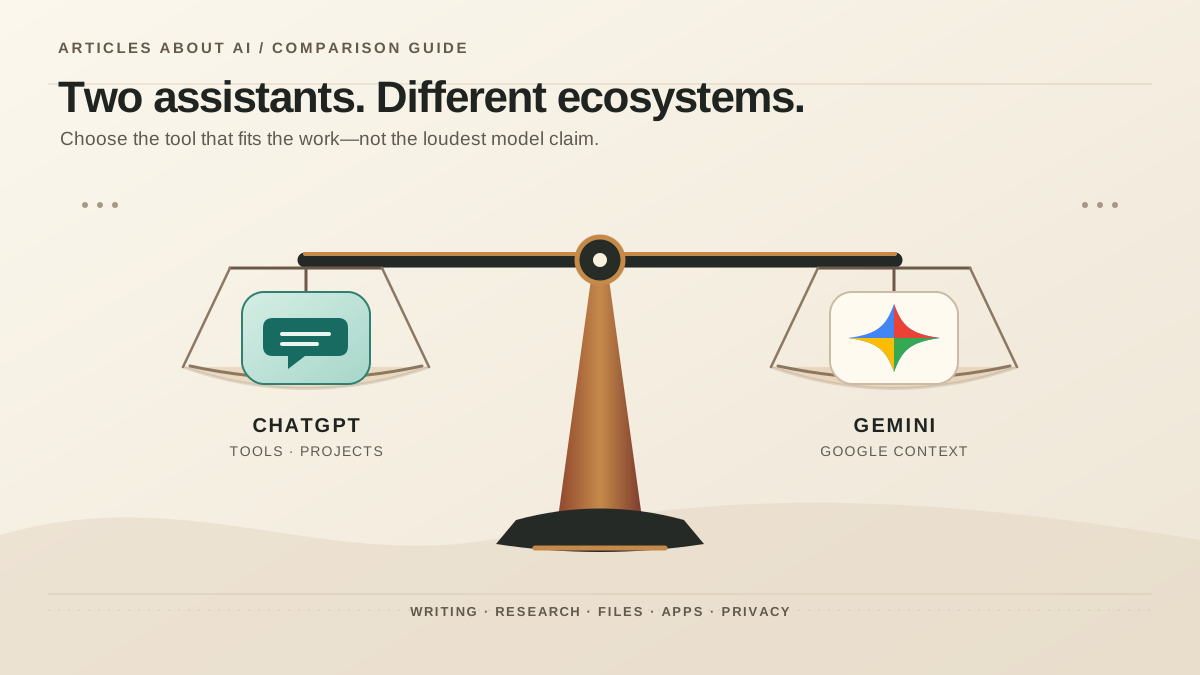
ChatGPT and Google Gemini can both explain difficult ideas, draft documents, summarize information, work with images, and help people solve everyday problems. For many users, either assistant can handle the basics. The meaningful differences appear when you look at the surrounding workflow: where your files live, which apps you already use, how you research a question, which tools are available on your plan, and how much you are willing to pay.
There is no reliable universal winner. The products change frequently, feature availability can vary by country and subscription, and an assistant that fits a student may not be the best choice for a business analyst or a developer. The practical question is not simply which model is smarter. It is which product helps you complete your recurring tasks with the least friction while producing results you can verify.
This guide compares ChatGPT and Google Gemini across common use cases and explains how to choose between them without relying on a single benchmark or a broad marketing claim. Features and plan limits change, so check the official product pages linked below before making a purchase or depending on a specific capability.
ChatGPT vs. Gemini at a glance
| What matters to you | ChatGPT may be the better fit when… | Gemini may be the better fit when… |
|---|---|---|
| General writing and conversation | You prefer ChatGPT’s conversational workflow, projects, or custom GPT ecosystem | You want an assistant that fits naturally into your Google-oriented workflow |
| Research | You want to use ChatGPT Search or Deep Research in the same workspace as your other ChatGPT tools | You want Gemini’s research features and, where available, connections to Google services |
| Documents and spreadsheets | You already work with ChatGPT’s file analysis and data-analysis tools | Your work is centred on Google Drive, Docs, Gmail, Sheets, or other Google services |
| Images and multimodal tasks | You want to combine image understanding or generation with ChatGPT’s other tools | You want Gemini’s available image, audio, video, and Google ecosystem features |
| Coding | You want to discuss code, upload files, or use coding-oriented ChatGPT tools | You want Gemini’s coding capabilities and available repository or Google development integrations |
| Subscription value | The specific ChatGPT limits and tools you need justify its current price | Gemini’s current plan and bundled Google benefits better match your needs |
| Privacy and administration | ChatGPT’s consumer or organizational controls match your requirements | Gemini’s consumer or Google Workspace controls match your requirements |
Treat this as a starting point, not a test result. Both products have multiple models and plans, and their feature sets are not identical across web, mobile, personal accounts, and managed workspaces.
1. Writing, editing, and everyday assistance
Both assistants can help produce a first draft, restructure a report, rewrite an email, summarize a long passage, brainstorm headlines, or explain a technical topic in plain language. In these tasks, the quality of the result depends heavily on the brief you provide, the context you share, and the amount of editing you do afterward.
ChatGPT is worth trying if you want to build a repeatable writing workflow around projects, saved instructions, or custom GPTs where available. You can provide a clear role, audience, tone, constraints, and examples, then refine the response through follow-up instructions. Our guide to writing better ChatGPT prompts explains how to make those instructions more precise.
Gemini is a strong candidate when your writing begins with material already in Google’s ecosystem or when you want assistance inside supported Google products. Depending on the account, plan, and rollout, Gemini features may be available in services such as Gmail and Docs. That can reduce the need to copy material from one application to another, but it does not eliminate the need to review the output.
Neither assistant should be treated as a dependable source of facts merely because its prose sounds confident. For a factual article, ask for a source list, open the original sources, and check names, dates, quotations, figures, and causal claims. For a sensitive email or a public-facing document, review the final language yourself. An assistant can improve clarity without knowing whether every claim in the source material is true.
Practical test: give both tools the same short brief and source material. Compare factual accuracy, structure, tone, the number of corrections required, and how well each follows constraints. Do not judge only by which answer sounds more polished on the first attempt.
2. Web search and deeper research
ChatGPT includes search capabilities for questions that need current information, while its Deep Research feature is designed for more involved research tasks that synthesize information across sources. These tools can help you establish an initial overview, discover leads, and organize findings. Their availability and usage limits depend on the current product and plan.
Gemini also offers research capabilities, including Deep Research. Google has described integrations that allow Deep Research to draw on information from services such as Gmail, Drive, Docs, Sheets, Slides, and Chat for eligible users. Check Google’s current documentation for the exact services, account types, and regions supported before planning a workflow around those connections.
The distinction that matters is how the research process fits your work. If your project is spread across ChatGPT conversations, uploaded files, and ChatGPT research tools, staying in ChatGPT may be convenient. If important background material lives in Google Drive and Gmail, Gemini’s supported connections may save time. Neither advantage automatically makes one assistant’s conclusions more accurate.
For serious research, evaluate the evidence rather than the length of the generated report. Check whether the assistant cites original documents, distinguishes evidence from interpretation, includes dates, and acknowledges gaps. A citation is not proof by itself: it may be outdated, irrelevant to the claim, or misrepresented. Open the source and confirm that it actually supports the statement.
For breaking news, legal requirements, medical questions, financial decisions, or fast-changing product details, use the assistant to accelerate discovery—not as the final authority. Prefer official announcements, documentation, regulatory publications, and primary research over unsourced summaries.
3. Files, PDFs, and data analysis
Both assistants can work with supported files and use their contents to answer questions. ChatGPT’s capabilities overview documents file uploads and data analysis, including work with structured data such as spreadsheets and CSV files. Gemini’s file and document capabilities should be checked against its current help documentation and your account’s enabled features.
For a PDF, start with a narrow task: ask for the document’s purpose, its main claims, and the page or section supporting each important finding. Then ask targeted follow-up questions. If the file contains tables, footnotes, scanned pages, or complex layouts, verify extracted figures against the original. OCR and table extraction can fail even when a summary looks plausible.
For spreadsheets, ask the assistant to explain the columns and assumptions before requesting calculations. Give it a clear definition of each metric, specify how missing values should be handled, and request a reproducible explanation of any calculation. If the result informs a budget, business decision, or published analysis, validate the formulas and totals independently.
The better choice often depends on where the files are stored and what you need to do with them. If you frequently upload files into ChatGPT and analyze them there, ChatGPT may be the simpler workflow. If your documents are maintained in Google Drive and your account supports the relevant Gemini connections, Gemini may make it easier to work from that existing context.
For a step-by-step ChatGPT workflow, see our guide to uploading files to ChatGPT and analyzing them. It covers preparing a file, asking focused questions, and checking the result.
4. Images, audio, and other multimodal tasks
Multimodal capability means an assistant can work with more than plain text—for example, images, audio, or video where supported. ChatGPT’s official capabilities overview describes image input and generation, file and audio uploads, and Voice Mode. Google’s Gemini product pages describe multimodal features as well, but exact tools and limits depend on the product version, plan, device, and region.
For image understanding, try giving both assistants the same screenshot, chart, or photograph and asking a concrete question. Check whether each correctly identifies the relevant details, separates visible evidence from assumptions, and says when something is unclear. For image generation, compare whether the tool follows the brief, handles text accurately, and produces an image suitable for your intended use. One sample is not enough to establish a general performance ranking.
For spoken interaction, compare speech recognition, interruption handling, response quality, accessibility, and how easily you can return to the transcript. A voice feature can be useful for language practice, hands-free brainstorming, or explaining a document, but it may be less suitable for a task that requires careful editing or exact quotations. See our ChatGPT Voice Mode guide for details about that product’s workflow.
Do not assume that a feature available in a demonstration is available to every user. New capabilities often roll out gradually and can be restricted by subscription, country, age, account type, or administrator settings. Confirm availability in your own account before choosing a service for a recurring task.
5. Integrations and the productivity ecosystem
This is one of the most important differences for many people. An assistant is not just a model that generates text; it is also an interface to tools, files, and services.
Gemini’s main ecosystem advantage is its relationship with Google products. For users who spend much of the day in Gmail, Google Docs, Drive, Sheets, and other supported services, a compatible Gemini integration can reduce context switching. The value depends on which services are actually enabled for the account and whether the assistant can access the information needed for the task.
ChatGPT offers its own workflow features, which can include projects, custom GPTs, file analysis, search, and other tools depending on the plan and product surface. These can be useful if you prefer to keep instructions and related work inside ChatGPT rather than moving between separate apps. The exact feature set changes, so consult the current ChatGPT capabilities and pricing pages.
A useful way to compare the ecosystems is to list five tasks you perform every week. For each task, record the files and apps involved, whether the assistant can access them with your current account, how many manual steps remain, and whether you can verify the output. This exposes the real productivity difference better than a long list of advertised integrations.
Before connecting either assistant to work accounts, review permissions. Grant only the access needed for the task, follow your organization’s policies, and avoid connecting personal or confidential material to an account that is not approved for it.
6. Coding and technical work
Both ChatGPT and Gemini can explain code, propose implementations, help interpret errors, generate tests, and discuss architecture. Their usefulness depends on the language, the complexity of the task, the context available, and the tools enabled in your account.
For a small programming problem, provide a minimal reproducible example, the expected behavior, the actual result, and the full error message. Ask the assistant to explain its assumptions and propose a test that would reveal whether the fix works. Then run the code in a controlled environment. Generated code can contain security issues, incorrect dependencies, or subtle edge cases even when it appears reasonable.
For larger repositories, context handling and integrations become especially important. Consider whether the assistant can work with the relevant files, understand the project structure, and preserve conventions. Do not paste API keys, passwords, private tokens, customer records, or proprietary code into a personal account unless the applicable policy explicitly permits it.
Choose by task rather than brand. If one assistant consistently produces correct patches and useful tests for your repository, that is stronger evidence than a general benchmark score. Repeat the comparison on representative tasks and track how much human correction each tool requires.
7. Privacy, data controls, and workplace use
Privacy should be evaluated from the actual terms and settings that apply to your account—not from a broad claim that one brand is inherently private. Consumer services, business plans, and managed workplace accounts can have different controls, data practices, retention rules, and administrative options.
Before sharing information, determine whether the content is personal, confidential, regulated, or owned by an employer or client. Review the provider’s current privacy documentation and the controls available in your account. Where relevant, check whether conversations can be used to improve models, how temporary chats work, how data can be deleted or exported, and what administrators can manage.
For workplace adoption, compare administrative controls, identity management, retention, audit needs, contractual terms, and the specific plan being considered. A consumer subscription should not be assumed to provide the same commitments as a business or enterprise offering. If your organization has an approved AI policy, follow it even if another product seems more convenient.
A practical rule applies to both tools: share only the information necessary to complete the task, remove unnecessary personal details, and verify that you are using the intended account before uploading sensitive files.
8. Pricing and free versus paid plans
ChatGPT and Gemini both offer free access and paid options, but plan names, prices, included benefits, usage limits, and regional availability can change. Some Google AI subscriptions may bundle benefits beyond the Gemini app; ChatGPT subscriptions may provide broader access to models or tools within ChatGPT. Compare the current official pages rather than relying on an old price quoted in a review.
Start with your usage pattern. If you only ask occasional questions, summarize short passages, or draft simple messages, a free tier may be enough. If you regularly conduct research, analyze large files, create media, or depend on higher limits, a paid plan may be worth evaluating. Do not subscribe simply because a paid model is marketed as more powerful.
Compare the actual limits that affect your work: messages, model access, file uploads, research reports, image generation, audio or video features, and any service integrations you plan to use. A plan can be excellent value for one person and poor value for another. If a feature is essential, confirm that it is available in your country and account before paying.
You can also test one subscription for a month, track the tasks where it saves measurable time, and cancel if the value is not clear. If you are comparing subscriptions, our guide to ChatGPT Free vs. Plus explains why the paid tier should be judged by its limits and tools rather than by the assumption that every response is automatically better.
Official pricing pages:
9. How to run your own fair comparison
A short, repeatable test is more useful than choosing based on online arguments. Use the same prompt and equivalent source material in each assistant, and compare the results against a clear rubric.
- Writing: ask both to turn the same notes into a short article for a specified audience. Check structure, accuracy, tone, and whether either invents details.
- Research: ask the same current question and require primary-source citations. Open the cited sources and verify the key claims.
- Files: upload equivalent documents and ask for a summary with page references. Check whether figures and qualifications are preserved.
- Data: provide a small spreadsheet with known totals and request a calculation. Compare the result with an independently verified answer.
- Coding: give each assistant the same bug report and test case. Run the proposed fix and review it for security and maintainability.
- Workflow: complete one real task using your usual apps. Count the steps, repeated uploads, and manual corrections required.
- Cost: compare the current plan prices with your actual usage, not a hypothetical power-user workload.
Score each result on correctness, completeness, instruction-following, source quality, ease of use, and correction time. Save the prompts and outputs so you can repeat the test after a major update. Avoid claiming that one model is universally superior based on a single question or an unverified leaderboard.
Which one should you choose?
Choose ChatGPT if its writing workflow, project organization, custom GPTs, file analysis, voice features, or other tools match the work you do most often—and the access limits on your plan are sufficient.
Choose Google Gemini if your daily work is closely tied to Google services and its available integrations make it easier to work with your existing documents, email, and productivity tools. Its current research and multimodal features may also fit your needs, depending on your account and region.
Consider using both if your work benefits from a second opinion. You might draft with one assistant and check claims with the other, or compare two analyses before making a decision. But do not treat agreement between two AI systems as independent proof: both can make similar mistakes. Important claims still need to be checked against reliable evidence.
The best choice is the assistant that repeatedly produces useful, verifiable work within your budget and privacy requirements. Start with the tasks you actually perform, test both products on those tasks, and revisit the decision as their features and plans change.