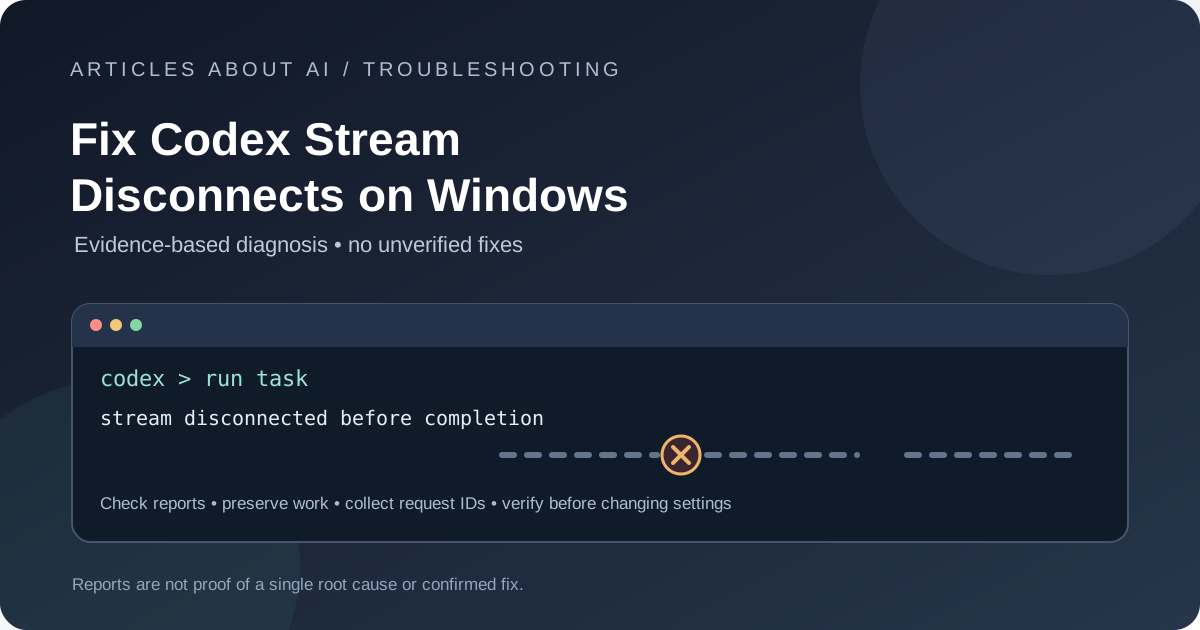
If OpenAI Codex stops with “stream disconnected before completion”, the immediate symptom is clear: the response stream ended before the turn completed. The underlying cause is not always clear. A connection interruption, a service-side failure, or a problem affecting a particular client or long-running conversation can produce symptoms that look similar.
In October 2026, multiple users reported intermittent stream disconnections in the Codex Windows desktop app. Some reports also describe failed remote context compaction, which can prevent work from continuing in a long conversation. These are user reports in the public issue tracker—not an official confirmation that every case has the same cause.
This guide explains how to investigate the error without risking your local work or applying unverified fixes.
What has been reported?
Two relevant reports in the public OpenAI Codex issue tracker describe related symptoms:
- Issue #52919: intermittent stream disconnects and reconnect failures on Windows was opened on October 10, 2026. The reporter describes repeated disconnections and reconnections in Codex Desktop and VS Code. The report identifies Windows 11 25H2 and a desktop package version reported as
26.1007.2314.0. - Issue #53203: responses and compaction fail in Windows version 26.1007.2314.0 was opened on October 11, 2026. It describes failed responses and errors while attempting remote context compaction in long-running conversations.
The reports were updated on October 12, 2026, but their timestamps indicate when the reports were created or updated—not necessarily when the underlying issue first began for every user. Versions and environments are supplied by the reporters and are not independently verified for every affected installation.
Important limitation: Similar error text does not prove a shared root cause. At the time of writing, these reports do not establish a universal fix or identify a confirmed release that resolves all cases.
Step 1: Check whether there is a service incident
Before changing local settings, check the official OpenAI status page.
Look for an incident that matches the product and approximate time of your failure. An unrelated incident elsewhere on the status page is not evidence that it caused a Codex stream error. Conversely, a status page without a matching incident does not prove that the problem is local to your computer.
Record the time of the error and your time zone. This makes it easier to compare your experience with incident updates and support responses.
Step 2: Record the exact error and environment
Capture the following details before restarting, updating, or changing configuration:
- Codex client: Windows desktop app, VS Code extension, or CLI.
- Exact version shown by the application or installed package metadata.
- Windows version and architecture.
- Model selected and whether the failure occurs in a new chat or only an existing conversation.
- Approximate time of each failure, including the time zone.
- The complete error text and any available request or feedback ID.
- Whether the task had already run tools or changed files before the response disconnected.
Do not publish private conversation contents, authentication tokens, API keys, or sensitive repository data in a public issue. Redact personal and confidential information from screenshots and logs.
Step 3: Test a short request in a new conversation
If your current conversation repeatedly fails, preserve the important context and then test a small, non-destructive request in a new conversation.
For example, ask Codex to explain a small code snippet without editing files or running commands. Compare the result with the original conversation.
- The new conversation works: this suggests the failure may be associated with the original conversation, its accumulated context, or a transient condition. It does not prove which explanation is correct.
- Both conversations fail: the problem may be broader than one conversation, but that alone does not distinguish a client, network, account, or service-side issue.
- Responses work but context compaction fails: record the exact compaction error separately. Do not assume that a successful ordinary response means the compaction path is healthy.
This is a diagnostic comparison, not a guaranteed workaround.
Step 4: Protect long-running work before retrying
If the error appears during a coding task, avoid repeatedly resubmitting a large task without checking what has already happened.
- Inspect the working tree and review any files Codex may have changed.
- Save useful work in your normal version-control workflow. If you use Git, run
git statusand reviewgit diffbefore deciding what to commit or discard. - Copy essential requirements and decisions into a safe local note if the conversation is at risk of becoming inaccessible.
- Avoid deleting the affected conversation until you have preserved the information you need.
- If you resume in a new conversation, provide a concise summary of the task, the current repository state, completed steps, and remaining work.
These actions help preserve work; they do not repair the stream or remote compaction mechanism itself.
Step 5: Check for client updates carefully
Check the official Codex release information and the update mechanism for your installed client. If an update is available, review its release notes before installing it, then record the new version and test again.
Do not assume that a version number mentioned in an issue is the latest version or that a newer version contains a fix. The issue reports cited here do not, by themselves, identify a confirmed fix release for all of these symptoms.
If the failure began immediately after an update, include that timing in your report. A sequence of events can be useful evidence, but it does not alone prove that the update caused the failure.
Step 6: Check network conditions without disabling security
If the error affects several conversations or clients, compare the behavior on a trusted, stable network if that is practical and permitted by your organization.
- Check whether other services are experiencing connectivity problems at the same time.
- If you use a VPN, proxy, or managed corporate network, follow your organization’s troubleshooting process and record whether the connection path changed.
- Do not disable endpoint protection, firewall rules, or organizational security controls just to see whether the error disappears.
- Do not share private logs publicly without reviewing them for credentials and confidential data.
A successful test on another network may narrow the investigation, but it does not establish the root cause. Likewise, an apparently healthy browser connection does not guarantee that every connection used by a coding client is healthy.
Step 7: Report the issue with useful evidence
If the problem continues, use the official OpenAI Help Center or the relevant public issue tracker. Include the exact client and version, operating system, timestamps, error text, reproduction steps, and request or feedback IDs when available.
A concise report should answer these questions:
- Does the failure occur in every conversation or only one?
- Does it happen on short requests, long tasks, or during remote context compaction?
- Does the same symptom occur in the desktop app, VS Code, or CLI?
- What changed shortly before the first observed failure?
- Can the failure be reproduced, and what is the smallest reliable reproduction?
Avoid uploading an entire private conversation or repository when a short, redacted reproduction is sufficient.
Is there a confirmed fix?
The cited reports document symptoms and affected environments, but they do not establish one confirmed root cause or a release that fixes every reported case. Restarting the client, changing networks, or opening a new conversation may help with diagnosis in some circumstances, but should not be presented as a proven universal fix.
The safest current approach is to check service status, record the exact environment, test a small request separately, preserve local changes, and submit reproducible evidence. Revisit the official issue tracker and release notes for a maintainer-confirmed explanation or fix.
Frequently asked questions
What does “stream disconnected before completion” mean in Codex?
It means the response stream ended before the current turn completed. The message describes the symptom; it does not, by itself, identify whether the cause is local, network-related, or service-side.
Does the error mean my code changes were lost?
Not necessarily. Some tool actions may have completed before the response stopped. Inspect your working tree and Git diff before retrying the task, and preserve any useful changes.
Is this definitely a Windows-only problem?
No. The two reports discussed here focus on Windows, but similar error text can appear in other environments. These reports do not establish that every occurrence has the same cause or is limited to Windows.
Should I delete the conversation or reinstall Codex?
Do not start by deleting the conversation or removing local data. Preserve the context and inspect local changes first. Reinstallation is not a confirmed fix for the reported problem and may make diagnosis harder if useful logs or state are lost.
Sources
- OpenAI Codex issue #52919 — user report of intermittent Windows desktop and VS Code stream disconnects, including the reported environment and version.
- OpenAI Codex issue #53203 — user report of failed responses and remote context compaction in long-running Windows conversations.
- OpenAI Codex issue #53167 — additional report of a Codex service failure; useful as supporting context, not proof of a shared root cause.
- OpenAI Status — official service incident information.
- OpenAI Help Center — official support channel.
Related Articles
- Claude Code vs Codex vs Gemini CLI: Which AI Coding Agent Should You Choose? — compare coding agents and choose a workflow that fits your project.
- OpenAI Speeds Up Codex Steering in ChatGPT Desktop: How Follow-Up Controls Work — learn how to steer a running Codex task and queue follow-up instructions.