
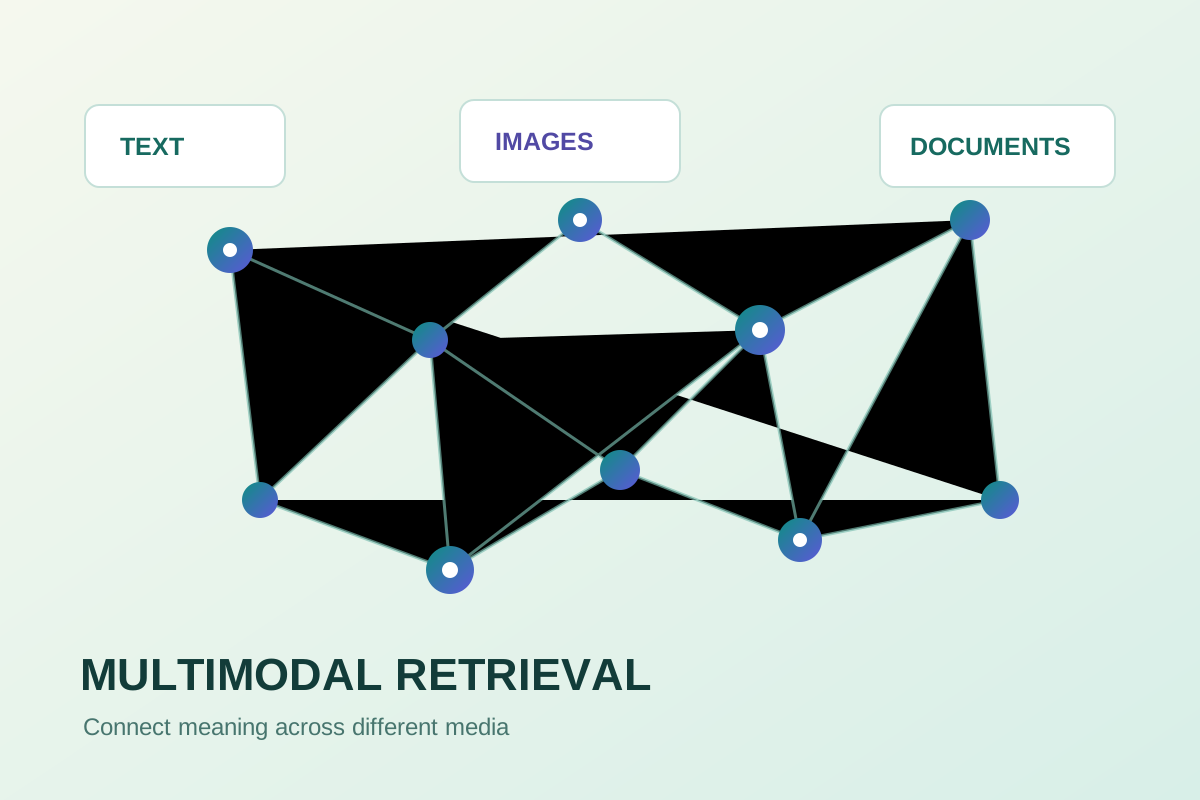
Perplexity announced a new family of multimodal retrieval models on
October 7, 2026: pplx-embed-v2-late. The release includes two model
checkpoints, perplexity-ai/pplx-embed-v2-late-0.6b and
perplexity-ai/pplx-embed-v2-late-9b, published through the company’s
Hugging Face organization. Perplexity describes them as late-interaction
models for retrieving text, images, and visual documents. The two sizes
share an embedding space, allowing a system to create a document index
with the larger model and encode incoming queries with the smaller one.
The announcement is relevant to developers building semantic search and retrieval-augmented generation (RAG), especially when their data includes PDFs, presentations, scanned pages, screenshots, charts, and tables. It is not a new conversational assistant, and the release does not mean that the models automatically power every Perplexity product. The company says it plans to progressively roll out support for late-interaction, dense, and contextual embeddings on its API platform, but its announcement does not set a general-availability date for this model family through that API.
This article explains the problem the models are designed to address, the trade-offs developers should expect, and a practical way to decide whether this type of retrieval belongs in a real application. Product details are based on Perplexity’s official research post and its published model cards; the implementation advice and evaluation framework are independent analysis.
What the release adds
Embedding models convert content into numerical representations that software can compare. They are commonly used to find documents related to a question, recommend similar items, or retrieve evidence before a language model generates an answer. Perplexity’s new family differs from a conventional one-vector embedding approach by retaining token-level representations and comparing query and document content at a finer level.
The company describes the architecture as ColBERT-style late interaction. The models produce 128-dimensional vectors for retained tokens and use MaxSim to score query-document matches. The smaller and larger checkpoints are intended to offer different cost and quality options. The official model cards list an MIT license and compatibility requirements for current versions of Sentence Transformers and Transformers.
Those details establish what is being released, but they do not establish that the models will outperform every alternative on every dataset. The useful question for a developer is narrower: does preserving more detail during retrieval improve the results enough to justify the additional storage, indexing, and scoring work?
Why retrieval quality affects AI answers
Many AI applications follow a two-stage pattern. First, a retrieval system identifies passages, pages, or other records relevant to a user’s question. Then a language model uses the retrieved material to produce a response. This is the core idea behind retrieval-augmented generation.
The arrangement can improve answers by supplying relevant evidence, but it also creates a dependency: the language model cannot use a document that the retrieval stage fails to surface. A poor retrieval result can leave the generator with incomplete context, even if the generator is otherwise capable. A system may then omit an important qualification, use a less relevant passage, or answer with too much uncertainty.
This is why choosing an embedding model should not be treated as a cosmetic infrastructure decision. Retrieval influences what the rest of the system sees. At the same time, the embedding model is only one component. Chunking, metadata filters, index construction, ranking, query rewriting, access control, and the language model’s context handling can all affect the final result.
A useful evaluation therefore compares complete retrieval workflows, not just model names. The same encoder can look strong in one pipeline and disappointing in another if the documents are segmented poorly, the candidate set is too small, or the evaluation queries do not reflect how people actually search.
The limits of a single-vector representation
A conventional dense embedding model often maps an entire input to one fixed-size vector. That representation is compact and convenient. Once a corpus has been encoded, an approximate nearest-neighbor index can retrieve candidates without running the full model over every document for every question. The approach can scale well when a system needs to search a large collection at low latency.
Compression is the trade-off. A long report may discuss dozens of subjects, contain many named entities, and include evidence spread across text, tables, and figures. One vector has to summarize that content. A query may refer to a detail that occupies only a small portion of the document, and the document-level summary may not preserve that detail strongly enough for the best match to rank highly.
Chunking is one common response. Instead of embedding a whole document as a single unit, a pipeline divides it into passages and indexes those passages separately. Chunking can improve the granularity of retrieval, but it introduces decisions about passage length and overlap. A passage that is too long can dilute the relevant detail; a passage that is too short can lose the surrounding explanation that makes a statement meaningful. Splitting a document can also separate a table from its caption or a conclusion from the conditions that qualify it.
No embedding architecture eliminates these design choices. It changes the trade-offs a retrieval system can make.
What late interaction changes
Late-interaction models preserve multiple vectors for an input rather than collapsing all content into one representation. A system can encode documents in advance, then compare token-level representations when a query arrives. This allows different parts of a query to match different parts of a candidate document.
Consider a question about a contract’s notice period after a particular type of breach. The question contains several concepts: the relevant clause, the notice period, and the triggering event. A fine-grained retrieval method can score how the query’s components align with separate parts of the document, instead of relying entirely on one summary vector. That may help when the useful evidence is localized or when several related topics appear in the same document.
Perplexity’s model cards describe a MaxSim scoring approach: each query token is matched with its strongest-scoring document token, and those similarities contribute to the final score. This gives the scoring stage more expressive power, but it also requires more computation than a single vector comparison. The model’s representation is richer; the search system has to pay to store and compare it.
That cost matters. A large corpus may contain millions of documents or passages. If each document is represented by many vectors, index storage can grow significantly. Scoring a large candidate set can also become expensive, especially for long documents. Developers should estimate these costs using real corpus statistics before assuming that a more detailed model will be the most practical option.
Why visual documents are an important use case
A large share of professional information is stored in formats that are not plain text. Researchers work with papers and scanned archives. Finance teams work with reports and spreadsheets exported as PDFs. Engineers use diagrams and technical drawings. Businesses rely on slide decks, forms, and screenshots. In these settings, relevant information may depend on layout or visual relationships as well as words.
Traditional search pipelines often extract text with parsers or optical character recognition. That can be effective, but extraction may introduce errors or lose structure. A table can become a sequence of lines with ambiguous relationships between values and labels. A chart can lose the connection between a plotted line, its legend, and the axis. A screenshot may contain labels or interface states that are difficult to recover from text alone.
Perplexity says its new models support text-to-image retrieval, including searching rendered PDF pages without requiring OCR or parsed text as an intermediate representation. This is potentially useful when a text query needs to retrieve a visually informative page. The same family is also described as supporting semantic retrieval over natural images.
It is important to distinguish retrieval from full visual understanding. A retrieval model ranks candidate material. It does not independently verify every value in a chart, explain the whole document, or guarantee that the highest-ranked page contains the complete answer. A downstream system may still need a vision-language model or a human reviewer to inspect the retrieved evidence.
Choosing between the two sizes
The shared embedding space gives developers more flexibility than a simple choice between a small model and a large model. The model cards identify a 0.6B checkpoint and a 9B checkpoint, and Perplexity says their representations are compatible for cross-model retrieval.
There are three straightforward deployment patterns.
Use the same model for indexing and querying. Running the larger model for both tasks prioritizes the performance Perplexity reports for that configuration, but it also puts the larger model on the live query path. Running the smaller model for both tasks can reduce resource requirements and simplify deployment, though the result must be tested against the quality target.
Use the larger model to index and the smaller model to encode queries. Indexing is generally performed ahead of time, so its compute cost can be spread across many future requests. Query encoding happens on the critical path each time someone searches. A system may therefore choose to spend more compute when building the index and less when answering each query. The shared embedding space is designed to make this asymmetric arrangement possible.
Choose based on the operational environment. A team with access to suitable accelerators may be comfortable running the larger checkpoint. A smaller team may need to prioritize memory, throughput, or local execution. Model size alone does not determine cost: batching, sequence lengths, hardware, quantization choices, concurrency, and index design can have substantial effects.
Perplexity’s announcement describes the deployment possibilities, not a universal best configuration. The right choice depends on how much retrieval quality matters, how quickly queries must return, and how much infrastructure the team can operate.
How to evaluate the models fairly
Perplexity reports results across text retrieval, visual-document retrieval, image retrieval, and other retrieval-related tasks. Its published post includes evaluations such as ViDoRe V3 and Q2D-Web, alongside a collection of domain-specific benchmarks. Those results offer a starting point for comparison, but vendor-reported scores are not a guarantee of production performance.
Before comparing models, define what success means for the application. A legal-document search tool may care about retrieving the exact clause and its surrounding conditions. A support assistant may care about surfacing the current troubleshooting article. A visual archive may care about finding the right scanned page from a short natural-language query. Different applications need different relevance judgments.
Build a test set from real or representative queries. For each query, identify the documents that should count as relevant. Include easy examples and difficult ones: synonyms, abbreviations, long documents, ambiguous wording, tables, multilingual material, and questions whose answers depend on a small detail. Keep a separate set for final evaluation so that repeated tuning does not simply optimize the same examples.
Measure ranking quality with an appropriate retrieval metric, but also record operational metrics. These may include query latency, throughput, index size, memory use, time required to build or refresh the index, and the cost of serving a typical workload. A model that retrieves slightly better results but multiplies the operating cost may be a poor choice for a high-volume service. A model that costs more but reliably finds critical evidence may be worthwhile in a high-stakes internal workflow.
Inspect failure cases rather than relying only on an average score. If a model misses a relevant document, ask whether the problem came from the representation, the candidate-generation stage, chunking, metadata filters, or the relevance labels. This diagnosis is more useful than immediately switching models.
What Perplexity’s reported numbers mean
In its published evaluation, Perplexity reports different results for the two sizes across domain-specific text tasks and visual-document retrieval. The company says its evaluation datasets were excluded from training and explains that some web-scale evaluation subsets are influenced by documents surfaced by existing retrieval systems. It also describes a combined set that adds language-model judgments for documents not surfaced by those systems.
The methodology matters because benchmark numbers are meaningful only in relation to the task, candidate set, and metric. A score from one retrieval benchmark cannot be directly compared with a percentage from an unrelated classification task. Nor does a model’s result on a public benchmark predict exactly how it will perform on a company’s internal documents.
Perplexity’s reported results should therefore be treated as evidence worth investigating, not as independent proof that the new family is best for every use case. A team should reproduce the comparison on its own data, document the test conditions, and evaluate whether improvements persist after the full application pipeline is included.
Practical integration considerations
The official model cards provide usage examples built around Sentence
Transformers’ MultiVectorEncoder and list compatibility requirements
for Sentence Transformers and Transformers. Developers should follow
those model-specific instructions rather than assuming that a standard
single-vector embedding example will work unchanged.
The documented flow distinguishes query encoding from document encoding and uses MaxSim to compare their representations. This distinction is important in retrieval systems because query and document inputs may have different lengths and operational constraints. A production implementation should preserve the model’s expected formatting and scoring behavior.
The model cards also note that text-only and image-only batches should be encoded separately in the documented workflow; mixed text-plus-image batches are not supported there. That is a concrete implementation detail to check before building a data pipeline. Teams should also test long inputs, malformed files, image preprocessing, batch sizes, and error handling using the actual library versions they intend to deploy.
The models are only one part of the system. The application still needs an index that can store the required representations, a candidate-retrieval strategy, ranking logic, metadata filters, logging, monitoring, and access controls. If documents are updated, the pipeline needs a strategy for refreshing their embeddings and removing stale records. If users have different permissions, the retrieval layer must enforce those permissions before protected content reaches a language model.
Availability, hosting, and data governance
Perplexity has made both checkpoints available through its Hugging Face organization, and the model cards specify an MIT license. That gives developers a public route to evaluate the models and deploy them on infrastructure they manage, subject to their hardware, dependency, and organizational requirements.
The company says it plans to progressively add support for late-interaction, dense, and contextual embeddings to its API platform. Because the announcement does not set a firm general-availability date for this family through the API, developers should confirm current API documentation before planning around a hosted endpoint.
Self-hosting provides control over infrastructure but shifts responsibility for scaling, updates, monitoring, access restrictions, and compute costs to the team. A hosted service can simplify operations, but it introduces service availability, billing, rate-limit, and data-handling considerations. The appropriate choice depends on operational capacity and the sensitivity of the corpus.
Embeddings should not be treated as a privacy mechanism by themselves. Even when an application uses local inference, it must consider where source files, queries, embeddings, logs, and retrieved passages are stored or transmitted. A system may also expose sensitive information if it fails to enforce document-level permissions. The architecture—not just the model choice—determines the privacy properties of the final application.
When late interaction may not be the right choice
A late-interaction model may be unnecessary for a small corpus with short documents and straightforward queries. A conventional dense model can be simpler to operate and may meet the quality requirement at lower storage and serving cost. If the application needs only keyword matching or exact identifier lookup, a lexical index may remain an important component or even the better first choice.
Likewise, a more complex embedding model cannot fix every retrieval problem. Poor document parsing, missing metadata, outdated source material, weak access controls, and unclear relevance criteria can dominate the outcome. It is worth improving those foundations before assuming that a larger or more expressive model will solve the problem.
The decision should be based on measured improvement. If late interaction finds relevant passages that the baseline misses, and the improvement justifies the extra infrastructure, it may be a strong candidate. If the gain is marginal, a simpler design may be easier to maintain and scale.
The broader significance
The release illustrates a continuing engineering tension in AI search: systems need representations rich enough to preserve important detail, but compact and fast enough to serve real workloads. Single-vector dense retrieval is attractive for its efficiency. Cross-encoders can model richer interactions but are costly to apply to every document in a large corpus. Late interaction occupies a middle ground by precomputing token-level representations and comparing them more richly at query time.
Perplexity’s shared-space design adds a deployment dimension to that trade-off. A larger model can do more of the expensive work during indexing, while a smaller model handles live queries. For visual-document retrieval, avoiding dependence on a text-extraction stage may also preserve information that conventional pipelines can lose.
These are promising design choices, not automatic wins. Every deployment has its own corpus, hardware, latency budget, security requirements, and definition of relevance. The practical next step is a controlled test: choose representative data, compare against a strong baseline, measure quality and cost, inspect errors, and make the decision from those results.
Official sources
- Perplexity Research: Multimodal embeddings beyond a single vector
- PPLX-Embed-v2-Late 0.6B model card
- PPLX-Embed-v2-Late 9B model card
- Perplexity API documentation
Articles About AI is an independent publication. This draft reflects the official announcement and model-card information checked on October 9, 2026. Benchmark results are reported by Perplexity and should be validated against the requirements of each deployment.