
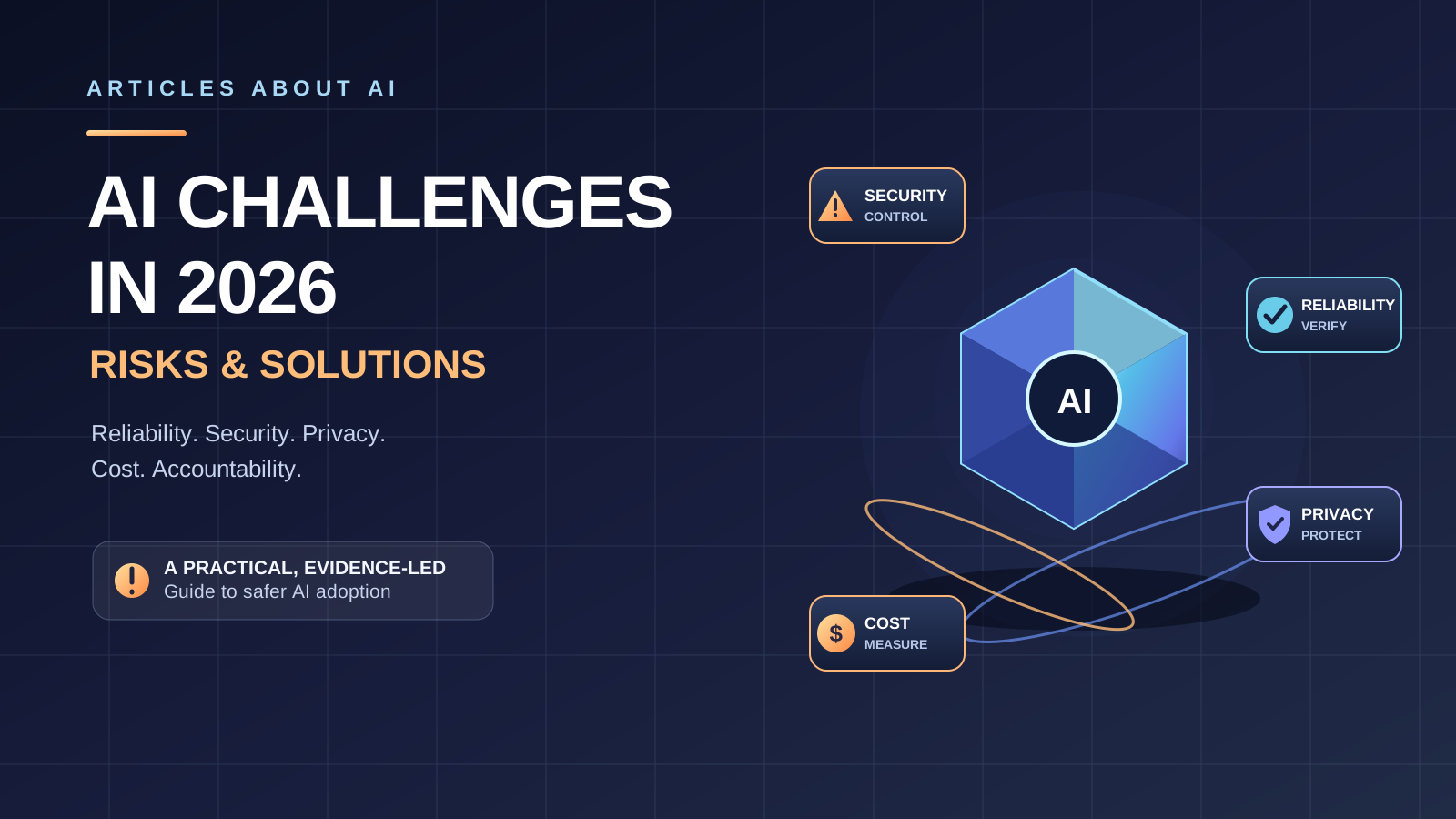
Artificial intelligence is becoming part of everyday work: people use it to draft documents, analyze information, write software, generate media, and automate routine tasks. Businesses are moving beyond chatbots toward AI systems that can search company data, call tools, update records, and complete multi-step workflows. These capabilities create real opportunities, but they also make mistakes more consequential.
The central AI challenge in 2026 is no longer simply whether a model can produce an impressive answer. It is whether the complete system can be trusted to do the right thing, protect sensitive information, remain secure, justify its cost, and provide evidence when something goes wrong. A fluent answer can still be false. An agent can complete a task while taking an unauthorized action. A promising pilot can fail to deliver measurable value when deployed at scale.
Recent analysis from Gartner on AI agent reliability, published on October 2, 2026, highlights the gap between enthusiasm for autonomous agents and the reliability, governance, and cost controls needed to use them responsibly. Gartner predicts that 40% of agentic AI projects will be canceled by the end of 2027 because of factors including escalating costs, unclear business value, or inadequate risk controls. This is a forecast, not a certainty, but it underscores why deployment discipline matters as much as model capability.
This guide examines the major AI challenges facing individuals and organizations in 2026, explains why they happen, and outlines practical measures to reduce them. No single control eliminates every risk. The strongest approach combines suitable technology, careful processes, ongoing evaluation, and meaningful human accountability.
1. AI Hallucinations and Unreliable Answers
Generative AI systems can produce statements that sound authoritative but are inaccurate, incomplete, outdated, or unsupported. This behavior is commonly called hallucination. It can affect factual explanations, citations, calculations, summaries, software suggestions, and answers about recent events.
The problem is not always that a model lacks relevant information. A system may infer a plausible answer from incomplete context, misread a source, confuse similar entities, or generate a citation that does not support the claim. Retrieval and web search can improve grounding, but they do not guarantee that the final answer faithfully represents the sources.
Why it matters
An incorrect suggestion in a casual brainstorming session may be harmless. The same error in a medical summary, legal analysis, financial decision, security review, or news article can have serious consequences. The risk increases when users treat confident wording as proof of correctness or copy an answer into another workflow without checking it.
Practical solutions
- Verify important claims against primary sources. Prefer official documentation, original research, legislation, company announcements, and direct datasets over summaries that merely repeat another source.
- Ask for evidence, not just an answer. Where the tool supports it, request links, quotations, assumptions, and the exact source passage behind each material claim. Open the source and confirm that it says what the AI claims.
- Separate facts from inference. Ask the system to label uncertainty, assumptions, estimates, and conclusions that are not directly established by the evidence.
- Use deterministic tools for deterministic tasks. Calculations, database queries, code execution, and structured validation are often more reliable when performed by the appropriate tool rather than inferred in natural language.
- Create risk-based review rules. Require independent verification for high-impact decisions, while using lighter checks for low-risk drafts.
For organizations, evaluate error rates on representative tasks before deployment and continue sampling outputs after launch. A model that performs well on a public benchmark may still fail on internal terminology, unusual documents, or the specific workflows employees use.
2. AI Agents That Take the Wrong Action
AI agents extend generative models with tools and the ability to perform multi-step tasks. Depending on their permissions, they may search files, send messages, modify records, run code, create tickets, or trigger business processes. This creates a different risk from a chatbot that only generates text: an incorrect decision can change a real system.
An agent may misunderstand a request, follow malicious instructions embedded in a document, repeat an action, use an inappropriate tool, or continue after the task has drifted away from its original goal. Even if each individual step seems reasonable, the overall workflow can end in an unintended result.
Practical solutions
- Apply least-privilege access. Give an agent only the accounts, files, APIs, and actions required for its specific job. Avoid broad administrative permissions.
- Separate proposing from executing. Let the agent draft a payment, email, deployment, deletion, or permission change, but require an authorized person to approve consequential actions.
- Set explicit action limits. Restrict spending, number of operations, accessible data, execution time, and the resources an agent can modify.
- Use allowlists and validation. Permit only approved tools and validate parameters before each action reaches the underlying system.
- Build stop and recovery mechanisms. Make it possible to pause a run, revoke credentials, cancel queued actions, and restore data from backups.
- Log the complete workflow. Record the request, relevant context, tool calls, approvals, results, and errors in a way that supports investigation.
Start with narrow, reversible tasks and expand autonomy only after the system demonstrates reliable performance. A written policy is not enough if technical controls cannot enforce it while the agent is running. This is a central theme in Gartner’s analysis of agentic AI governance.
3. Cybersecurity Threats and Prompt Injection
AI introduces familiar security problems as well as new ways to exploit them. Attackers may try to manipulate model behavior, expose sensitive context, abuse connected tools, poison data, or exploit weaknesses in the application surrounding a model. Prompt injection is one example: malicious instructions placed in a webpage, document, email, or other input attempt to override the system’s intended behavior.
Prompt injection is particularly important when an AI system reads untrusted content and can use tools. A document might contain instructions that appear relevant to the model but should never be treated as authorization to reveal confidential information or perform an external action.
Practical solutions
- Treat retrieved webpages, uploaded documents, emails, and user-generated content as untrusted data, not as privileged instructions.
- Keep system instructions, credentials, and sensitive configuration out of content that does not need them.
- Enforce access control in the application and API layer. Do not rely on the model to decide whether a user is authorized to access a record.
- Validate tool arguments and outputs, and require confirmation before destructive or external actions.
- Test for prompt injection, data exfiltration, unsafe tool use, and permission escalation before launch and after significant changes.
- Monitor unusual behavior, limit the impact of compromised credentials, and maintain an incident-response plan.
AI security needs defense in depth. Filters and model-level safeguards can help, but they should not replace conventional controls such as authentication, authorization, network restrictions, secret management, dependency updates, and audit logging.
For a practical example of reviewing AI-generated security changes rather than trusting them automatically, see our guide to using GitHub Copilot Agentic Autofix to fix code scanning alerts.
4. Privacy, Confidential Data, and Data Governance
AI systems may process personal information, customer records, internal documents, source code, financial data, or confidential business plans. Risk depends on the product’s data-handling terms, retention settings, access controls, integrations, and the way employees use it. Pasting sensitive material into an unapproved tool can create exposure even when the model itself is functioning as designed.
Privacy also involves more than preventing a public leak. Organizations need to know why data is being processed, whether it is appropriate to use for the task, who can access it, how long it is retained, and whether the output could reveal information about an individual.
Practical solutions
- Classify data before choosing a tool. Define which information is public, internal, confidential, or restricted, and identify which approved AI services may handle each category.
- Minimize what is sent. Remove unnecessary identifiers and confidential details; use representative or synthetic data for testing whenever practical.
- Review provider terms and settings. Confirm retention, training use, access controls, regional processing, deletion, and administrative options from current official documentation.
- Apply existing data protection rules. Use access control, encryption, retention schedules, data-loss prevention, and documented legal bases where required.
- Control connected data sources. An AI assistant should inherit appropriate user permissions and should not expose documents merely because they are indexed.
- Establish incident procedures. Employees need a clear way to report accidental disclosure, suspicious output, or inappropriate access.
Before deploying an AI feature, map the data flow from input to storage, model provider, connected tools, logs, and output. If the organization cannot explain where sensitive information goes, it is not ready to approve that workflow.
5. Bias, Fairness, and Unequal Outcomes
AI models learn patterns from training data and may reproduce or amplify historical biases. Problems can also arise from unrepresentative samples, flawed labels, proxies for protected characteristics, or the way a model is used in a particular setting. A system can perform well on average while producing substantially worse outcomes for a subgroup.
Bias is not limited to obvious offensive language. It can appear in ranking, hiring support, fraud detection, eligibility assessment, moderation, translation, image generation, and other systems that influence how people are treated.
Practical solutions
- Define the decision and its consequences. Identify who could be harmed, which outcomes matter, and what fairness means in the specific context.
- Evaluate relevant groups. Where lawful and appropriate, test performance across meaningful demographic, linguistic, geographic, and accessibility groups.
- Inspect data quality and labels. Look for missing populations, historical exclusions, inconsistent annotations, and proxy variables that could produce unfair results.
- Keep humans accountable. High-impact decisions should have a clear owner, meaningful review, and a way for affected people to challenge errors.
- Monitor after deployment. User populations, data distributions, and model behavior can change; fairness checks should not end at launch.
There is no universal fairness metric that resolves every trade-off. Teams should document which measures they use, why those measures fit the application, what limitations remain, and how disagreements are handled. A fairness claim without a defined population and evaluation method is difficult to assess.
6. Deepfakes, Misinformation, and Trust
AI can generate realistic text, images, audio, and video at scale. This can support legitimate creative work, but it can also make impersonation, fabricated evidence, scam messages, and misleading political or commercial content easier to produce. The challenge is not only detecting synthetic media; it is verifying claims in an environment where authentic and fabricated material can look similar.
Automated detectors can be useful signals, but they are not definitive proof. Their accuracy can vary with the generation method, compression, editing, language, and the type of media being examined. A false positive can wrongly discredit genuine material, while a false negative can allow a convincing fabrication to spread.
Practical solutions
- Verify consequential claims through independent, credible sources rather than relying on a single viral post or clip.
- Confirm requests for money, credentials, or urgent action through a separate, known communication channel.
- Preserve original files and provenance information when authenticity matters.
- Use platform reporting tools and clearly label synthetic media where disclosure is required or appropriate.
- Teach staff to recognize impersonation tactics, but do not make visual intuition the only defense.
- Avoid publishing AI-generated claims about real people without evidence and editorial review.
Newsrooms and researchers should maintain a documented verification process. Businesses should consider voice and video impersonation in fraud exercises, particularly for payment approvals, executive requests, and account recovery. The goal is not to assume that every AI-generated item is false; it is to require appropriate evidence before acting on consequential claims.
7. Rising Costs and Unclear Return on Investment
A successful demonstration does not automatically become a cost-effective production service. AI expenses can include model usage, retrieval, storage, evaluation, monitoring, human review, integration, security, and the infrastructure needed to run the application. Agentic workflows may use multiple model calls and tool executions for one user request, making costs less predictable than a simple chat interaction.
Cost pressure can also be hidden. A tool may save a few minutes for one employee but create extra review work elsewhere. A faster output may be less useful if it requires extensive correction. Organizations need to measure the whole workflow rather than counting generated responses.
Practical solutions
- Set a baseline. Measure the time, quality, error rate, and cost of the existing process before introducing AI.
- Define success in advance. Choose measurable outcomes such as completion time, resolution rate, error reduction, customer satisfaction, or cost per accepted task.
- Route tasks to suitable models. Use more capable or expensive systems only when the task needs them; simpler tasks may work with smaller models or conventional software.
- Control context and repetition. Retrieve relevant information instead of sending unnecessary documents, cache repeatable results where appropriate, and avoid blind retries.
- Track total cost. Include integration, monitoring, security, human review, and failure recovery—not just the provider’s model price.
- Set budgets and alerts. Apply usage limits, monitor cost per successful outcome, and investigate sudden increases.
- Stop weak pilots. If a use case cannot meet its quality and value thresholds after a fair test, redesign it or discontinue it.
Gartner’s 2026 analysis identifies unclear business value and escalating costs among the reasons agentic AI projects may be canceled. The practical lesson is to measure outcomes early and expand only when evidence supports the investment.
8. Copyright, Provenance, and Intellectual Property
AI-generated text, images, audio, and code can raise questions about training data, licensing, ownership, attribution, confidentiality, and similarity to existing works. The legal position differs across jurisdictions and depends on the material, the product’s terms, the manner of use, and the facts of a particular case. It is unsafe to assume that every generated output is automatically free of restrictions or that every use is automatically prohibited.
Practical solutions
- Check the provider’s current terms and the licenses for any models, datasets, tools, or assets used.
- Review generated code and creative work for copied material, license obligations, and sensitive information.
- Keep records of important prompts, source materials, model versions, human edits, and review decisions when provenance matters.
- Use approved assets and maintain a process for handling attribution, takedown requests, and rights-holder concerns.
- Obtain qualified legal advice for high-impact commercial uses or disputed rights questions.
Provenance is also an operational issue. If an AI-generated report influences a business decision, a team may need to retain the input sources, relevant context, model version, and review history to explain how the result was produced. Recreating the answer later may not reproduce the original output.
9. Energy Use, Infrastructure, and Environmental Impact
Training and operating AI systems require computing resources, electricity, cooling, data centers, networking, and hardware. The environmental impact varies widely by model, hardware efficiency, data-center energy source, workload, and utilization. It is therefore misleading to assign one universal energy cost to every AI query without specifying how it was measured.
The challenge is to balance useful capability against resource use while recognizing that efficiency gains can be offset if total usage grows rapidly.
Practical solutions
- Use the smallest model that meets the required quality threshold.
- Reduce unnecessary calls, duplicated processing, and oversized context windows.
- Cache repeatable work and use batching when appropriate.
- Measure workload-level energy or infrastructure indicators where reliable data is available.
- Consider utilization, hardware lifecycle, cooling, and energy sourcing when selecting infrastructure.
- Evaluate whether AI is genuinely the right tool for the problem; a simpler algorithm or ordinary search may be more efficient.
Efficiency should be measured alongside quality and total workload. A more efficient model per request does not guarantee lower overall impact if it leads to substantially more requests or larger applications.
10. Skills Gaps, Workforce Change, and Overreliance
AI can change how work is organized, which tasks are automated, and which skills become valuable. Some activities may become faster or disappear; other roles may gain new responsibilities involving verification, system design, customer judgment, data quality, and exception handling. The effects differ across occupations, industries, and organizations, so sweeping claims that AI will eliminate all jobs—or create no disruption—are not useful planning assumptions.
A related risk is overreliance. If people routinely accept generated answers without examining them, they may lose familiarity with the underlying work and struggle when the system fails. This is especially concerning when users cannot explain or challenge decisions made with AI assistance.
Practical solutions
- Map tasks, not just job titles, to identify where automation may help and where human judgment remains essential.
- Train employees in verification, privacy, security, prompt design, and the limits of the tools they use.
- Redesign workflows with affected workers rather than introducing automation without clear ownership.
- Preserve human expertise for exceptions, appeals, and consequential decisions.
- Measure job quality and error rates as well as speed and output volume.
- Make it clear who is accountable for final decisions and how employees can escalate questionable results.
Good AI adoption is not simply a matter of replacing a human step with a model. It is a redesign of responsibilities, safeguards, and feedback so that people can use the system effectively without surrendering judgment.
A Practical Framework for Managing AI Risk
Organizations do not need to solve every AI problem before running any experiment. They do need a repeatable process that matches safeguards to the potential consequences of failure. The NIST AI Risk Management Framework and its Generative AI Profile provide structured guidance for identifying, measuring, and managing AI risks across a system’s lifecycle. NIST also announced a concept note in April 2026 for a profile focused on trustworthy AI in critical infrastructure.
A practical implementation can follow five steps:
- Define the use case. Document the intended users, task, expected benefit, data involved, connected systems, and decisions the AI may influence.
- Classify the risk. Consider potential harm, reversibility, affected people, confidentiality, legal obligations, and the degree of autonomy. Higher-impact uses require stronger controls.
- Test before release. Create representative test cases, including edge cases, adversarial inputs, failures, and attempts to access unauthorized information. Record a baseline and acceptance criteria.
- Deploy with limits. Start with a restricted pilot, narrow permissions, human approval for consequential actions, monitoring, logging, and a rollback plan.
- Review continuously. Track failures, user feedback, cost, drift, security events, and performance across relevant groups. Reassess controls whenever the model, data, tools, or workflow changes.
This process should have named owners. A product manager may own the use case, a security team may assess threats, legal and privacy specialists may review obligations, and operational staff may monitor day-to-day performance. Responsibility should be explicit rather than delegated to the model provider or to an AI system itself.
AI Challenges in 2026: Quick Comparison
| Challenge | First control to implement | What to measure |
|---|---|---|
| Hallucinations | Source verification and output evaluation | Factual error rate and unsupported claims |
| Agent mistakes | Least privilege and approval gates | Unauthorized actions, task success, recovery time |
| Cybersecurity | Threat modeling and tool-level access control | Attack-test results and security incidents |
| Privacy | Data classification and minimization | Sensitive-data exposure and policy violations |
| Bias | Group-based evaluation and human appeal | Performance gaps and adverse outcomes |
| Misinformation | Independent verification and provenance | Correctly verified claims and impersonation incidents |
| Cost and ROI | Baseline measurement and budgets | Cost per successful, accepted outcome |
| Copyright and provenance | License review and traceable records | Unresolved rights issues and missing provenance |
| Environmental impact | Efficient model and workload selection | Resource use per useful result |
| Workforce change | Training and clear accountability | Quality, rework, adoption, and employee readiness |
The table is a starting point, not a universal compliance checklist. The right metrics depend on the application, and a low average error rate can still be unacceptable when the remaining failures are severe.
Frequently Asked Questions
What is the biggest AI challenge in 2026?
There is no single challenge for every use case. Reliability, agent security, privacy, governance, and cost are particularly important as AI systems move from generating content to taking actions. The most urgent risk depends on what the system can access and what happens if it makes a mistake.
Can AI hallucinations be eliminated completely?
There is no general method that guarantees zero hallucinations across all models and tasks. Retrieval, source checking, structured outputs, testing, and human review can reduce risk, but important claims still need verification.
Are AI agents safe to use for business tasks?
They can be useful when their permissions and responsibilities are tightly scoped. Start with low-risk, reversible work, limit access, log actions, and require human approval for consequential operations. Do not grant broad autonomy merely because a demonstration succeeded.
How can a company reduce AI costs?
Measure cost per successful outcome, route tasks to appropriately sized models, minimize unnecessary context, avoid duplicate calls, and set budgets. Include integration, review, monitoring, and recovery costs in the calculation.
What framework can help organizations manage AI risk?
NIST’s AI Risk Management Framework and Generative AI Profile provide practical structures for identifying, assessing, and managing risk. Organizations should adapt them to their own legal obligations, risk tolerance, and use cases rather than treating a framework as an automatic certification.
Will AI replace human workers?
The effects will vary by task, occupation, sector, and adoption strategy. AI may automate some activities while changing others and creating new responsibilities. Employers should evaluate actual workflows, train workers, and preserve human accountability where judgment and consequences matter.
Conclusion: Build Trust Before Expanding Autonomy
The AI challenges of 2026 are not only technical problems inside a model. They arise across the full system: the data it receives, the instructions it follows, the tools it can call, the people who rely on its output, the business process it changes, and the controls that detect failure.
The most effective response is disciplined rather than dramatic. Verify important claims. Restrict agent permissions. Protect sensitive data. Test for security and bias. Measure costs against real outcomes. Preserve provenance. Train people to challenge unreliable results, and keep clear human ownership of consequential decisions.
There is no single switch that makes AI completely safe, accurate, fair, or inexpensive. But organizations can reduce avoidable harm by matching autonomy to demonstrated reliability and expanding only when the evidence supports it. In 2026, the advantage will not belong simply to those who deploy AI fastest. It will belong to those who can show that their systems work, that their risks are controlled, and that their results are worth trusting.
Sources and Further Reading
- Gartner: AI Agent Success Requires Reliability Before Autonomy — October 2, 2026
- Gartner: Agentic AI Fails Where Governance Stops — September 24, 2026
- NIST: AI Risk Management Framework
- NIST: Artificial Intelligence Risk Management Framework — Generative AI Profile
- ISACA: The Promise and Peril of the AI Revolution — Managing Risk, March 25, 2026
- Reuters: The Missing Chain of Custody for Enterprise AI — October 15, 2026