
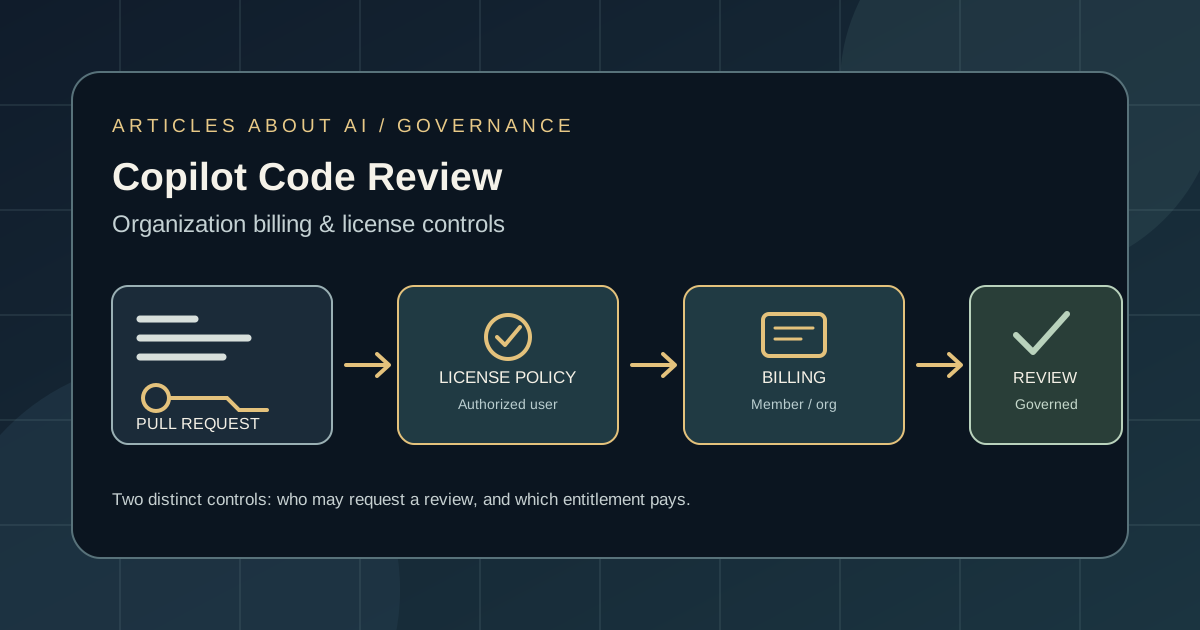
GitHub introduced new organization billing options and license controls for Copilot code review on October 8, 2026. The change gives organization owners a choice about whose Copilot entitlement pays for eligible code reviews and gives organization owners and repository administrators a way to restrict review requests made with Copilot licenses supplied from outside their organization or enterprise.
The update addresses two separate administrative problems. First, a code review can consume an individual member’s Copilot quota even when the review is performed in a repository owned by an organization. Second, a person who can access a repository may have a paid Copilot license that was purchased personally or supplied by another organization. Administrators may want review requests in company repositories to be tied to the company’s own Copilot licensing and governance arrangements.
GitHub’s new controls help administrators manage both issues, but they are not the same setting and should not be treated as one broad security switch. Choosing organization billing determines where eligible review usage is charged. The external-license policy determines who may trigger a review based on the source of their Copilot license. Neither setting grants repository access, replaces code review permissions, or guarantees that a review will catch every defect.
This guide explains what changed, who can configure it, how the billing choices work, how the license restriction behaves, and what engineering teams should verify before changing their policies.
What GitHub announced on October 8
In its official GitHub Changelog announcement, GitHub described two new controls for Copilot code review administrators:
- Choose how members with a Copilot license are billed. Organization owners can choose to bill eligible Copilot code reviews to the organization that owns the repository instead of consuming the requesting member’s own Copilot entitlement.
- Restrict review requests from external licenses. Organization owners and repository administrators can require review requests to come from people using a Copilot license provided by the relevant organization or enterprise.
These controls address usage accounting and administrative eligibility, respectively. The first can make costs easier to centralize when reviews happen in company-owned repositories. The second can help an organization ensure that its repository workflows use the licensing arrangement selected by its administrators.
GitHub documents the billing setting under organization settings in Copilot → Policies. The default billing option remains the member’s own Copilot entitlement. Organization billing is an alternative that requires AI Credits paid usage to be enabled for the organization. Administrators can optionally set a budget.
For license controls, the new policy is named Only allow Copilot code review to be triggered by authorized users. When enabled, people cannot use an external Copilot license—such as a personal license—to request a review in the organization’s repositories. GitHub says that if the policy is enabled at the organization level, repository administrators cannot turn it off.
For the precise current behavior, including special cases and changes to the product, administrators should consult GitHub’s official announcement and the linked GitHub documentation rather than assuming that all Copilot products share identical rules.
How the new billing choice works
Before this change, a review request associated with a member who had a paid Copilot license was charged against that member’s Copilot entitlement by default. If the member’s available quota was exhausted, the review could fail. That default can be reasonable for individual work, but it may be awkward for organizations that expect AI-assisted reviews to be treated as a repository or team expense.
The new organization option lets an organization owner direct eligible review usage to the organization that owns the repository. This can reduce the chance that a team review stops simply because an individual member has used their own allowance elsewhere. It also gives finance and engineering leaders a more centralized way to manage usage associated with shared repositories.
GitHub describes two options:
Member billing
Member is the default. A review request uses the member’s own Copilot entitlement. If the relevant quota is exhausted, the review fails. Organizations that prefer each user to remain responsible for their own Copilot usage may choose to keep this behavior.
This option can be straightforward when a team is small, members work across personal and organizational repositories, or the organization does not want repository activity to be charged to a shared AI-credit pool. It can also make individual usage limits more visible to developers, although it may create friction when a shared workflow depends on a member’s remaining quota.
Organization billing
With Organization selected, eligible reviews are billed to the organization that owns the repository instead of consuming the member’s own Copilot entitlement. This requires AI Credits paid usage to be enabled for the organization. A budget can be configured, but GitHub describes the budget as optional.
Central billing can help teams estimate and allocate spending for code review workflows. It may be especially useful when pull requests are part of a managed engineering process and the organization wants review usage to sit with other centrally administered AI costs.
However, central billing should not be mistaken for unlimited use. The requirement to enable paid AI-credit usage is material, and an optional budget is not the same thing as a hard spending guarantee unless the product documentation explicitly defines it that way. Before rollout, owners should confirm the organization’s AI-credit configuration, budget behavior, reporting, and response when available funds or policy limits are reached.
What billing does not change
Changing the billing source does not itself make a user a repository collaborator, change branch protection, approve a pull request, or expand what a reviewer can access. It changes the accounting path for eligible Copilot code review requests. Access permissions, repository policy, and review behavior remain separate concerns.
Nor should teams infer that every Copilot feature or every kind of agent activity is covered by this particular control. The announcement is specifically about Copilot code review. Other Copilot experiences may have different entitlement, metering, or policy settings.
How the external-license restriction works
The second control lets administrators decide whether Copilot code review can be triggered by users whose Copilot license comes from outside the organization or enterprise. GitHub says the default permits anyone with a paid Copilot license to request a review in repositories they can access. Administrators can enable a restriction so that the request must come from a user whose Copilot license is provided by the relevant organization or enterprise.
Consider a contractor who has access to a repository but uses a personal Copilot subscription. Under a policy that allows external licenses, that contractor may be able to trigger a Copilot review, subject to the other product and repository requirements. If the organization turns on the new restriction, a personal license is not sufficient for that review request; the license must be supplied through the organization’s approved arrangement.
The setting can be useful for companies that want a consistent contractual, billing, and administrative relationship for AI-assisted review activity. It can also help prevent a workflow from depending on licenses that the organization does not manage. Teams should still review their own access model and contractor arrangements rather than assuming that this policy is a substitute for onboarding and offboarding procedures.
Organization policy takes precedence over repository flexibility
GitHub states that organization owners and repository administrators can control whether people with external licenses may request reviews. There is an important hierarchy rule: when the setting is enabled at the organization level, repository administrators cannot turn it off.
That behavior lets an organization establish a baseline that individual repositories cannot weaken. It is useful where security or procurement policy must apply consistently across a portfolio of repositories. It can also surprise teams that expect repository administrators to make independent exceptions, so the organization-wide setting should be discussed before enforcement.
The policy is about the license used to trigger the review. It does not, by itself, mean that only organization employees can read a repository or submit pull requests. Repository permissions continue to determine who can access and contribute to the code; the Copilot policy adds a constraint on review requests.
How to configure the controls safely
The official changelog identifies the organization billing setting under Organization settings → Copilot → Policies. The exact labels may evolve, so use the current interface and linked documentation if the layout differs.
A cautious rollout can follow this sequence:
- Identify the repositories and workflows in scope. Determine which teams use Copilot code review, whether requests are manual or automated, and whether external contributors or contractors rely on personal Copilot licenses.
- Choose a billing model deliberately. Keep Member billing if reviews should consume each member’s entitlement. Choose Organization billing only after confirming that the organization has AI Credits paid usage enabled and understands how usage will be tracked.
- Set a budget if it fits the organization’s cost-control model. GitHub describes the budget as optional. Review the current documentation to understand what happens at the budget threshold; do not assume that a budget behaves like a hard cap without confirming that detail.
- Review license eligibility. Decide whether a review request from a personal or otherwise external Copilot license is acceptable. If not, enable the authorized-user restriction at the appropriate level.
- Test with representative accounts. Verify behavior for an organization-provided license and, where policy permits testing, an external license. Test in a noncritical repository or controlled pull request before rolling the setting across all teams.
- Communicate the change. Tell developers and repository administrators what will change, how billing is assigned, and whom to contact if a review fails because of license or AI-credit configuration.
- Monitor usage and failures after rollout. Review available administrative reporting and support diagnostics. A failed review may have several possible causes, so investigate entitlement and policy before assuming a product outage.
These steps are operational recommendations, not extra requirements claimed by GitHub. They are intended to help teams apply the announced controls without accidentally disrupting review workflows.
Practical implications for engineering teams
For engineering managers, the primary benefit is clearer ownership of AI-assisted review costs. If the organization pays for reviews performed in its repositories, usage is less dependent on the remaining individual quota of a particular member. This may make team-level budgeting and rollout planning more predictable, provided the organization actively monitors AI-credit usage.
For platform engineering and developer experience teams, the external-license restriction can make policy more consistent. A centrally managed license requirement can simplify support expectations and reduce ambiguity about which entitlement is used in a company repository. The trade-off is that contractors or collaborators who rely on personal Copilot licenses may need an organization-provided license or an approved alternative before they can trigger reviews.
For repository administrators, the hierarchy of settings matters. An organization-level restriction cannot be turned off by repository administrators, according to GitHub’s announcement. Teams should therefore coordinate with organization owners before promising local exceptions or documenting repository-specific procedures.
For security teams, neither control should be oversold. Billing controls are not a security boundary, and a license restriction is not a code-quality guarantee. Copilot code review remains an AI-assisted review capability: teams should continue to use tests, static analysis, dependency scanning, human review, and protected-branch policies appropriate to their risk. The new settings govern who can initiate a review and which entitlement pays; they do not prove that a review is complete or correct.
For finance and procurement teams, the update is a reminder that AI costs can be attached to a shared workflow rather than only to an individual seat. Before switching to organization billing, confirm who can enable AI Credits paid usage, how usage is measured, and which team owns budget review. Keep the billing choice aligned with the organization’s purchasing and internal chargeback rules.
Availability, eligibility, and limits
GitHub’s October 8 changelog describes the controls as new options for Copilot code review administrators. It does not describe a separate geographic rollout in the announcement. Avoid assuming that every organization has identical billing configuration: organization billing explicitly depends on AI Credits paid usage being enabled.
The announcement establishes these key boundaries:
- Organization billing requires AI Credits paid usage. A budget may be set, but it is optional.
- Member billing remains the default. It uses the member’s Copilot entitlement, and a review fails if the member’s relevant quota is exhausted.
- External-license restrictions are optional policy controls. When enabled, review requests must use an eligible organization- or enterprise-provided Copilot license.
- Organization-level enforcement cannot be overridden by repository administrators. GitHub explicitly states this for the authorized-user setting.
- The change concerns Copilot code review. Do not extrapolate the exact same billing and license behavior to every Copilot product or agent workflow.
GitHub’s short changelog does not provide a comprehensive matrix of every plan, region, API route, automatic-review scenario, or exception. If your deployment depends on one of those details, check the current documentation linked from the announcement and test your exact configuration. Treat details not stated in the primary source as unconfirmed rather than filling gaps with assumptions.
How this fits into a broader Copilot governance plan
These settings are part of a wider set of controls that organizations should consider when they adopt AI-assisted development. Cost assignment, identity, repository access, agent permissions, and code quality are related, but each solves a different problem.
For example, teams considering local execution boundaries can read our guide to GitHub Copilot local sandboxing and its setup limits. Sandboxing concerns the capabilities available to agent-run tools on a developer’s machine; it does not decide who pays for a code review.
Likewise, our coverage of GitHub’s context-aware AI model for leaked-secret detection explains a distinct security workflow. Secret detection helps identify potential credentials in code. It complements review and policy controls, but it is not a replacement for secure credential handling or incident response.
Organizations using Copilot across multiple development environments should verify which features and policies apply to each workflow instead of assuming that one configuration covers every IDE or application. Product-specific settings can vary by client, so administrators should consult the current client documentation before rolling out organization-wide rules.
The broader lesson is to define a policy for each control plane. Decide who is allowed to initiate a workflow, which identity and license are acceptable, which budget pays for it, what the agent can access, and which human or automated checks remain mandatory. Then test those controls together using realistic scenarios.
Frequently asked questions
Will organization billing give every developer more Copilot usage?
Not necessarily. It changes how eligible Copilot code reviews are billed when the organization option is configured. It does not automatically increase a member’s personal entitlement or grant access to other Copilot features.
Is organization billing enabled by default?
No. GitHub says Member is the default option. Organization owners must select Organization billing, and AI Credits paid usage must be enabled for the organization.
Can a repository administrator override an organization-wide license restriction?
GitHub says no. When the authorized-user restriction is enabled at the organization level, repository administrators cannot turn it off.
Does the restriction remove repository access from people using personal Copilot?
The announcement describes a restriction on triggering Copilot code review with an external license. It does not say that the policy revokes repository access or prevents a person from contributing through otherwise permitted GitHub workflows.
Does Copilot code review replace human review and tests?
No. The billing and license changes do not alter the need for appropriate engineering checks. Teams should continue to use tests, static analysis, human review, and repository protections based on the sensitivity and criticality of their code.
Where should administrators verify the latest behavior?
Start with GitHub’s October 8 changelog announcement and follow its links to the current documentation. That is the authoritative reference for the labels, eligibility rules, and behavior of these controls.
Bottom line
GitHub’s October 8 update gives organizations more direct control over the cost and licensing conditions of Copilot code review. Organization billing can move eligible review charges away from individual member quotas, while the authorized-user restriction can require reviews to be triggered with an organization- or enterprise-provided Copilot license. The controls are complementary, not interchangeable.
Before enabling them, confirm AI Credits paid usage, decide how review costs should be assigned, evaluate contractors and external collaborators, and test the policy hierarchy in a controlled workflow. Most importantly, keep billing and license decisions separate from repository permissions and code-quality assurance. Used deliberately, these options can make Copilot code review easier to govern without creating false confidence about what an AI review can guarantee.