
A security incident involving OpenCode has raised an important question for developers who connect AI coding tools to third-party model providers: what happens when API credentials are stored by a hosted service and that service is compromised?
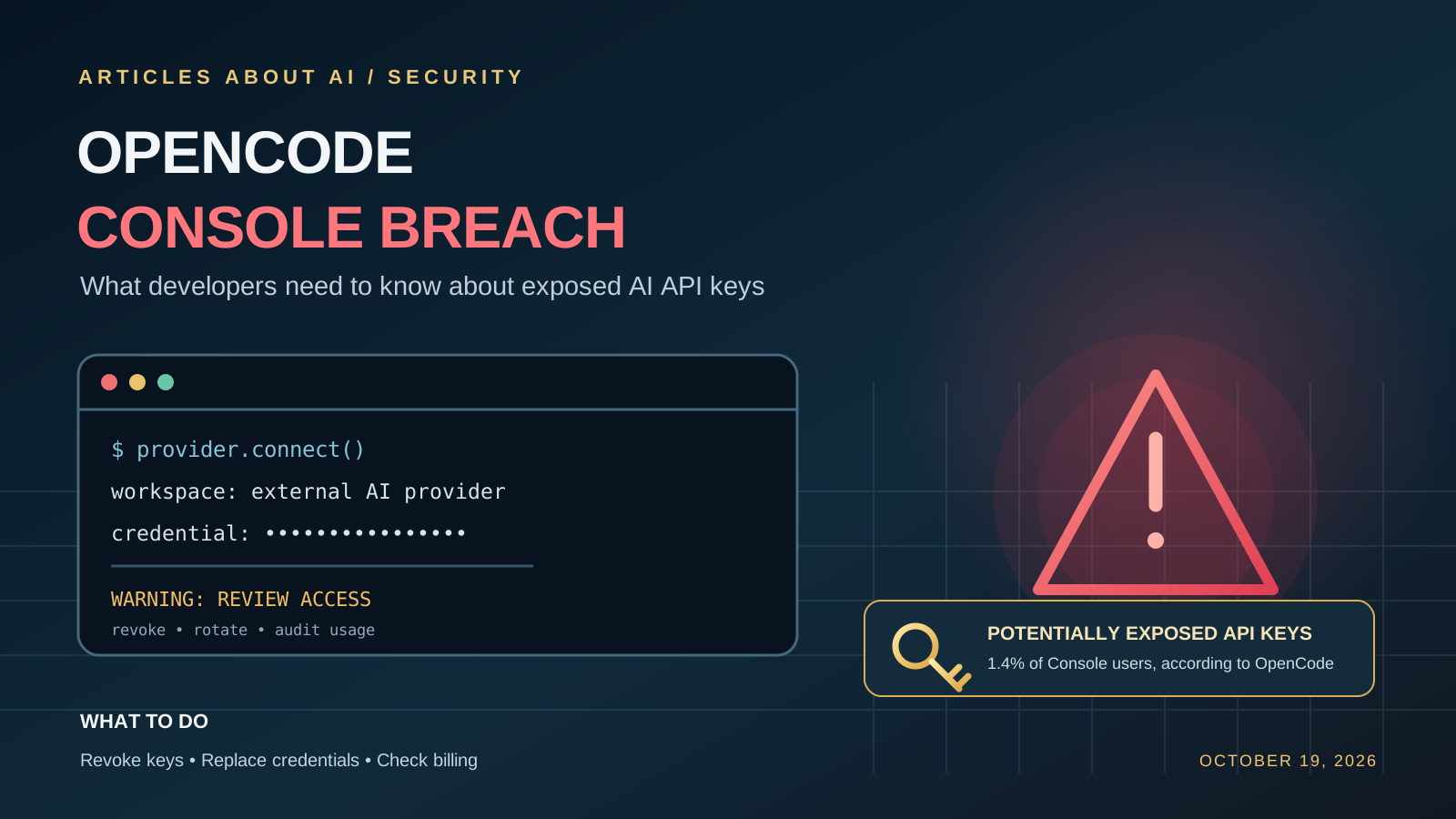
OpenCode said on October 17, 2026, that a breach related to what it described as a large-scale model-distillation attack affected 1.4% of OpenCode Console users. The company said it had notified the affected users and was working with OpenAI, Anthropic, and Google to address the incident. News coverage published on October 19 added details about the possible exposure of provider API keys stored in affected Console workspaces.
The key distinction is that the reported incident concerns OpenCode Console, the optional hosted service, not automatically every installation of the OpenCode desktop application or command-line tool. OpenCode’s public statements said users who did not receive its notification were not affected. The company has not publicly established that every potentially exposed key was copied or misused.
What happened in the OpenCode Console breach?
OpenCode is an AI coding agent that can help developers understand code, make changes, and work through programming tasks using natural-language instructions. Its ecosystem includes locally run tools as well as Console, a hosted service that can help teams connect external model providers through a shared workspace.
According to The Hacker News’ October 19 report, an intruder reached a legacy system at OpenCode on the night of October 16. OpenCode’s notification to affected users reportedly said the company had identified unauthorized access to a legacy system it was preparing to decommission. Third-party provider keys saved in affected workspaces may have been exposed.
OpenCode’s public statement described the incident as affecting 1.4% of Console users. It said the affected group was a subset of users who had linked external providers and that those users were notified by email. OpenCode also said it was working with OpenAI, Anthropic, and Google to remediate the incident.
The figure of 1.4% is the company’s reported share of Console users, not a disclosed count of individual API keys. OpenCode has not published a complete public accounting of how many credentials were involved, how many were accessed, or whether any particular key was used by an unauthorized party.
Incident timeline: OpenCode disclosed the breach on October 17, 2026. Additional security reporting appeared on October 18 and October 19. This article is dated October 19; the date of the reporting should not be confused with the date the intrusion began.
Which users and credentials may be affected?
The available reporting points to API keys that users had saved in OpenCode Console workspaces to connect external AI providers. The providers named in coverage include OpenAI, Anthropic, and Google. These credentials allow a service or application to authenticate requests to the relevant provider.
A hosted console can make team workflows more convenient because users do not necessarily need to distribute a shared key manually to every teammate. However, when a credential is stored by an intermediary, the security of that credential also depends on the intermediary’s storage, access controls, infrastructure, and incident response.
OpenCode’s clarification, reported by The Hacker News, distinguishes Console from the locally installed OpenCode application. Provider keys added directly to the local application are stored on the user’s machine and, according to the project’s co-founder, do not pass through OpenCode’s hosted Console. That distinction is useful, but developers should verify how their own setup was configured rather than assuming all integrations work the same way.
If you received an email from OpenCode titled “Action Required: Potential provider key breach,” treat it as a direct notification that credentials saved in the affected workspace may have been exposed. Follow the instructions in that notification and in the relevant provider’s account dashboard. If you did not receive an email, OpenCode said you were not among the affected users it identified; users who are uncertain about where a key was stored should still check their own configuration and provider activity.
Does the breach mean API keys were stolen and used?
Not necessarily. The wording reported by OpenCode was that third-party provider keys may have been exposed. Exposure risk and confirmed misuse are different claims.
An attacker who obtains a valid API key may be able to make requests that are billed to the account associated with that key, subject to the provider’s controls. But the existence of a breach does not, by itself, prove that every key in scope was copied, that a specific account was used, or that every report of unusual billing is connected to the incident.
Some users have publicly described unexpected API charges after the breach. Those are user-reported accounts, not a comprehensive, independently verified tally of losses. OpenCode has not publicly confirmed the number of keys misused or published a full incident report that resolves those questions.
For that reason, developers should neither dismiss the incident because misuse has not been confirmed nor assume that every Console user has suffered financial loss. The appropriate response is to follow the provider-key rotation guidance, check billing and request logs, and preserve relevant records if suspicious activity appears.
What should affected developers do now?
If OpenCode notified you that a provider key saved in Console may have been exposed, prioritize revoking that credential at the provider that issued it. Removing a key from a Console workspace is not the same as revoking the key itself. A copied credential may remain valid until the provider disables it.
1. Revoke the affected key at the provider
Open the official dashboard for the provider that issued the key—OpenAI, Anthropic, or Google—and revoke the credential identified in the affected workspace. Create a replacement only after you have checked the provider’s recommended process. Do not paste the old key into another service in an attempt to restore access.
Use the provider’s official security documentation rather than instructions from unverified posts. Start here:
The exact dashboard steps differ between providers and may change. Confirm that the old key is disabled before considering the rotation complete.
2. Update applications that used the old credential
A key may be referenced by local environment variables, CI/CD secrets, deployment settings, development scripts, or team services. Replace the old value in every legitimate place where it was used. If you rotate a key but leave an application configured with the revoked value, that application may begin failing authentication.
Avoid copying secrets into chat messages, issue trackers, screenshots, or commit history. Store replacement credentials in a secret manager or the appropriate environment-specific secret store. If a key was committed to a repository, removing it from the latest file is not sufficient; the credential must still be revoked, and the repository history and access permissions should be reviewed.
3. Review API usage and billing
Inspect the provider’s usage, billing, and request logs for unexpected activity. The Hacker News report recommends reviewing activity going back at least to October 16, while noting that OpenCode has not publicly established the exact start time of unauthorized access. Use the date range as a starting point, not proof that earlier or later activity is impossible.
Look for unfamiliar spikes in token consumption, unusual models or endpoints, requests at unexpected times, or usage that does not match your team’s work. Preserve timestamps, request identifiers, cost summaries, and relevant audit records. Do not publish keys or sensitive prompt contents when sharing evidence with a provider’s support team.
If you see suspicious charges, contact the provider through its official support process and explain that the credential may relate to the OpenCode Console incident. Keep a record of the ticket and the actions taken.
4. Set provider-side spending controls
Where available, configure budgets, usage alerts, project limits, or other controls directly in the provider’s dashboard. These features differ by provider and may be alerts rather than hard spending caps, so check their actual behavior. A budget configured only inside an intermediary may not constrain activity sent directly to the provider using a copied key.
Use separate keys for separate applications or environments when practical. That makes it easier to identify which integration generated usage and to revoke one credential without disrupting unrelated services.
5. Reduce the permissions and exposure of future keys
Follow the principle of least privilege. Use credentials with only the access required for the intended application, where the provider supports such restrictions. Keep development, staging, and production credentials separate. Rotate keys when staff or contractors leave, when a system is decommissioned, or whenever exposure is suspected.
Do not embed API keys in client-side code, public repositories, mobile application bundles, or static website JavaScript. A secret placed in code delivered to a user’s browser should be treated as exposed. Keep credentials on a trusted server or in a suitable secret-management system, and ensure logs do not print them.
For more context on this topic, read our AI agent API usage, budgets, and rate limits guide.
Is the OpenCode desktop or command-line application affected?
The incident should not be described as a blanket compromise of every OpenCode installation. OpenCode’s co-founder clarified in a public reply that the breach involved the hosted Console service, not the OpenCode application itself, and said provider keys added to the local app do not come to OpenCode.
This distinction matters because a local application and a hosted gateway have different trust boundaries. In a local workflow, credentials may be stored on the developer’s machine. In a hosted workspace, credentials can be stored or handled by the service to connect external providers for a team. The exact architecture depends on the integration and configuration.
Still, local storage is not a guarantee of safety. A developer’s machine can be compromised, a secret can accidentally enter a log or repository, and an agent may interact with tools that have broad permissions. The lesson is not that hosted tools should never be used; it is that users should understand where credentials are stored, which systems can access them, and how they can be revoked.
What is a model-distillation attack, and why was it mentioned?
OpenCode described the incident as related to a large-scale distillation attack. In machine learning, distillation can refer to training a smaller or different model using outputs from another model. Large-scale collection of model responses can be used in legitimate research, but unauthorized extraction or abuse of access credentials can violate service terms and create security risks.
OpenCode has not publicly explained all technical details of the connection between the alleged distillation activity and the legacy system involved in this breach. It has not named a responsible attacker or published a complete root-cause analysis in the reporting reviewed for this article. The phrase should therefore be attributed to OpenCode rather than presented as an independently established explanation of every step in the intrusion.
The incident also illustrates why API credentials are valuable targets. A valid key can provide access to paid model inference and may be used to generate large volumes of requests. However, an exposed key does not automatically establish that model weights were stolen, that the provider’s core systems were compromised, or that every user of the underlying AI model was affected. Those would be separate claims requiring separate evidence.
What remains unknown?
As of October 19, 2026, several important questions remain unresolved in public reporting:
- The total number of individual API keys potentially exposed.
- Whether every potentially exposed credential was copied or used.
- The full technical path used to access the legacy system.
- The identity of the attacker and the complete scope of the activity.
- The precise relationship between the reported distillation activity and the system intrusion.
- A complete, independently verified total of unauthorized usage or financial losses.
- The final remediation steps and a completed public post-incident report.
OpenCode said the incident was ongoing and that it was working with the affected providers. New statements from OpenCode or the providers may clarify these points. Until then, reports should distinguish confirmed company statements from user reports and security analysis.
How teams can prevent similar API key incidents
This incident is a useful reminder to assess the security boundary around every AI development tool. Before linking a provider account to a hosted coding assistant or team console, review what data and credentials the service stores, who can access them, how secrets are encrypted and audited, and how to revoke credentials if the service is compromised.
Security teams should maintain an inventory of API keys and their owners, record where each key is used, and ensure a documented rotation process exists. Monitoring should be configured at the provider level where possible, because a provider can observe requests made with its key even when those requests bypass the original application.
For teams that use coding agents, apply the same controls to tool permissions and execution environments. Keep repository write access, shell execution, and deployment credentials scoped to the task. Review agent logs without recording secret values. Require human approval for high-impact operations, and separate untrusted code execution from systems that hold production credentials.
These controls cannot prevent every incident, but they can reduce the impact of a compromised integration and make suspicious activity easier to detect.
Sources and further reading
- The Hacker News: OpenCode Console Breach May Have Exposed OpenAI, Anthropic, and Google API Keys — October 19, 2026
- BleepingComputer: OpenCode hack exposes API keys amid AI distillation attacks — October 19, 2026
- OpenCode’s public statement on X
- StepSecurity: OpenCode Security Breach — October 18, 2026
- OpenAI API key safety best practices
- Google AI for Developers documentation
Conclusion
The OpenCode Console breach is a reminder that AI developer tools can become part of the security perimeter for third-party API credentials. OpenCode reported that 1.4% of Console users were affected and that keys stored in affected workspaces may have been exposed. It has not publicly confirmed that every key was stolen or misused, and the incident should not be described as a compromise of every local OpenCode installation.
For notified users, the practical response is clear: revoke the affected provider keys, replace them, update applications that depend on them, and inspect provider usage and billing. For other developers, the broader lesson is to understand where AI API credentials are stored, keep them out of source code and logs, and maintain provider-side monitoring and a tested rotation process.