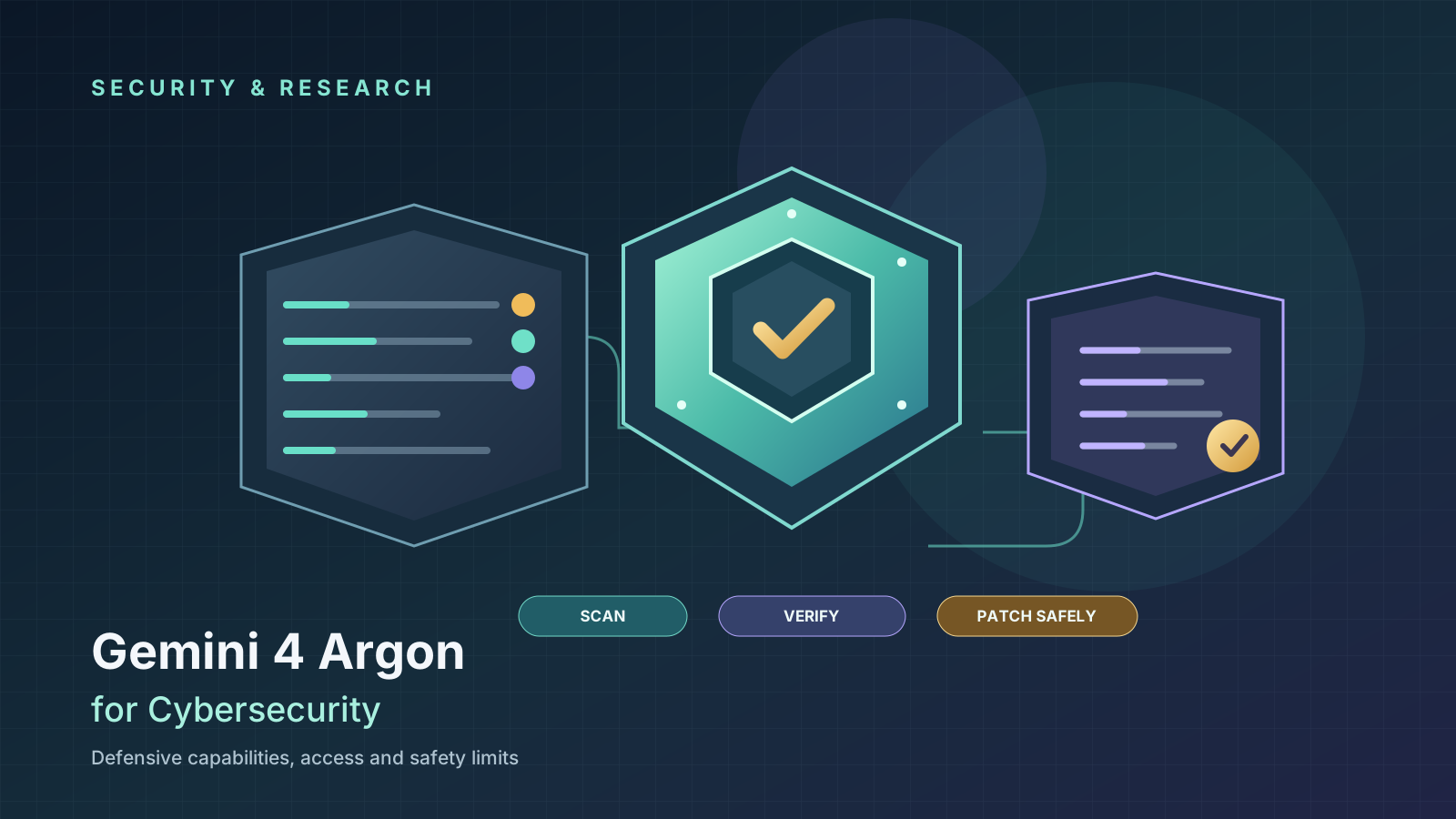
Google’s Gemini 4 Argon is designed for complex, multi-step work, and cybersecurity is one of the areas where the company says it has made substantial progress. Google describes Argon as capable of helping defenders identify difficult software vulnerabilities, reason across large codebases, and produce fixes. At the same time, the company says these capabilities create meaningful misuse risks, so access to some of the most permissive cyber-defense functionality is restricted.
That distinction is central to understanding Argon for security teams. The standard Gemini 4 Argon model is being rolled out through Google’s developer and enterprise products, but the specially configured Gemini 4 Argon Cyber Permissive model is available only to approved users through an allowlist and the Fairwind Program. A developer should not assume that a regular Gemini subscription or API key grants access to the restricted cyber model.
This guide separates Google’s published claims from independently verified facts, explains what the access paths mean, and outlines how organizations can evaluate the model safely. It is focused on defensive security, authorized testing, vulnerability remediation, and governance—not instructions for exploiting real systems.
What Is Gemini 4 Argon?
Gemini 4 Argon is Google’s frontier reasoning model for complex workflows across software engineering, enterprise knowledge work, science, and cybersecurity defense. According to Google’s Gemini API model documentation, its stable model ID is gemini-4-argon. The documented model supports text, image, video, audio, and PDF inputs, with a combined context window of up to 1,048,576 tokens. Specific capabilities and limits can vary by API surface, so teams should check the current model documentation before designing a production integration.
For security teams, a large context window can help a model reason across more code, technical documentation, logs, test output, and vulnerability reports in a single workflow. That does not mean every repository can be loaded into one request or that a model will correctly understand every dependency. Context limits, retrieval quality, tool permissions, and the quality of the evidence still matter.
Argon is also an agent-capable model. When connected to approved tools, a workflow may involve several stages: inspecting code, proposing a hypothesis, gathering evidence, preparing a patch, and checking whether the change passes tests. Each stage needs appropriate permissions and validation. A model’s ability to propose a fix is not the same as proving that the fix is correct or safe to deploy.
What Google Has Announced for Cybersecurity
In its October 13, 2026 safety and security announcement, Google said Argon performed strongly in cybersecurity evaluations and was being rolled out more broadly, while access to additional cyber-defense capabilities would expand through Fairwind. Google also described internal security work and examples from early-access partners. These are company-reported results; readers should distinguish them from independent replication across a representative range of organizations.
Google’s announcement, Developing Gemini 4 Argon responsibly and safely, describes two linked challenges. The first is preventing misuse of a capable model for harmful cyber activity. The second is making sure an agent performs authorized tasks reliably, respects boundaries, and does not follow malicious instructions embedded in untrusted content.
The company says its evaluation suite included 12 end-to-end simulated cyberattack scenarios that Argon solved, compared with five for its previous generation. That figure should be read as a result on Google’s specific evaluation set—not a universal measure of real-world security effectiveness. Test composition, scoring, tool access, and evaluation conditions affect what benchmark results mean.
Google has also published a Gemini 4 Argon model card describing capabilities, limitations, and safety mitigations. Model cards are useful starting points for risk assessment, but they do not replace testing on an organization’s own systems and threat model.
The Two Access Paths: Standard Argon and Cyber Permissive
One of the most important details is that “Gemini 4 Argon for cybersecurity” can refer to different access arrangements.
Standard Gemini 4 Argon
Google says standard Argon is available through public developer and enterprise products, subject to each product’s eligibility, billing, region, and rollout requirements. Developers can review the Gemini API model page for its public model ID and documented capabilities.
Standard Argon includes safety mitigations intended to block harmful offensive requests. A security engineer may still be able to use it for legitimate defensive work, such as explaining a static-analysis finding, reviewing a proposed patch, summarizing an incident report, or helping prioritize remediation. Exact behavior depends on the prompt, available tools, policy controls, and product surface.
Do not infer that public API access includes every security feature mentioned in Google’s announcements. Public access to a model and access to a restricted configuration are different things.
Gemini 4 Argon Cyber Permissive
Google’s Gemini Enterprise Agent Platform model documentation describes a separate model ID, gemini-4-argon-cyber-permissive, for approved defensive cybersecurity use cases. The documentation says this version is allowlist-only and that access can be requested through the Fairwind Program or a Google account team. It also says access to the earlier Gemini 3.8 Flash Cyber program does not automatically carry over.
The restricted configuration is intended for vetted defenders who need capabilities for authorized vulnerability discovery, reverse engineering, exploit verification, and patch generation. Its availability is not a general entitlement for every developer, and it should not be treated as a route around safety policy. Google ties access to governance and verification of the organizations and teams that will use it.
The practical rule is simple: start with the public model and its published capabilities. If your organization has a legitimate need for restricted defensive functionality, read the official eligibility requirements and apply through the authorized process. Do not plan a workflow around an assumption that access will be granted.
What Security Teams Can Use It For
1. Reviewing code and explaining potential vulnerabilities
A model can help a developer understand why a static-analysis tool has flagged a function, summarize the data flow around a risky operation, or identify what evidence is still needed to assess a report. It may also help turn a technical finding into a clear explanation for maintainers and product owners.
The model should be given the relevant code and the finding’s context, not unrestricted access to unrelated repositories by default. It should be asked to cite the specific files or evidence it used, and the result should be checked against the actual code and tool output. A fluent explanation can still be mistaken.
2. Supporting vulnerability remediation
Finding a possible weakness is only part of the job. Security teams also need a minimal, correct patch that preserves intended behavior. Argon may help draft a fix, explain trade-offs, or suggest tests that would catch a regression. Google’s CodeMender project is one example of a specialized code-security agent built around vulnerability discovery and repair.
Google describes CodeMender and Argon as tools intended to help defenders find and fix vulnerabilities. See Google DeepMind’s Fairwind Program overview for the program’s stated focus and access model. A generated patch should still go through code review, automated tests, security tests, and normal release controls.
3. Summarizing incident evidence
During an incident, teams may need to correlate alerts, timelines, code changes, configuration records, and analyst notes. A model can help organize supplied evidence into a timeline, list unanswered questions, or draft an incident summary. It should not be treated as the authoritative source of truth: timestamps, identities, indicators, and causal claims must be verified against the underlying records.
Use data minimization. Remove secrets and unrelated personal information before submitting logs, and ensure that the product and account you use are approved for the sensitivity of the data. Access controls around the model do not replace your organization’s incident-handling and evidence-retention policies.
4. Helping prioritize fixes
Not every finding has the same risk. A model may help compare evidence about exploitability, exposure, affected assets, and mitigation options. It should not assign final severity from a short description alone. Risk decisions should consider asset criticality, exposure, existing controls, known exploitation, and the business context.
A useful workflow asks the model to separate observed facts from assumptions, identify missing evidence, and explain why a proposed priority follows from the supplied data. Security owners should retain the decision and document any exceptions.
What the Published Benchmarks Do—and Do Not—Show
Google’s Fairwind and Argon materials cite cybersecurity evaluation results, including a 68% score on CWE-Bench v1 for vulnerability remediation. Google DeepMind’s program page also presents additional comparisons for vulnerability discovery and penetration-test benchmarks. These results can indicate that the model is worth evaluating, but they do not prove that it will outperform a specialist analyst or every competing tool on your particular environment.
Benchmarks often test a defined set of tasks under controlled conditions. Real deployments introduce unfamiliar frameworks, custom business logic, incomplete documentation, permissions, flaky tests, and operational constraints. Results can also differ depending on whether the model is used alone or with tools, retrieval, a harness, or a human reviewer.
Before adopting Argon, ask what a benchmark measures, who ran it, whether the methodology is public, and whether the test set resembles your use case. For a critical security workflow, run a controlled evaluation using authorized code and a baseline such as your existing static-analysis, dependency-scanning, and code-review process. Track true positives, false positives, missed findings, patch quality, regressions, analyst time, and the cost of review.
Do not turn a headline percentage into a guarantee. A high score on a particular benchmark is not the same as a verified security posture.
Safety Limits and Misuse Risks
The same capabilities that help find and repair weaknesses can also be misused. Google’s public Argon release includes cyber safeguards intended to refuse harmful requests, while the more permissive configuration is limited to trusted defenders. Google says it is applying additional safeguards because its evaluations indicate elevated capabilities in cybersecurity and other high-risk domains.
For a security team, this has two implications. First, a refusal on an ambiguous request does not necessarily mean the model cannot support defensive work; describe the authorized purpose and provide legitimate context. Second, do not attempt to evade safeguards or use a different product surface to obtain restricted functionality. Use the approved access process and keep testing within the scope of authorization.
Agentic systems also introduce risks beyond the model’s answer. A model connected to a terminal, repository, issue tracker, cloud account, or deployment pipeline may have the ability to change real resources. Malicious instructions can appear in issue descriptions, source comments, webpages, logs, and other untrusted material. The model should not treat that content as authority to override system rules or expand its permissions.
Use least privilege. Separate read-only analysis from write access, require approval for consequential changes, isolate execution environments, and log tool activity. Do not allow an AI agent to deploy a security patch directly to production without the same controls required of a human change.
A Responsible Evaluation Plan for Organizations
A safe pilot should begin with a narrow, reversible use case. For example, ask Argon to explain a set of known static-analysis findings in a non-production repository. Keep the source of truth in the scanner output and repository history, and require reviewers to verify the model’s claims.
A practical evaluation plan can follow these steps:
- Define the scope. List the repositories, assets, data classes, and tasks that are explicitly authorized. State what the model must not access or change.
- Choose a baseline. Record how the team currently detects, triages, and fixes vulnerabilities, including the time spent by analysts and the existing tools’ results.
- Prepare a representative test set. Include confirmed findings, benign cases, false positives, incomplete reports, and known regressions. Use only data the organization is authorized to process.
- Start with read-only access. Let the model inspect approved code and produce explanations or proposed patches without permission to merge or deploy.
- Verify every claim. Check file paths, line references, dependency assumptions, reproduction evidence, and proposed fixes. Treat unsupported claims as errors, not as useful creativity.
- Measure outcomes. Track precision, recall where measurable, patch acceptance, regression rate, review time, latency, and cost. Compare like with like across tools and model versions.
- Add controls before expanding. If the pilot succeeds, introduce narrowly scoped write permissions, approvals, sandboxing, and audit logs before allowing any automated action.
- Define a stop condition. Pause the pilot if it accesses out-of-scope data, repeatedly fabricates evidence, causes unsafe changes, or exceeds the agreed cost or error thresholds.
This process helps determine whether the model improves the workflow rather than simply producing impressive demonstrations. It also gives security leadership evidence for deciding where automation is appropriate.
How to Request Restricted Access
Organizations that believe they need Gemini 4 Argon Cyber Permissive should begin with Google’s official Fairwind Program page. Google describes Fairwind as a limited-access program for governments, critical-infrastructure operators, core technology platforms, and vetted cybersecurity partners. The program applies due diligence and restrictions intended to keep access focused on defense and research.
Applicants should be prepared to explain their organization, security use cases, operational controls, and the teams that would use the model. Google’s program materials describe controls such as strong authentication, user-level access management, and restrictions on who may use the model. Eligibility and availability can change, so follow the current application instructions rather than relying on a third-party summary.
Access to Fairwind should not be treated as guaranteed, and joining a previous program does not automatically authorize use of the new model variant. If your organization only needs general assistance with secure coding, reviewing documentation, or explaining scan results, first determine whether the standard public Argon model and your existing security tools are sufficient.
How Argon Fits With Existing Security Tools
Argon is best considered an additional reasoning and workflow component, not a replacement for the security stack. Static application security testing, software composition analysis, secrets detection, fuzzing, endpoint detection, cloud security posture management, and human code review each have different strengths. A language model may help interpret findings or coordinate steps, but it does not remove the need for these tools.
A mature architecture gives each component a defined role. Deterministic scanners produce findings; the model helps organize or explain them; tests and analysis tools verify a patch; a qualified reviewer approves changes; and deployment systems enforce release policy. Keep the original evidence accessible so that reviewers can compare the model’s summary with the underlying result.
For teams already using AI coding tools, related practical background is available in our guides to Gemini 4 Argon API setup, Gemini 4 Argon in GitHub Copilot, and Gemini 4 Argon in Android Studio. These cover developer integration paths, not entitlement to restricted cybersecurity features.
Key Takeaways
Gemini 4 Argon is a significant development in AI-assisted security work, but the important question is not whether a model can perform a striking demonstration. It is whether it can improve a defined defensive workflow under your organization’s access controls, review standards, and threat model.
- Standard Gemini 4 Argon and Gemini 4 Argon Cyber Permissive are not the same access tier.
- The restricted cyber-permissive model is allowlist-only and tied to Google’s Fairwind access process.
- Google reports strong results in its own cybersecurity evaluations, but organizations should validate performance on representative, authorized tasks.
- Vulnerability explanations and generated patches require independent verification, tests, and review.
- Agentic security workflows need least-privilege permissions, sandboxing, audit logs, and human approval for consequential changes.
- Existing security tools remain essential; Argon should complement them rather than replace them.
The responsible path is to start small, measure against a baseline, preserve human accountability, and expand only when the evidence supports doing so. That approach lets security teams explore the value of Gemini 4 Argon without confusing model capability with guaranteed security or unrestricted access.