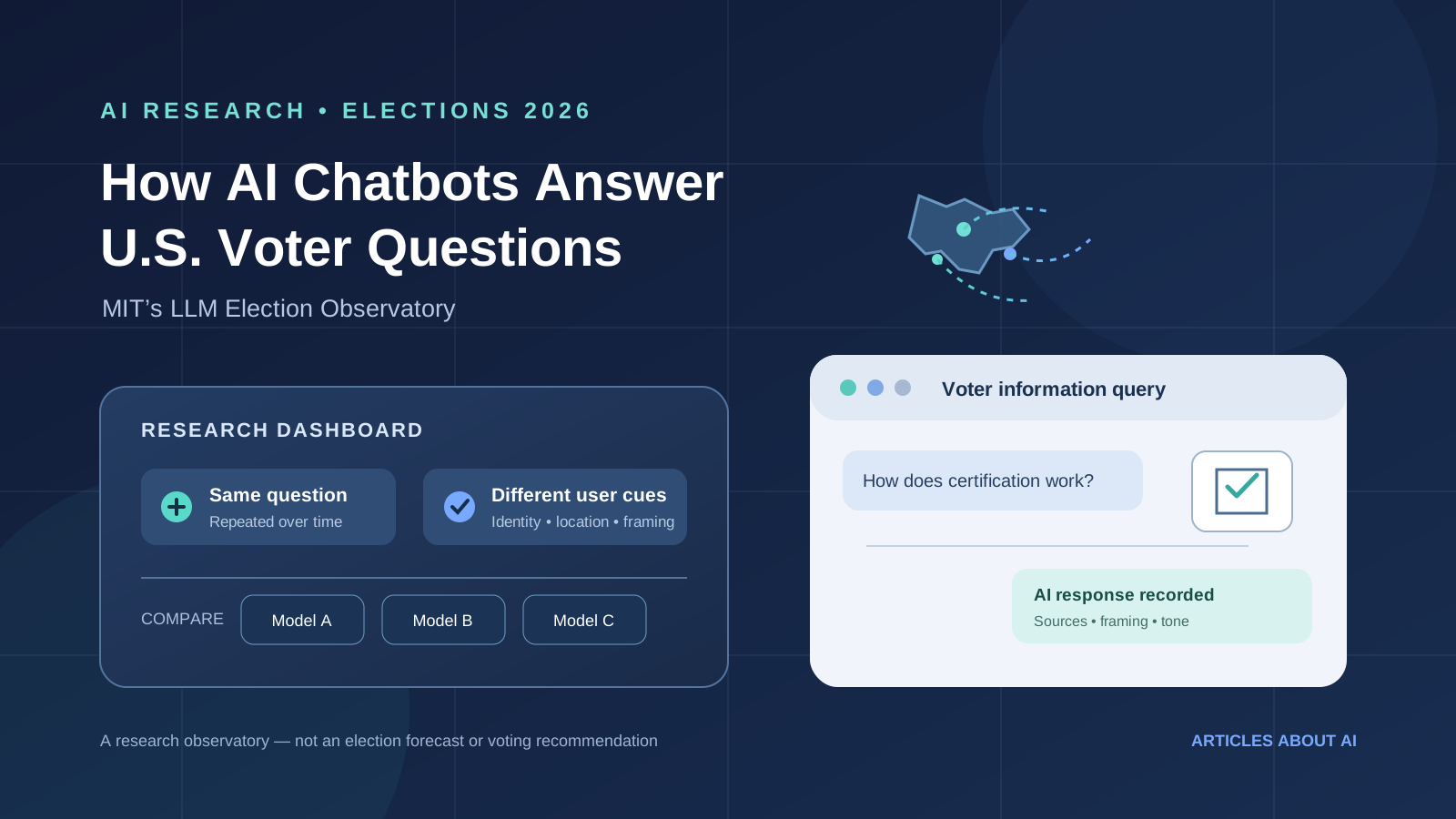
MIT researchers have launched a public research dashboard designed to track how artificial intelligence chatbots answer questions about the 2026 U.S. midterm elections. Called the LLM Election Observatory, the project compares responses from widely used large language models (LLMs) and records how those answers change across questions, user descriptions, and dates.
The observatory addresses a growing research question: when people use ChatGPT and other AI assistants to understand candidates, election procedures, political issues, and news coverage, what information and framing do different users actually receive?
The project is led by MIT researchers Adam Berinsky, Chara Podimata, and Charles Stewart III. Its public dashboard makes collected responses available for inspection, allowing researchers and the public to compare chatbot outputs rather than relying only on isolated examples or retrospective accounts.
What is the MIT LLM Election Observatory?
The LLM Election Observatory is a research dashboard that systematically collects and compares AI-generated answers to a fixed set of election-related questions. The MIT team asks popular AI models questions about several parts of the 2026 U.S. election information environment, including:
- Election administration and certification.
- Issues that are prominent in political debate.
- Candidates and election-related information.
- News coverage and political developments.
- Questions about election results and predictions.
The researchers repeat the questions every few days. This repeated collection is important because AI models, their underlying information, and the election news environment can all change during a campaign. A chatbot answer captured at one point may not be identical to an answer produced by the same system later.
The dashboard is available through the LLM Election Observatory, where visitors can explore responses by question, model, date, and the additional information supplied about the person asking.
How does the project compare AI chatbot answers?
The MIT researchers are not simply collecting one answer from each chatbot. They are examining how responses vary when the underlying question remains the same but the prompt or the described user changes.
The project tests several dimensions:
- Model differences: Do different AI chatbots provide different answers to the same election question?
- Prompt framing: Does changing the wording or framing of a question alter the response?
- User identity cues: Does a model answer differently when the prompt describes the person asking as belonging to a particular political party or identity group?
- Location: Does the location attributed to the user affect the information or sources in the answer?
- Time: Do responses change as models are updated and the 2026 midterm campaign progresses?
- Sources and presentation: Which sources do chatbots cite, what information do they emphasize, and how do tone and uncertainty differ?
The observatory’s approach is intended to make differences between AI-generated information environments easier to examine. Two people can ask what appears to be the same question yet receive answers with different emphasis, source selection, or wording. A systematic record can help researchers study those differences over time.
What has MIT found so far?
MIT’s October 30, 2026, discussion of the project describes some early patterns, but the researchers emphasize that the full longitudinal analysis has not yet been completed.
In the preliminary 2026 data, the team has observed differences in how answers are presented, which sources are cited, and the tone of responses across some of the user identities included in the study. The researchers say these differences can appear even when the underlying facts are similar.
That observation should be interpreted carefully. MIT has not yet established how stable these patterns are throughout the election cycle, whether they will become more or less pronounced, or how real voters will interpret and react to the responses. The researchers also have not presented evidence from this early work showing that the observatory’s findings demonstrate an effect on voting behavior.
The distinction matters: identifying variation in chatbot responses is not the same as proving that an AI system changed someone’s political beliefs or voting decision.
Why is MIT studying AI and the 2026 U.S. midterm elections?
AI chatbots are increasingly used as conversational tools for finding explanations, summarizing news, and asking questions about public affairs. Unlike a conventional search results page, a chatbot may present a synthesized answer in a confident, conversational style. Users may not always see which information was omitted, how the answer was framed, or whether another user received a different response.
The 2026 U.S. midterm elections provide a broad setting for studying these questions. Voters encounter information about national and local contests, the U.S. House and Senate, election administration, policy debates, and campaign developments. The observatory gives researchers a way to compare how AI systems handle a recurring set of questions across that changing environment.
The project also addresses a research challenge specific to conversational AI: individual chatbot conversations are generally not visible to other users. Without a systematic collection process, it can be difficult to compare what different people might have been told or reconstruct how answers changed over time.
By publishing a searchable record, the MIT team aims to support public scrutiny and further research into AI-generated political information.
How this project builds on MIT’s 2024 election research
The new observatory builds on earlier research examining how large language models responded to questions during the 2024 U.S. presidential election.
In a separate project reported by MIT CSAIL in September 2025, researchers described collecting more than 16 million responses from 12 AI models using over 12,000 carefully constructed prompts. The queries were run nearly daily during the months leading up to the 2024 election.
That earlier work examined how responses varied across models and prompt framings during a different election cycle. The 2026 observatory extends this line of research with a public-facing dashboard and a focus on the 2026 midterm election information environment. The 2024 dataset and the 2026 observatory are related research efforts, not one continuous dataset.
Read the MIT CSAIL report on how LLMs responded to the 2024 election for details about the earlier study.
What should voters know when using AI for election information?
The observatory is a research resource, not an official election information service or a voting recommendation tool. Its data consists of AI-generated responses collected for research, and the dashboard itself warns that those responses may contain errors or outdated information.
MIT political scientist Adam Berinsky also cautions that a chatbot’s confident tone does not guarantee that its answer is accurate. An answer may be incomplete or rely on a weak source, even when it sounds authoritative.
People using AI to research the 2026 U.S. midterm elections should therefore treat chatbot responses as a starting point:
- Check registration deadlines, polling locations, identification requirements, and voting procedures with the relevant official state or local election office.
- Open the sources cited by a chatbot and confirm that they support the specific claim being made.
- Compare important claims with multiple reliable sources, especially when information is changing.
- Distinguish factual explanations from political opinions, predictions, or unsupported claims.
- Remember that an answer can omit context even when individual statements in it are accurate.
For a practical guide to checking election information with an AI assistant, see our article on how to use Claude for 2026 U.S. election information. Readers can also review how ChatGPT Search works and how to inspect its sources and how to use Google AI Search to find official websites and sources.
What the LLM Election Observatory could help researchers understand
As the 2026 election cycle develops, the observatory may help researchers examine several questions: whether models give consistent answers to repeated questions, whether user descriptions affect source selection or framing, and whether responses shift after model updates or major political events.
It may also provide a record that researchers can revisit after the election. That historical perspective is valuable because a chatbot’s answer can change, and a single screenshot cannot show how the same system responded weeks earlier or how another model handled the same prompt.
However, the project’s eventual conclusions will depend on the full dataset and analysis. The early observations should not be treated as proof that chatbots systematically favor a political party, determine election outcomes, or persuade voters. Those are separate claims that require evidence beyond the initial response comparisons.
Where to explore the MIT AI Election Observatory
The public dashboard is available at llmelectionobservatory.org. Visitors can inspect responses across questions, models, dates, and prompt variations. The project is intended to make the data collection and preliminary comparisons accessible to people outside academia as well as to researchers.
MIT’s announcement and the observatory provide the primary sources for understanding the project’s scope and current findings. As additional data is collected and the longitudinal analysis develops, the dashboard may offer a clearer picture of how AI-generated election information changes during the 2026 U.S. midterm elections.