
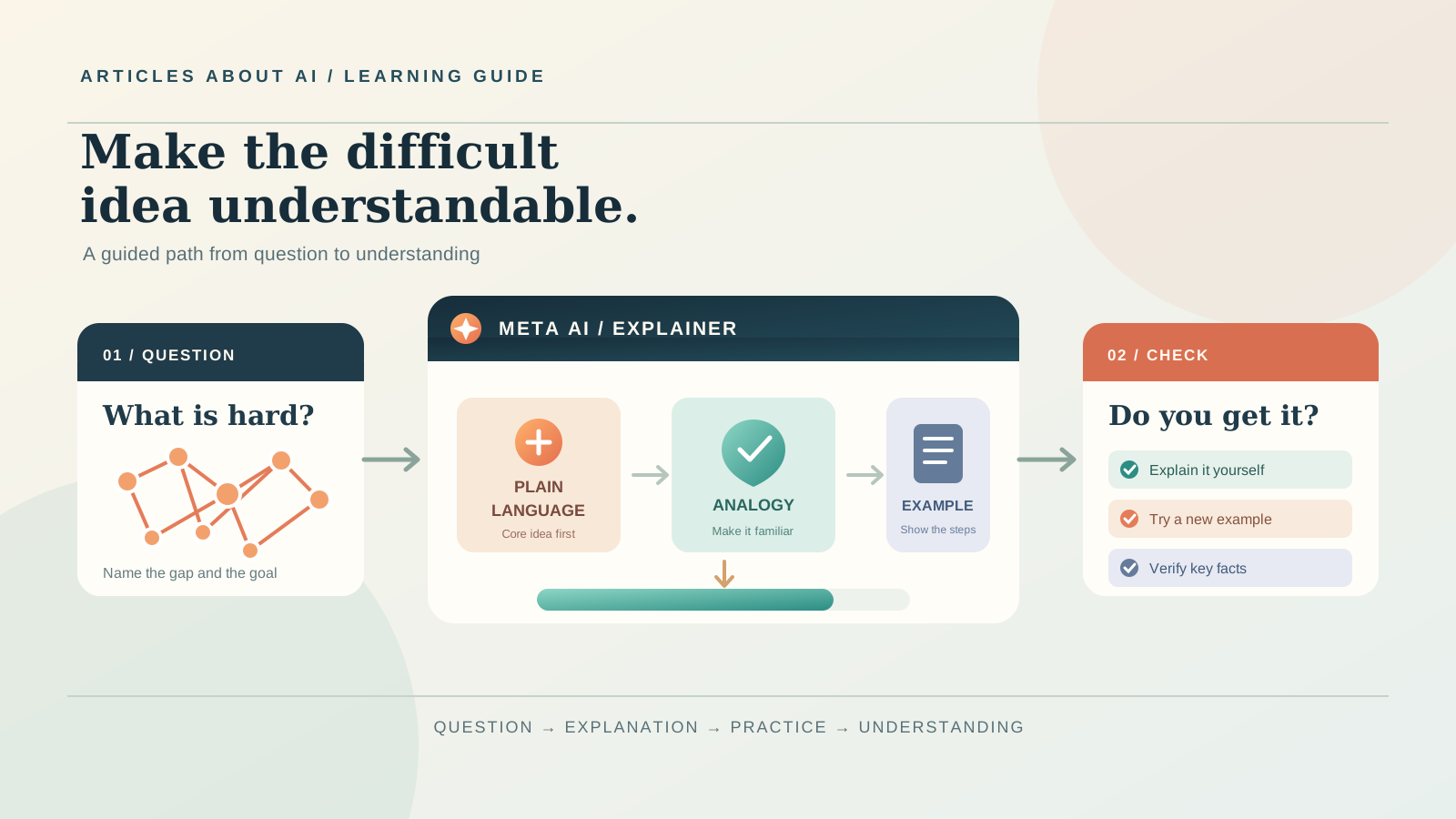
A difficult subject often becomes easier when it is explained in the right order. A definition may be accurate but still feel abstract. An analogy can make the idea familiar, but it may hide important details. A worked example can show how the parts fit together, while a short question can reveal whether the explanation has actually made sense.
Meta AI can help you move through those stages: from an unfamiliar concept to a plain-language explanation, then to examples, questions, and a clearer understanding of where the idea applies. The quality of the result depends less on finding a magic prompt than on giving the assistant a clear learning goal and guiding it through a sequence.
This guide explains how to use Meta AI to understand difficult topics with examples. It includes reusable prompts, a worked demonstration using the Domain Name System (DNS), ways to adapt an explanation to your level, and checks that help you avoid learning an attractive but inaccurate simplification.
What Meta AI can do as a learning assistant
Meta AI is available through Meta’s AI experience on the web and, depending on region and account availability, through Meta apps such as Facebook, Instagram, WhatsApp, and Messenger. Meta has described ways to call the assistant in a direct conversation and, where supported, in group chats. Its interface and available features can differ across countries, products, and accounts, so the controls you see may not match every example in this article.
Meta’s product announcements also show that the assistant’s capabilities have evolved. In April 2026, the company introduced Muse Spark and said it powered the Meta AI app and website at launch. In July 2026, Meta described research capabilities that could synthesize information from the web, research papers, and content shared by creators and communities on its apps. The same announcement described the ability to steer a report or plan while it is being prepared and said those features were beginning to roll out in select markets through the Meta AI app and meta.ai.
Those announcements are useful context, not a guarantee that every account has every feature. A standard chat can still be useful for a structured explanation. If research, slide generation, voice, image understanding, or other tools appear in your version, treat them as optional aids rather than requirements for learning.
For this task, Meta AI is best used as an interactive explainer. You can ask it to:
- Define an unfamiliar term without assuming specialist knowledge.
- Separate a large subject into smaller concepts.
- Explain why each part matters before moving to the next.
- Compare an analogy with the real mechanism it represents.
- Work through a concrete example one step at a time.
- Give a counterexample that shows where a rule does not apply.
- Ask questions that test your understanding instead of immediately giving away the answer.
- Rephrase an explanation when a particular step remains unclear.
It is not a substitute for a teacher, textbook, technical standard, or professional source. Meta AI can produce a fluent explanation that contains an error, omits an important condition, or uses an analogy too literally. Use it to make a subject more approachable, then check consequential details against reliable material.
Step 1: Tell Meta AI what you are trying to understand
A broad request such as “Explain quantum computing” leaves several important questions unanswered. Is the reader a school student, a software developer, or a manager deciding whether a technology matters? Should the explanation focus on the underlying physics, the hardware, or practical applications? How much mathematics is appropriate?
Start by specifying the subject, your current level, and what you want to be able to do after the explanation. The goal should be observable. “Understand the basics” is less useful than “be able to explain what a qubit is, how measurement differs from an ordinary bit, and why quantum computers are not simply faster versions of normal computers.”
Prompt: Set the audience and learning goal
I want to understand [topic]. Assume I am a [beginner / secondary-school student / university student / professional in another field]. I already understand [relevant background]. By the end, I want to be able to [specific task or outcome]. Explain the topic in plain English, introduce technical terms only when needed, and define each term when it first appears. Start with a short overview and a list of the main ideas I need to understand.
This prompt gives Meta AI a boundary. It asks for a particular explanation rather than an encyclopedic survey. It also tells the assistant what background it can rely on.
If you are not sure what you already know, ask for a short diagnostic first:
Before explaining [topic], ask me five short questions about the background knowledge I may need. Ask one question at a time. Use my answers to identify what I should review, but do not assume that a wrong answer means I know nothing about the subject.
A diagnostic is useful because many difficult explanations fail at the prerequisite level. Someone may struggle with a lesson on derivatives because the underlying difficulty is algebra, functions, or the meaning of a rate of change. Finding that gap is more productive than repeating the same advanced explanation.
Step 2: Ask for a simple explanation before the technical one
Once the goal is clear, request a first explanation in ordinary language. The purpose is not to remove every technical detail. It is to establish a mental outline before adding precision.
Ask Meta AI to explain the central idea in three layers:
- The short version: one or two sentences that state what the concept does.
- The main mechanism: the essential parts and how they relate.
- The precise version: the technical terms, assumptions, and qualifications that make the explanation accurate.
Prompt: Explain it in layers
Explain [topic] in three layers. First, give me a two-sentence explanation that avoids specialist language. Second, explain the main mechanism in a few connected steps. Third, give me a more precise explanation with the important technical terms and assumptions. Keep the three layers consistent: do not introduce a claim in the simple version that becomes false in the technical version.
The final instruction matters. A simplified explanation should be incomplete in a controlled way, not misleading. If the assistant says that a computer “thinks like a brain” or that a network “looks up a website’s address in one place,” ask it to identify exactly which parts of the comparison are literal and which are only illustrative.
You can also ask for a list of terms before the full explanation:
List the six most important terms I need to understand before studying [topic]. Define each in one sentence and show how the terms connect. Do not explain every detail yet.
This is especially useful for fields with dense vocabulary, such as economics, biology, networking, law, and machine learning. Learning the vocabulary first can make a later explanation much easier to follow.
Step 3: Use an analogy, but ask for its limits
An analogy connects an unfamiliar system to something familiar. It can provide a useful first mental picture, but it is not a proof and should not be treated as a complete model.
For example, a database index is sometimes compared with the index at the back of a book. The comparison helps explain why an index can make a search faster: instead of reading every page, you use an organized reference to find a likely location. But a database index has technical structures and maintenance costs that a printed book index does not. If the analogy is stretched too far, it can create a new misunderstanding.
Prompt: Build and test an analogy
Explain [topic] using an analogy from [everyday activity or familiar object]. First, describe the analogy. Then map each part of the analogy to the real concept. After that, list at least three ways the analogy is incomplete or inaccurate. Finish by explaining the real mechanism without relying on the analogy.
You can ask for two different analogies if the first does not help:
Give me two analogies for [topic]: one based on an everyday activity and one based on a familiar technical system. Explain which part of the concept each analogy makes easier to understand, and where each analogy breaks down. Do not present either analogy as a literal description.
A useful analogy should reduce the number of unfamiliar ideas you need to hold at once. It should not replace the actual explanation. The best follow-up is often: “Now remove the analogy and explain the same process using the correct terms.”
Step 4: Request a worked example with every step visible
Examples turn definitions into something you can inspect. Instead of asking only what a concept means, ask Meta AI to demonstrate how it works in a realistic situation.
A good worked example includes:
- The starting conditions and any assumptions.
- The information or inputs used.
- Each step in the process, in the correct order.
- The intermediate result after each important step.
- The final result.
- A short explanation of why the result follows from the steps.
Prompt: Create a worked example
Give me one realistic worked example of [topic]. State the assumptions first. Then walk through the example one step at a time. At each step, explain what changes, why it changes, and what information is being used. Show intermediate results where possible. End by explaining which part of the example demonstrates the central principle.
If the topic involves mathematics, request the formula and the meaning of each variable before the calculation. If it involves programming, ask for a small input, the expected output, and an explanation of the important lines. If it involves a social science concept, ask for a clearly labelled hypothetical scenario rather than an invented real-world case.
Do not accept a worked example merely because the final answer looks plausible. Check the arithmetic, definitions, units, assumptions, and edge cases. For code, run the example in an appropriate environment before relying on it.
Step 5: Learn through a concrete example — how DNS works
The Domain Name System is a useful demonstration because it connects a familiar action—opening a website—to a distributed technical process. A simplified explanation might say that DNS helps translate a domain name into information a computer can use to reach a service. The underlying system involves more than a single address book.
The Internet standards RFC 1034 and RFC 1035 describe the DNS architecture and message formats. RFC 1034 introduces the domain name space, resource records, name servers, and resolvers. RFC 1035 specifies implementation details, including the message format and resource record representation.
You can use Meta AI to approach the subject in stages.
First prompt: Explain the purpose
Explain the Domain Name System to someone who knows how to use a web browser but has never studied networking. Start with why domain names are useful. Then explain what a resolver, a name server, and a resource record do. Use one short analogy, but tell me where that analogy stops being accurate.
A useful first answer should establish that people usually enter a readable domain name, while network software needs address information and other DNS records. It should introduce the resolver as the component that obtains DNS information for a client, and name servers as systems that hold or provide information about parts of the DNS namespace.
Second prompt: Trace one request
Walk through a simplified DNS lookup for the example domain www.example.com. Show the roles of the local or recursive resolver, the root name servers, the top-level-domain name servers, and the authoritative name server. Explain where caching can reduce later work. Mark this as a conceptual example, and distinguish the general process from details that depend on a resolver’s configuration or cached data.
The explanation should make clear that a resolver may already have useful information in its cache. If it does not, it can follow referrals through the DNS hierarchy until it reaches the information needed to answer the query. The actual path and number of network exchanges can vary; a teaching example should not imply that every lookup always follows an identical sequence.
Third prompt: Test the analogy
Compare DNS with a distributed directory service. Explain which parts of the directory analogy correspond to DNS names, records, resolvers, and authoritative name servers. Then identify three important differences between a simple directory and the real DNS system, including caching and delegated responsibility.
This step matters because analogies can hide the distributed nature of DNS. The system is not one central database that every device consults for every website. Its information is divided among zones and served by different name servers, while resolvers can cache answers for a period determined by record data and DNS rules.
Fourth prompt: Check the explanation against the standard
Review your DNS explanation against RFC 1034 and RFC 1035. Identify any statement that is too broad, outdated, or simplified. Separate what the standards specify from what you added as a teaching analogy. If you cannot verify a detail from those documents, mark it as something I should check rather than guessing.
Then open the standards yourself:
- RFC 1034: Domain Names — Concepts and Facilities
- RFC 1035: Domain Names — Implementation and Specification
The purpose of the exercise is not to memorize every DNS detail. It is to see how a well-structured prompt can turn a dense technical subject into a sequence: purpose, components, process, analogy, and verification.
Step 6: Ask for contrasting examples and non-examples
A single example can make a rule seem broader than it really is. Contrasting examples help you see which conditions matter.
Suppose you are learning the difference between correlation and causation. Ask for one example where two variables move together because of a third factor, one where a causal relationship is supported by stronger evidence, and one where the apparent relationship disappears when the data is examined more carefully.
Prompt: Show the boundary of the concept
Give me two examples of [concept] and one non-example. For each one, explain why it qualifies or does not qualify. Identify the condition that makes the difference. Use simple, clearly labelled hypothetical examples unless you can provide a verifiable source for a real case.
A non-example is particularly useful in mathematics, logic, programming, and grammar. It shows what the concept is not. If Meta AI gives examples that seem almost identical, ask it to change only one condition and explain why the classification changes.
You can also ask for a comparison table:
Compare [concept A] and [concept B] in a table. Include their purpose, main mechanism, typical use, and one common misunderstanding. Then explain the most important difference in a short paragraph.
This is helpful when two terms are often used together, such as encryption and hashing, RAM and storage, supervised and unsupervised learning, or a compiler and an interpreter.
Step 7: Turn the explanation into an interactive lesson
Reading an explanation can create a feeling of familiarity without proving that you can use the idea. A better test is to explain the concept yourself, answer a question, or apply the principle to a new situation.
Ask Meta AI to become a patient tutor rather than a source of finished answers.
Prompt: Use a Socratic teaching sequence
Teach me [topic] through questions. Ask one question at a time and wait for my answer. Do not reveal the full solution immediately. If I make a mistake, identify the exact part of my reasoning that needs attention and give me a hint. After I answer correctly, increase the difficulty gradually. At the end, ask me to explain the concept in my own words.
This approach makes it easier to locate a misunderstanding. If you cannot answer a question, ask for a smaller hint or a simpler example rather than requesting the entire solution.
For a shorter review, use a three-question check:
Ask me three questions about [topic]: one about the definition, one about how the mechanism works, and one that requires applying the idea to a new example. Wait for my answer to each question before showing the explanation.
After the quiz, ask Meta AI to identify the difference between a factual mistake, a missing step, and a misunderstanding of terminology. These are different problems and need different corrections.
Step 8: Ask Meta AI to change the explanation when you are stuck
Repeating the same explanation in slightly different words may not help. Tell the assistant exactly where the difficulty occurs and request a different route.
Useful follow-up instructions include:
- “I understand the definition, but not why the process is necessary.”
- “Explain the second step using a numerical example.”
- “Replace the analogy with a diagram described in words.”
- “Show the same process with a different set of inputs.”
- “Explain the difference between these two terms before continuing.”
- “Give me the simplest case first, then add one complication.”
- “Tell me which prerequisite I may be missing.”
Prompt: Diagnose the point of confusion
I understand [part I understand], but I do not understand [specific part]. Do not repeat the entire explanation. Identify the prerequisite idea I may be missing, explain that idea briefly, and then return to the difficult step using a new example. Ask me one question to check whether the new explanation helped.
If the assistant is preparing a longer report or research response in a version where that feature is available, Meta’s July 2026 announcement says users can steer the work while it is being produced—for example, by changing the focus or tone or removing a section. In a normal chat, you can achieve a similar learning loop by sending a focused follow-up message.
Step 9: Use visuals only when they clarify the structure
Some subjects are easier to understand when you can see relationships. A flowchart can show the order of a process. A labelled diagram can identify components. A timeline can show how events relate. A comparison table can separate concepts that are easy to confuse.
Meta has announced image generation and, in selected markets, research and slide-generation capabilities for Meta AI. Availability varies, so do not assume that every account can generate the same visual output. You can still ask for a text-based diagram or a structured table in an ordinary conversation.
Prompt: Request a learning visual
Create a simple visual explanation of [topic] for a beginner. Use no more than five labelled parts. Show the direction of the process with arrows, define each label, and add one short example. Do not include decorative details that make the diagram harder to read. If you cannot create an actual diagram in this chat, provide a clear text layout that I can turn into one.
After receiving a visual, inspect it. Check that labels are readable, arrows point in the correct direction, and the relationships are not misleading. A polished diagram can still contain a wrong sequence or an incorrect label.
Step 10: Verify important claims before relying on the explanation
Meta AI is useful for turning complex material into accessible language, but an AI-generated explanation should not become its own source of authority. It may simplify a rule too aggressively, confuse two related terms, omit an exception, or state an incorrect detail confidently.
The National Institute of Standards and Technology discusses this problem in its Generative Artificial Intelligence Profile, NIST AI 600-1. The report describes confabulation: generated content that is erroneous or false but presented confidently. It also notes that generated reasoning or citations can appear to justify an answer even when the answer is wrong.
Use a verification prompt when the topic matters:
Audit your explanation of [topic]. List the factual claims that a learner should verify. For each claim, identify a suitable authoritative source, such as an official technical standard, government publication, original research paper, or recognized textbook. Separate established facts from your analogies and interpretations. Do not invent citations or claim that you checked a source unless you actually accessed it.
Then check the original material. For technical subjects, look for specifications, standards, and official documentation. For scientific topics, look for research papers and recognized scientific institutions. For laws and regulations, use the actual legislation or regulator’s publication rather than a general summary.
If the explanation includes a formula, verify the variables and units. If it includes a historical date, check a reliable record. If it describes a software feature, check the product’s current documentation. If it offers medical, financial, or legal guidance, do not use a conversational explanation as a substitute for qualified professional advice.
For a broader approach to writing effective instructions, see our guide to writing better ChatGPT prompts. The same principles—clear context, a defined task, useful constraints, and iterative refinement—apply to many conversational AI tools.
Practical Meta AI prompts for different subjects
The following prompts give you a starting point. Replace the bracketed text with the subject you want to study and adjust the audience and level.
Science
Explain [scientific concept] to a beginner. Start with the real-world question the concept helps answer. Define the key terms, describe the mechanism, and give one everyday example. Then identify the parts of the explanation that are simplified and explain what a more advanced student would need to learn next.
Mathematics
Teach me [mathematical topic] step by step. Explain what problem the method solves, define every symbol, and work through one example with all intermediate steps shown. Then give me a similar problem to solve without showing the answer until I try.
Programming
Explain [programming concept] to someone who knows [language or skill level]. Use a small example, show the input and expected output, and explain the important lines. Include one common mistake and explain how to recognize it. Do not invent output from code you have not executed.
For a related debugging workflow, see our guide to using DeepSeek to explain a Python traceback.
Economics
Explain [economic concept] using a clearly labelled hypothetical example. Define the variables, distinguish the model from real-world behaviour, and identify the assumptions behind the explanation. Then give me a counterexample or situation in which the simplified model may not apply.
History and politics
Explain [historical event or political institution] in chronological order. Separate established facts, disputed interpretations, and later analysis. Identify the primary documents or reputable historical sources I should consult. Do not present a contested interpretation as an uncontested fact.
Law and public policy
Explain the general meaning of [legal or policy concept] in plain language. State the jurisdiction and date that would be necessary for a precise answer. Distinguish the general principle from legal advice, and point me toward the official legislation or government guidance I should read.
These prompts are starting points, not guaranteed outputs. The more consequential the subject, the more important it is to check the answer against original sources.
How to get better results from Meta AI
A useful explanation usually emerges through several focused turns rather than one enormous prompt. Keep the conversation organized around a single learning goal and use follow-up questions to resolve specific gaps.
A practical sequence is:
- Define the outcome. State what you want to understand or be able to do.
- Set your level. Tell Meta AI what you already know and what it should not assume.
- Build the outline. Ask for the main concepts and their relationships.
- Simplify carefully. Request plain language, then ask for technical precision.
- Make it concrete. Use an analogy, a worked example, and a non-example.
- Test yourself. Answer questions before asking for the solution.
- Verify the details. Check important claims against authoritative material.
Avoid asking the assistant to “explain everything.” A narrower question gives you a better chance of seeing the logic clearly. If a subject is broad, divide it into modules and finish one before moving to the next.
You can also ask Meta AI to maintain a short learning summary at the end of a session:
Summarize what I have learned in this conversation. List the concepts I can explain correctly, the questions I answered incorrectly, the terms I should review, and three next steps. Do not claim that I have mastered a topic simply because I completed the conversation.
If you are using Meta AI for a longer study routine, our guide to creating a personalized study plan with Meta AI explains how to organize goals, available time, review sessions, and progress checks.
Common mistakes to avoid
Asking for a complete subject in one message. A broad request can produce a long overview that skips the precise idea you need. Divide the topic into smaller questions.
Accepting an analogy as a literal model. Analogies are teaching aids. Always ask where the comparison breaks down.
Requesting examples without assumptions. A hypothetical example can hide the conditions that make a result possible. Ask for the starting conditions and the reasoning behind each step.
Confusing fluent language with correctness. A confident answer can still be wrong. Verify technical, scientific, legal, and historical details.
Reading without testing. Familiarity is not the same as understanding. Explain the concept in your own words and apply it to a new case.
Assuming every Meta AI feature is available everywhere. Product features may roll out gradually and differ by country, app, device, or account. Check the controls available in your own version.
Sharing sensitive material unnecessarily. Do not paste passwords, private records, confidential work, or personal information into an AI conversation unless you have reviewed the applicable privacy settings and terms and have permission to share the material.
Final thoughts
The most effective way to use Meta AI to explain a difficult topic is to treat the conversation as a structured lesson. Begin with a clear learning goal, establish the essential terms, request a plain-language explanation, and then move from analogy to worked example and practice questions. When a step remains confusing, identify the exact point of difficulty and ask for a different explanation rather than repeating the original request.
Meta AI can help make unfamiliar subjects more approachable, and its evolving research and creative features may add useful ways to explore a topic. But understanding still requires your own reasoning. Ask questions, test the explanation, inspect its assumptions, and verify important claims against reliable sources. The result should not simply be an answer that sounds clear; it should be an idea you can explain, question, and use correctly.
Sources and further reading
- Introducing Muse Spark: Meta’s Most Powerful Model Yet — Meta Newsroom, April 8, 2026; updated May 12, 2026.
- Meta AI Doesn’t Just Think, It Acts — Meta Newsroom, July 2026; research, reporting, real-time steering, and rollout context.
- Introducing the Meta AI App — Meta Newsroom, April 29, 2025; app, web, voice, and Discover experience.
- Europe, Meet Your Newest Assistant: Meta AI — Meta Newsroom, March 2025; access through Meta apps and group-chat use.
- RFC 1034: Domain Names — Concepts and Facilities — Internet Engineering Task Force, November 1987.
- RFC 1035: Domain Names — Implementation and Specification — Internet Engineering Task Force, November 1987.
- NIST AI 600-1: Artificial Intelligence Risk Management Framework — Generative Artificial Intelligence Profile — National Institute of Standards and Technology, July 2024.