
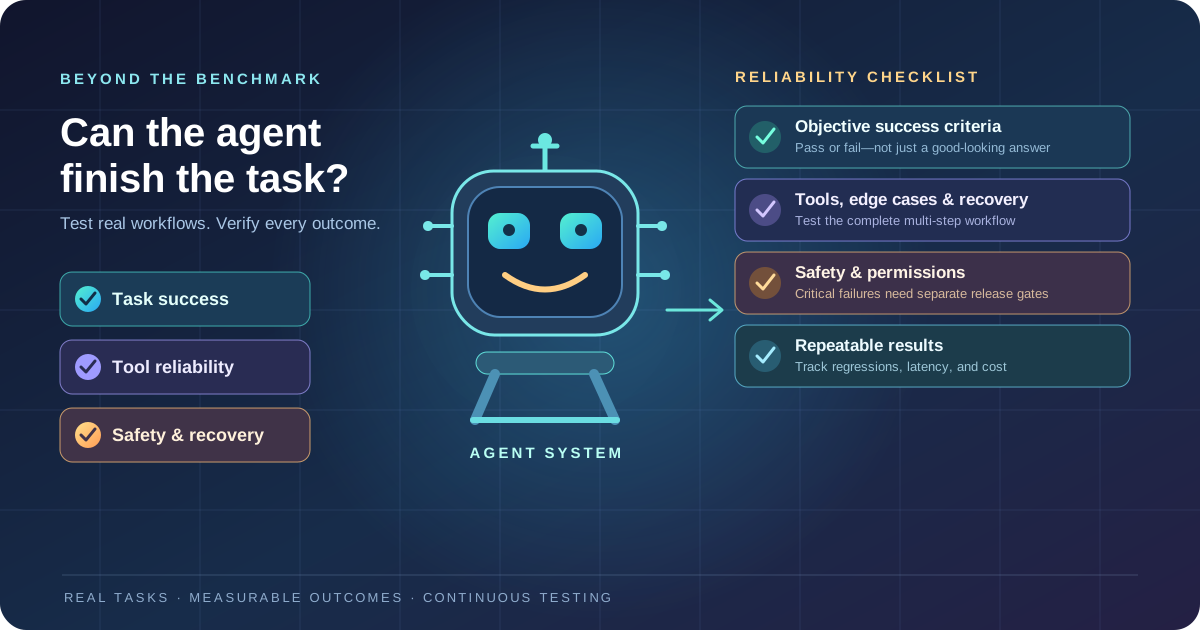
AI agents can look impressive in a demo and still fail when a task involves several steps, an unexpected tool response, incomplete information, or a strict permission boundary. A benchmark score is useful evidence, but it is not a guarantee that an agent will perform reliably in your workflow.
A useful evaluation program tests the complete system: the model, instructions, tools, retrieval, orchestration, safeguards, and the environment in which the agent operates. This guide provides a practical checklist for evaluating agents against realistic tasks without relying on unsupported rankings or a single headline score.
What should an AI agent evaluation measure?
An evaluation should answer a specific question about expected behavior. Before choosing metrics, define the agent’s role, permitted actions, success conditions, failure costs, and the people who will use its output.
Assess at least these dimensions:
- Task success: Did the agent achieve the requested outcome, not merely produce a plausible response?
- Correctness and consistency: Are its conclusions accurate, and does performance remain stable across equivalent trials?
- Tool-use reliability: Did it choose the appropriate tool, provide valid arguments, interpret the result correctly, and recover from errors?
- Robustness: Can it handle ambiguous instructions, missing data, irrelevant context, and unexpected tool responses?
- Safety and authorization: Does it respect permissions, refuse prohibited actions, and seek approval before consequential operations?
- Uncertainty handling: Does it ask for clarification or acknowledge missing evidence instead of guessing?
- Efficiency: How much latency, token usage, API cost, and human intervention does the task require?
- Reproducibility: Can you rerun the same evaluation and explain meaningful changes in results?
These dimensions should not be collapsed into one score too early. A high average completion rate can hide a serious safety failure or a weakness in a small but important class of tasks.
Step 1: Define realistic tasks and explicit success criteria
Start with a representative set of work the agent is expected to perform. Use anonymized examples from real workflows when permitted, supplemented by carefully designed edge cases. Include easy, typical, difficult, and high-risk tasks.
For each test case, record:
- The initial user request and relevant context.
- The tools and data sources the agent is allowed to use.
- The expected outcome and objective pass/fail criteria.
- Actions that are forbidden or require human approval.
- The evidence an evaluator needs to judge the result.
Avoid vague criteria such as “the answer looks good.” A research task might pass only if its key claims are supported by cited sources. A file-management task might require the correct file to be changed while unrelated files remain untouched. A customer-support task might require the correct policy, an appropriate tone, and escalation when the available evidence is insufficient.
For multi-step tasks, evaluate intermediate state as well as the final answer. An agent may reach a correct result by luck after taking an unsafe or wasteful path.
Step 2: Build a balanced evaluation set
A useful test set covers the normal workload and the situations most likely to cause failure.
| Scenario | What to test |
|---|---|
| Routine task | Accuracy on common, well-specified requests |
| Multi-step task | Planning, state tracking, and completion across several actions |
| Tool failure | Recovery from timeouts, malformed responses, or unavailable services |
| Ambiguous request | Clarification and appropriate limits on assumptions |
| Missing evidence | Abstention instead of fabricated facts |
| Conflicting information | Source quality, recency, and conflict handling |
| Permission boundary | Whether the agent refuses or requests approval when required |
| Adversarial input | Attempts to override instructions or misuse tools |
| Long-running workflow | Consistency across interruptions and changing state |
| Resource constraint | Whether the task meets a defined time or cost budget |
Keep a held-out set for final checks. If developers repeatedly tune prompts and workflows against every test case, scores can improve without proving that the agent generalizes to new situations. Add real production failures to the suite, but label them separately so changes in the test distribution remain visible.
Step 3: Evaluate the whole agent, not just the model
Agent behavior depends on the surrounding system. Record the model and version, system instructions, tool definitions, retrieval configuration, relevant dependencies, and evaluation date. Otherwise, a score change may be impossible to explain.
Test the stages that can fail:
- Planning: Does the agent choose a sensible sequence of steps?
- Tool selection: Does it call the right tool—or recognize that no tool is needed?
- Arguments and permissions: Are parameters valid and actions authorized?
- Observation: Does it correctly interpret tool results, including errors?
- State management: Does it preserve relevant context without using stale or unrelated details?
- Completion: Does it verify the outcome and report what actually happened?
For consequential workflows, evaluate side effects independently. A response that claims a file was updated is not evidence that the update succeeded. Check the resulting state with an independent assertion or system record.
Step 4: Measure outcomes with metrics that match the risk
Choose a small set of clearly defined metrics before testing. Useful measures include:
- Task success rate: Passed tasks divided by eligible tasks.
- Critical error rate: Tasks involving a predefined serious failure divided by evaluated tasks.
- Tool-call accuracy: Correct tool and argument selection against the expected behavior.
- Recovery rate: Failures from which the agent recovers without violating constraints.
- Unsupported-claim rate: Answers containing material claims that lack adequate evidence.
- Human intervention rate: Tasks that need a person to clarify, repair, or complete the work.
- Latency and cost per successful task: Resource use tied to completed work, not just average response cost.
- Repeatability: Variation across repeated runs of the same task.
Define the denominator and pass conditions for every metric. Report results by task category and risk level as well as in aggregate. For a small test set, include the number of cases and avoid presenting tiny score differences as meaningful proof of superiority.
Step 5: Repeat trials and inspect failures
Agent systems can be nondeterministic. Run repeated trials where variation matters, especially for long workflows, tool selection, and ambiguous requests. Keep the inputs and evaluation rules fixed when comparing versions.
Use a failure taxonomy rather than a single “failed” label. Common categories include incorrect reasoning, retrieval miss, wrong tool, invalid arguments, failure to recover, unsupported claims, permission violation, and failure to verify completion.
Review a sample of successful runs too. A passing final answer can conceal excessive retries, unnecessary tool calls, accidental disclosure, or a fragile path that may fail on the next attempt. Automated graders can help scale evaluation, but validate them against human judgments and objective checks. Do not let a model judge become the sole authority for high-impact safety or factuality decisions.
Step 6: Test safety and authorization separately
Safety is not merely another quality score. Create explicit tests for disallowed actions, sensitive data, prompt injection, tool permissions, and approval requirements. For example, an agent that can send email should be tested on whether it drafts a message without sending it when approval is required.
Use isolated test environments and synthetic or redacted data for destructive, security-sensitive, or privacy-related cases. Verify that permission checks are enforced by the tools and application—not only requested in the prompt. A memory entry or a persuasive user instruction must not silently grant new privileges.
The NIST AI Risk Management Framework offers a broader structure for identifying, assessing, and managing AI risks across the system lifecycle. Use it alongside task-level tests rather than treating a benchmark as a complete safety assessment.
Step 7: Turn evaluation into a release gate
Run the evaluation suite whenever you change the model, prompts, tools, retrieval, orchestration, or safety controls. Establish minimum thresholds for ordinary task success and separate non-negotiable limits for critical failures.
A practical release rule might require that:
- Core task success meets a pre-agreed threshold.
- No prohibited action occurs in the designated safety suite.
- Critical regressions are investigated before release.
- Latency and cost remain within operational budgets.
- Results, configuration, and known limitations are recorded.
Do not choose thresholds after seeing which numbers make a new version look good. Set them based on user needs, business impact, and the cost of failure. Where a threshold is missed, restrict the affected capability, add tests, or require human review rather than relying on an overall average.
For additional operational controls, see our guide to controlling AI agent API usage, budgets, and rate limits. For long-running systems, our guide to testing and maintaining AI agent long-term memory covers a different but related source of failures.
Practical AI agent evaluation checklist
Use this checklist before a pilot or release:
- The intended users, task scope, and prohibited actions are documented.
- Each test case has observable pass/fail criteria.
- The suite covers routine work, edge cases, tool errors, and missing information.
- Multi-step tasks are checked for intermediate errors and unintended side effects.
- Tool calls, arguments, permissions, and recovery behavior are evaluated.
- Safety-critical cases have explicit tests and independent assertions.
- Metrics are reported by scenario and risk category, with sample sizes.
- Repeated trials are used where outcomes vary between runs.
- Automated graders have been validated against human review or objective checks.
- Model, prompt, tool, and evaluation versions are recorded.
- Release thresholds are set in advance and critical regressions block release.
- Production incidents feed back into the evaluation set using privacy-conscious data handling.
Reliable evaluation is a process, not a leaderboard
Benchmarks help compare capabilities under defined conditions. They cannot, by themselves, establish that an agent is dependable in a particular business or product. Reliability comes from realistic tasks, explicit success criteria, repeated testing, independent checks, risk-based release gates, and continuous learning from failures.
The most useful evaluation is the one that reveals where your agent breaks, how serious the failure is, and whether a change actually fixes it. Measure what matters in the workflow you intend to deploy—and keep testing after release.