
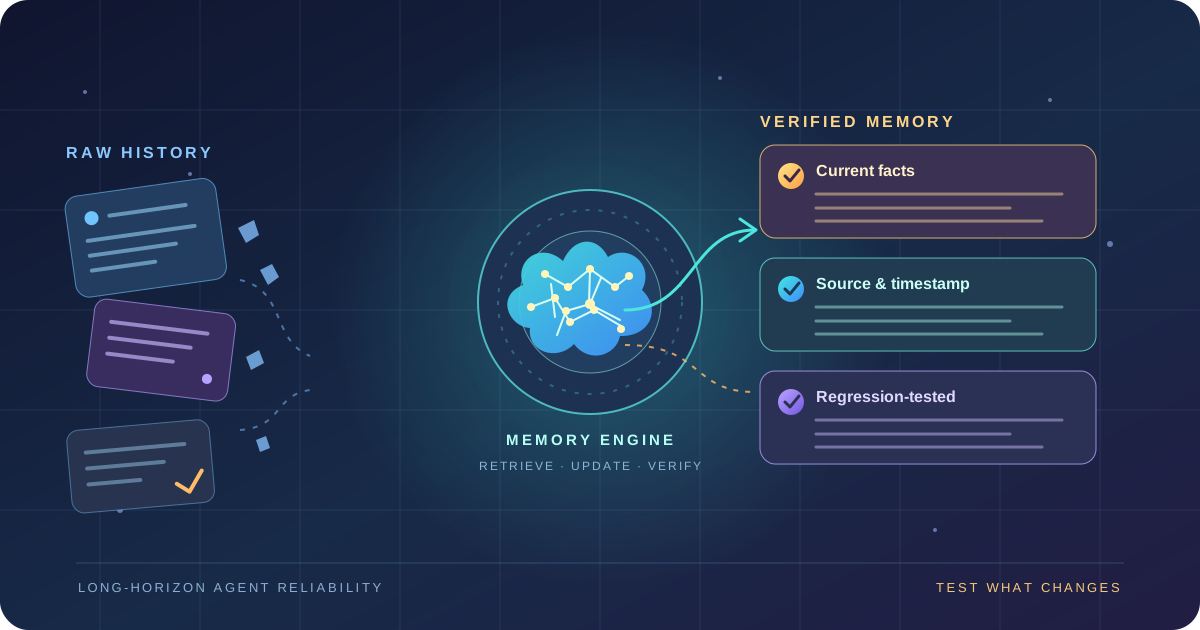
An AI agent can perform well in a short demo and still become unreliable after weeks of use. The model may not have changed, but the system around it has: its memory store has grown, user facts have changed, summaries have compressed earlier details, and retrieved records may conflict with newer information. The result can be an agent that confidently uses outdated preferences, repeats a failed action, or forgets a constraint that mattered earlier.
This kind of degradation is not inevitable, and memory is not the only possible cause of an agent’s decline. But long-running systems need tests that go beyond a fresh-session benchmark. They must measure whether an agent can preserve useful information, revise it when circumstances change, ignore stale records, and apply what it remembers to later tasks.
Why long-term agent memory becomes unreliable
A memory-enabled agent usually has several moving parts: a process that writes memories, a store that keeps them, a retrieval mechanism that selects relevant records, and a model that interprets those records. Failures can enter at any stage.
1. Summaries lose details that later matter
To control storage and context length, a system may summarize long conversations or interaction histories. Compression is useful, but a summary can drop a deadline, a condition, an exception, or the reason behind a decision. A detail that seemed unimportant when it was written may become essential in a later task.
2. New facts do not replace old facts
A person’s plans, project status, or preferences can change. If a system adds the new fact without invalidating the old one, retrieval may surface both. The agent then has to decide which record is current—and may choose incorrectly if timestamps, provenance, or conflict rules are missing.
3. Similar memories compete with one another
As a memory store grows, it can accumulate near-duplicates and records that refer to different versions of the same project. A retriever may return a semantically similar record rather than the correct one. Relevance alone is not enough; the system also needs recency, source quality, scope, and relationships between facts.
4. Remembering does not guarantee correct action
An agent might retrieve the right constraint but fail to apply it when selecting a tool, filling parameters, or planning a later step. Memory evaluation should therefore test downstream decisions—not only whether the system can answer a question about the past.
Research reflects these distinctions. The LongMemEval benchmark evaluates capabilities including multi-session reasoning, temporal reasoning, knowledge updates, and abstention. The 2026 Memora benchmark specifically examines long-term personalized memory and reports failures involving obsolete memories and changing facts. These findings identify testable failure modes; they do not mean every deployed agent will degrade at the same rate.
A practical test plan for long-term memory
Do not begin by asking whether the agent “has memory.” Build a small, repeatable evaluation set that checks what the system stores, retrieves, updates, and does with the information.
Test 1: Retention across sessions
Create a set of facts and constraints in an earlier session, then ask relevant questions or assign tasks in later sessions. Vary the time gap and insert unrelated conversations between the original fact and the test.
Examples:
- A project has a fixed deadline and a specific deployment target.
- A user prefers concise status updates rather than long reports.
- A task must not modify production data without approval.
Measure whether the agent retrieves the right fact when it matters, not whether it repeats every stored detail. Also test whether it avoids using a fact when the current task is unrelated.
Test 2: Updates and contradictions
Introduce a fact, then explicitly change it. Later, ask a question that requires the current value and another that requires understanding the change over time.
For example, first record that a project uses staging, then update its deployment target to production after approval. A reliable system should use the current target for new work while retaining the history only when that history is relevant.
Track stale-memory errors separately from ordinary retrieval misses. A system that returns no answer is different from one that confidently applies an obsolete answer.
Test 3: Conflicting sources and provenance
Add two conflicting records with different dates, sources, or scopes. Test whether the agent can prioritize the authoritative and applicable record, explain uncertainty, or ask for clarification when the conflict cannot be resolved.
Useful metadata includes:
- When the fact was observed or last confirmed.
- Where it came from and how trustworthy that source is.
- Which user, project, or task the fact applies to.
- Whether the record is current, superseded, or disputed.
Do not assume the newest record is always correct. A recent unverified statement should not automatically override an authoritative policy or a confirmed system state.
Test 4: Retrieval under distraction
Place the target fact among similar records, old project names, unrelated details, and paraphrased duplicates. Test short queries as well as indirect requests that do not repeat the original wording.
This exposes a common weakness: a retriever may return a related memory that looks plausible but belongs to another task. Include negative examples where the correct action is to ignore the retrieved record.
Test 5: Memory-to-action transfer
Evaluate multi-step tasks where the agent must use a remembered constraint to choose a tool or parameter. Examples include honoring a previously stated budget, respecting a project-specific environment, or avoiding an action that was explicitly prohibited.
The MemoryArena research studies interdependent agent tasks in which memory must guide later actions. Its framing highlights why recall questions alone cannot establish that memory works in an operational workflow.
Test 6: Missing information and safe abstention
Sometimes the correct behavior is to say that a fact is unavailable, ask a question, or verify the current state with a trusted source. Seed the test set with details that were never provided, records that have expired, and conflicts that cannot be resolved.
A system should not invent a remembered preference or treat an old note as proof of a current external state. Measure unsupported answers and unnecessary guesses as explicit failure categories.
Metrics worth tracking
Start with a small set of metrics that can be interpreted and compared across versions:
| Metric | What it reveals |
|---|---|
| Current-fact accuracy | Whether the agent uses the valid version of a fact |
| Stale-memory error rate | How often superseded information drives an answer or action |
| Retrieval precision | How often retrieved memories are actually relevant and applicable |
| Retrieval coverage | How often the system finds the needed memory when one exists |
| Conflict-resolution accuracy | Whether it handles inconsistent records appropriately |
| Task success with memory | Whether memory improves the final task, not just recall |
| Unsupported-answer rate | How often the agent guesses when evidence is missing |
| Latency and cost | The operational price of retrieval, summarization, and extra checks |
Define each metric before running the test. For example, retrieval precision and task success are not interchangeable: a system can retrieve a relevant memory but still use it incorrectly. Report results by scenario type as well as an overall score, so a strong average does not hide severe failures in updates or safety constraints.
How to maintain memory without hiding regressions
Keep memory records structured
Where possible, store important facts as records with a value, scope, source, timestamp, and status. Separate stable preferences from temporary task state, and distinguish confirmed facts from inferred summaries. Structure will not eliminate errors, but it makes conflicts and stale records easier to detect.
Give updates an explicit lifecycle
When a fact changes, decide whether to replace the old record, mark it as superseded, preserve it as history, or ask for confirmation. Avoid accumulating contradictory entries without a resolution rule. If a fact has an expiration date, test what happens after it expires.
Re-evaluate after changes
Run the same evaluation set after changing the memory-writing prompt, summarizer, embedding model, retrieval ranking, storage schema, or agent orchestration. Keep a fixed regression set and add newly observed production failures as separate cases. Compare versions on the same inputs rather than relying on anecdotes from a few successful sessions.
Use controlled maintenance
Deduplication, summarization, pruning, and re-indexing can improve memory quality, but each operation can also remove useful information or alter retrieval behavior. Test maintenance on a copy or controlled cohort first, then rerun the regression set. Keep enough provenance to investigate why a record was changed.
Monitor real workflows safely
Track memory-related errors, task outcomes, retrieval misses, stale-record use, latency, and cost. Use redacted traces and avoid logging secrets or sensitive conversation content unnecessarily. If an agent performs consequential actions, require independent authorization checks; a memory note should not itself grant permission to perform an action.
For broader deployment controls, see our guide to controlling AI agent API usage and budgets and the overview of Gemini agent workflows in Google Cloud.
Long-term memory reliability checklist
Before releasing a memory-enabled agent, confirm that:
- Tests cover multiple sessions, interruptions, and unrelated conversations.
- Updated facts reliably supersede or qualify older records.
- Records include enough provenance, timestamps, and scope to resolve conflicts.
- Similar and duplicate memories do not routinely displace the correct record.
- The agent applies remembered constraints in tool calls and multi-step tasks.
- It can abstain or ask for clarification when information is missing or contradictory.
- Regression tests run after changes to memory, retrieval, or orchestration.
- Maintenance jobs are tested for information loss and behavior regressions.
- Production monitoring uses privacy-conscious traces and actionable error categories.
The takeaway
Long-term memory should be treated as a changing subsystem, not a feature that can be declared reliable after one successful demo. Test retention, updates, conflicts, retrieval, and downstream action separately; then repeat those tests as the memory store and system evolve. The goal is not to make an agent remember everything. It is to help it use the right information, at the right time, and recognize when its memory is no longer trustworthy.
Research sources: LongMemEval (ICLR 2025) · From Recall to Forgetting / Memora (ACL Findings 2026) · Benchmarking Agent Memory in Interdependent Multi-Session Agentic Tasks (ICML 2026)