Meta introduced Muse Wonder and Muse Wonder Full on October 12, 2026, describing them as its most capable AI models to date for personal and professional agent tasks. The release puts particular emphasis on two capabilities: remembering relevant context across conversations and continuing to work through difficult, multi-step tasks instead of stopping at an initial answer.
The announcement is important for developers because Meta says Muse Wonder is available through the Meta Model API and Muse Code, while Muse Wonder Full is available to Muse Code subscribers. However, the models are not yet described as generally available across the consumer Muse experience: Meta says Muse Wonder will power more Muse experiences soon, beginning with subscribers.
This guide separates what Meta has announced from what developers can use now, and explains what the new memory and task-execution features could mean for agent-based applications.
What Are Muse Wonder and Muse Wonder Full?
Muse Wonder is part of Meta’s Muse model family, built on the groundwork of Muse Spark. Meta positions the new models for tasks that require more than a short response, including software development, document-heavy work, planning, and professional workflows.
The release includes two models:
- Muse Wonder: Available to developers and builders through the Meta Model API and Muse Code, according to Meta’s announcement.
- Muse Wonder Full: Available to Muse Code subscribers. Meta presents it as the more capable option for demanding tasks.
Meta has not published pricing for these models in the announcement. Developers should check the current Meta Model API and Muse Code interfaces for access conditions and any applicable usage charges before committing to a deployment.
The Two Main Features: Active Memory and Active Focus
Meta’s announcement centers on two features that target common weaknesses in AI agents: losing useful context and failing to make progress when a task becomes difficult.
Active Memory: Bringing Relevant Context Forward
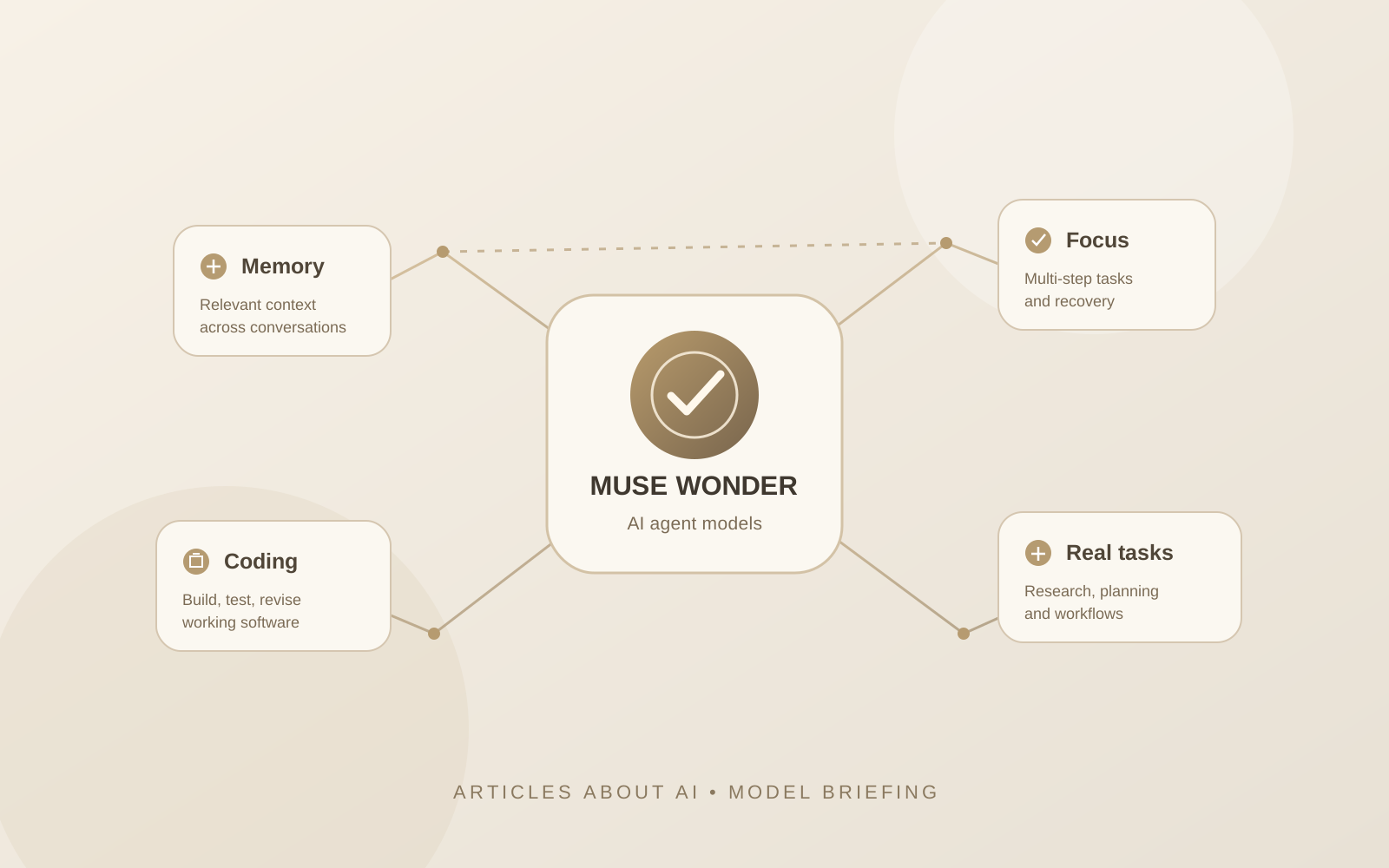
Meta calls its memory approach Active Memory. The company describes it as the ability to carry important context across conversations and retrieve details when they become relevant to the current task.
For an agent, memory is not simply storing a transcript. A useful system must identify which information matters, recover it at the right time, and avoid confusing old context with a user’s current instructions. Meta’s announcement describes the intended behavior, but it does not by itself establish how reliably the models will remember information across every workflow or account configuration.
For developers building their own products, it is worth testing memory with realistic cases: changed preferences, conflicting instructions, stale details, and requests that should not reuse sensitive information. Our guide to AI agent memory and reliability explains why long-term context needs ongoing evaluation rather than being treated as an automatic improvement.
Active Focus: Continuing When a Task Gets Difficult
Meta calls the second capability Active Focus. According to the company, the models can try alternative approaches, work through blockers, adapt to new information, recover from errors, and ask for clarification when needed. Meta also says the models check in before taking important actions.
This matters for coding and other multi-step work. A software task can require reading an unfamiliar codebase, understanding requirements, making edits, running tests, and revising a solution after failures. A model that produces a promising first response but cannot sustain that process may still require substantial human intervention.
The practical question is not whether an agent claims to keep working; it is whether it reaches the correct outcome, reports failures honestly, respects permissions, and avoids taking consequential actions without approval. Developers should measure completion rate, error recovery, time, cost, and the frequency of unnecessary or unsafe actions.
What Can the Models Do?
Meta highlights work across several areas:
- Coding: Building and revising software, from smaller applications to more complex projects.
- Professional documents: Interpreting material such as leases and insurance documents, then helping users work through the associated tasks.
- Law, finance, and health-related information: Applying domain knowledge to document-heavy or specialized tasks. These use cases still require appropriate professional review and should not be mistaken for a replacement for qualified advice.
- Planning and coordination: Using preferences and task context to create plans, handle constraints, and progress through multiple steps.
- Agent workflows: Working across tools and information sources when the relevant product environment grants access.
Meta’s research page includes demonstrations such as generating a playable 3D kitchen game, preparing a running plan, and creating a seating chart from complex requirements. Demonstrations show what a system can do in selected scenarios; they do not guarantee the same quality on arbitrary real-world tasks.
How Strong Are the Benchmark Results?
Meta says the Muse Wonder family achieves state-of-the-art results across selected evaluations for personal and professional agents, memory, and coding. Its research discussion refers to evaluations including FocusBench and SWE-Marathon, as well as specialized tasks in areas such as law, finance, and health.
Those are claims from the model developer, and they should be read in that context. Benchmark results can help compare systems, but they do not fully predict reliability in a particular business workflow. Results also depend on the task set, prompting, tools, inference settings, and the way success is measured.
Meta links to a research report with additional evaluation details. Readers comparing Muse Wonder with ChatGPT, Claude, Gemini, or coding agents should examine the test methods and model versions rather than treating a broad “state-of-the-art” description as proof that one model is best for every use case.
For a practical selection process, see our AI agent reliability evaluation checklist. A representative test set built from your own tasks is often more useful than choosing a model from one headline benchmark.
Availability: What Can You Use Today?
As of Meta’s October 12, 2026 announcement, the stated availability is:
| Product | Availability announced by Meta |
|---|---|
| Muse Wonder | Available through the Meta Model API and Muse Code |
| Muse Wonder Full | Available to Muse Code subscribers |
| Muse app integration | Planned; Meta says Muse Wonder will roll out to subscribers first |
| General consumer access to both models | Not confirmed as broadly available in the announcement |
| Public pricing | Not specified in the announcement |
The distinction between developer availability and consumer rollout is important. A model can be accessible through an API or coding product before it becomes part of a broadly available assistant experience.
Meta has not specified a public per-token API price in the announcement. Because access and commercial terms can change, check the official developer interface before estimating operating costs or selecting a model for production.
Safety and Privacy Considerations
Meta says the models were trained to avoid sharing private information without permission, resist harmful requests, and strengthen defenses against cyber misuse while preserving defensive security work. It also says the models are evaluated under its Meta Superintelligence Scaling Framework.
These are relevant design goals for personal agents, which may interact with messages, calendars, documents, and other sensitive information. But developer claims about safeguards are not a substitute for testing the system in the environment where it will be deployed. Meta says a fuller report with additional safety evaluations will be available soon; until those details are published and reviewed, some aspects of the safety assessment remain incomplete.
Before granting any agent access to important accounts or files, use least-privilege permissions, require approval for consequential actions, keep auditable logs, and test how the system handles prompt injection and requests to reveal private information. These controls remain necessary even when a model is designed with safety features.
Should Developers Pay Attention to Muse Wonder?
Muse Wonder is worth evaluating if your work involves coding, tool use, or workflows that extend across many steps. Active Memory and Active Focus target two real agent-design challenges: maintaining useful context and making progress after the first attempt fails.
That does not automatically make the models the right choice for every application. Before adopting them, developers should verify API access, pricing, rate limits, data handling terms, tool support, latency, and performance on their own tasks. They should also compare the total cost of completing a task—not just the cost of a single model call—including retries, tools, and human review.
For now, the clearest conclusion is that Meta has announced a new model family and made defined access routes available. Broader consumer integration is still described as upcoming, public pricing was not specified in the announcement, and independent evaluation is needed to establish how the models perform across real production workloads.
Official Sources
- Meta: Introducing Muse Wonder and Muse Wonder Full
- Meta AI Research: Muse Wonder
- Meta Model API
- Muse Code
This article reflects information available in Meta’s October 12, 2026 announcement. Availability, pricing, and product capabilities may change; consult the official links for the latest details.