
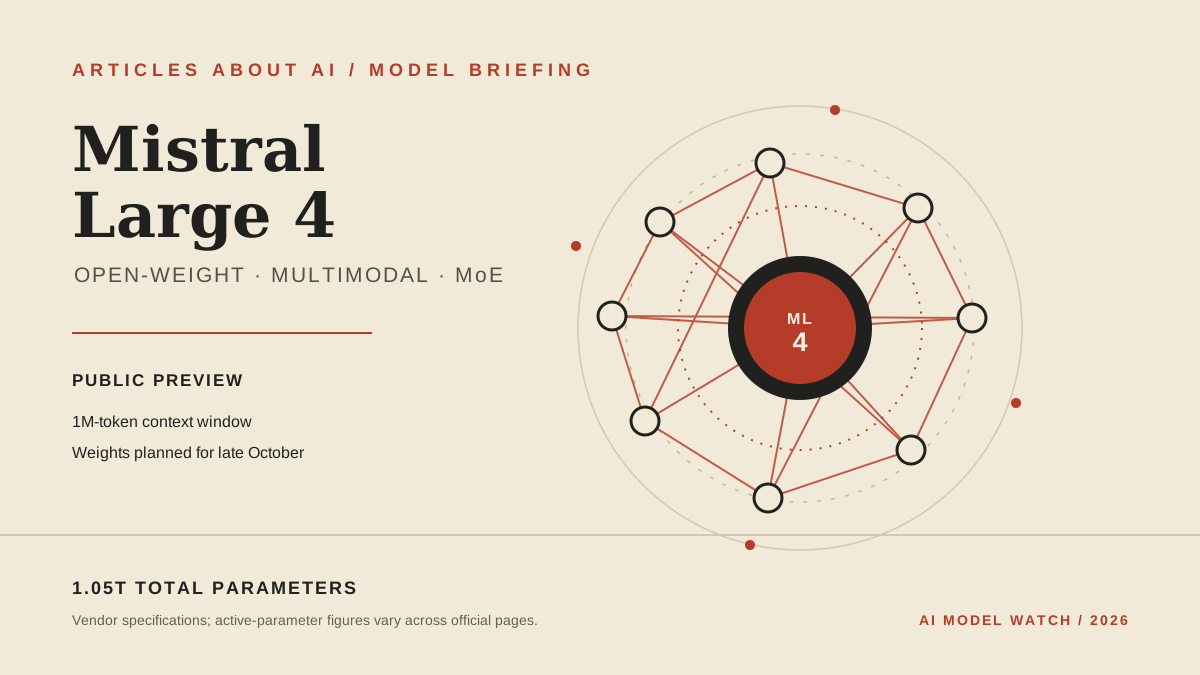
Mistral AI introduced Mistral Large 4 on October 6, 2026, opening a public preview of its newest general-purpose multimodal model through the Mistral API. The company describes it as an open-weight Mixture-of-Experts model with 1.05 trillion total parameters, 52 billion active parameters, a 1.6-billion-parameter vision encoder, and a one-million-token context window. Its model documentation lists capabilities including structured outputs, function calling, document question answering, chat completions, batching, and agent-oriented workflows.
One specification needs careful handling: Mistral’s launch announcement describes 49 billion active parameters, while its model documentation currently lists 52 billion. The company’s public materials therefore disagree on this figure; this article identifies the documentation value where relevant rather than treating the discrepancy as resolved.
The announcement is relevant to developers and businesses comparing AI systems for coding, document analysis, long-context tasks, and automated workflows. Mistral is positioning Large 4 as a single model that can handle text and images, reasoning, software engineering, and multi-step work. But the release has an important limitation: as of October 10, Mistral’s announcement describes API access as a public preview and says downloadable weights are planned for the end of October. The planned weight release should not be confused with a download that is already available.
This article separates the company’s claims from practical analysis. Model specifications, benchmark results, and rollout plans below come from Mistral’s official announcement and documentation unless explicitly identified as analysis. Vendor-reported scores can help identify promising use cases, but they do not replace testing on a team’s own tasks.
Official sources:
What was announced
Mistral Large 4 is in public preview through the Mistral API, and Mistral directs users to try it in Mistral Studio. The company says it plans to release the weights by the end of October 2026, with further details about architecture, additional benchmarks, and post-training methods to follow. This creates two different stages for developers: hosted API evaluation can begin now, while organizations interested in self-hosting must wait for the weight files and review the accompanying license and deployment instructions.
Mistral describes Large 4 as its largest and most capable model so far. It is intended to combine general instruction following, reasoning, multimodal input, coding, and agentic behavior. The company highlights enterprise work in finance, engineering, manufacturing, logistics, pharmaceuticals, science, shipping, and the public sector. These are target areas rather than guarantees that the model will meet every domain’s quality or compliance requirements.
The release is explicitly a preview. Mistral says training and reinforcement learning are still progressing and that the model continues to improve. That means capabilities, benchmark scores, pricing, and deployment guidance may evolve. Teams planning production use should evaluate the current version and allow time to retest when the service changes.
Architecture and active parameters
Mistral’s model page lists 1.05 trillion total parameters and 52 billion active parameters. Large 4 uses a Mixture-of-Experts architecture, in which a routing mechanism selects a subset of model components for a given computation. The total parameter count describes the broader capacity of the model, while active parameters help explain how much of that capacity is engaged for a token. Neither number alone tells a buyer how fast the model will run, how much memory a deployment will need, or how well it will solve a particular task.
The model page also lists a 1.6-billion-parameter vision encoder. This component supports the model’s ability to process visual information alongside text. Mistral’s examples include reading complex documents and charts, inspecting technical drawings, finding objects in large satellite images, and combining visual understanding with longer tool-driven workflows.
For buyers, the architectural headline is less useful than measured behavior. A large model may have broad capabilities, but its real value depends on output quality, latency, token cost, context handling, and the amount of human correction required. Teams should measure those factors directly rather than choosing a model solely because its parameter count is larger than a competitor’s.
One-million-token context window
Mistral’s documentation lists a context window of one million tokens. A context window is the amount of tokenized information that a model can process in a request or conversation, subject to the API’s limits. It is not the same as one million words, and it does not guarantee that every detail in a long input will be remembered or used correctly.
A large context can help with extensive codebases, long contracts, multiple research papers, technical documentation, and collections of business records. It may reduce the need to split source material into many separate prompts and can make it easier to ask questions that depend on information spread across several documents.
Context capacity is only one part of long-document performance. A model can accept a large input and still overlook a key clause, confuse similar passages, or give a summary that is not fully supported by the source. A useful evaluation should include questions whose answers appear at the beginning, middle, and end of a long document. It should also test whether the model can identify the source of a conclusion and distinguish direct evidence from inference.
For professional use, teams should pair long context with source grounding and verification. A legal or finance workflow might ask the model to identify the document and passage supporting each conclusion, then require a qualified person or deterministic validation step to check the evidence before acting on it. Large context makes more information available; it does not eliminate the need to verify the answer.
Multimodal understanding
Mistral says Large 4 can reason across complex documents, charts, and natural images. Its examples include inspecting mechanical parts, interpreting engineering drawings, extracting evidence from PDFs, and scanning large geospatial images for specific objects. The company also describes workflows in which a model can combine visual grounding with agentic capabilities, such as examining an image, inspecting a detail, and checking whether the evidence supports a conclusion.
Mistral reports a 42% result on Dense 200, a visual-grounding evaluation, compared with 41% for GPT-6 Astra. This is a company-reported benchmark comparison. A one-point difference on one test should not be treated as proof that a model is generally superior across image tasks. Results depend on the dataset, evaluation settings, and similarity between the benchmark and a real workload.
The practical test is whether the model can find the right evidence in the images a team actually uses. Engineers should test their own drawing formats and component types. Researchers should test scientific figures and scanned documents. Organizations working with satellite imagery should test across different terrain, resolution, and image quality. Public benchmark scores are a starting point, not a substitute for evaluation against the real task.
Coding and agentic work
Mistral positions Large 4 for software engineering, repository understanding, and complex terminal workflows. Its announcement reports scores of 61.7% on DeepSWE v1.1, 59.4% on SWE-Atlas-QnA, and 28.3% on Terminal-Bench 4. Mistral also reports a combined Coding Agent Index score of 49.8%. In a blind human evaluation with Surge AI, the model ranked second among five models for coding quality, behind Claude Opus 5.
These figures are Mistral’s reported results, not a universal ranking across programming languages, repositories, or agent frameworks. Coding benchmarks measure different skills: issue resolution, terminal interaction, repository questions, or the quality of generated changes. A model can do well on one test and still struggle with a team’s build system, dependencies, conventions, or codebase.
Developers should evaluate Large 4 on representative tasks: bug fixes, feature work, refactoring, test creation, code explanation, and multi-file changes. Record whether the model understands repository conventions, produces changes that pass tests, avoids unrelated edits, and explains uncertainty when it cannot finish a task. The amount of human intervention matters as much as the percentage of tasks completed.
Agentic workflows add another dimension. A model may need to gather information, call tools, run a sequence of actions, inspect intermediate results, and recover from errors. Mistral reports a 59.9% score on AutomationBench, which covers business workflows across applications such as email, spreadsheets, messaging, and customer-management tools. It also reports 1,393 Elo on AA-Briefcase, a benchmark for long-horizon knowledge work. Those results suggest that the company is targeting more than code completion, but teams should test tool selection, state tracking, recovery, and deliverable quality in their own environments.
Science, finance, and knowledge work
Mistral says Large 4 is intended for professional work involving spreadsheets, documents, legal tasks, financial analysis, and scientific problem-solving. The company reports strong performance on selected scientific and engineering evaluations, including SciCode-Verified, and describes an example in which the model generated a Hartree–Fock simulation in one attempt. That is a vendor-reported demonstration, not evidence that every scientific output will be correct without specialist review.
For finance, Mistral points to evaluations involving spreadsheet creation and editing, plus multi-step analysis of public-company filings and financial reports. For legal work, it cites Harvey’s Legal Agent benchmark. The attraction is a model that can read source material, reason across it, and produce a structured deliverable in one workflow.
High-stakes tasks need additional safeguards. Financial calculations should be reconciled against trusted data and deterministic computation. Legal conclusions should be checked against the underlying authorities and reviewed by qualified professionals. Scientific results should be reproducible and validated using the relevant methods. A polished spreadsheet or fluent explanation is not proof that every assumption is correct.
Organizations comparing models should evaluate both the final output and the audit trail: which sources were used, which calculations were performed, where uncertainty remained, and how often a human had to correct the result.
Open weights and deployment control
Mistral’s open-weight positioning is important to organizations that want more control over how AI is deployed. If the weights are released under terms suitable for a company’s intended use, organizations may be able to evaluate self-hosting, customize the model, and choose their own infrastructure instead of relying exclusively on a hosted API. Mistral says Large 4 is intended to support private-cloud or on-premises use for organizations that need control over data and deployment.
However, “open-weight” should not automatically be treated as synonymous with unrestricted open-source software. The license, use conditions, weight files, system requirements, and deployment instructions all matter. Mistral’s October 6 announcement said the weights were planned for release by the end of October. As of October 10, that remains a plan rather than a completed release described in the announcement.
Self-hosting also creates operational responsibilities. A model of this scale may require substantial memory, accelerator capacity, high-bandwidth infrastructure, monitoring, and careful serving configuration. The 52-billion active-parameter figure does not by itself establish the minimum hardware needed for a particular sequence length, throughput target, quantization method, or inference engine. Organizations should wait for the actual weight files and official deployment guidance before estimating the full cost.
A sensible sequence is to use the hosted preview for initial evaluation, compare it with existing models on a controlled test set, then reassess when weights and deployment documentation arrive. That avoids making a self-hosting decision based only on a launch announcement.
API access and pricing
Mistral says users can try the public preview API through Mistral Studio. The official model page lists structured outputs, function calling, document question answering, chat completions, batching, agents and conversations, and built-in tools. These capabilities can help developers build applications that need more than a plain text response, although exact limits and behavior should be verified in the API documentation before implementation.
At the time of this check on October 10, 2026, Mistral’s model documentation displays sale prices of $0.68 per million input tokens, $0.07 per million cached input tokens, and $2.09 per million output tokens. The page also shows original prices of $1.36, $0.14, and $4.18 respectively. Because the lower figures are explicitly labeled sale prices, developers should check the live model page before budgeting for production or committing to a long-running service.
Token prices alone do not determine total workflow cost. Large prompts, repeated context, tool calls, retries, and long outputs can increase usage. A system that repeatedly resubmits an entire codebase may cost more than one that retrieves only relevant files. Conversely, a model that completes a multi-step task with fewer retries may cost less end to end even if its output token price is higher than another model’s.
A useful cost evaluation records input and output tokens, cached input where applicable, tool calls, completion rate, human review time, and the cost of failed or corrected work. Compare models on the same representative tasks, then repeat the evaluation as the preview changes.
Current pricing and capabilities: Mistral Large 4 model documentation.
Availability and release timeline
Mistral announced Large 4 on October 6, 2026, as a public preview. The company directs users to the preview API in Mistral Studio and says weights are planned for release by the end of October. Additional architecture information, benchmarks, and post-training details are also planned.
Mistral says the model will be available across multiple regions worldwide, including a European deployment operated end to end by Mistral under European law. The announcement does not provide a complete country-by-country availability table. Users should check the options available to their account and should not assume every region or deployment mode is already supported.
The company says Large 4 was trained on 3,800 NVIDIA Grace Blackwell GPUs in its own European datacenters and that the public preview is served on that infrastructure. This supports Mistral’s infrastructure and sovereignty positioning, but it does not answer every customer’s questions about data processing, retention, contracts, or regulatory obligations. Those require review of the applicable service terms and documentation.
How developers should evaluate Large 4
Begin with the task, not the leaderboard. For coding, use real repository tasks with known outcomes. For document analysis, use representative PDFs, tables, and long files. For vision, use the image types the application will encounter. For agents, test tool reliability, state tracking, authorization, and error recovery.
Use a fixed test set so results can be compared with current production models. Record quality, latency, cost, completion rate, and the number of human interventions. Review failure cases in detail: a model that scores well overall may still fail on the language, document format, or domain that matters most to a team.
For hosted preview testing, use non-sensitive data unless the service terms and internal policies explicitly permit the intended data. Review privacy, retention, regional options, and contractual commitments before sending confidential or regulated information. A model announcement alone does not establish data-handling guarantees.
If the weights are released, evaluate the license, hardware needs, inference performance, observability, and operational ownership before deploying them. Open weights can expand control, but they do not eliminate the need to secure the serving stack or manage updates.
What the launch means
Large 4 adds another large multimodal model to the market for developers seeking general reasoning, coding, and agentic capabilities. Mistral’s pitch is that one model can cover many kinds of work while remaining on a path toward open-weight deployment. If the eventual weights and license support the use cases described, the model could appeal to organizations that want to customize or operate AI within their own infrastructure.
The most important questions remain empirical: how does it perform on independent evaluations, what hardware does self-hosting require, how stable are preview prices and capabilities, what license will accompany the weights, and how reliably does it handle long contexts and tool-driven tasks in production? Those questions cannot be settled by a parameter count or a vendor benchmark alone.
As of October 10, 2026, the immediate opportunity is to evaluate the hosted preview against measurable requirements. Mistral has announced a substantial model and published enough information for developers to begin testing it, while the promised weight release and further technical details remain important future milestones.
Bottom line
Mistral Large 4 is in public preview through the Mistral API, with a one-million-token context window and reported capabilities across multimodal understanding, coding, agents, science, and professional knowledge work. The official model page lists sale pricing, which should be rechecked before budgeting. Mistral says downloadable weights are planned for the end of October; they should not be described as already available based on the October 6 announcement.
Developers can start with controlled API tests, while enterprises can evaluate quality, cost, regional deployment options, and potential future self-hosting. The release is worth watching, but its production value will depend on results from real workloads and the technical and licensing details that arrive with the weights.