
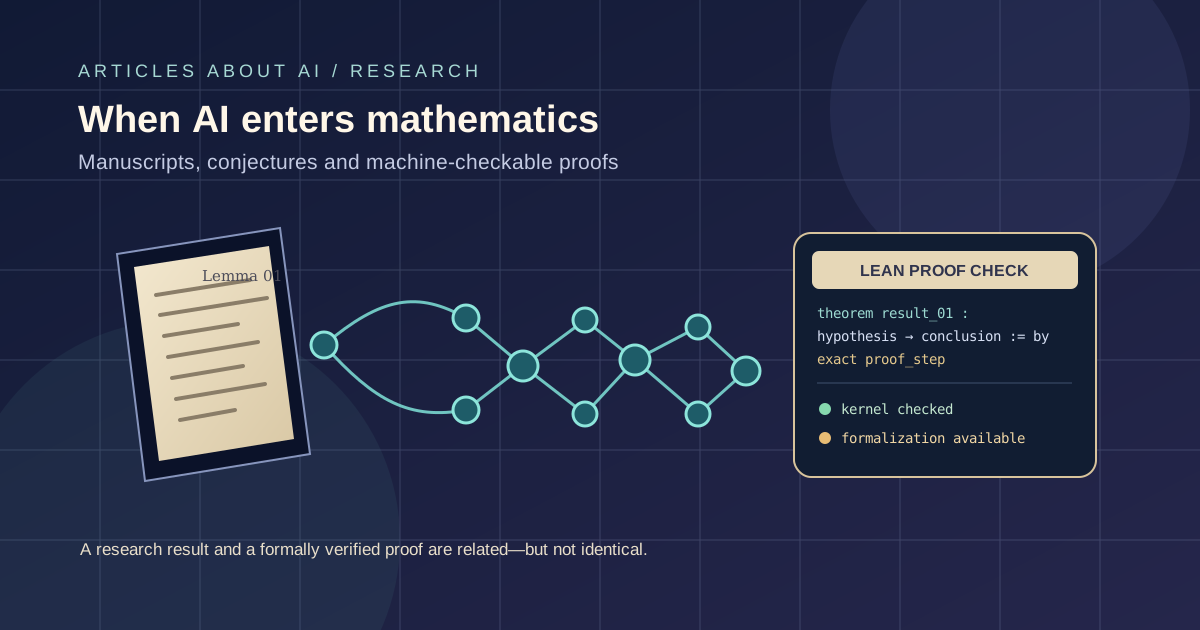
OpenAI published a broad collection of mathematical results produced by an internal frontier model on October 6, 2026, making the manuscripts, supporting artifacts, selected reasoning summaries, and some machine-checkable proof formalizations available through a public GitHub repository. The release is notable not simply because an AI system produced mathematical work, but because OpenAI is sharing a large research collection alongside information intended to help mathematicians inspect, cite, and evaluate it.
The collection is substantial: the repository’s catalogue lists 719 manuscripts organized into 372 families. OpenAI says the evaluation process posed approximately 4,000 problems to the model, then grouped outputs into manuscript families and selected results considered sufficiently significant for the collection. The company reports that the average result used compute equivalent to roughly three hours of ChatGPT Pro thinking, while noting exceptions to that procedure.
Those numbers describe the scale and process of the release; they do not establish that every manuscript is correct, independently accepted, or formally verified. OpenAI explicitly warns that the results are at different stages of verification, that some do not have Lean formalizations, and that unformalized work may contain issues. That distinction is central to understanding what the announcement means for mathematical research.
This article explains what was released, how Lean formalization fits into the picture, what the repository lets readers inspect, and what researchers and technically curious readers should—and should not—infer from the announcement.
What OpenAI announced on October 6
In its official announcement, “Sharing AI progress in mathematics”, OpenAI said it was releasing a broad range of mathematical results generated by an internal frontier model. Rather than presenting the release as one paper or one benchmark score, the company published a research collection with manuscript files, supporting materials, a history of revisions, and instructions for citations.
The main public resource is the OpenAI mathematics repository on GitHub. Its README describes a set of mathematical manuscripts and supporting proof artifacts produced by an internal OpenAI model. It organizes related papers into families, which may include a principal result, companion arguments, consequences, or alternative proofs. Each family is classified by mathematical discipline.
The repository also provides a manuscript map, an overview document, preprints and their source files, and a record of changes. OpenAI says it will preserve the release history: corrections and revisions will be recorded as new versions rather than silently erasing earlier versions. That matters in research, where a claim can change as errors are discovered or an argument is improved.
The company says it consulted the independent Advisory Group on Mathematics and Artificial Intelligence at the Institute for Advanced Study and used the group’s public recommendations to inform how it shared the work. OpenAI also says it is exploring other community-hosted alternatives that meet the committee’s guidelines. It has committed to improving citations, mathematical exposition, and presentation in future releases.
How large is the collection?
The repository’s current README describes 719 manuscripts in 372 families. The distinction between manuscripts and families is useful. Multiple manuscripts may be related to a shared mathematical question, provide a consequence of a central result, or present alternative arguments. Counting every file as a completely independent discovery would therefore misrepresent the structure of the collection.
OpenAI says the model was posed approximately 4,000 problems during the evaluation. Outputs were then grouped into families of related work, and the collection was curated around results judged to have an appropriate level of significance. This is a pipeline of generation, organization, and selection—not a claim that every attempted problem yielded a new theorem.
The company also reports that the average result used compute equivalent to roughly three hours of ChatGPT Pro thinking. That figure gives readers a rough sense of the resources associated with the procedure, but it should not be read as a universal cost for mathematical discovery. OpenAI identifies exceptions, including work on a zero-free region for the Riemann zeta function and a proof of the Hodge Conjecture for CM abelian varieties. It also notes that the write-up for one zero-free-region result was human-edited for readability.
The figures should be interpreted with care. The repository’s catalogue is a snapshot that can change as materials are revised and formalizations are added. The number of manuscripts does not equal the number of independently validated breakthroughs, and the compute estimate is not a complete accounting of research, verification, or infrastructure costs.
Why Lean formalization matters
One of the most important parts of the release is its use of Lean, a programming language and proof assistant that allows mathematical arguments to be represented in a formal system and checked by a proof kernel.
In ordinary mathematical writing, an author presents definitions, lemmas, and a chain of reasoning in a form that other mathematicians can read and scrutinize. That process is essential, but natural-language exposition can leave room for a hidden assumption, a skipped step, a misapplied theorem, or a notation error. A formal proof encodes the argument in a language with explicit rules, allowing a machine to check whether the formal derivation follows from its premises.
OpenAI says many of the released results have Lean formalizations and that it will add more as they become available. The repository README currently reports that roughly 42% of the top-line results are formalized. That is meaningful progress toward machine-checkable evidence, but it also means formalization is not available for the entire collection.
Formalization has a specific scope. A proof assistant can check that a formal proof follows the rules of its underlying system and uses the stated assumptions. It does not automatically show that the theorem is important, that the formal statement captures every nuance of the intended mathematical claim, or that the result has been independently judged novel by the research community. Those questions require mathematical interpretation, comparison with prior work, and peer scrutiny.
Nor does the absence of a Lean formalization prove that a manuscript is wrong. Many correct mathematical proofs are published in conventional form and have not been formalized. It does mean that readers cannot treat the manuscript as having the extra layer of machine-checking associated with a completed formal proof.
A useful way to think about the release is to separate three things: a model-generated mathematical claim, a written argument that a reader can inspect, and a formal proof checked by a proof assistant. They can support one another, but they are not interchangeable.
What is available in the repository?
OpenAI’s public mathematics repository offers several ways to explore the collection:
- Manuscripts and preprints. The
preprints/directory contains PDFs, source files, and manuscript-specific citation and build instructions. - A manuscript map. The catalogue helps readers locate individual papers and supporting materials.
- An overview document. The repository’s overview describes families of results, making it easier to navigate a collection too large to read linearly.
- Lean formalizations. The Lean library and formalization catalogue identify formal proofs and their associated papers, with configuration information for checking them.
- Selected reasoning summaries. OpenAI released ten abridged summaries covering selected results, including topics in number theory, complexity theory, mathematical physics, and algebra.
- A version history. The repository records changes and provides citation guidance for individual manuscripts.
The reasoning summaries are selected explanatory materials, not a complete transcript of every internal computation. OpenAI describes them as abridged summaries. Readers should therefore avoid treating them as a comprehensive, independently auditable record of all internal model reasoning.
The repository is the right starting point for readers who want to evaluate a particular claim. A headline or summary may communicate the broad significance, but a research conclusion depends on the exact statement, its assumptions, its proof, and its relationship to existing literature.
What the release says about AI-assisted discovery
The announcement points toward a research workflow in which a model can generate candidate mathematical results at scale, while people and formal tools help determine which outputs are worth retaining and how they should be checked. The value of this approach is not merely that a model can produce a plausible proof-shaped explanation. It is that the system can contribute candidate arguments and connections that researchers can investigate, formalize, correct, or reject.
The distinction between producing a candidate and validating it is especially important in mathematics. A fluent argument can conceal a gap. A claim can be true but already known. A proof may depend on an unstated condition, or a formalization may encode a narrower proposition than a headline suggests. The research process has to address each of those issues separately.
Large-scale generation may help researchers explore more conjectures, compare approaches, and identify promising lines of inquiry. But a large volume of output also increases the work required to triage, check, explain, and cite it. The repository’s organization into families and its selected reasoning summaries are attempts to make a large collection navigable, while formalization provides an additional route for checking a subset of the claims.
For readers interested in AI research workflows, this is a useful case study in the difference between a model’s capability and the evidence needed to trust a result. Our guide to using Deep Research in ChatGPT discusses a related but distinct problem: using AI to gather and organize evidence from sources. Mathematical proof checking has its own formal standards, and it cannot be replaced by a well-cited web summary.
What is verified—and what is not?
OpenAI’s own caveats are among the most important parts of the release. The company says the collection contains results at different stages of verification. Not every result has a Lean formalization, and some unformalized results could contain issues. OpenAI says it will work to fix issues quickly and continue adding formalizations.
That means readers should not describe the entire catalogue as “719 proven theorems” without qualification. The more accurate description is 719 manuscripts in a collection of model-produced mathematical results, with varying levels of supporting evidence and formalization. The status of a particular result must be checked individually.
When evaluating a manuscript, readers can ask:
- What is the exact claim? Read the formal statement and definitions rather than relying only on the title or summary.
- What assumptions does it require? Determine whether the result depends on hypotheses that are easy to overlook.
- Is a proof supplied? Distinguish a claimed result, a written argument, and a formal proof artifact.
- Is the Lean formalization complete and associated with the same statement? Check the repository’s formalization catalogue and instructions.
- Has the result been independently reviewed? Look for external analysis, corrections, or subsequent research rather than assuming that publication by a lab settles the matter.
- Is it genuinely new? Mathematical novelty requires comparison with prior literature and existing results, not just generation by a new system.
These checks are not an accusation that the work is unreliable. They are standard safeguards for interpreting a research collection whose contents explicitly have different verification statuses. The company is publishing both results and information about their limits, and responsible coverage should preserve that distinction.
Readers who use AI to understand papers should follow a similar discipline. Our practical guide to analyzing PDFs in ChatGPT explains how to ask questions about a document while checking the source passages, tables, and limitations yourself. For mathematical research, that practice should be paired with expert review and formal tools where appropriate.
How the release compares with a conventional research paper
A conventional research paper usually presents a focused claim, explains the context, states the result, and provides a proof or evidence that readers can evaluate. OpenAI’s release is broader: it publishes a large, structured collection of manuscripts and supporting artifacts produced during an evaluation process.
That format can accelerate exploration, but it also changes the editorial challenge. A collection with hundreds of manuscripts cannot be evaluated responsibly through a single headline. Different families may have different levels of significance, different proof status, and different relationships to existing literature. Some may be easier to formalize than others; some may require substantial expert work before their contribution is clear.
The public repository is therefore both a research output and a research infrastructure. It provides files, a catalogue, revision history, and formalization resources that enable researchers to inspect individual claims. The usefulness of that infrastructure will depend on how consistently manuscripts are documented, how quickly corrections are recorded, and how the mathematical community responds.
OpenAI says it will continue improving exposition, citations, and presentation, and will update formalizations as it obtains them. Those commitments are important because accessibility is part of reproducibility: readers need to know what changed, how to cite the current version, and which supporting materials belong to a specific claim.
Availability and limitations
The release is available publicly through OpenAI’s announcement and the OpenAI math GitHub repository. The repository contains manuscripts, supporting artifacts, selected reasoning summaries, and Lean resources. Readers do not need access to the internal model that produced the results to browse the released materials.
However, access to the outputs is not the same as access to the model. OpenAI describes the model as an internal frontier model and says it is working toward a responsible release of the model that produced the results. The October 6 announcement does not announce a public download of that model or promise that every ChatGPT user can reproduce the same process.
The release also does not make every manuscript formally verified. The repository itself says that some results have no Lean formalization and that some unformalized work could contain issues. The approximately 42% formalization figure applies to top-line results as described in the README, not to every manuscript in a way that would justify assuming uniform proof coverage.
OpenAI’s reported compute estimate should also be treated as contextual information, not a general pricing promise. The company compares average result-generation compute with roughly three hours of ChatGPT Pro thinking, but identifies exceptions to the procedure. That does not mean an ordinary user can enter a prompt and obtain an equivalent result within three hours, nor that the estimate includes all human curation, formalization, and review costs.
Finally, the collection is evolving. OpenAI says it will preserve versions and record corrections, and the repository may receive additional Lean formalizations. Researchers citing a result should use the manuscript-specific citation instructions and record the version they consulted.
Why the release matters to developers and researchers
For mathematicians, the immediate opportunity is to inspect selected claims, study their supporting arguments, and evaluate whether they suggest useful new directions. For formal-methods researchers, the Lean materials provide concrete artifacts for investigating how AI-generated mathematics can be represented and checked in a proof assistant. For AI researchers, the collection offers a window into a workflow that combines large-scale model generation with curation and increasingly formal verification.
For developers and technically curious readers, the larger lesson is that AI-generated work should be evaluated according to the standards of its domain. In software engineering, tests and code review can provide evidence about a program; in mathematical research, proof and formalization serve different but related roles. No single benchmark, fluent explanation, or large output count replaces domain-specific validation.
The release may also influence how future AI research is reported. If labs publish not only headline results but manuscript sources, version histories, formal proof artifacts, and clear caveats, independent researchers will have more ways to examine claims. The approach still depends on the quality of the artifacts and the community’s capacity to review them, but it is a more inspectable model than a result described only in a press release.
Frequently asked questions
Did OpenAI release a public mathematics model?
No. The October 6 announcement shares results produced by an internal frontier model and provides a public repository of manuscripts and supporting artifacts. OpenAI says it is working toward a responsible release of the model, but the announcement does not make the model itself publicly available.
Are all 719 manuscripts formally proven in Lean?
No. The repository says the catalogue contains 719 manuscripts in 372 families and reports that roughly 42% of top-line results are formalized. OpenAI explicitly says not all results have Lean formalizations and that unformalized work may contain issues.
Does Lean guarantee that a result is mathematically important or new?
No. Lean can check that a formal proof follows from its formal assumptions and rules. It does not automatically establish the importance or novelty of the claim, or whether the formal statement captures the intended mathematical contribution. Those questions require mathematical interpretation and comparison with existing literature.
How much compute did the results use?
OpenAI says the average result used compute equivalent to roughly three hours of ChatGPT Pro thinking. The company notes exceptions, so the figure is an average description of its procedure rather than a universal cost or reproducibility guarantee.
Where can I inspect the papers?
Start with the official OpenAI announcement and the OpenAI math repository. The repository includes a manuscript map, preprints, supporting files, Lean resources, selected reasoning summaries, and citation guidance.
The bottom line
OpenAI’s October 6 mathematics release is significant because it makes a large body of model-produced mathematical work more inspectable. The 719-manuscript catalogue, 372 families, selected reasoning summaries, version history, and Lean formalizations provide researchers with multiple ways to explore the work rather than relying on a single headline.
But the correct conclusion is not that every item in the catalogue is already a verified mathematical breakthrough. OpenAI says the results have different verification statuses, that not all are formalized, and that some unformalized work may contain issues. The strongest assessment will come from reading individual manuscripts, checking their assumptions and proof artifacts, and allowing independent mathematical scrutiny to establish what holds up.
For now, the release is best understood as a substantial research collection and an experiment in transparent AI-assisted discovery. Its long-term importance will depend not only on the claims it contains, but also on the quality of verification, documentation, correction, and community review that follows.