
Choosing between Claude Opus 5.5 and GPT-6 Astra for coding is not as simple as declaring the model with the highest benchmark score the winner. Coding work ranges from fixing a small bug to navigating a large repository, building a feature across several files, using a terminal safely, and verifying that a change has not broken existing behavior. Different tests measure different parts of that work.
This comparison analyzes published evidence from Anthropic, OpenAI, and an independent frontend benchmark. Articles About AI did not run a new controlled head-to-head test for this article. The goal is to interpret the available results, explain their limits, and give developers a practical way to choose.
Quick verdict
- Start with Claude Opus 5.5 if your main consideration is published Terminal-Bench 4.0 performance and lower standard API token prices.
- Test GPT-6 Astra if your coding workflow is part of a broader agentic process involving complex reasoning, computer use, research, or multi-step professional work. OpenAI positions Astra for these demanding end-to-end tasks.
- Do not treat either result as a universal winner. Benchmark harnesses, reasoning effort, tools, task selection, and output-token use can change the outcome.
These are starting recommendations, not a substitute for testing the models against your own codebase.
1. What the published coding benchmark says
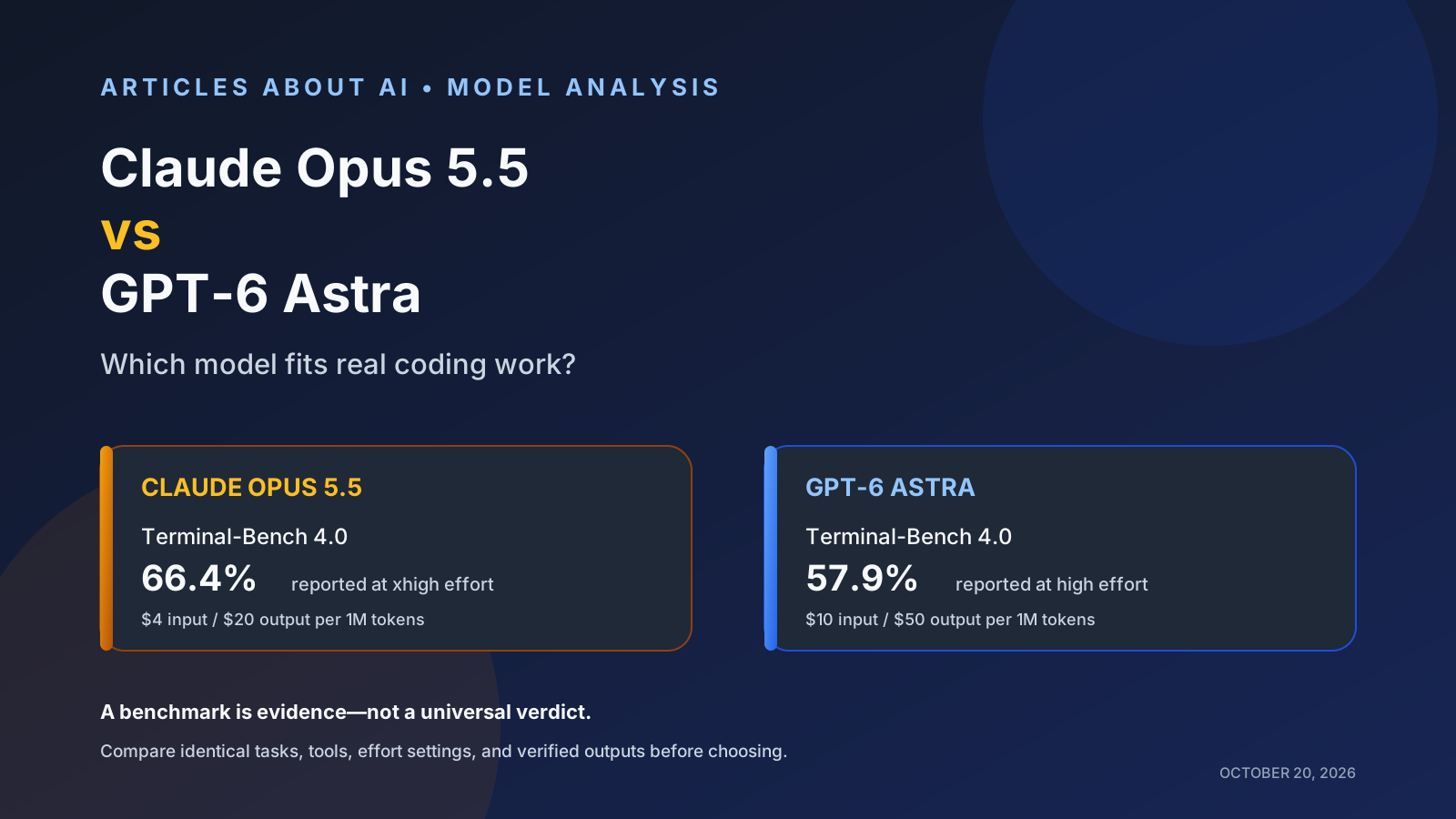
Anthropic’s official Claude Opus 5.5 benchmark page reports the following Terminal-Bench 4.0 results, with the Astra figure attributed to OpenAI:
| Model | Reported Terminal-Bench 4.0 score | Effort setting reported |
|---|---|---|
| Claude Opus 5.5 | 66.4% | xhigh |
| GPT-6 Astra | 57.9% | high |
Source: Anthropic’s official Claude Opus page.
On these reported figures, Opus 5.5 leads by 8.5 percentage points. That is a meaningful signal for command-line coding tasks—but it is not proof that Opus will outperform Astra on every programming language, repository, or engineering workflow.
There is also an important comparison caveat: the figures use different reasoning-effort settings, and Anthropic explicitly says the results reflect each model’s reported highest score. A score produced with a different effort setting or agent harness is not a perfectly controlled apples-to-apples experiment. The page also notes uncertainty around benchmark estimates and the role of production safeguards.
For that reason, use the Terminal-Bench result as one piece of evidence rather than a final ranking.
2. A separate frontend benchmark shows a much narrower gap
Startrise published a separate evaluation on October 5, 2026, using twelve frontend briefs and a combination of automated browser checks, blind model-based judging, and human review. In that specific run, Claude Opus 5.5 at high effort scored 80.2, while GPT-6 Astra scored 79.9. Both produced scorable outputs for all twelve briefs in that configuration.
Source: Startrise’s October benchmark report.
The 0.3-point difference is too small to support a broad claim that one model is categorically better at frontend development. The benchmark’s own methodology also matters: it focuses on twelve single-shot frontend tasks, not every part of professional software engineering. Its results should not be mixed directly with Terminal-Bench scores because the tasks, scoring scales, and evaluation procedures differ.
Taken together, these two sources suggest a more useful conclusion than a simple winner label: the result depends on the kind of coding task and how the model is evaluated.
3. Price per token is not the same as cost per completed task
The standard API prices listed on the vendors’ official pages are:
| Model | Input price per 1 million tokens | Output price per 1 million tokens |
|---|---|---|
| Claude Opus 5.5 | $4 | $20 |
| GPT-6 Astra | $10 | $50 |
Sources: Anthropic and OpenAI’s GPT-6 Astra model documentation.
At these listed rates, Astra’s standard input and output token prices are 2.5 times Opus 5.5’s. However, the final bill depends on how many input and output tokens the model uses, whether prompt caching applies, which tools are called, and how much rework is needed.
A model with a higher token rate can still be economical if it completes a task with substantially fewer tokens or less human intervention. Conversely, a cheaper response is poor value if it introduces defects that take an engineer an hour to find.
A fair cost comparison should therefore measure cost per accepted change, not just cost per million tokens. Include retries, tool calls, review time, and defects found after the first answer.
4. Where each model may fit best
Claude Opus 5.5: a strong starting point for terminal-oriented coding
The Terminal-Bench result and lower published API rates make Opus 5.5 a sensible first candidate for terminal-heavy tasks such as debugging, repository maintenance, refactoring, and multi-step command-line work. Anthropic also describes Opus 5.5 as designed for long-running coding agents and work across large codebases.
That positioning is useful context, but vendor descriptions are not independent proof of quality. Validate its changes with tests, linters, type checks, and code review.
GPT-6 Astra: consider the wider workflow, not just code generation
OpenAI describes GPT-6 Astra as a model for coding, computer use, research, complex reasoning, and end-to-end professional work. This broader scope may matter when a task requires more than writing code—for example, investigating documentation, navigating a web interface, or coordinating several steps before a change is complete.
Its higher standard token prices make usage measurement especially important. If Astra reduces manual review or completes a multi-stage task more reliably in your environment, that benefit may outweigh the token-price difference. Do not assume that it will; measure it.
Official reference: OpenAI GPT-6 Astra model documentation.
5. A fair test you can run on your own repository
For a decision that affects a real engineering team, run both models through the same evaluation:
- Choose representative tasks. Include a reproducible bug fix, a feature spanning multiple files, a refactor, a test-writing task, and a task that requires reading unfamiliar code.
- Start from the same clean commit. Give each model the same issue description, repository state, allowed tools, and acceptance criteria.
- Record the configuration. Note the exact model identifier, reasoning effort, context supplied, agent harness, tool permissions, and any relevant caching.
- Run the same checks. Use the project’s existing test suite, linting, type checking, and build. Add a regression test when the task calls for one.
- Review blindly where practical. Have a reviewer assess correctness, maintainability, scope control, and unnecessary changes without knowing which model produced the patch.
- Measure total cost and time. Record API charges, retries, tool calls, elapsed time, review time, and defects that survive the first pass.
- Repeat important tasks. A single successful run can be luck. Repeat tasks where feasible and report the failure rate as well as the average score.
A simple weighted scorecard can help, but keep the raw measurements visible. For example, score correctness, regression safety, maintainability, instruction following, and total cost separately before calculating an overall score. A model should not be rewarded for producing more code if that code does not pass the acceptance tests.
For more background on choosing coding workflows, see our guides to Claude Code vs Codex vs Gemini CLI and GPT-6 vs Claude Opus 5.5 for complex reasoning.
6. What this comparison cannot establish
The evidence above does not establish a universal ranking across all software development. Terminal-Bench and a frontend benchmark measure different task sets; vendor-reported numbers may use different settings; and a model’s performance can change with its agent harness, context, and available tools.
The independent frontend report is useful because it documents a specific task suite and scoring process, but it is still one evaluation from one organization—not a complete picture of production engineering. Likewise, published pricing is not a forecast of your bill.
This article does not claim that Articles About AI independently tested either model. The recommendations are an interpretation of the cited published information and should be updated as comparable evidence becomes available.
Final recommendation
For a developer choosing an AI coding model today, Claude Opus 5.5 is a reasonable first test when terminal-coding performance and token cost are priorities. GPT-6 Astra deserves a direct trial when the work depends on a broader agent workflow or when it may reduce the amount of human supervision needed.
The decisive question is not simply “Which model has the highest score?” It is: Which model produces the most reliable, reviewable change for your repository at an acceptable total cost? Run both against the same real tasks and let verified outcomes decide.