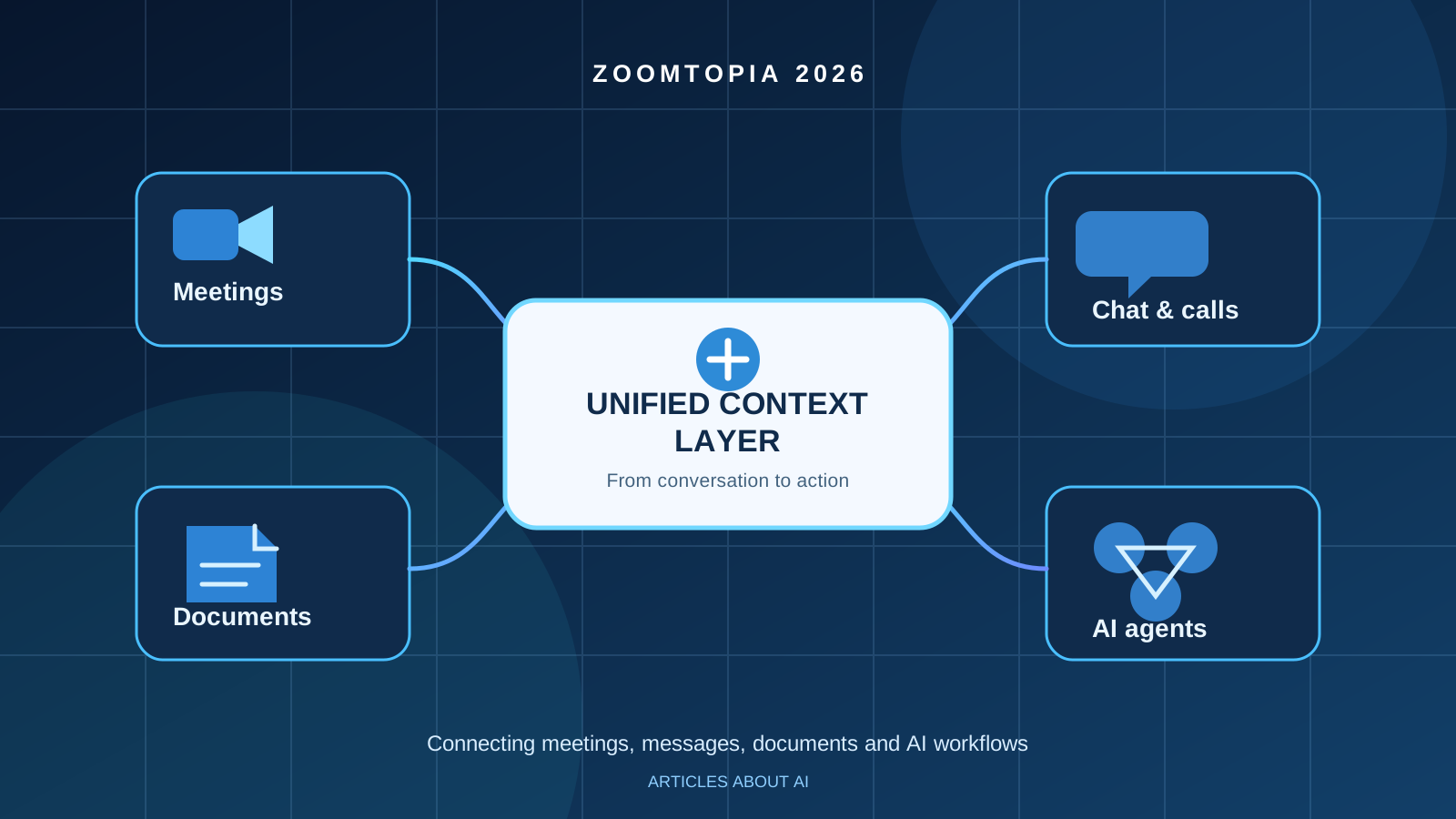
Zoom announced a new Unified Context Layer at its Zoomtopia 2026 customer conference on October 20, 2026. The company says the technology is designed to connect information from meetings, phone calls, chat conversations, documents, and supported third-party applications so that people and AI agents can use a more complete picture of work to answer questions and carry out follow-up tasks. The announcement is part of Zoom’s broader effort to turn business conversations into completed work, rather than leaving employees to manually reconstruct decisions and action items across disconnected tools. Read Zoom’s official announcement.
The news matters because enterprise AI systems are only useful when they can retrieve relevant information with appropriate permissions and connect that information to a real workflow. A meeting transcript by itself may record what was said, but it does not necessarily connect a decision to the customer record, the related document, or the task that must happen next. Zoom’s proposal is to make those pieces of context more accessible across its platform and connected services.
What is Zoom’s Unified Context Layer?
Zoom describes the Unified Context Layer as a way to bring together dynamic conversation information and more structured business knowledge. Conversation data can come from Zoom Meetings, Zoom Phone, Zoom Chat, and contact-center interactions. Related documents and connected third-party systems can provide additional context about customers, projects, decisions, and ongoing work.
The intended result is that users and AI agents can search for information and understand what happened without manually checking every meeting, message thread, and application. Rather than treating each conversation as an isolated event, the system aims to connect what was discussed, what was decided, and what needs to happen next.
This is an enterprise-context approach to AI, not simply another meeting transcription feature. Its practical value will depend on the quality of the connected sources, the permissions available to each user or agent, and how well the resulting information fits the organization’s actual workflows.
What did Zoom announce at Zoomtopia 2026?
Zoom’s October 20 announcement describes several capabilities associated with the Unified Context Layer and its wider AI strategy.
1. Search across conversations and connected applications
Zoom says its agentic search can surface answers from Zoom Meetings, Phone, and Chat, as well as more than 40 third-party applications, including ServiceNow, Workday, Google Drive, and Microsoft OneDrive. The goal is to reduce the time employees spend searching separate systems to find a decision, customer detail, or previous discussion. Zoom says this search capability is available now.
2. My Notes and automated follow-up workflows
Zoom is expanding My Notes beyond capturing meeting information. My Notes Workflows is designed to send meeting summaries into tools such as Zoom Chat and Salesforce, with templates for sales, marketing, and IT teams. Zoom said these workflows were expected in October 2026. Availability may vary as the rollout progresses, so organizations should check the product’s current status before planning a deployment.
The concept is straightforward: a meeting summary should be a starting point for the next action, not another document that someone must manually copy into a CRM or task system. Businesses will still need to review generated outputs and ensure that automated actions follow their internal approval rules.
3. ZoomMate AI Agent Teams
Zoom also highlighted ZoomMate AI Agent Teams, in which specialized agents can work on different parts of a project while a coordinating agent brings the results together for human review. Zoom lists this capability as available now in its announcement.
For teams, the potential benefit is task coordination: instead of using AI only to draft a response or summarize a meeting, an agent team can help organize several related subtasks. The announcement does not mean every business process can run unattended; the quality of the result, access controls, and human review remain important.
4. Access through APIs and Model Context Protocol
Zoom says its APIs and Model Context Protocol (MCP) servers can make supported capabilities available outside the Zoom application, including within other AI tools and agent workflows. The company also described Search & Ask APIs that can query the Unified Context Layer from supported AI environments.
This is relevant to organizations that use more than one AI assistant. Rather than requiring every employee to move between applications, integrations can bring permitted Zoom context into the tools where work is already happening. The exact capabilities depend on the integration, its configuration, and the access granted by administrators.
For more background on the integration approach, see Zoom’s official developer-platform announcement.
How could this help businesses?
The most plausible benefits are practical rather than abstract. A sales representative could look for the latest customer decision without searching several meeting transcripts. A project manager could trace an action item back to the conversation where it was agreed. A support team could use relevant interaction history to avoid asking a customer to repeat information. An AI agent could use authorized context to prepare a follow-up or update a connected workflow.
These are examples of intended use cases, not independent performance tests. The announcement does not establish that every organization will save a specific amount of time or achieve the same productivity improvement. Results will depend on data quality, adoption, system integrations, and the complexity of each workflow.
The announcement also reflects a wider enterprise AI trend: connecting models to company information and tools so they can do more than generate text. For related coverage, read our guide to enterprise AI agent workflows and our AI API technology overview.
Security, privacy, and administrative controls
Connecting conversation history and business systems creates governance questions. Organizations should determine which data can be accessed, which users and agents can retrieve it, how permissions are inherited, and what records are retained. Zoom says the Unified Context Layer includes configurable settings and controls to help manage access, and its wider Zoomtopia announcements include additional AI management and security capabilities.
Those controls should be evaluated against each organization’s security, privacy, retention, and regulatory requirements. Before enabling integrations, administrators should review the relevant documentation, test permissions with representative accounts, and confirm how generated summaries and agent actions are logged. AI-generated content can omit important details or misinterpret a conversation, so consequential decisions should retain an appropriate human review step.
Zoom’s announcement is a product description, not a substitute for a security assessment or legal advice. Businesses should verify the precise features available to their plan and region before relying on them in production.
How is this different from a standard AI meeting assistant?
A conventional AI meeting assistant typically focuses on tasks such as transcription, summaries, and action-item extraction. Zoom’s stated direction goes further by connecting meeting information with chat, phone interactions, documents, third-party systems, and agents that can help continue the work.
The distinction is the context and workflow layer around the model. A summary tells an employee what happened in one meeting. A connected context system aims to help answer questions across multiple interactions and move information into the next approved step. That broader approach can be useful, but it also increases the importance of access control, source accuracy, and clear boundaries on what agents are allowed to do.
What is available now, and what is still rolling out?
Zoom’s October 20, 2026 announcement marks some capabilities as available now and others as expected in later months. For example, Zoom says agentic search and ZoomMate AI Agent Teams are available now, while My Notes Workflows were expected in October 2026 and some meeting-capture features were scheduled for November or December.
These labels should not be treated as a guarantee that every feature is enabled for every customer. Availability can depend on subscription, configuration, region, and rollout timing. Businesses should consult Zoom’s current product documentation or administrator console to confirm access.
What the announcement means for enterprise AI
Zoom’s Unified Context Layer is an attempt to address a central challenge in workplace AI: the information needed to complete a task is often spread across multiple conversations and applications. By connecting those sources and making supported context available to AI agents and workflows, Zoom aims to shorten the path from discussion to action.
The announcement is significant as a product direction, but its real value will be determined by implementation. Organizations will need reliable source data, appropriate permissions, useful integrations, and measurable ways to assess whether workflows are faster and more accurate. The strongest deployments will treat AI as a tool for reducing repetitive work while keeping people accountable for important decisions.
For continuing coverage, explore our latest AI news, practical guides, and analysis of enterprise AI tools at Articles About AI.
Official sources
- Zoom: Unified Context Layer and Zoomtopia 2026 announcements
- Zoom: Unified Context Layer, My Notes, and ZoomMate capabilities
- Zoom: Developer platform, AI Services APIs, and MCP expansion
SEO keywords: Zoom Unified Context Layer, Zoom AI announcement October 2026, Zoomtopia 2026 news, Zoom AI news today, Zoom artificial intelligence, Zoom enterprise AI, Zoom AI agents, AI agents for business, enterprise AI workflows, AI meeting assistant, AI meeting summaries, meeting transcription AI, conversation intelligence platform, AI-powered meeting notes, Zoom My Notes, ZoomMate AI Agent Teams, Zoom Workplace AI, business conversation intelligence, enterprise productivity AI, AI workflow automation, AI-powered collaboration tools, AI search across business apps, agentic search, enterprise knowledge search, AI context layer, unified business context, Model Context Protocol, Zoom MCP servers, Zoom APIs for AI, AI integrations for businesses, generative AI in the workplace, enterprise software AI, business process automation, AI productivity tools, AI for sales teams, AI for customer service, October 20 2026 AI news, latest artificial intelligence news, Articles About AI.