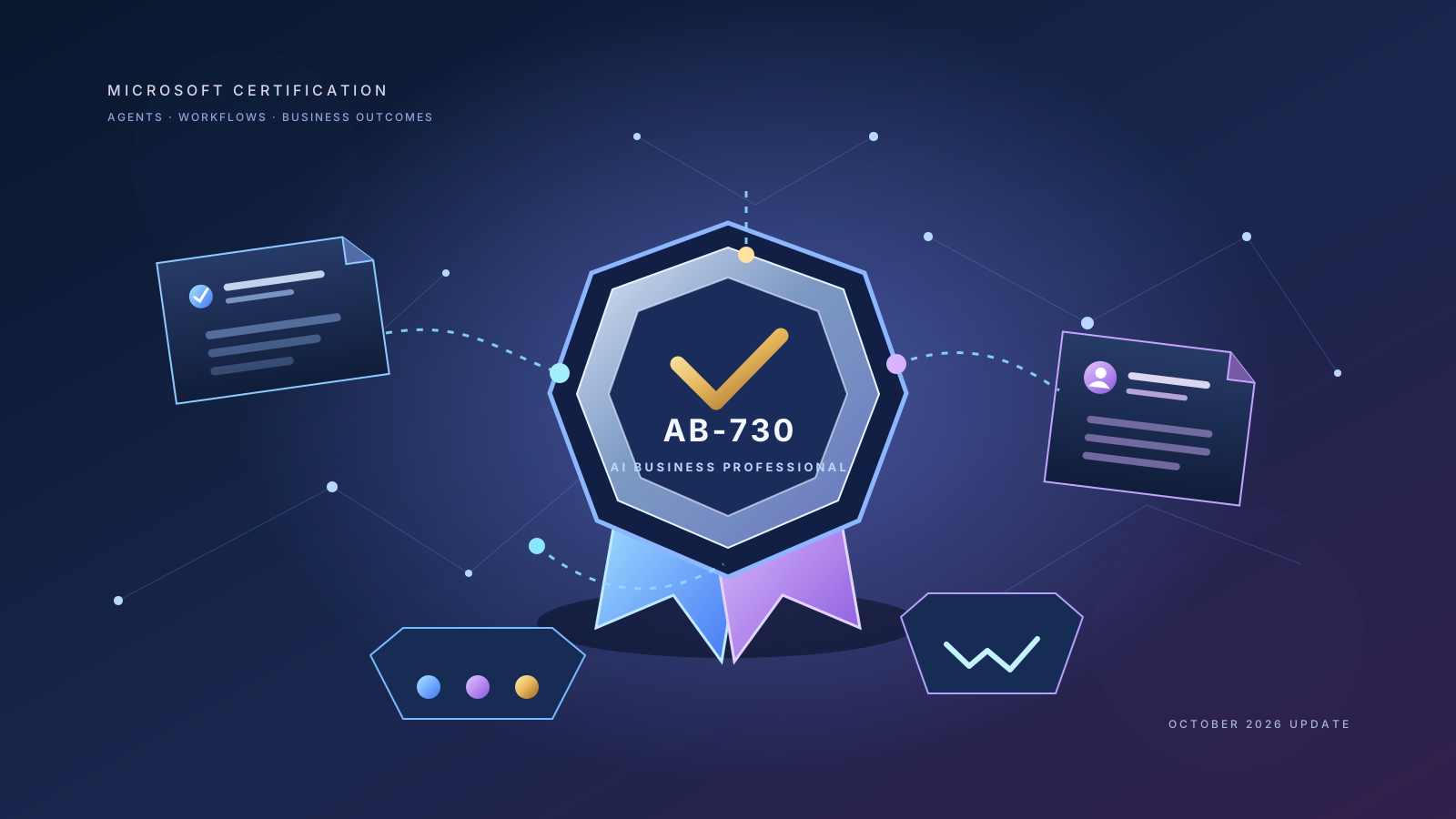
Microsoft’s AB-730: AI Business Professional exam has a revised skills outline effective October 20, 2026. The updated study guide introduces a dedicated area for driving business outcomes with agents, including selecting prebuilt Microsoft 365 Copilot agents and performing business tasks with Microsoft Copilot Cowork. If you are preparing for AB-730, the most useful next step is to rebuild your study plan around the current exam objectives—not rely on an older checklist.
This guide explains what changed, how to prioritize the new material, and how to turn the official skills outline into a practical study plan. It is based on Microsoft’s published exam guide; always check the official page again before booking an exam because objectives and product availability can change.
What changed in the AB-730 exam on October 20, 2026?
Microsoft’s official study guide labels the current skills as those measured from October 20, 2026. Its change log identifies several major changes, including new agent-related objectives and revisions to existing Copilot skills.
The most important change for candidates is the new skill area Drive business outcomes by using agents, weighted at 20–25% of the exam. It includes two practical areas:
- Select and apply prebuilt Microsoft 365 Copilot agents. Recognize when an existing agent suits a business workflow, choose between a prebuilt agent and a custom one, apply an agent in supported Copilot experiences, and filter chats by agent.
- Perform business tasks by using Microsoft Copilot Cowork. Understand multi-step work, how Cowork uses skills, how to delegate a task, how to review its plan and results, and how to manage scheduled tasks or prompts.
The revised guide also changes the wording and weighting of other domains, including generative AI fundamentals, prompts and chats, and business content and collaboration. That means candidates should compare the full current skills outline with any course or notes they already use rather than studying only the new Cowork section.
Official reference: Microsoft Learn — Study guide for Exam AB-730: AI Business Professional.
The updated exam domains and what to study
Use the official percentages as a guide to allocating study time. The full page contains the definitive objective list; the summary below highlights the practical preparation implications.
1. Understand generative AI fundamentals — 25–30%
Continue reviewing how generative AI works across Microsoft 365 experiences, how context affects responses, and when to use Copilot Chat, agents, or Cowork. The guide also emphasizes responsible AI and data protection, including inaccuracies, prompt injection, over-reliance, verification, and sensitive information.
For practice, take a common business task—such as drafting a meeting summary—and identify which Copilot experience fits best, what data it needs, what could go wrong, and how a person should verify the result.
2. Manage prompts and chats by using Microsoft 365 Copilot — 20–25%
Review prompt creation and management, interpretation of AI-generated content, and collaboration workflows. Be ready to explain how a prompt should be evaluated against a business goal, not merely whether it produces fluent text.
Practice refining a prompt with a clear role, context, constraints, desired output, and verification criteria. Then compare the output against the source information and correct any unsupported claims.
3. Drive business outcomes by using agents — 20–25%
This is the new domain to pay particular attention to. Learn to distinguish a prebuilt agent from a custom agent, select a suitable agent for a workflow, and understand how a task is handed off and reviewed.
For Copilot Cowork, focus on the lifecycle of a multi-step task: define the outcome, delegate the appropriate work, inspect the plan and progress, review the final result, and understand where human approval is necessary. Know the security considerations and documented limitations described in Microsoft’s learning materials.
4. Manage business content and collaboration
The updated guide also covers drafting and analyzing business content, meetings, collaboration, and Microsoft 365 Copilot experiences such as Pages and meeting support. Check the current official guide for the exact objectives and weighting; do not use a previous edition’s headings as the final checklist.
Useful related practice includes our tutorial on using Microsoft Copilot in Excel for formulas, data analysis, and charts and our guide to creating AI images, infographics, and visual stories with Microsoft Copilot.
How to prepare for the new Copilot Cowork objectives
Do not prepare for an agent-related objective by memorizing product names alone. The exam guide points to practical judgment: matching a tool to a workflow, delegating work, understanding limitations, and checking results.
Use this sequence to build your own hands-on practice:
- Choose a realistic business task. For example, prepare a project update from a small set of approved meeting notes and documents.
- Decide which experience fits. Explain whether a standard Copilot chat, a prebuilt agent, or Cowork is the most appropriate choice and why.
- Define the expected result. Specify the deliverable, the source material that may be used, and any constraints.
- Review the plan before relying on it. Where the interface provides a plan or progress view, check whether the proposed steps match the intended outcome.
- Validate the output. Compare names, dates, numbers, and recommendations with the original sources. Do not assume an answer is correct because it sounds confident.
- Check permissions and data handling. Use only approved data and understand which actions or connected services require additional permission.
- Record the lesson. Write a short note explaining why you chose that Copilot experience, what you verified, and what you would do differently next time.
These exercises build useful familiarity with the concepts in the guide. They are not official exam questions and should not be presented as guaranteed predictions of what will appear on the test.
Prebuilt agent or custom agent: how to reason through the choice
The revised AB-730 outline expects candidates to recognize when a prebuilt agent can improve a workflow and when a custom agent might be more appropriate. Use the business need—not novelty—as the starting point.
A prebuilt agent is worth evaluating when its supported capabilities closely match the task, it is available in the relevant environment, and its permissions and behavior meet organizational requirements. Consider a custom agent only when the workflow requires capabilities or rules that an existing option does not adequately support, and when the organization has the ability to configure and govern it.
Before choosing either option, ask:
- Is the task well-defined and repeatable?
- Does an available agent support the required workflow?
- What information can the agent access, and under whose permissions?
- What should a person review before the result is used or shared?
- How will success and errors be measured?
The goal is to select an appropriate tool and manage the outcome responsibly—not to assume that a custom agent is always better.
Responsible AI, privacy, and verification still matter
The updated study guide continues to emphasize responsible AI and data protection. In practical terms, candidates should understand that AI-generated content can be inaccurate, prompts and retrieved content can introduce risks, and sensitive information requires appropriate handling.
For every practice task, get into the habit of checking important claims against source material, limiting access to the information needed, and keeping human review in the workflow when decisions or external actions matter. Our broader guide to the biggest AI challenges in 2026 covers related risks and mitigations. If Copilot is not behaving as expected during practice, see our Microsoft Copilot troubleshooting guide.
A practical seven-day AB-730 study plan
This schedule is a suggested structure, not an official Microsoft plan. Adjust it to your current knowledge and the time you have available.
| Day | Focus | Practical output |
|---|---|---|
| 1 | Read the current official AB-730 guide | A checklist of every current skill area |
| 2 | Generative AI fundamentals and Copilot experiences | A comparison of chat, agents, and Cowork for sample tasks |
| 3 | Prompt creation, chats, and content review | Three prompts revised against explicit business goals |
| 4 | Prebuilt agents and agent selection | A decision note explaining which workflow fits a prebuilt agent |
| 5 | Copilot Cowork and multi-step tasks | A sample task plan with checkpoints and a reviewed result |
| 6 | Meetings, collaboration, privacy, and verification | A checklist of permissions, source checks, and human review |
| 7 | Review weak areas and use official practice resources | A final gap list mapped to the current exam objectives |
Prioritize the domain weightings shown on Microsoft Learn, but do not ignore smaller domains. A study plan is useful only if it covers the complete current outline.
Official resources to use before booking the exam
Use Microsoft’s own materials as the source of truth for current objectives, exam policies, and preparation options:
- AB-730 study guide and change log — the main checklist for the current skills measured.
- Microsoft Certified: AI Business Professional (AB-730) — certification details and preparation resources.
- Microsoft Learn — search for relevant learning paths and modules, and confirm that the material aligns with the current exam guide.
- Microsoft exam sandbox — explore the general exam experience before test day.
Third-party courses and notes can help explain concepts, but compare their publication dates and topic lists with the current Microsoft guide. Older resources may still teach useful fundamentals while omitting the revised agent and Cowork objectives.
Frequently asked questions
When do the revised AB-730 objectives take effect?
Microsoft’s study guide states that the current skills are measured as of October 20, 2026. Check the official page for any later revisions before you sit the exam.
What is the most important new AB-730 topic?
The new domain, “Drive business outcomes by using agents,” carries 20–25% of the exam and includes prebuilt Microsoft 365 Copilot agents and business tasks performed with Microsoft Copilot Cowork.
Should I use an older AB-730 study guide?
Use older material only as supplementary background. Compare it against the current official study guide and update your checklist to include every current objective, especially the new agent-related skills.
Does this article contain real exam questions?
No. This is a study-planning guide based on Microsoft’s published objectives, not a dump of exam questions or a claim about exact future questions.
Where should I confirm the exam details?
Use the official Microsoft AB-730 exam page and its linked study guide. These pages take precedence over third-party summaries.
Final takeaway
The October 20, 2026 AB-730 update makes agent-based business workflows and Microsoft Copilot Cowork explicit preparation priorities. Start with Microsoft’s current skills outline, map each objective to a hands-on exercise, and practice choosing the right Copilot experience, reviewing multi-step work, and validating outputs responsibly. That approach is more reliable than depending on an outdated study checklist or trying to guess the exact exam questions.