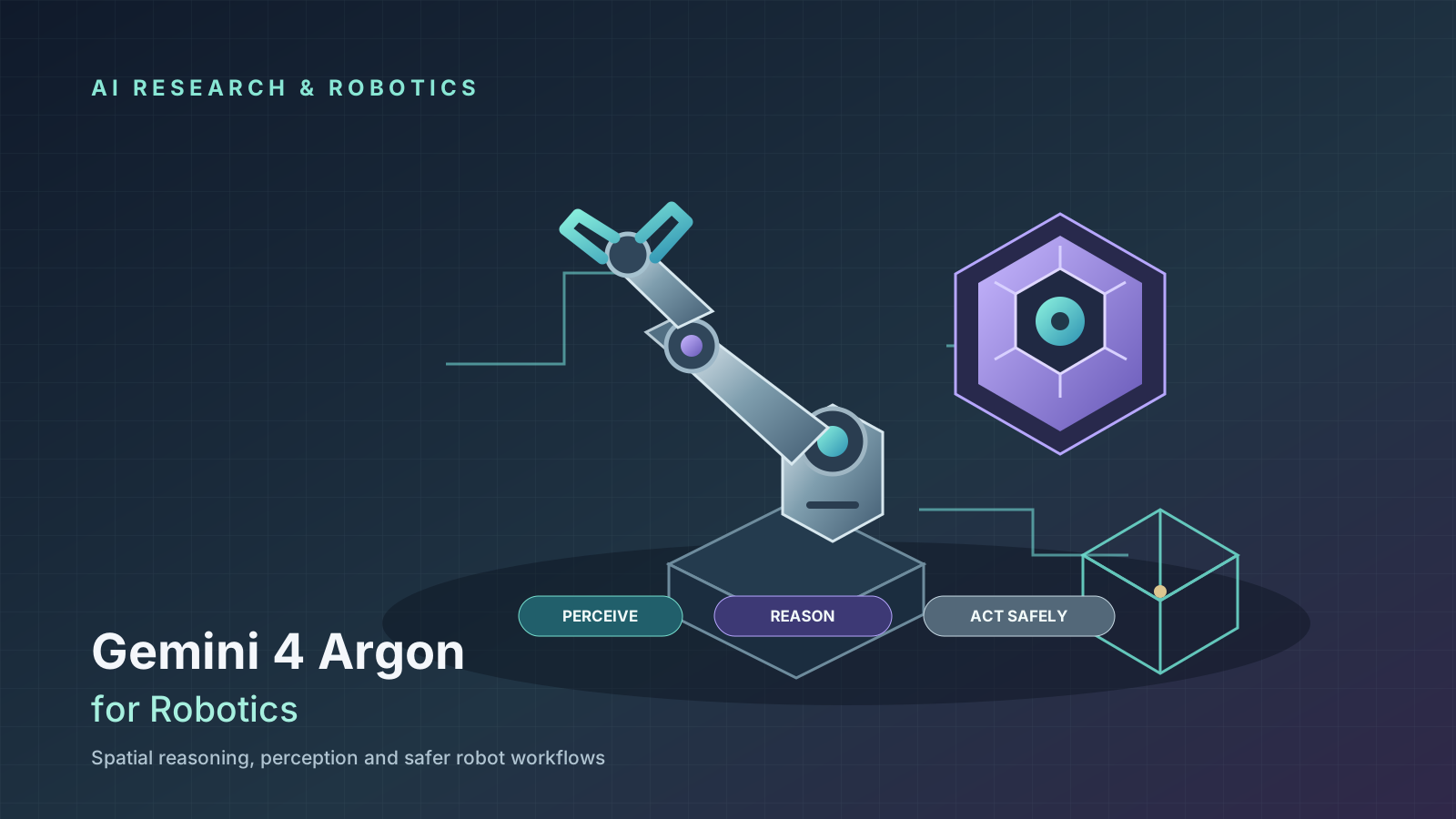
Google is positioning Gemini 4 Argon as a model for complex, multi-step reasoning, and robotics is one of the research areas where that ability may be useful. In its October 2026 developer communications, Google described Argon as supporting work involving multi-view video, three-dimensional geometry, physical interactions, simulation, and robot-control research. Those areas matter because a robot must do more than recognize an object in a picture: it needs to interpret a changing scene, reason about space, anticipate what an action might do, and operate within strict physical and safety constraints.
The opportunity is significant, but it needs to be described precisely. Gemini 4 Argon is a general-purpose model that can contribute to parts of a robotics workflow; it is not, by itself, a complete robot operating system, a certified safety controller, or a guarantee that a physical action will succeed. A useful prototype usually combines a model with perception systems, robot-specific software, simulation, motion planning, hardware interfaces, and independent safety mechanisms.
This guide explains Google’s published direction for Argon in robotics, identifies realistic developer experiments, and lays out a cautious path from a software-only prototype to a controlled physical test. It also distinguishes announced capabilities from results a team should validate for itself.
What Google Has Announced
Google’s developer material, Gemini 4 Argon for Robotics, describes research focused on embodied intelligence: the ability to connect information about the physical world with reasoning about possible actions. The announcement discusses multi-view video, 3D geometry, physical interactions, telemetry, simulation, and robotic control as areas where Argon may help researchers and developers.
These are important building blocks, but they are not interchangeable capabilities. Understanding a video sequence is different from estimating a robot’s precise pose. Reasoning about a 3D scene is different from generating a collision-free trajectory. Suggesting an action is different from sending motor commands that are stable, timely, and safe. A robotics project must identify which part of the pipeline the model is intended to support.
Google’s broader Gemini 4 Argon API documentation describes the model’s input modalities and general interface. Availability of a modality in a general model API does not mean every robotics-specific workflow, sensor format, control interface, or hardware integration is built in. Developers should verify the exact endpoint, model features, limits, and product availability before committing to an architecture.
Why Robotics Needs More Than Visual Recognition
A robot operates in an environment where geometry, timing, contact, uncertainty, and consequences all matter. A camera may show a cup on a table, but a robot must also estimate where the cup is relative to its gripper, whether the gripper can reach it, whether another object blocks the path, and how the cup might move when touched.
A useful robotics system commonly separates several tasks:
- Perception: interpreting camera images, depth data, joint positions, and other sensor readings.
- State estimation: estimating the robot’s position, the state of its joints, and the location or motion of objects.
- World representation: maintaining a usable representation of geometry, obstacles, and task-relevant objects.
- Planning: deciding on a sequence of steps and calculating feasible movements.
- Control: converting a validated plan into timely commands for actuators.
- Safety supervision: checking limits, collision risks, emergency stops, and whether an action remains within the approved operating envelope.
A model such as Argon may help with semantic interpretation, high-level task decomposition, or reasoning over observations and documentation. It should not be assumed to replace the specialized systems responsible for precise state estimation, trajectory planning, low-latency control, and safety interlocks.
This division of responsibility is useful even in a small research project. It allows developers to test whether model-assisted reasoning improves a task without giving the model direct and unrestricted authority over physical hardware.
Potential Use Case 1: Understanding Multi-View Video
Robotics experiments often collect video from several camera positions or from a sequence of observations. A model that can interpret multi-view visual information may help a developer summarize what changed, identify objects relevant to a task, or compare the scene before and after a simulated action.
For example, a research team might record a tabletop scene from a fixed camera and a wrist-mounted camera. The model could be asked to describe which objects are visible, which actions appear to have occurred, and what evidence is uncertain. The result could help an engineer label demonstrations or create a natural-language summary for a test report.
However, natural-language scene descriptions should not be treated as calibrated measurements. If a robot needs a cup’s exact coordinates or a millimeter-level grasp pose, use the appropriate calibrated vision, depth, localization, and grasp-estimation tools. The model’s description can provide context, but the robot’s geometric pipeline must produce and validate the quantities required for motion.
A sound experiment compares the model’s interpretation against ground-truth annotations or a trusted perception pipeline. Track missed objects, incorrect relations, uncertainty handling, and how often a human must correct the output. Include clutter, occlusion, reflections, unusual lighting, and objects not represented in the prompt.
Potential Use Case 2: Reasoning About Three-Dimensional Geometry
Three-dimensional reasoning matters when a robot must understand the relationships between objects, surfaces, obstacles, and its own reachable workspace. Argon’s announced robotics direction includes 3D geometry and physical-world reasoning, but developers should verify what the available product interface can actually accept and return.
A prototype might provide a scene description, a rendered simulation view, or structured geometry generated by a trusted perception system. The model could help interpret a task such as, “Move the blue block to the empty tray without disturbing the red block,” then propose a high-level sequence: identify the target, check for obstructions, move to a pre-grasp pose, grasp, lift, and place.
The proposed sequence is not a motion plan. A motion planner must calculate feasible joint trajectories, account for robot kinematics, check collisions, and respect joint and velocity limits. The task should fail safely if the geometric representation is incomplete or the model proposes an impossible movement.
For evaluation, construct scenes with known object positions and obstacles. Ask the model to produce a structured task plan, then run that plan through deterministic validation checks in simulation. Measure invalid steps, omitted constraints, unnecessary movements, and the rate at which the system correctly asks for additional information.
Potential Use Case 3: Turning Instructions Into Task Plans
Robotics often begins with instructions written by a person: sort objects, inspect a part, move a component to a station, or retrieve an item from a known location. A reasoning model may help translate that instruction into a sequence of smaller, auditable actions.
For instance, a warehouse prototype might receive: “Move the labeled container to the inspection area and leave fragile items undisturbed.” A high-level planner could produce a list of candidate steps, required observations, and conditions that must be true before continuing. A separate task executive would then check whether each action is supported by the robot’s available skills.
This is a useful boundary for model-assisted robotics. The model can suggest a plan in a constrained schema, while the task executive decides whether each action is valid and available. If the model requests a nonexistent skill, identifies an ambiguous target, or omits a safety condition, the executive should reject the plan or ask for clarification.
Avoid accepting arbitrary natural-language output as executable code or direct actuator commands. Use a small, enumerated set of allowed actions, typed parameters, validation rules, timeouts, and explicit failure states. Require confirmation for actions that could damage equipment, endanger people, or move outside the test area.
Potential Use Case 4: Connecting Simulation With Reasoning
Simulation gives robotics teams a place to test ideas before using physical equipment. A model may help describe a scenario, generate a candidate sequence of actions, explain why a simulated attempt failed, or propose a new experiment. Argon’s published robotics direction references physics simulation and embodied reasoning, but the exact integration remains dependent on the tools and APIs available to a developer.
A practical architecture keeps the simulator in charge of the physical state. The model receives a limited summary or selected observations, proposes a high-level next step, and the simulation environment validates and executes that step. The result is then summarized back to the model or recorded for later evaluation.
For example, if a simulated arm cannot reach a target, the model might suggest checking the target pose, obstacle placement, or robot configuration. A deterministic diagnostic tool should provide the actual joint limits, collision report, and planner error. The model can help organize hypotheses, but it should not invent simulator telemetry or claim a fix worked without a new run.
Simulation is necessary but not sufficient. Sim-to-real differences can arise from friction, compliance, sensor noise, calibration, latency, lighting, payload variation, and unmodeled contact dynamics. A successful simulated run is evidence about the simulation, not proof of physical safety.
Potential Use Case 5: Reviewing Robot Telemetry and Test Results
Robotics systems produce logs: timestamps, sensor status, joint positions, controller states, planning failures, battery conditions, and task outcomes. A model may help turn a long test log into a concise report, identify repeated error messages, or propose which questions an engineer should investigate next.
A safe workflow provides only the telemetry needed for the investigation and preserves access to the original records. The model’s report should link each claim to a timestamp, log line, or measurement. If the input does not contain evidence for a suspected cause, the output should mark it as a hypothesis rather than a fact.
This can be useful for triage, but a generated summary must not replace formal incident analysis or safety reporting. A model may miss rare events, confuse similar error messages, or attribute a failure to the wrong subsystem. Validate summaries against source logs and test them with deliberately misleading or incomplete records.
How Developers Can Start
The most reliable starting point is a software-only experiment that tests one narrow question. Do not begin by connecting a newly configured model directly to a robot arm, mobile platform, or other moving system. First establish the model’s actual access path, verify supported inputs, and measure the quality of its outputs in a controlled environment.
Step 1: Verify model and product access
Start with Google’s official Gemini 4 Argon API documentation and the current Google developer announcement about robotics. Confirm the model identifier, supported input types, account eligibility, region, billing, and the current terms for your intended interface.
Do not assume that a robotics research demonstration means there is a turnkey robotics SDK or a supported direct connection to your hardware. If a specific capability is available only in a research program, partner environment, or limited rollout, plan around the access actually granted to your team.
If you are new to the API, our Gemini 4 Argon API setup guide covers the general developer integration path. Follow current official documentation if SDK imports, model limits, or request patterns have changed.
Step 2: Define a task with measurable outcomes
Choose a task that does not require immediate physical action. Examples include describing a recorded manipulation attempt, classifying a known simulator failure, or producing a constrained plan for a static scene. Define what a correct answer looks like before testing the model.
For a task-planning test, the expected output could be a list of allowed action names, required object identifiers, preconditions, and a completion condition. Do not accept a plan that invents an object, ignores an obstacle, or skips a required verification step.
Write down the baseline: how a human or existing planner performs the task, what errors occur, and how long the process takes. This will help determine whether the model adds measurable value rather than simply producing readable prose.
Step 3: Keep the first integration read-only
Use a local script or research harness to submit a small, non-sensitive observation and receive a proposed description or plan. Store the input, model response, model/version details, and evaluation result so that the experiment can be reproduced.
For the first iteration, do not give the model permission to control a robot, execute shell commands, change simulator configuration, or write to production systems. If you later connect tools, expose only the minimum read-only functions needed for the experiment and validate their inputs.
Step 4: Validate output with deterministic software
Convert the model’s output into a structured representation and validate it before using it. Check that object IDs exist, actions belong to an allowed list, numeric values are within bounds, preconditions are satisfied, and the sequence does not violate known constraints.
If the model returns an invalid or ambiguous plan, reject it and record the failure. Do not silently guess what the model intended. A robust system must handle refusal, timeout, malformed output, unavailable model access, and incorrect reasoning as ordinary failure cases.
Step 5: Evaluate in simulation
Run approved actions through a simulator with collision checking, joint-limit enforcement, and explicit task boundaries. Start with simple scenes and increase complexity only after the model-assisted workflow meets the test criteria.
Record success rate, collision or constraint violations, number of replans, completion time, and human interventions. Compare the model-assisted system with a baseline that uses your existing planner or hand-authored task sequence. Include difficult scenes and negative examples, not just demonstrations selected because they work.
Step 6: Consider a physical test only after review
A physical test should be a separate project milestone, not the automatic next step after a successful simulation. Have robotics and safety specialists review the system, confirm the operating envelope, test emergency-stop behavior, and verify that the model cannot bypass the low-level controller’s safeguards.
Begin in a controlled area with low speed, limited force, a clear exclusion zone, and a trained operator present. Use hardware interlocks and an independent safety controller where appropriate. Never rely on the language model as the sole mechanism for collision avoidance, emergency stopping, or personnel protection.
A Reference Architecture for Model-Assisted Robotics
A cautious architecture can be represented as a sequence of separate responsibilities:
- Sensors and perception produce observations and calibrated measurements.
- State estimation and world model represent the robot, objects, obstacles, and uncertainty.
- Gemini 4 Argon interprets context or proposes a high-level task plan.
- Plan validator checks the proposed plan against an allowlist, object state, permissions, and task constraints.
- Motion planner and controller calculate and execute feasible movement using robot-specific algorithms.
- Independent safety layer enforces emergency stops, speed and force limits, workspace boundaries, and hardware protections.
- Telemetry and review record what happened and compare the result with the expected outcome.
The model should not be able to skip the validator or override the safety layer. This separation reduces the consequences of a hallucination, prompt injection, stale observation, or malformed tool response. It also makes failures easier to diagnose because each component has a defined contract.
If the model is connected to a tool-using agent, treat camera descriptions, task instructions, documents, and external data as potentially untrusted inputs. A label or message seen in the environment must not be allowed to redefine system permissions. Validate tool arguments, limit tool scope, and require human approval for actions with meaningful physical consequences.
Limitations Developers Should Expect
Latency and determinism. A remote model request can have variable latency and may fail due to network or service issues. Many low-level control loops need predictable timing and should remain in conventional real-time controllers rather than waiting for a language-model response.
Perception errors. The model may misunderstand a scene, miss a small object, or describe a spatial relation incorrectly. Calibrated sensors and task-specific perception systems remain important.
Physical grounding. Language can describe an action without representing the precise forces, tolerances, joint states, and contact mechanics needed to perform it safely. Physical parameters must come from suitable models, sensors, and validated controllers.
Tool and integration limits. General model support does not guarantee a ready-made connector for every robot, simulator, camera, or middleware stack. Developers must check the current supported interfaces and implement integration boundaries.
Evaluation gaps. A strong result on a demonstration or benchmark may not generalize to different hardware, lighting, objects, tasks, or environments. Validate on representative cases and document failure rates.
Security and privacy. Sensor feeds, maps, telemetry, and recorded video may contain sensitive information. Limit collection, remove unnecessary identifiers, control access, and verify that the selected product and account are appropriate for the data being processed.
How to Judge Whether Argon Helps
The right evaluation should focus on the system-level outcome, not just whether the model’s explanation sounds convincing. Choose metrics that match the task. For scene understanding, measure object and relation accuracy against annotations. For high-level planning, measure valid-plan rate, missing preconditions, and recovery from ambiguous instructions. For telemetry summaries, measure factual accuracy and whether every material claim can be traced to a source record.
For simulated or physical tasks, record completion rate, collision events, constraint violations, time to completion, number of human interventions, and the cost of failures. Evaluate the model against a baseline and report the exact test conditions. A workflow that succeeds more often but requires much more human correction or adds unacceptable latency may not be an improvement.
Include failure cases deliberately. Test occluded objects, unexpected obstacles, ambiguous instructions, stale state, missing telemetry, invalid object IDs, and requests that exceed the robot’s capability. A dependable system should refuse or request clarification when the evidence is inadequate rather than fabricate certainty.
What This Means for Robotics Teams
Gemini 4 Argon makes robotics a promising area to explore for model-assisted reasoning, especially where a system must interpret visual context, organize multi-step tasks, and help engineers work with complex logs or simulations. But its value depends on the integration: the model must be connected to reliable observations, constrained tools, deterministic validation, and a safety architecture that remains independent of the model.
For research teams, the sensible next step is a small reproducible experiment with a clear baseline. For product teams, it is a careful assessment of latency, privacy, reliability, hardware integration, and operating risk. For anyone working with physical robots, the rule remains that a generated plan is a proposal until validated by the systems and people responsible for execution.