
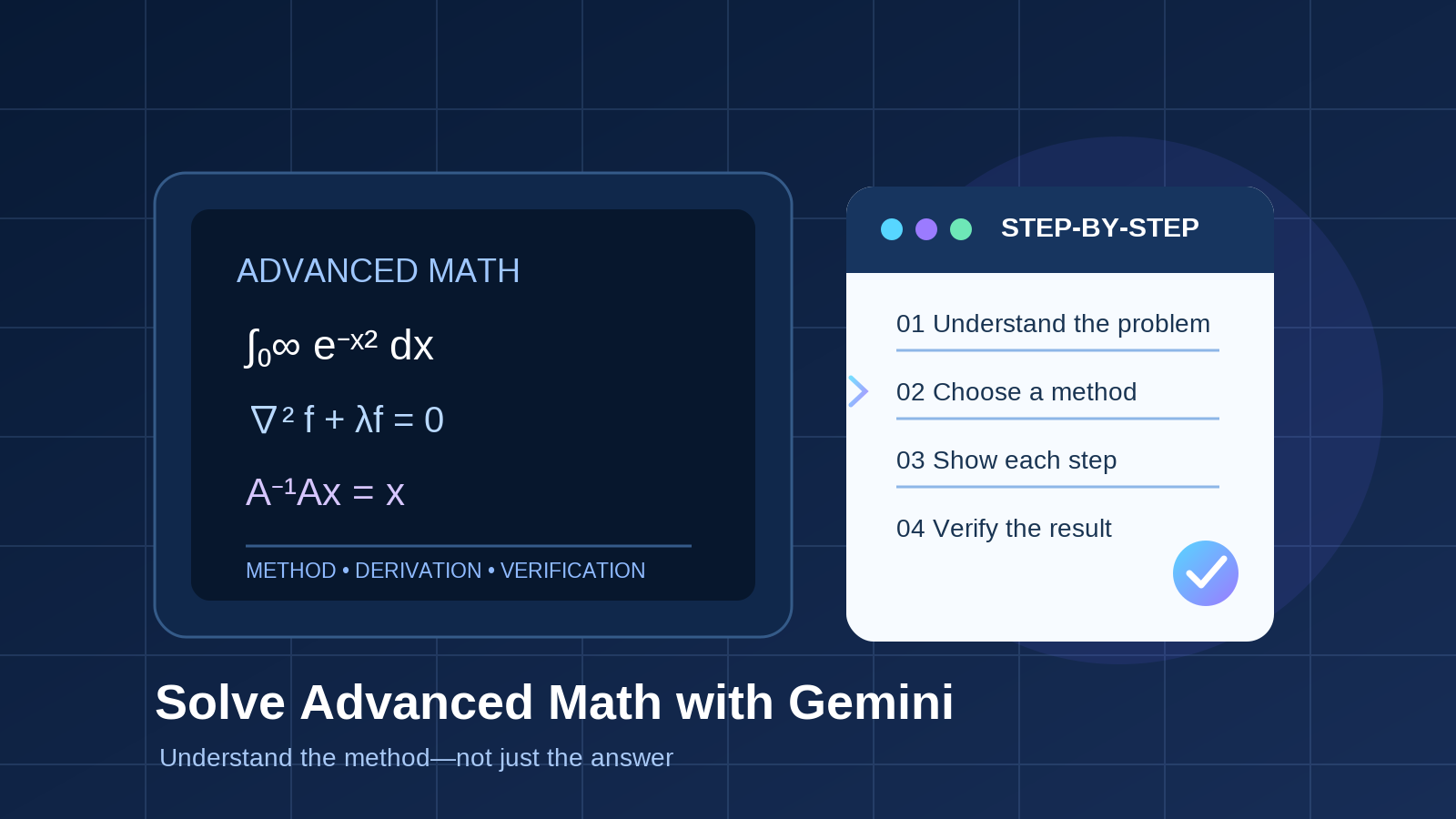
Advanced mathematics problems are often difficult not because of a single calculation, but because they require choosing the right method, connecting several concepts, and checking whether each step is valid. Gemini can help you work through these challenges by explaining a problem, proposing a solution strategy, showing intermediate steps, and asking questions that test your understanding.
This guide explains how to use Gemini to solve advanced math problems step by step across calculus, linear algebra, differential equations, probability, optimization, and mathematical proofs. The goal is to use Gemini as a learning assistant—not simply as a calculator that returns a final answer.
Gemini’s interface, model options, and learning features may vary by account, region, subscription, and rollout. When available, use a reasoning-oriented model or Guided Learning for problems that require deeper explanation. Always verify important calculations and proof steps.
What Gemini can help with in advanced mathematics
Depending on the problem and the tools available in your Gemini account, it can help you:
- Interpret a problem statement and identify what is given and what must be proved or calculated.
- Choose a suitable mathematical method and explain why it applies.
- Break a long derivation into smaller steps.
- Explain unfamiliar definitions, notation, and theorems.
- Solve equations and simplify expressions while showing intermediate work.
- Explore alternative methods and compare their advantages.
- Check a proposed solution for algebraic, logical, or computational errors.
- Generate similar practice problems to help you learn the technique.
It is particularly useful when you provide the full problem, relevant assumptions, and the level of mathematics you are studying.
Step 1: Open Gemini and choose an appropriate reasoning mode
Go to Gemini and start a new conversation. If your model picker offers options designed for reasoning or complex tasks, select one for advanced mathematics rather than the fastest option. Feature names and access can change, so use the options currently shown in your account.
For a learning-focused explanation, look for Guided Learning or the learning-related tool available in the Gemini interface. Google’s documentation describes Guided Learning as an experience that helps users work through topics step by step with questions and explanations. If it is unavailable, you can recreate the workflow in a regular chat by instructing Gemini to tutor you interactively.
Step 2: Enter the problem clearly
For a text problem, paste the complete statement. Include the definitions, constraints, and any conditions that might affect the solution.
For handwritten problems, upload a clear photo or screenshot if image input is supported in your account. Make sure the image includes the entire question, all symbols, and any diagram. For complex notation, type the expression separately to reduce transcription errors.
Use this prompt before asking for a full solution:
Read the following advanced mathematics problem carefully. Restate it using precise mathematical notation. List the known information, assumptions, unknown quantities, and the mathematical concepts that may be relevant. Do not solve it yet. If any notation or part of the problem is ambiguous, ask me to clarify.
This preliminary step can reveal whether Gemini has interpreted the question correctly.
Step 3: Ask for a solution plan before the derivation
One of the most useful habits is separating strategy from execution. A model may start calculating immediately, even when a different technique would be shorter or more appropriate.
Prompt:
Solve this problem at the level of an advanced university mathematics course. Before calculating, outline the solution strategy. Identify the theorem, definition, substitution, algorithm, or technique you intend to use, explain why it applies, and mention any conditions that must be checked. Wait for my approval before proceeding with the detailed solution.
Review the proposed approach. If it uses a theorem, ask Gemini to state the theorem and its hypotheses. If it proposes a substitution, ask why that substitution is useful. If several methods are possible, request a comparison.
Step 4: Request a step-by-step derivation
After you understand the strategy, ask Gemini to work through the solution without skipping important algebra or reasoning.
Now solve the problem using the plan we reviewed. Show each mathematical step in order. For every transformation, state the rule, identity, theorem, or reasoning that justifies it. Keep intermediate expressions visible, define any new variables, and do not jump directly to the final result. At the end, clearly state the answer and the conditions under which it is valid.
For particularly difficult problems, request one step at a time:
Work through this problem interactively. Show only the next step and explain why it is valid. Then ask me what I think should happen next. Wait for my response before continuing. If I make a mistake, identify the specific error and give me a hint rather than immediately revealing the entire solution.
This approach makes Gemini more useful as a tutor because you remain involved in the reasoning.
Step 5: Use Gemini for different advanced math topics
Calculus and multivariable calculus
For limits, derivatives, integrals, series, partial derivatives, and constrained optimization, ask Gemini to identify the method before applying it.
Example prompt:
Evaluate this integral step by step. First identify whether substitution, integration by parts, partial fractions, a trigonometric identity, or another method is most appropriate. Explain why. Show the intermediate steps, state any conditions on the variables, and verify the result by differentiating your final expression where possible.
For multivariable problems, specify the domain, constraints, and whether you need a geometric interpretation. Ask it to explain the gradient, Jacobian, Hessian, or Lagrange multipliers when relevant.
Linear algebra
Gemini can help explain matrix operations, eigenvalues and eigenvectors, diagonalization, vector spaces, rank, orthogonality, and linear transformations.
Prompt:
Solve this linear algebra problem step by step. Identify the relevant definitions and theorem. Show the row operations or matrix calculations explicitly, explain what each step means, and verify the final result by substituting it into the original equation or checking the required matrix property.
For eigenvalue problems, ask it to check eigenvalues by evaluating the characteristic polynomial and to verify each eigenvector using the original matrix equation.
Differential equations
For ordinary or partial differential equations, include the initial or boundary conditions and the expected solution type if known.
Prompt:
Solve this differential equation step by step. First classify the equation and identify the appropriate method. Explain why that method applies, show the intermediate transformations, and apply the initial or boundary conditions only after deriving the general solution. Substitute the final result back into the original equation to verify it.
If the solution involves a series, ask Gemini to state the convergence assumptions and explain how the coefficients are determined.
Probability and statistics
For probability distributions, conditional probability, Bayes’ theorem, expectation, variance, hypothesis testing, and statistical inference, explicitly request definitions and assumptions.
Prompt:
Solve this probability problem. Define the random variables and events, identify the assumptions, choose the appropriate probability rule or distribution, and show each calculation. Explain the interpretation of the result and check whether the final probability is within the valid range.
For statistics, ask it to distinguish the mathematical result from the interpretation, and to explain any assumptions such as independence, normality, or sample-size requirements.
Optimization
For constrained or unconstrained optimization, ask Gemini to distinguish necessary from sufficient conditions.
Prompt:
Analyze this optimization problem. Identify the objective function, variables, and constraints. Determine whether the problem is convex. Show how to find candidate solutions, explain the role of the gradient and Hessian or Lagrange multipliers, and check boundary cases and feasibility. Do not claim a global optimum unless the required conditions support it.
Mathematical proofs
Proofs require special care because a plausible explanation may contain a hidden logical gap.
Prompt:
Help me prove this statement. First identify the definitions and theorem conditions involved. Propose a proof structure, then work through each logical implication. Clearly distinguish assumptions from conclusions. Do not use the statement being proved as an assumption. After the proof, audit it for circular reasoning, missing cases, and unjustified steps.
For a proof you have already written, ask Gemini to act as a critical reviewer instead of rewriting it immediately.
Step 6: Ask Gemini to explain the reason behind each step
A solution is more valuable when you understand why it works. After a derivation, ask targeted follow-up questions such as:
- Why is this substitution valid?
- Which theorem justifies this transformation?
- What would happen if this assumption were removed?
- Is there another way to solve the problem?
- Why did we choose this method instead of a different one?
- Can you explain this step using a geometric interpretation?
- Which part of the solution is most likely to be misunderstood?
Avoid asking only “Explain more.” A specific question helps you locate the exact gap in your understanding.
Step 7: Verify the result independently
Do not assume that a detailed, confident solution is correct. Ask Gemini to perform a separate verification, ideally using a different method.
Prompt:
Verify the solution independently. Do not simply repeat the previous derivation. Check the result against the original problem, test the assumptions and boundary conditions, recompute the critical algebra, and use a second method where possible. List any uncertainty or step that cannot be verified confidently.
Depending on the problem, verification may include:
- Substituting the answer into the original equation.
- Differentiating an antiderivative.
- Checking a matrix identity or eigenvector equation.
- Testing initial or boundary conditions.
- Confirming units and dimensions.
- Evaluating special cases or limits.
- Checking whether a probability lies between 0 and 1.
- Reviewing every logical implication in a proof.
- Using a symbolic calculator or numerical computation as an independent check.
For calculations where exactness matters, compare Gemini’s output with a dedicated symbolic mathematics tool or a calculator.
Step 8: Turn the solution into a learning exercise
After you understand the worked solution, ask Gemini to remove some steps and make you complete them.
Prompt:
Create a practice problem that uses the same core technique but has different values and a slightly different structure. Do not show the solution. Give me one hint at a time only when I ask. After I finish, compare my solution with the correct one and explain any errors.
You can also ask for a graduated exercise set:
Generate three related problems: one basic, one intermediate, and one advanced. Each should test the same concept in a different way. Keep the answers hidden until I attempt each problem.
This is a better way to build transferable mathematical skills than copying a solution.
A complete example workflow
Suppose you are studying a challenging integral, matrix problem, differential equation, or proof.
- Upload or enter the problem: Include all symbols, assumptions, and constraints.
- Ask Gemini to restate it: Confirm that the question was interpreted correctly.
- Request a strategy: Identify the relevant method and conditions.
- Work through the derivation: Ask for justified intermediate steps.
- Pause at difficult steps: Discuss the theorem or concept you do not understand.
- Check the result: Use substitution, an alternate method, or a tool.
- Practice a variation: Solve a new problem without seeing the answer.
- Summarize the technique: Ask for a short explanation of when to use the method and common mistakes.
Prompts for advanced math you can copy
Explain a difficult concept
Teach me [MATHEMATICAL CONCEPT] at the level of [COURSE / LEVEL]. Begin with the intuition, then provide the formal definition, a worked example, and a counterexample. Explain how the concept connects to [RELATED CONCEPT]. Ask me one question at a time to check my understanding.
Find an error in my solution
Review my solution to this problem as a mathematics instructor. Do not replace it with a new solution immediately. Identify the first incorrect or unjustified step, explain exactly why it is wrong, and give me a hint to correct it. If the solution is valid, identify any missing justification or assumptions.
Compare two methods
Solve this problem using two different methods. Explain the assumptions and steps for each, compare their efficiency and clarity, and tell me how to recognize when each method is useful in other problems.
Prepare for an advanced math exam
Create a focused revision session for [TOPIC]. Start with five diagnostic questions covering definitions, conceptual understanding, calculations, and applications. Based on my answers, identify my weak areas and teach them interactively. Finish with a new problem that combines multiple concepts.
Check a proof rigorously
Audit this proof for mathematical rigor. Check whether every implication is justified, all cases are covered, assumptions are used correctly, and the conclusion follows. Identify the earliest logical gap, if any. Do not assume the proof is correct just because the conclusion is true.
Common mistakes when using Gemini for math
Asking for the answer without specifying the level. Tell Gemini whether you are studying introductory calculus, advanced undergraduate mathematics, graduate mathematics, or a particular course.
Accepting skipped steps. Ask it to show the transformation between expressions, especially in algebra, limits, integrals, and proofs.
Not checking theorem conditions. A method may be valid only under particular assumptions. Ask Gemini to state and verify those conditions.
Confusing numerical agreement with proof. A numerical check can detect some mistakes, but it does not establish a general mathematical statement.
Using AI-generated notation without reviewing it. Symbols can be misread or copied incorrectly, particularly from images or handwritten work.
Letting Gemini solve everything immediately. For learning, hints and interactive questions can be more useful than a complete solution on the first attempt.
Failing to verify the final answer. Use the original problem, an alternative derivation, or an independent mathematical tool to check important results.
Frequently asked questions
Can Gemini solve university-level math problems step by step?
Gemini can help with many university-level problems by explaining concepts, proposing methods, and producing worked solutions. Performance varies by problem complexity, model, prompt, and available tools. Difficult proofs and calculations should be checked independently.
Can Gemini solve calculus and differential equations?
It can assist with calculus, derivatives, integrals, multivariable calculus, and differential equations. Provide the complete problem and ask it to show the method, intermediate steps, assumptions, and a verification.
Does Gemini have a math tutor mode?
Gemini’s learning-oriented features, such as Guided Learning where available, can support interactive explanations and step-by-step learning. You can also use a standard conversation and prompt Gemini to act as a tutor who asks questions and waits for your answers.
Is Gemini accurate for advanced mathematics?
It can produce useful reasoning, but it is not guaranteed to be correct. It may make algebraic errors, apply a theorem without checking its conditions, misinterpret notation, or present an incomplete proof. Independent verification is important.
Can Gemini check my math homework?
You can provide your own solution and ask Gemini to identify mistakes, explain missing steps, and give hints. This review workflow is often more educational than asking it to solve the entire problem from scratch.
What is the best prompt for solving difficult math problems?
A strong prompt specifies the course level, the full problem, the desired method or learning objective, a request for justified intermediate steps, and a final verification. The prompts in this guide provide reusable templates.
The bottom line
Gemini can be a useful AI math tutor for advanced mathematics when you guide it through a structured process: interpret the problem, plan the method, derive the solution, explain the reasoning, verify the result, and practice a variation.
Use it to understand the mathematics behind the answer. For advanced calculations and proofs, treat AI output as a candidate solution that needs checking—not as an authoritative mathematical source.
Sources and further reading
- Gemini for Students — Homework help and learning features. Google’s student-focused overview includes uploading a problem or image and requesting step-by-step help.
- Google — 6 study tips for college students using Gemini. Google describes Guided Learning for step-by-step explanations and math help from images.
- Google — Gemini app features that support students. Official overview of learning support, quizzes, study materials, and step-by-step guidance.
- Google Gemini Apps release notes. Check current model and feature availability, including reasoning-oriented options.
Feature names, model access, and usage limits can change. Consult Google’s current documentation and the Gemini interface for the options available to your account.