
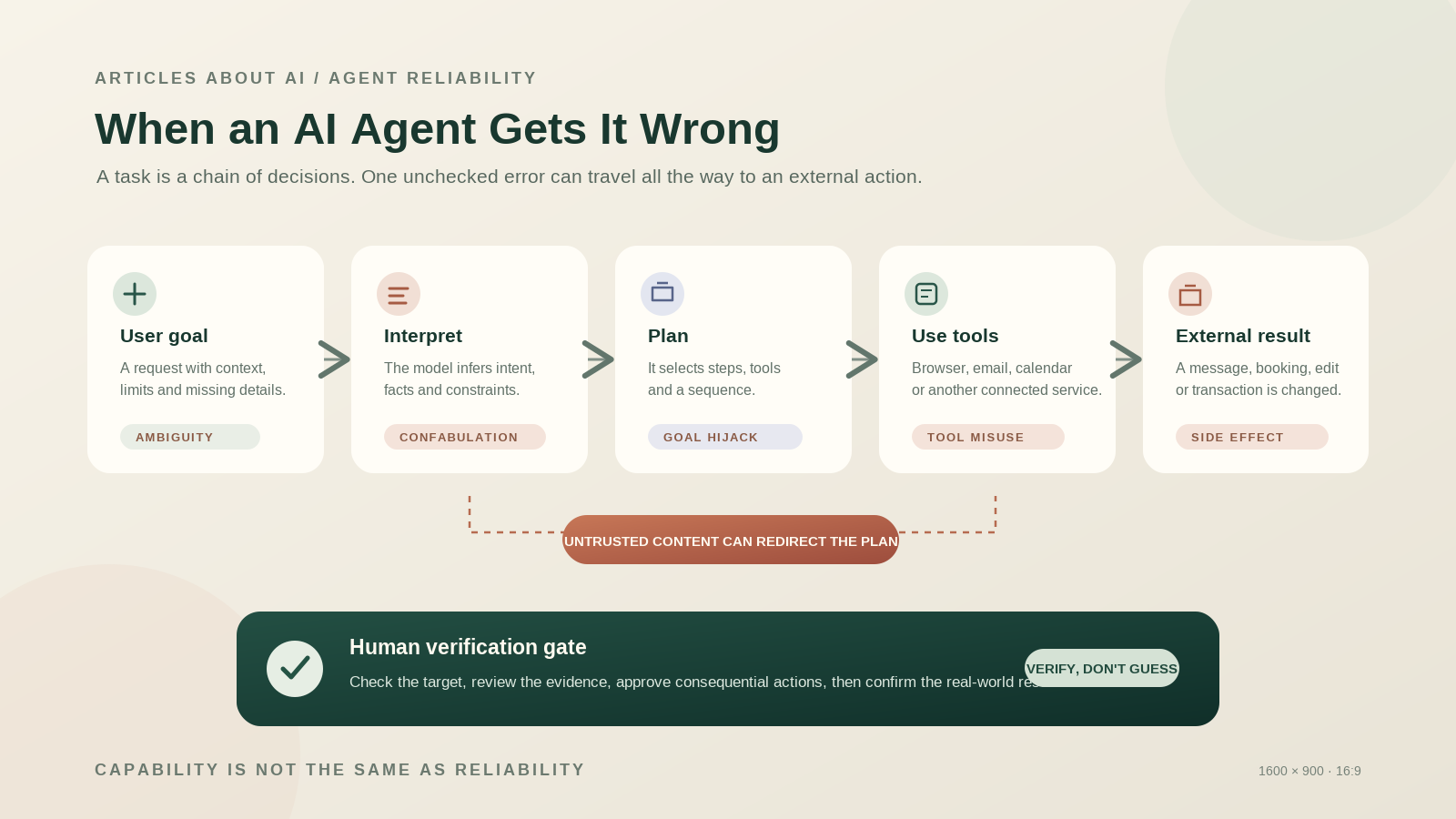
An AI assistant that only writes a paragraph can give a wrong answer. An AI agent can make the same mistake and then act on it: send the message, change the booking, edit the file, or submit a form. That difference is central to understanding the risks of autonomous AI agents.
Can Instinct AI make mistakes? Yes. Instinct’s own Terms of Service say that the service is not error-free, that its outputs may be incorrect or incomplete, and that it can make errors while performing actions. The terms also warn that actions may not always be reversible and require users to maintain meaningful human oversight. Those statements are not proof that every task is unsafe. They are a clear reason not to treat an agent’s confident report as proof that an external task was completed correctly.
This guide explains the main ways an AI agent can fail, what Instinct’s published documents say, what a publicly reported Instinct incident does—and does not—show, and how to reduce the risk before delegating consequential work.
The short answer: an agent can be wrong in several different ways
A mistake is not limited to a fabricated fact. An autonomous assistant can fail at different points in a task:
- Understanding: It misreads what you meant, overlooks a condition, or assumes a detail you did not provide.
- Reasoning: It draws an incorrect conclusion or invents a plausible explanation.
- Planning: It chooses the wrong sequence of steps or an unsuitable service.
- Tool use: It clicks, types, searches, or selects the wrong item.
- Execution: A message, booking, cancellation, payment, or file change is submitted incorrectly.
- Verification: It reports success without checking whether the external service actually accepted the action.
These failure types can overlap. A wrong assumption early in a workflow can lead to a technically successful action that is still the wrong action for the user.
Why AI agents have a different failure surface from chatbots
A conventional chatbot usually returns text for a person to interpret. A personal AI agent can connect the conversation to external systems. Instinct describes itself as a personal assistant that can be contacted by text or phone and can use a phone and computer in ways similar to a person. Its public terms also describe interactions with connected services and other third-party platforms.
That creates a longer chain:
- Interpret the user’s goal.
- Identify the relevant account, website, or service.
- Choose a plan and sequence of actions.
- Use a tool, browser, or connected service.
- Interpret the result returned by that service.
- Decide whether another step is needed.
- Tell the user what happened.
Every handoff is an opportunity for a mistake. A model may understand the broad goal but miss a date, choose a similarly named contact, misunderstand a website’s layout, or fail to notice that a request was rejected. A website may also change after the agent has inspected it. The result is not necessarily a dramatic system failure; it may be a small error that becomes consequential because the agent can act.
For a broader explanation of the difference between conversation and action, see Instinct AI vs Traditional AI Chatbots: What’s the Difference?.
What Instinct says about mistakes and user responsibility
Instinct’s Terms of Service, last revised on November 17, 2026, are unusually direct about operational risk. They state that Instinct may generate incorrect or incomplete information, make errors when performing actions, and perform actions that are not always reversible. They also say that the accuracy and completeness of an action depend partly on the input the user provides.
The terms require users to maintain meaningful human oversight. That includes reviewing actions, checking that Instinct did not make an error, and using approval workflows when the nature or consequences of an action justify them. The terms say that safeguards or confirmation requirements may be applied to some actions, but do not promise that those controls will prevent every unintended or erroneous action.
There are several practical implications:
- A confirmation prompt is a useful checkpoint, not a guarantee of correctness.
- A task description that omits a critical condition can produce the wrong result.
- An action log or completion message should not replace checking the destination service.
- A task that creates a financial obligation, affects another person, exposes sensitive information, or is difficult to reverse needs stronger oversight.
- Instinct’s terms say it is not intended for high-risk activities and that its output is not a substitute for professional medical, legal, investment, tax, or financial advice.
Read the Instinct Terms of Service alongside the Instinct Privacy Policy. The policy explains that the assistant may process information from connected services and interact with third-party websites or applications to carry out tasks. The official Instinct website currently describes text and phone interaction and says the assistant can use a phone and computer.
Six common ways an autonomous AI agent can fail
1. Hallucinations and invented details
A language model can produce a statement that sounds coherent but is not supported by the available evidence. The U.S. National Institute of Standards and Technology (NIST) calls this risk confabulation: confidently presented content that is false or erroneous. The risk is especially important when users treat a fluent answer as if it were a verified record.
In a personal-assistant workflow, a fabricated detail might be a booking reference, a policy condition, a person’s name, a price, or an explanation of why an action failed. The agent may then use that invented detail in later reasoning. A false premise can become a false plan.
NIST’s Generative AI Profile, NIST AI 600-1, explains why confident language is not a reliable indicator of factual accuracy. The lesson is simple: ask for evidence, and independently check details that matter.
2. Misunderstanding an instruction or missing a constraint
Natural-language requests often contain unstated assumptions. “Cancel my appointment” may refer to one of several appointments. “Find the cheapest ticket” may omit baggage, refundability, departure time, or transfer preferences. “Reply to Alex” may be ambiguous when several contacts share that name.
An agent can follow the words it inferred while still violating the user’s actual intention. This is why a useful instruction includes the target, relevant constraints, what must not change, and the point at which the assistant must stop and ask.
3. Incorrect tool use or an unintended action
A browser agent may select a nearby result, click a button whose meaning has changed, enter a value into the wrong field, or submit a form before all details are checked. Connected services introduce their own rules, authentication states, delays, and interface changes.
The error can be more serious than a bad answer because the external system may accept the action. A cancellation may take effect, an email may be sent, or a purchase may create a charge. Instinct’s terms explicitly warn that actions can be wrong and may not be reversible.
4. Partial completion reported as success
A multi-step task may stop after one step succeeds. A reservation request might be submitted but not confirmed. An email draft might be created but not sent. A cancellation page might be opened without the cancellation being finalized.
The final response can sound complete even when the external state is not. A reliable workflow must distinguish between attempted, submitted, accepted, and verified. Ask the assistant to show the confirmation number, receipt, status page, or other evidence that the service itself provides.
5. Prompt injection and hostile content in websites or messages
An agent may read emails, documents, or web pages while carrying out a task. Some of that content can contain instructions designed to manipulate the agent—for example, text telling it to ignore the user’s request, disclose information, or take an unrelated action.
NIST’s Center for AI Standards and Innovation describes this as agent hijacking through indirect prompt injection. An attacker can place malicious instructions inside an otherwise ordinary-looking email, file, or website that the agent is expected to inspect. The risk is not unique to Instinct; it applies to tool-using agents generally.
The OWASP Top 10 for Agentic Applications 2026 also identifies agent goal hijacking, tool misuse and exploitation, identity and privilege abuse, memory or context poisoning, cascading failures, and human-agent trust exploitation as important risk categories.
6. Cascading failures in long workflows
An early error can affect every later step. If an agent reads the wrong date, it may search for the wrong availability, select an unsuitable option, and send a confirmation based on the original mistake. Each later action may be internally consistent with the incorrect starting point.
Longer workflows therefore need checkpoints. The agent should verify important facts before acting, pause before consequential changes, and check the final state after each external transaction—not simply run through a long chain and summarize it at the end.
A reported Instinct incident: what is known and what is not
On September 24, 2026, Business Insider reported on a user’s screenshots showing Instinct apparently supplying an unfamiliar middle name and describing a financial-document image that the user said they had never sent. In the exchange described by the publication, the assistant initially said that the image had crossed into the conversation.
Instinct founder Noah Shinn said the episode was a hallucination, not a data breach, and stated that no user data had been shared or isolation boundary violated. He also described safeguards and said the company was working on a hallucination-detection layer. Business Insider noted that Shinn did not explain publicly how he had determined that the incident was a hallucination.
This report should be read carefully. The user’s screenshots and the founder’s response are evidence of a disputed incident and its explanation; they do not independently establish either a cross-user data leak or the complete technical cause. It would be inaccurate to present the episode as proof of a breach. It would be equally unwise to treat a confident explanation from the assistant or company as a substitute for independent verification.
The episode is useful because it illustrates a particular failure mode: an agent can generate a convincing but false account of its own actions or of information it supposedly encountered. When that happens, the user needs an auditable record and a way to verify what data was actually accessed.
Source: Business Insider, September 24, 2026.
Which tasks need the strongest human review?
Risk depends on the action’s consequences, not on how simple the request sounds.
| Task type | Examples | Sensible control |
|---|---|---|
| Lower consequence | Summarizing a public page, drafting a shopping list, finding opening hours | Review the answer; check important facts |
| Moderate consequence | Drafting an email, comparing travel options, preparing a booking | Review recipient, dates, prices and terms before submission |
| High consequence | Sending sensitive information, cancelling an important service, making a purchase, changing account security | Require explicit review and approval; verify directly with the provider |
| Unsuitable for delegation without qualified oversight | Medical, legal, investment, tax or other high-risk decisions | Do not rely on the agent as the decision-maker |
This is a practical risk framework, not a claim that every task in a category has the same level of danger. A low-value purchase can be easy to reverse; a short email can expose confidential information. Consider the amount at stake, the people affected, the sensitivity of the data, and the difficulty of reversing the result.
How to reduce the risk when using Instinct
Give the agent a bounded task
State what it may do, what it must not do, and when it must stop. Avoid vague instructions such as “sort out my account” when the task could involve payments, cancellations, or disclosure of personal information.
For example:
Research the available options and compare the total cost. Do not book, purchase, cancel, send a message, or change an account. If a detail is missing, ask me before continuing.
Separate research from execution
Use one stage to gather facts and another to authorize an action. Ask for the exact service, account, recipient, date, amount, cancellation terms, and any non-refundable conditions before proceeding.
Require a confirmation checkpoint
For consequential tasks, use a clear boundary:
Before taking any external action, show me the exact action, destination, recipient, date, amount, and consequences. Wait for my explicit approval. If the information cannot be verified, stop.
A prompt cannot replace technical controls or guarantee that an agent will obey every instruction. It does, however, make the intended approval boundary explicit.
Limit access to what the task needs
Do not connect every account simply because the option exists. Use the minimum set of services needed for the current task, review permissions periodically, and disconnect integrations that are no longer required. Our guide to what information Instinct AI may access explains the main data categories, while Instinct AI Privacy: How to Protect Your Personal Information covers practical privacy controls.
Verify the external result
Do not rely only on a sentence such as “Done.” Check the original service:
- For a booking, look for the provider’s confirmation and the correct date, time, and party size.
- For a cancellation, check the account or obtain a cancellation reference.
- For an email, inspect the Sent folder and the recipient address.
- For a purchase, verify the order, final price, shipping details, and payment record.
- For a calendar change, open the event and check the updated details.
If the external service shows no completed action, treat the task as unverified.
Stop and recover when something looks wrong
If the assistant takes an unexpected action, stop the workflow rather than asking it to continue from an uncertain state. Check the relevant account directly, contact the service provider if a booking or payment is involved, and secure the account if you suspect unauthorized access. Preserve confirmation messages and other records. For a suspected Instinct account compromise, its terms direct users to contact support.
For more detailed precautions, see Is Instinct AI Safe to Use? Security and Privacy Explained.
Test reliability before delegating important work
Do not judge an agent by one impressive demonstration. Start with tasks that have low consequences and an easily checked result. Use a small test set that resembles your real workflow:
- Give it a clear request with all necessary details.
- Repeat a similar task with a small change, such as a different date or recipient.
- Introduce an ambiguity and see whether it asks a clarifying question rather than guessing.
- Check whether it reports a failed or blocked action honestly.
- Compare its final report with the actual state of the external service.
Record more than whether the final answer sounded plausible. Did it choose the right account? Did it preserve constraints? Did it use the correct tool? Did the external service confirm the action? Did it stop when the task became ambiguous?
The public Instinct Terms of Service do not provide a general task-success rate that would justify assuming a particular level of reliability across all workflows. The same is true of a single successful personal test: it demonstrates that one task worked once, not that every similar task will work consistently.
Availability and pricing: what to check before relying on it
As of November 26, 2026, Instinct’s Terms of Service, last revised November 17, state that the service is currently available without charge. The company reserves the right to introduce fees in the future and says it will provide notice before applicable fees become payable.
The same terms do not guarantee that Instinct or every feature will be available on every device, service plan, or geographic location. They also describe early-access offerings as voluntary and provided as-is, with the possibility of errors, defects, bugs, or inaccuracies. Check the current Instinct website and terms before relying on a feature or assuming that access is available in your region.
Free access does not remove the need for oversight. The main question is not whether a task costs money to delegate; it is what could happen if the agent misunderstands or executes it incorrectly.
Frequently asked questions
Can Instinct AI make mistakes?
Yes. Its Terms of Service explicitly say that Instinct is not error-free, that outputs may be wrong or incomplete, and that it may make errors while performing actions. Users are expected to review actions and maintain meaningful oversight.
Does an AI agent mistake mean someone else’s data was leaked?
No. A fabricated description of another person’s information can look like a data leak, but the appearance alone does not prove that data crossed between accounts. In the September 2026 incident reported by Business Insider, the user raised a concern and Instinct’s founder attributed the episode to hallucination. The public reporting did not independently establish a cross-user breach.
Can a confirmation prompt prevent every mistake?
No. A confirmation step can reduce the chance of an unintended action, but the person approving it still needs to check the details. Instinct’s terms say that safeguards and confirmation requirements may be used but do not guarantee that they will prevent erroneous actions.
Should I let Instinct handle financial or medical decisions?
No. Instinct’s terms say the service is not intended for high-risk activities and that its outputs are not a substitute for professional medical, legal, investment, tax, financial, or other professional advice. Do not delegate consequential decisions to the agent as the final authority.
How can I tell whether a task actually succeeded?
Check the system that was supposed to change. Look for a provider-issued confirmation, a sent message, an updated account record, a receipt, or another independent record. Treat the agent’s completion message as a report to verify, not as proof by itself.
The practical conclusion
Instinct can be useful precisely because it can move beyond conversation and interact with the services people use. But the ability to act introduces risks that a text-only answer does not have: incorrect assumptions can become external changes, hostile content can try to redirect a task, and a fluent completion message can conceal an incomplete or mistaken result.
The responsible approach is neither to assume that every action will fail nor to trust the agent without checks. Give it bounded tasks, share only the access it needs, require approval for consequential actions, and verify the result in the original service. An autonomous agent can do the work; the user still needs to decide whether the result is correct.
Sources and further reading
- Instinct Terms of Service — last revised November 17, 2026.
- Instinct Privacy Policy — last revised November 17, 2026.
- OWASP Top 10 for Agentic Applications 2026.
- NIST: Strengthening AI Agent Hijacking Evaluations — January 17, 2025.
- NIST AI 600-1: Generative Artificial Intelligence Profile — July 2024.
- OpenAI: Computer-Using Agent — January 23, 2025.
- Business Insider: Instinct’s founder says the AI agent’s hallucinations can look like another person’s data — September 24, 2026.