
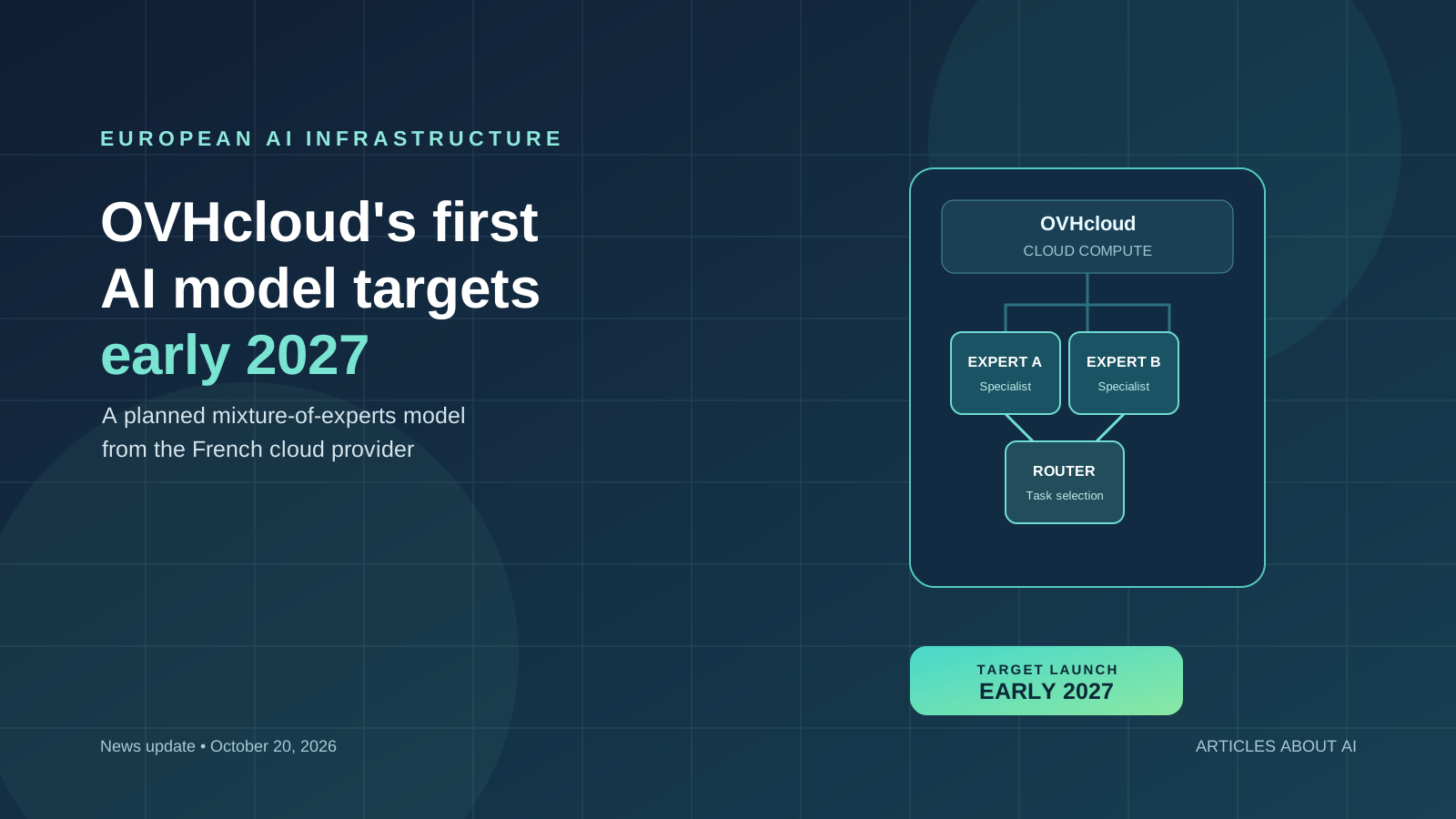
France-based cloud provider OVHcloud plans to launch its first AI model in early 2027, according to chief executive Octave Klaba in an interview reported by Reuters on October 20, 2026. The model is expected to use a mixture-of-experts (MoE) design, which routes a request to specialised sub-models rather than activating every part of a model for every task. The announcement adds a new product ambition to OVHcloud’s effort to expand from cloud infrastructure into AI services.
The launch remains a plan, not a release. Reuters did not report a public model name, benchmark results, a pricing schedule, an API launch date, licensing terms, or a confirmed list of supported use cases. Those details will matter to developers and businesses deciding whether the future service can compete with existing European and international AI options.
What OVHcloud announced
Reuters reported on October 20 that OVHcloud expects to launch its first AI model in early 2027. Klaba said the company had already started working on its own models using the Jupiter supercomputer. The model is intended to be part of OVHcloud’s broader AI strategy, potentially putting the French cloud provider into more direct competition with European model developers such as Mistral AI.
The same report covered the company’s near-term plans for OVHai Workspace, a productivity platform tuned on OVHcloud’s internal data and designed to work with workplace applications such as email. Klaba said its first pilot would be released shortly, ahead of the planned AI model launch next year. OVHai Workspace and the future AI model are related parts of the company’s AI direction, but they should not be treated as the same product.
Key points as of October 20, 2026:
- Target launch: Early 2027, according to the CEO’s comments to Reuters.
- Architecture: Mixture of experts, according to the CEO.
- Development infrastructure: OVHcloud has said it began model work on the Jupiter supercomputer.
- Related product: OVHai Workspace is expected to enter a pilot phase shortly.
- Still unannounced: Model name, access method, pricing, licensing, public availability, and independent performance results.
These are the limits of the public announcement currently reported by Reuters. The schedule may change, and the company has not yet published the technical details needed for a full model evaluation.
What is a mixture-of-experts AI model?
A mixture-of-experts model is an architecture that divides parts of a neural network into specialised components, often called experts, and uses a routing mechanism to select which experts handle a given input. Rather than sending every token through every expert, a model can activate a subset for a particular task.
In principle, this approach can increase a model’s total capacity without requiring every parameter to be used on every inference step. It can also create engineering trade-offs involving routing quality, memory use, communication between hardware components, serving complexity, and workload distribution. Actual efficiency depends on the design and how it is deployed; the label “mixture of experts” alone does not prove that a model will be faster or cheaper.
For OVHcloud, the announced architecture is relevant because the company operates cloud infrastructure and aims to offer AI services built on its own computing resources. A model can be judged only after the company provides details and users can evaluate it on representative workloads. Developers will want to know the context window, tool-calling support, structured-output reliability, supported languages, throughput, latency, and the total cost of completing real tasks.
Why OVHcloud is developing its own model
Cloud infrastructure providers can offer GPUs, storage, networking, orchestration, and managed AI platforms without necessarily owning the models customers use. Developing a model adds another layer to the stack. It may allow a provider to integrate model serving with its infrastructure and products, tailor features to customer requirements, and offer an alternative for organisations that prefer a European cloud supplier.
OVHcloud has publicly described an AI strategy built across several layers, from data-center GPUs and orchestration to AI platform services and software. In a September 23, 2026 post, CEO Octave Klaba discussed the company’s approach to the European AI gigafactory plans and described the role of infrastructure, GPU orchestration, and AI services in its roadmap. That company-authored post provides useful context for the strategy, but it is not a technical specification for the model announced for 2027.
The potential opportunity is broader than building another chatbot. If the forthcoming model is offered through APIs or managed services, developers could assess it for document processing, enterprise assistants, retrieval workflows, coding support, and other applications. These are possible evaluation areas, not confirmed product features. Until OVHcloud publishes supported capabilities, it would be premature to claim that the model will outperform competitors or suit a specific workload.
For context on Europe’s model ecosystem, see our coverage of Mistral Large 4 and its preview availability and Mistral’s managed deployments. They illustrate different approaches to making AI models available to organisations; they do not establish how OVHcloud’s unreleased model will perform.
OVHcloud’s available cloud capacity
The AI announcement came alongside reporting on OVHcloud’s infrastructure and financial position. Reuters said the company had 250 megawatts of connected capacity, with 140 MW in operation and 110 MW available to take on new business. Klaba said this available capacity could let OVHcloud onboard customers without waiting for additional construction, while some competitors need more capacity to meet regional demand.
These figures describe connected cloud capacity, not a measure of how much capacity is dedicated to the future AI model. The company has not publicly disclosed the model’s expected compute requirements, training budget, serving footprint, or the proportion of capacity it may consume. It would therefore be misleading to assume that the 110 MW available figure will be used for model training or that it guarantees immediate access to AI compute for all customers.
The distinction matters to organisations evaluating European AI infrastructure. Data-center capacity is one part of the equation; access to accelerators, networking, power availability, software support, service-level commitments, data residency, and the cost of running workloads also affect whether a service is practical.
How it could fit into Europe’s AI market
OVHcloud’s plan reflects an increasingly layered market in which European companies are trying to offer not only hosting and computing, but also model access and finished AI applications. Different businesses may prioritise different factors: model quality, support for European languages, data governance, deployment options, predictable costs, or integration with existing systems.
However, a European supplier is not automatically the best option for every European customer. Buyers should compare actual service terms and technical evidence rather than relying only on where a provider is headquartered. When OVHcloud releases further details, useful comparisons will include task-level accuracy, latency under load, price per successful task, data handling, service availability, and how easily customers can move their workflows elsewhere.
AI buyers should also distinguish among three layers:
- Infrastructure: the servers, accelerators, networking, and storage used to train and operate models.
- Model access: the model itself and the interface through which developers call it, such as an API or managed endpoint.
- Applications: finished products such as workplace assistants that combine models with company data and business workflows.
OVHcloud’s comments point toward activity across these layers, but the details and release status differ by product. OVHai Workspace’s expected pilot is not confirmation that the standalone model is publicly available, and the early-2027 target is not a guarantee of launch on a specific date.
What developers and businesses should watch next
The next useful update from OVHcloud would be a technical announcement that moves beyond the launch window. Before committing a product to the service, developers should look for:
- Access and eligibility: Will the model be available through a public API, a managed endpoint, OVHai Workspace, or selected customers first?
- Technical specifications: Which languages, context lengths, tool calls, multimodal inputs, and output formats will it support?
- Performance evidence: Are benchmarks published with reproducible methods, independent comparisons, and clear evaluation limits?
- Pricing and limits: What are the input and output rates, caching rules, quotas, rate limits, and enterprise terms?
- Data governance: Where will inference run, how will requests and logs be retained, and what options exist for regulated or confidential workloads?
- Reliability: What latency, uptime, support, and service-level commitments will customers receive?
For teams already running agents, the most meaningful comparison is not necessarily which model scores highest on a single benchmark. A realistic pilot should test the exact workflow, measure completion quality and failure rates, track latency and total cost, and confirm the service meets security requirements. OVHcloud’s infrastructure background may be relevant, but the future model should be evaluated on evidence once that evidence is available.
Our coverage of NVIDIA Vera CPU and AI-agent infrastructure explains why the systems around a model can also influence the performance and cost of agent workloads. It is a complementary infrastructure story, not a direct comparison with OVHcloud’s planned model.
Bottom line
OVHcloud expects to launch its first AI model in early 2027, and CEO Octave Klaba says it will use a mixture-of-experts architecture. The company has also said it began developing models on the Jupiter supercomputer, while its OVHai Workspace productivity platform is expected to enter a pilot phase shortly. The plan is significant because it would extend OVHcloud’s AI offering beyond infrastructure into model development.
For now, important details remain unknown: the model’s name, capabilities, pricing, licensing, API availability, benchmarks, and exact launch date. The most responsible conclusion is that OVHcloud has announced a target and a high-level architectural direction—not a publicly available model that can already be tested. We will update this report as the company publishes verifiable technical and availability information.
Sources
- Reuters: Half of OVHcloud capacity is available, AI model launching in early 2027, CEO says — October 20, 2026
- OVHcloud Blog: AI Gigafactory — the unfindable business model? — September 23, 2026
SEO keywords: OVHcloud AI model, OVHcloud AI model 2027, OVHcloud first AI model, OVHai Workspace, mixture of experts AI, MoE model, European AI model, French AI company, European cloud computing, Octave Klaba, Jupiter supercomputer, OVHcloud news October 2026, AI infrastructure Europe, European AI alternatives, AI model launch 2027.