
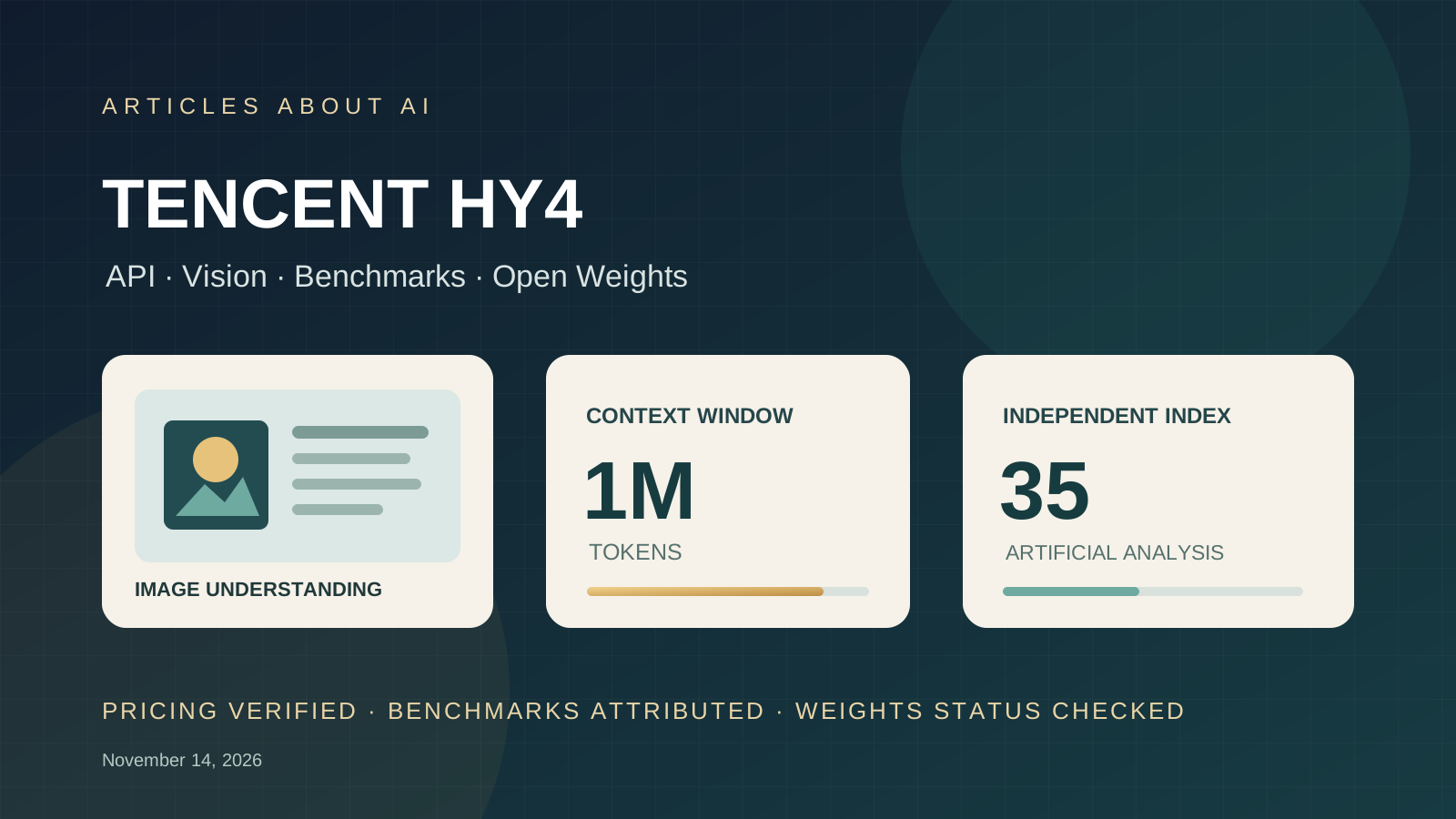
Tencent Hy4 arrived on November 4, 2026, as the full release following the Hy4 Preview model introduced in August. The release adds image understanding and computer-use capabilities, while keeping the same headline API list prices as the preview. It also raises a question that matters to developers and infrastructure teams: is the full Hy4 model actually open-weight, or are only the preview weights downloadable?
The distinction is important. Tencent’s launch announcement says it plans to release the full model weights and a system card, but the public model repositories checked for this guide contain the preview checkpoints, not a verified full-release Hy4 checkpoint. Meanwhile, independent evaluation pages now provide measurable results for Hy4, including a score of 35 on the Artificial Analysis Intelligence Index and a 59.35% Vals Index result.
This guide covers the Tencent Hy4 API, current TokenHub pricing, image input, context limits, supported API protocols, independent benchmarks, and the evidence behind its open-weights status.
Research note: Information and links were checked on November 14, 2026. Tencent’s product claims and internal evaluations are identified as vendor-reported. Artificial Analysis and Vals AI results are presented separately as third-party evaluations. Articles About AI has not independently run Hy4 or reproduced these benchmarks.
What is Tencent Hy4?
Tencent Hy4 is a reasoning-focused large language model from the Tencent Hunyuan team. The November 4 release is the production-facing successor to Hy4 Preview, which Tencent released in August.
The full release adds two capabilities highlighted by Tencent:
- Visual understanding: Hy4 accepts image input and is designed to interpret screenshots, detailed images, charts, and visual mathematical problems.
- Computer use: Tencent says the model can interact with command-line interfaces and graphical user interfaces to complete multi-step tasks.
Tencent also describes improvements in instruction following, long-context comprehension, and long-horizon agentic work. Those are statements from the developer; they should not be confused with independent proof that Hy4 leads every benchmark or performs reliably in every application.
The current TokenHub model listing identifies the API model as hy4 and lists image understanding, deep thinking, structured output, function calling, and prompt caching.
Tencent Hy4 API specifications
The official Tencent Cloud TokenHub model listing gives the following limits for the full Hy4 release:
| Specification | Tencent Hy4 |
|---|---|
| Model ID | hy4 |
| Context window | 1,048,576 tokens (1M) |
| Maximum input | 960,000 tokens |
| Maximum output | 65,536 tokens |
| Input modalities | Text and images |
| Output modality | Text |
| Reasoning | Supported |
| Function calling | Supported |
| Structured output | Supported |
| Prompt caching | Supported |
| Web search integration | Listed by TokenHub |
The one-million-token context window is a total context limit, not a promise that every request can contain one million input tokens and still generate the maximum output. The separate input and output limits matter: TokenHub lists a maximum input of 960,000 tokens and a maximum output of 65,536 tokens.
The official model page currently describes Hy4 as a text-and-image input model that produces text. Do not assume that the API accepts audio or video simply because Tencent demonstrates computer use or visual workflows. Check the input schema for the exact endpoint and SDK you plan to use.
Sources: Tencent TokenHub model details and Tencent Cloud model list.
Tencent Hy4 API pricing
Tencent’s standard TokenHub list price is:
| Billing item | Standard price per 1 million tokens |
|---|---|
| Input tokens | ¥6.00 |
| Output tokens | ¥18.00 |
| Cached input tokens | ¥0.30 |
Tencent’s November 4 announcement gives approximate USD equivalents of $0.90 per million input tokens, $2.70 per million output tokens, and $0.045 per million cached input tokens. The yuan-denominated TokenHub price sheet is the better reference for the actual platform rate.
50% TokenHub promotion
Tencent’s pricing notice says Hy4 usage on TokenHub receives a 50% discount through December 31, 2026. The discounted yuan rates are therefore:
| Billing item | Promotional price per 1 million tokens |
|---|---|
| Input tokens | ¥3.00 |
| Output tokens | ¥9.00 |
| Cached input tokens | ¥0.15 |
The TokenHub model page displays these discounted rates. The promotion applies to eligible usage during the stated period; after the promotion expires, the standard list prices apply unless Tencent announces a change.
OpenRouter currently displays the equivalent promotional rates of approximately $0.417 per million input tokens, $1.251 per million output tokens, and $0.021 per million cached input tokens. Provider routing, billing currency, and platform terms can differ, so check the live rate card before estimating production costs.
Example API cost calculation
Suppose an application sends 100,000 input tokens and generates 20,000 output tokens, with no cached input:
- Input: 0.1 million × ¥3 = ¥0.30
- Output: 0.02 million × ¥9 = ¥0.18
- Estimated total during the promotion: ¥0.48
At standard list prices, the same request would cost ¥0.96. This is a simple token-price calculation, not a quote for a complete workflow. Tool calls, retries, image-token accounting, and other platform charges can change the final bill.
Sources: Tencent TokenHub pricing, Hy4 model page, and OpenRouter Hy4 pricing.
How to access Hy4 through the API
Tencent lists three compatible request protocols for Hy4:
- OpenAI-compatible Chat Completions.
- OpenAI-compatible Responses.
- Anthropic-compatible Messages.
The model identifier is hy4. The corresponding common endpoint paths are:
| Protocol | Endpoint path |
|---|---|
| Chat Completions | /v1/chat/completions |
| Responses | /v1/responses |
| Anthropic Messages | /v1/messages |
Use the base URL, authentication method, and region specified in the Tencent TokenHub documentation for your account. Do not assume that an API key issued for one region works in another region or that every third-party gateway exposes every protocol.
OpenAI-compatible request example
The following is a minimal request shape. Replace the base URL and API key with the values shown in your Tencent TokenHub console.
curl "$TOKENHUB_BASE_URL/v1/chat/completions" \
  -H "Authorization: Bearer $TOKENHUB_API_KEY" \
  -H "Content-Type: application/json" \
  -d '{
    "model": "hy4",
    "messages": [
      {
        "role": "user",
        "content": "Summarize the main points in this report."
      }
    ],
    "max_tokens": 2048
  }'
For image understanding, use the image content format documented by the specific compatible endpoint. The model’s image capability does not mean every SDK’s generic text-only message helper will automatically serialize image inputs correctly.
Function calling and structured output
TokenHub lists function calling and structured output as supported capabilities. These features are useful when Hy4 needs to select an application function, return data in a defined schema, or participate in a multi-step agent workflow.
Treat tool execution as an application responsibility. The model can propose a tool call, but your application must validate arguments, enforce permissions, apply rate limits, and decide whether a requested action is allowed. Never treat a model-generated tool call as authorization to access data or execute a consequential operation.
Hy4 vs. Hy4 Preview: what changed?
The two names refer to different release stages. Hy4 Preview was released in August; the full Hy4 release followed on November 4.
| Feature | Hy4 Preview | Full Hy4 release |
|---|---|---|
| Release | August 2026 | November 4, 2026 |
| Image understanding | Not listed for the preview release | Added |
| Computer use | Not highlighted as a release capability | Announced by Tencent |
| Context window | 1M tokens | 1M tokens |
| Maximum output | 64K tokens | 64K tokens |
| API list pricing | ¥6 / ¥18 / ¥0.30 | Same list pricing |
| Public model weights | Preview checkpoints available | No verified public full-release checkpoint found as of Nov. 14 |
| Model ID | hy4-preview |
hy4 |
The preview’s public model card describes a 770-billion-parameter mixture-of-experts architecture with 49 billion active parameters per token. Those figures belong to Hy4 Preview. Tencent has not published a verified full-release Hy4 model card establishing that the production release has exactly the same parameter count and architecture. Do not automatically copy the preview’s architecture figures into a specification table for full Hy4.
For background on the distinction between downloadable weights and hosted models, see our guide to open-weight vs. closed AI models in 2026.
Is Tencent Hy4 open-weight? What is actually downloadable?
This is the most important qualification in the Hy4 launch story.
Tencent’s November 4 announcement describes Hy4 as part of its open-source model strategy and says the team plans to release the full model weights and system card in the coming days. However, the public Hugging Face repositories that could be verified for this article are:
These are preview checkpoints. Their model card identifies the preview architecture and its Apache 2.0 license. They are not evidence that the full November Hy4 release has been published under the same license.
As of November 14, this review did not find a publicly verifiable full-release Hy4 weights repository or a full-release license. The responsible description is therefore:
- Hy4 Preview: downloadable preview weights are public, with an Apache 2.0 license shown on the preview repository.
- Full Hy4: available through Tencent’s hosted API and supported products; Tencent has announced an intention to publish weights, but a public full-release checkpoint and its license were not verified for this article.
This distinction also affects deployment. If you need to run the exact full Hy4 release on your own infrastructure, do not assume that downloading Hy4 Preview gives you the same model. Confirm the full release’s weights, license, system card, hardware requirements, and supported inference engines before planning a self-hosted deployment.
For a broader explanation of model licensing and deployment trade-offs, see Open-Weight vs. Closed AI Models in 2026.
Tencent Hy4 independent benchmarks: what do the numbers show?
A benchmark score is meaningful only when the evaluator, test suite, model endpoint, and measurement date are clear. Tencent’s own launch material includes internal and partner evaluations, but those should not be presented as independent third-party benchmarks.
Two external evaluation sources provide a more useful view of the released Hy4 model.
Artificial Analysis Intelligence Index
Artificial Analysis lists Tencent Hy4 at 35 on its Intelligence Index. Its current model page also reports:
| Metric | Artificial Analysis result |
|---|---|
| Intelligence Index | 35 |
| Cost per Intelligence Index task | $1.03 |
| Time per Intelligence Index task | 14.3 minutes |
| Output speed | 91 tokens/second |
| Time to first answer token | 93.88 seconds |
| Context window | 1M tokens |
| Input modalities | Text and image |
Artificial Analysis describes the score as below the median for comparable models in its current price grouping. The evaluation is a composite: its current methodology includes agentic knowledge work, coding, science, reasoning, and other task families. It is not a universal measure of intelligence or a guarantee of performance on a particular company’s workload.
The page also shows a notable trade-off: Hy4’s token prices are competitive relative to the comparison group, but the measured time to first answer token is high. A developer choosing Hy4 should therefore evaluate both cost and latency, rather than selecting it on token price alone.
Source: Artificial Analysis — Tencent Hy4. The index version and rankings can change as the evaluator updates its model set and methodology.
Vals AI Index and task benchmarks
Vals AI reports a 59.35% Vals Index score, with a reported uncertainty interval of ±1.08 percentage points on its model page. Its page also lists:
| Vals AI evaluation | Result |
|---|---|
| Vals Index | 59.35% |
| Vals Finance Index | 58.05% |
| Vals Legal Index | 70.55% |
| Finance Agent v2.1 | 64.70% |
| Tax Agent Bench | 34.40% |
| Vibe Code Bench v1.1 | 81.01% |
| Terminal-Bench 4.0 | 39.39% |
| Cost per Vals Index test | $1.72 |
Vals AI says it evaluated Hy4 using its Vals Index v2.2 and accessed the model through OpenRouter for the evaluation described in its November 4 update. The page’s displayed ranks and comparison set can change as more models are added; the score and benchmark name are more useful than treating a rank as permanent.
These results suggest that Hy4’s performance varies substantially by task. Its Vals Finance and Vibe Code results should not be generalized to legal research, general reasoning, or every coding workflow. The benchmark table is evidence about the specific tests, not a substitute for evaluating the model on your own representative data.
Source: Vals AI — Tencent Hy4.
Tencent’s own evaluations are not independent benchmarks
Tencent’s launch announcement also reports a blind evaluation involving 213 financial professionals and 579 real-world financial tasks, with a score of 3.04 for Hy4. It compares that result with other models and reports internal improvements in hallucination-related measurements.
These results may be relevant, but the evaluation was conducted by Tencent’s Hy team in partnership with Tencent Financial Technology. It is therefore a vendor-associated evaluation, not an independent benchmark from Artificial Analysis or Vals AI. The same caution applies to Tencent’s WorkBuddy and internal agent benchmark results.
For a broader explanation of why benchmark leaderboards disagree, see Best AI Models in 2026: Benchmark Rankings Explained.
What is Hy4’s vision capability?
Hy4’s full release adds image input. Tencent specifically highlights fine-grained image processing, complex chart analysis, and mathematical visual reasoning.
The official TokenHub model page confirms that the API accepts both text and images and returns text. That is the most practical capability statement for developers: Hy4 can receive an image as part of a request and respond with a text result.
Potential applications include:
- Reading screenshots and describing interface elements.
- Extracting information from charts and diagrams.
- Interpreting visual material included with a written question.
- Reasoning about mathematical diagrams.
- Supporting computer-use workflows that combine visual observations with tool actions.
However, image understanding and computer use are not the same capability. Image input lets a model interpret visual content; computer use additionally requires an execution environment, action tools, and permission controls. Tencent’s launch announcement describes both, but developers should verify which computer-use components are available in the product or API integration they intend to use.
The official model listing does not establish general audio or video input for Hy4. This guide therefore describes Hy4 as a text-and-image input model, rather than calling it an unrestricted audio-video model.
Where can developers access Tencent Hy4?
Tencent says Hy4 is available through Tencent Cloud TokenHub and its own product ecosystem, including WorkBuddy, CodeBuddy, Yuanbao, WeCom’s AI Assistant, and ima. The company also names third-party access through OpenRouter, Hermes, and OpenCode.
Availability can differ by platform, account, region, and product plan. For production use, verify the model ID, rate limits, API protocol, and regional endpoint in the provider’s current documentation.
The TokenHub model page currently lists:
- Model ID:
hy4 - Chat Completions:
/v1/chat/completions - Responses:
/v1/responses - Anthropic Messages:
/v1/messages
OpenRouter lists the model as tencent/hy4 and provides its own provider routing, pricing display, and request compatibility layer. Those platform-level details should not be confused with Tencent’s direct TokenHub terms.
Who should use Hy4?
Hy4 is worth evaluating if you need a hosted reasoning model with a large context window, image input, function calling, and a relatively low promotional token price. Its 1M context window may be useful for long documents or large task histories, while its image support expands the kinds of inputs an application can process.
It may be less suitable when your application requires consistently low time to first token, a verified downloadable full-release checkpoint, or independently demonstrated leadership on a particular benchmark. Artificial Analysis’s current latency measurements and the absence of verified full-release weights are both relevant considerations.
A practical evaluation should compare Hy4 with alternatives using the same prompts, input data, tool definitions, output limits, and latency measurement method. Include cached and uncached requests, image inputs if relevant, and the cost of retries. For agentic applications, measure task completion and tool errors—not just the quality of a single generated answer.
Frequently asked questions
How much does Tencent Hy4 API cost?
Tencent TokenHub’s standard list price is ¥6 per million input tokens, ¥18 per million output tokens, and ¥0.30 per million cached input tokens. Tencent’s 50% promotion reduces these to ¥3, ¥9, and ¥0.15 respectively through December 31, 2026.
What is the context window of Hy4?
Tencent lists a 1,048,576-token context window, with a maximum input of 960,000 tokens and a maximum output of 65,536 tokens.
Does Hy4 support image input?
Yes. Tencent’s model listing identifies image and text as supported input types, with text output. Tencent highlights image understanding, chart analysis, and visual reasoning.
Is the full Tencent Hy4 model open-weight?
Not verified as of November 14, 2026. Tencent announced plans to release the full weights and system card, but the public repositories verified for this article contain Hy4 Preview checkpoints. The preview’s Apache 2.0 license should not be assumed to apply to the full release.
What is the difference between Hy4 and Hy4 Preview?
Hy4 is the November 4 full release; Hy4 Preview is the earlier August model. Tencent says the full release adds image understanding and computer use. The preview’s published 770B-parameter architecture is not a verified specification for the full release.
How does Hy4 perform on independent benchmarks?
Artificial Analysis currently lists an Intelligence Index score of 35. Vals AI reports 59.35% on its Vals Index and provides separate finance, legal, coding, and agent-task results. These are different benchmark systems and their scores should not be compared directly.
Can I run full Hy4 locally?
A publicly verifiable full-release checkpoint and license were not found during this review. The Hy4 Preview checkpoints are downloadable, but they are not proof that the full Hy4 release can be self-hosted.
Official and independent sources
Tencent official sources
- Tencent: Hy4 launch announcement — November 4, 2026
- Tencent Cloud TokenHub: Hy4 model page
- Tencent Cloud TokenHub: Model list — updated November 13, 2026
- Tencent Cloud TokenHub: Model pricing — updated November 5, 2026
Independent evaluations
- Artificial Analysis: Tencent Hy4
- Vals AI: Tencent Hy4 — evaluation update November 4, 2026
- OpenRouter: Tencent Hy4 model and provider pricing
Public preview weights
Tencent Hy4 is a meaningful step beyond its preview, particularly because it adds image understanding and computer-use capabilities while retaining a large context window and competitive API pricing. But the strongest buying decision comes from separating what is already verifiable from what Tencent has promised: the hosted Hy4 API is available, independent benchmark results exist, and the full release’s public weights and license still require confirmation.