
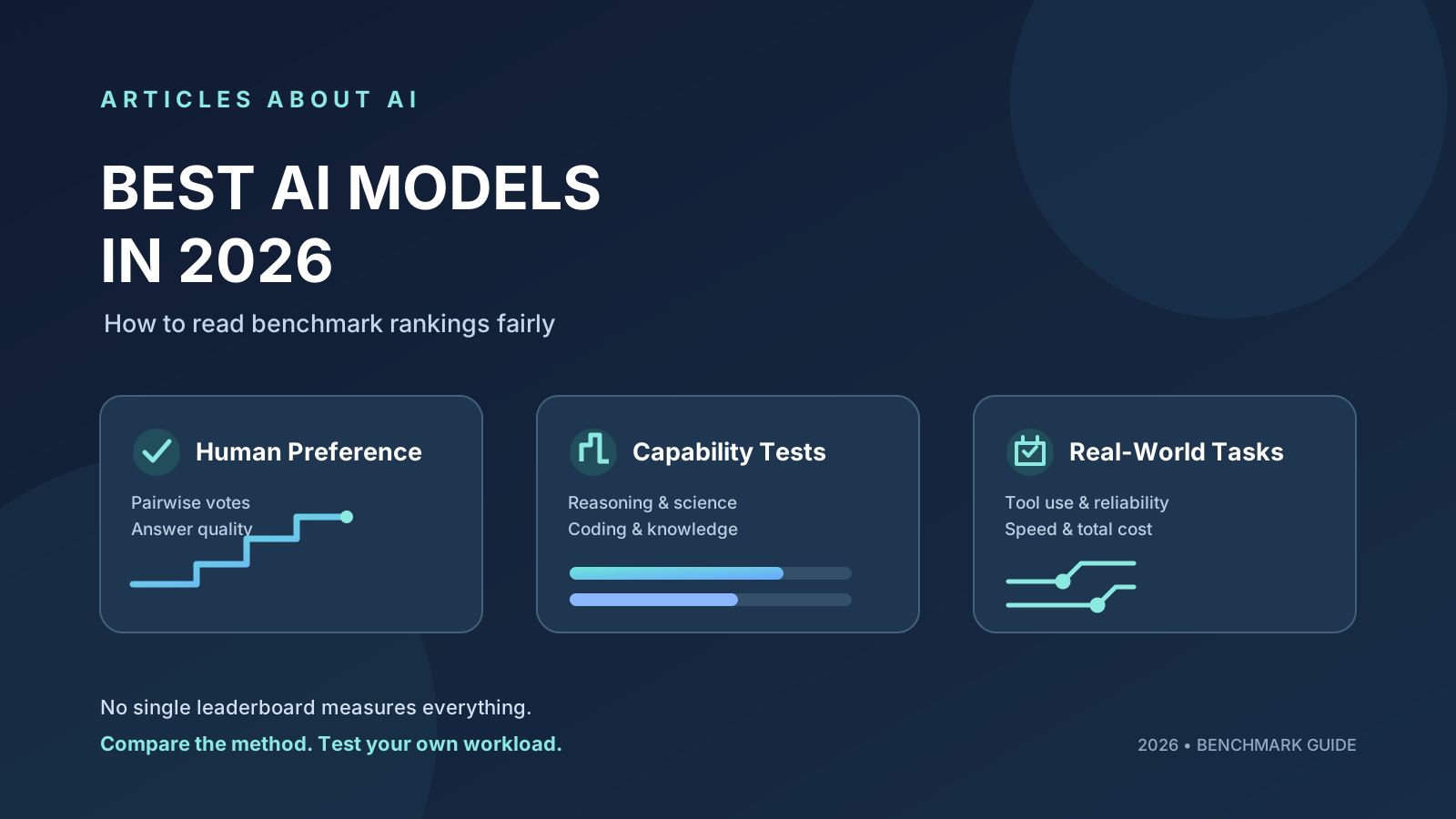
Choosing the best AI model in 2026 is not as simple as finding one leaderboard and picking the model in first place. Different evaluations measure different things: some collect human preferences between anonymous answers, some test reasoning and coding with fixed tasks, and others measure whether an AI agent can complete multi-step work using tools.
That distinction matters when comparing ChatGPT, Claude, Gemini, DeepSeek, and other leading AI systems. A model that excels at coding agents may not be the best choice for research, long-document analysis, image understanding, or low-cost API workloads.
This guide explains how to read current AI model rankings, which public evaluation resources are useful, and how to select a model based on evidence rather than a universal “best AI” claim. This is a benchmark-reading guide, not a claim that one model wins every task. Rankings change as models, test sets, and evaluation methods change.
Quick answer: which AI model ranks first?
There is no single, methodologically neutral ranking that answers every use case. Start with the evaluation that most closely resembles your work:
- Human preference for conversational answers: check the relevant text or task category on Arena’s live leaderboard.
- A composite view of reasoning, coding, science, and agent tasks: review the Artificial Analysis Intelligence Index methodology and the latest model results.
- Transparent, reproducible evaluation across scenarios and metrics: explore Stanford HELM.
- Real-world agent workflows: use an agent-specific leaderboard rather than assuming a chat leaderboard predicts tool-use performance.
Always record the model name, exact version or configuration, leaderboard category, date checked, and metric. Without those details, a ranking screenshot can become misleading very quickly.
What the major AI model leaderboards measure
1. Arena: human preference in pairwise comparisons
Arena asks people to compare responses from two anonymous models and vote for the answer they prefer. Aggregated votes produce ratings for the relevant leaderboard category. This approach can capture qualities that are hard to express in a fixed multiple-choice test, such as helpfulness, style, clarity, and how well an answer follows a prompt.
Arena is especially useful when the experience of interacting with a model matters. However, preference is not the same as factual accuracy. Results can also depend on the prompts users submit, the available model matchups, sample size, and the specific category being viewed.
Use the Arena leaderboard to inspect the category that matches your task. Do not transfer a text ranking directly to image generation, coding, or agentic work.
2. Artificial Analysis: a composite capability index
Artificial Analysis publishes a multi-evaluation Intelligence Index intended to summarize several dimensions of model capability. Its published methodology describes a weighted combination of evaluations spanning areas such as agents, coding, scientific reasoning, and general capabilities. The exact test suite and weights can change between index versions, so check the current methodology before comparing scores across time.
A composite index is useful for shortlisting models, but it is still a designed summary. The weighting determines which abilities influence the final score most. If your job is mostly writing SQL, reviewing legal documents, or summarizing research papers, the index’s overall order may not match your own results.
Read the official Intelligence Index methodology and check the current version, evaluation list, and scoring weights. Treat the score as one signal—not as a guarantee of performance on your own prompts.
3. Stanford HELM: broader and more transparent evaluation
Stanford’s Center for Research on Foundation Models developed HELM as an open evaluation framework for language and multimodal models. HELM emphasizes standardized scenarios and multiple metrics, which helps researchers inspect more than a single headline score. Its resources include different evaluation suites and leaderboards, so the specific HELM track matters.
HELM is useful when you want to understand how models behave across tasks and measures rather than rely on one aggregated ranking. It also requires careful reading: an older result, a different model snapshot, or a different evaluation track may not be directly comparable with a current commercial leaderboard.
Explore the HELM evaluation framework and confirm the date and scope of any result you cite.
How to compare AI models fairly
Use the following framework before declaring one model the winner.
| Evaluation dimension | What to check | Why it matters |
|---|---|---|
| Reasoning and knowledge | Multi-step problems, factual questions, domain-specific tests | A strong average score can hide weaknesses in a specialized subject |
| Coding | Bug fixes, unit tests, repository changes, code review | Short code snippets do not represent full software-engineering tasks |
| Research and citations | Source quality, claim verification, citation accuracy | Fluent answers can still cite weak or irrelevant evidence |
| Agent performance | Tool selection, task completion, recovery from errors | Tool-using systems behave differently from plain chat models |
| Multimodal capability | Image, audio, video, and document inputs | Text-only tests do not establish multimodal quality |
| Reliability | Repeated runs, consistency, refusal behavior, hallucinations | A one-off success may not be reproducible |
| Speed and cost | Latency, output tokens, API prices, total task cost | The most capable model may not be the most economical |
| Access and controls | Availability, rate limits, privacy, deployment options | A high score is irrelevant if the model does not fit your constraints |
Do not mix scores from unrelated benchmarks
A percentage score, an Elo-style rating, a pass rate, and a composite index are not interchangeable units. A model scoring 85% on one test is not automatically better than a model with an Elo rating of 1,400 on another. The tasks, scoring rules, sample sizes, and baselines differ.
Compare models directly only when the evaluation setup is sufficiently similar. If you build a table from multiple sources, label each metric and link to its original methodology rather than creating a single average from incompatible numbers.
Check model versions and configurations
Leaderboard entries may distinguish between model variants, reasoning effort levels, agent scaffolds, or dated snapshots. A model’s performance with tools enabled may differ substantially from its performance in a plain chat setting.
For a useful comparison, record:
- The full model identifier and version.
- Whether tools, browsing, or extended reasoning were enabled.
- The benchmark version and date.
- The metric and uncertainty range, where reported.
- The number and type of tasks or votes.
- Whether the model was evaluated independently or by its developer.
If any of these details are missing, state that limitation instead of presenting the score as definitive.
Why leaderboard rankings can disagree
Two reputable leaderboards can place the same models in different orders without either being automatically wrong.
First, the tasks differ. Human preference rankings emphasize what users like in an answer, while coding evaluations may measure whether code passes tests. Agent evaluations can consider successful tool use and completion of multi-step tasks. These are related abilities, but they are not identical.
Second, scoring choices differ. One evaluation may report a pairwise preference rating; another may combine several test results with explicit weights. Different choices can legitimately produce different rankings.
Third, samples and uncertainty matter. A small gap between two models may not represent a meaningful practical difference, particularly when the leaderboard reports uncertainty or the models have limited evaluation coverage. Look for confidence intervals, vote counts, test counts, and update dates.
Finally, benchmark contamination and saturation are ongoing concerns. If a test becomes widely known or appears in training data, high performance may become less informative about generalization. The 2026 Stanford AI Index technical-performance chapter discusses how rapidly improving models can outgrow the benchmarks designed to measure them.
Which AI model should you choose in 2026?
The practical answer depends on your workload. Use benchmark rankings to create a shortlist, then validate the finalists on representative tasks.
For everyday writing and general assistance
Begin with a current human-preference leaderboard and test the model on your own writing, planning, and question-answering prompts. Compare factual correctness, instruction following, clarity, and the amount of editing required—not just which answer sounds more confident.
Our related guide, ChatGPT vs Claude vs Gemini: Which AI Assistant Is Best in 2026?, discusses practical differences between the three assistant ecosystems.
For software development
Prioritize coding evaluations that resemble your work: repository-level changes, debugging, test generation, refactoring, and tool-assisted workflows. Ask candidate models to solve the same tasks under the same conditions, then run tests and inspect the diffs.
See our comparison of Claude vs ChatGPT for coding and the more focused DeepSeek vs Claude comparison of performance, cost, and coding. Those comparisons address workflow decisions; they should not be treated as a universal leaderboard.
For research and evidence-heavy work
Evaluate source discovery, whether cited pages support the claims, how well the model distinguishes evidence from inference, and whether it acknowledges uncertainty. A model can write a polished research summary while misrepresenting a source, so citation checking should be part of the test.
Our guide to Gemini vs ChatGPT for research covers this use case in more detail.
For open-weight or self-hosted deployment
Do not compare only capability scores. Include hardware requirements, quantization, throughput, license terms, context length, serving cost, and data-governance requirements. A model that performs well in a hosted benchmark may have different latency or memory needs when deployed on your own infrastructure.
For AI agents and automation
Look for evaluations that measure completed tasks, recovery from tool errors, tool selection, and consistency across multi-step jobs. A chatbot leaderboard alone cannot tell you whether an agent will safely and reliably operate your files, browser, or development environment.
A simple benchmark test you can run yourself
Public rankings are a starting point. A small, consistent evaluation on your actual tasks can make the final decision more useful.
- Select 10–30 representative tasks from your real workflow, including easy, typical, and difficult cases.
- Give each shortlisted model the same inputs, constraints, and tool access.
- Define a rubric before testing—for example, correctness, completeness, citations, code-test success, latency, and cost.
- Repeat tasks where outputs are stochastic, and keep the model settings consistent.
- Score outputs without relying solely on model self-evaluation. Use deterministic tests where possible and human review for qualitative work.
- Record failures as well as successes. Include hallucinated sources, missed requirements, unsafe tool calls, and unnecessary retries.
- Re-run a smaller regression set after a model or provider updates.
For coding tasks, measure whether tests pass and whether the patch introduces regressions. For research, verify each important citation. For agents, measure end-to-end completion and the number of human interventions. These measures are more actionable than a vague impression that one model “feels smarter.”
Common mistakes when reading AI rankings
- Treating one leaderboard as the final answer. Each leaderboard measures a particular task mix and objective.
- Comparing incompatible scores. Percentages, Elo ratings, pass rates, and composite indices need separate labels.
- Ignoring cost and latency. A small capability gain may not justify a much larger operational cost.
- Assuming the model name is enough. Versions, settings, tools, and reasoning budgets can change results.
- Using outdated screenshots. Always check the live page and its last-updated date before publishing a ranking.
- Confusing benchmark performance with production reliability. Your users, data, prompts, and constraints may differ from the test environment.
- Claiming a controlled test that was not run. Clearly distinguish third-party results from your own experiments.
Frequently asked questions
What is the best AI model in 2026?
There is no single winner across every task. Check a current leaderboard for the capability you need, then validate the leading candidates on representative prompts. Rankings can change with new releases and evaluation updates.
Which AI leaderboard is most reliable?
Reliability depends on the question. Arena is useful for human preference, Artificial Analysis provides a composite index across several capability areas, and Stanford HELM offers a broader evaluation framework with multiple scenarios and metrics. Cross-checking independent sources is more informative than relying on one ranking alone.
Are AI benchmark scores comparable between websites?
Not automatically. Different benchmarks use different tasks, metrics, baselines, samples, and model configurations. Compare numbers directly only when the methodology supports that comparison.
Do benchmark leaders always perform best in real work?
No. Benchmarks can help identify strong candidates, but your own workflow may involve specialized knowledge, long documents, private data, tools, or constraints that the benchmark does not cover. Real-task testing is essential for consequential decisions.
How often should I check AI model rankings?
Check the relevant leaderboard when making a selection, before publishing a dated comparison, and after meaningful model or benchmark updates. Record the date you consulted the source so readers can distinguish a time-specific snapshot from a permanent claim.
Bottom line
The best AI model rankings in 2026 are best understood as complementary evidence, not a universal league table. Use Arena to study human preference, Artificial Analysis to inspect a composite capability index, and Stanford HELM to explore broader standardized evaluations. Then test the shortlist on the work you actually need to complete.
The most defensible choice is the model that meets your quality threshold consistently, fits your budget and deployment constraints, and performs well under a transparent evaluation—not simply the one with the highest number on a leaderboard.