
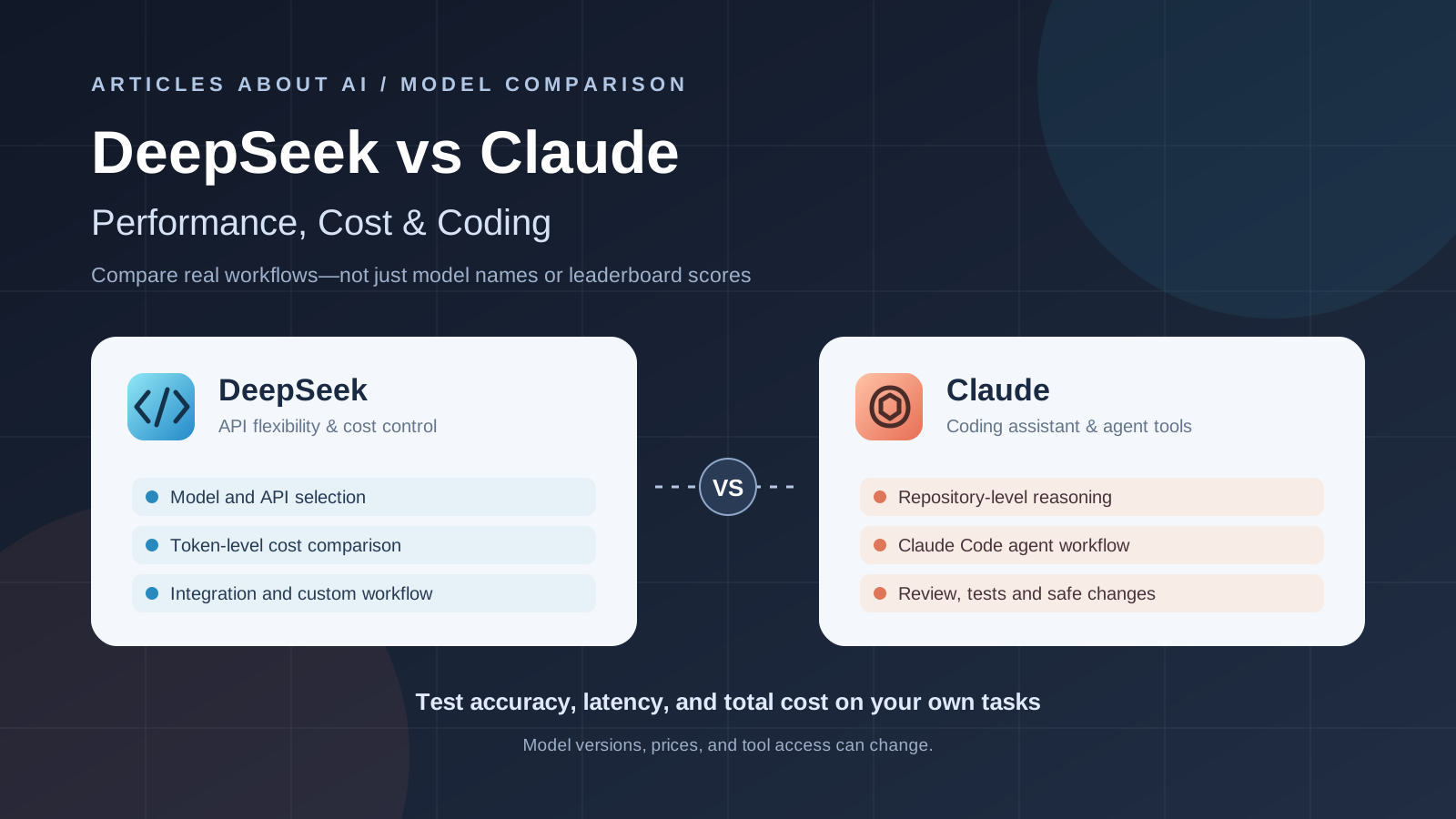
DeepSeek and Claude are both worth evaluating for software development, but a useful comparison must separate three questions: how well a model solves your coding task, how much it costs to run, and how well the surrounding tools fit your workflow. A model that produces strong code in a short prompt may not be the most efficient choice for a large repository, repeated agent runs, or a team that needs predictable controls.
This guide compares the practical trade-offs without inventing benchmark scores. We did not run a controlled head-to-head coding test for this article, and public leaderboard results cannot automatically predict how either system will perform on your codebase. Model versions, API prices, and product features also change, so consult the official pages linked below before making a purchase or architecture decision.
Quick take: DeepSeek is worth testing when API cost, flexible integration, and direct control over model calls are central to your workload. Claude is worth testing when you want to use its coding models and the Claude Code workflow for repository-level changes, debugging, and iterative development. Neither is the universal winner; your task mix, tool configuration, and verification process matter.
DeepSeek vs Claude: quick comparison
| Decision factor | DeepSeek | Claude |
|---|---|---|
| Coding use | Code generation, explanation, debugging, and API-based integrations | Code generation, debugging, review, and agent-assisted development |
| Tooling | DeepSeek API supports documented model and tool-call capabilities; check the selected model’s feature table | Claude is available through its products and API; Claude Code adds a repository-oriented coding workflow |
| Cost model | API usage is metered by input/output tokens, with current rates and cache rules on DeepSeek’s pricing page | API pricing varies by model and token type; Claude Code usage depends on whether you authenticate through a plan or API key |
| Best cost comparison | Measure token use, retries, latency, and successful task completion | Measure the same factors, including tool calls and agent iterations |
| Large code changes | Test with realistic repository context and explicit constraints | Test with the same repository, context, permissions, and acceptance tests |
| Reliability | Verify generated code with tests, static analysis, and review | Verify generated code with tests, static analysis, and review |
| Best choice | The model that meets your quality threshold at an acceptable total cost | The model and tools that meet your quality threshold at an acceptable total cost |
The comparison above is a selection framework, not a claim that one provider wins a particular benchmark. Performance depends on the exact model version, task, prompt, context, tools, and scoring method.
1. Coding performance: what should you compare?
“Coding performance” covers several distinct capabilities. A useful evaluation separates them rather than asking a model to solve one puzzle and treating the result as a complete ranking.
Code generation
Give both systems the same small feature request, the same language and framework, and the same acceptance criteria. Check whether the code runs, handles edge cases, follows the repository’s conventions, and avoids unnecessary complexity. A fluent explanation is not evidence that the implementation works.
Debugging and root-cause analysis
Provide a reproducible error, relevant logs, and the smallest useful code sample. Measure whether the model identifies the actual cause, proposes a minimal fix, and explains a way to verify it. Penalize speculative changes that do not address the failure.
Repository-level changes
A real task often requires reading multiple files, understanding existing interfaces, editing code, and running tests. Compare both systems with the same repository snapshot, available tools, permissions, and task instructions. If one system receives more context or can run commands while the other cannot, the test measures different setups rather than model quality alone.
Reasoning about trade-offs
Ask both models to review a proposed design and identify failure modes, security implications, and maintainability concerns. Then validate their claims against the code and documentation. Use a checklist prepared before the test so that the scoring is not adjusted to favor a preferred answer.
For a related model-level comparison, see our article on Claude Opus 5.5 vs GPT-6 Astra for coding. That article focuses on a different pair of models and benchmark evidence; this guide focuses on DeepSeek versus Claude and how to evaluate cost and workflow.
2. API cost: compare the bill, not just the headline rate
DeepSeek publishes token-based API pricing and model-specific details, including input and output rates and cache-related rules. Anthropic publishes API prices by Claude model and token category. The current numbers should be read directly from each provider’s official pricing page because model names, availability, and rates can change.
Official pricing references:
A lower price per token does not automatically mean a lower cost per completed task. A model may need more tokens, additional tool calls, more retries, or more human correction. A higher-priced model can sometimes be more economical if it solves the task in fewer attempts—but that must be measured, not assumed.
Track at least these metrics:
| Metric | Why it matters |
|---|---|
| Input tokens | Repository context, instructions, and previous turns can dominate the input |
| Output tokens | Long explanations and patches affect usage cost |
| Cache hits and cache writes | Provider-specific cache rules can change the effective price |
| Tool calls | Search, terminal, and other tools may have separate charges or usage limits |
| Retries | Repeated failed attempts add cost and latency |
| Human correction time | An inexpensive draft can become expensive if it needs extensive repair |
| Successful tasks | Cost per accepted result is more useful than cost per request |
A simple internal metric is cost per accepted task:
[ \text{Cost per accepted task} = \frac{\text{Total model and tool cost}}{\text{Tasks that pass the acceptance tests}} ]
Keep the acceptance criteria identical for both systems. Do not compare a subscription allowance on one side with raw API token prices on the other as if they were equivalent. A subscription, a pay-as-you-go API, and an agent product can bundle usage and tools differently.
3. Claude Code and API workflows are not the same comparison
Claude can be used through its chat product, API, and Claude Code workflow. Those are related but distinct ways of working. Claude Code is designed to work with a codebase and can use tools during a development session; the effective cost and capabilities depend on how you sign in and which models are available.
Anthropic’s Claude Code documentation and usage and limits guide explain the product workflow and how usage is metered. In general, plan-based usage and API-key usage should be evaluated separately.
DeepSeek can be integrated through its API and compatible developer tooling. Before choosing an integration, check the exact model identifier, supported features, rate limits, and provider terms. A compatible API format can reduce integration work, but it does not mean every model has identical behavior, tool support, or output quality.
For a broader comparison of coding-agent products rather than the models alone, read Claude Code vs Codex vs Gemini CLI. For a product-level workflow comparison between Claude and ChatGPT, see Claude vs ChatGPT for coding.
4. Context length and large codebases
A model’s advertised context window is only one part of repository performance. The relevant questions are how much context your selected model actually supports, how the tool chooses files to include, whether relevant information is retained across iterations, and whether the model can identify the right code without being overwhelmed by unrelated files.
To compare DeepSeek and Claude on a large project:
- Use the same commit and task description for both systems.
- Provide the same initial files or the same repository access.
- Ask each system to identify the files it plans to change before editing.
- Require a minimal patch and a short explanation of assumptions.
- Run the same tests, lint checks, and type checks.
- Review the diff for unrelated edits, regressions, and security problems.
- Record latency, token usage, retries, and whether the task passed.
A larger context window can help with broad tasks, but it does not guarantee that the model will attend to the right details. Retrieval, tool design, instructions, and verification still matter.
5. A fair DeepSeek vs Claude coding test
Use a small test set that reflects your actual work instead of relying on a single public benchmark. Include a mix of routine and difficult tasks, and run each task more than once if output variability matters.
Suggested test set:
- Bug fix: Resolve a reproducible issue with a regression test.
- Feature addition: Implement a small feature that follows existing project conventions.
- Refactor: Improve a module without changing externally visible behavior.
- Code review: Identify real defects in a patch that includes both intentional and planted issues.
- Test generation: Add tests for edge cases and failure paths.
- Repository navigation: Find the correct implementation point and explain the relevant dependencies.
Score each result against a rubric prepared in advance:
| Criterion | What to measure |
|---|---|
| Correctness | Does it pass the required tests? |
| Completeness | Does it meet every acceptance criterion? |
| Regression risk | Does it preserve existing behavior and avoid unrelated edits? |
| Maintainability | Is the change clear, consistent, and appropriately scoped? |
| Security | Does it avoid unsafe defaults, exposed secrets, and injection risks? |
| Efficiency | How many tokens, retries, and tool calls were needed? |
| Latency | How long did it take to reach a passing result? |
| Total cost | What did the accepted solution cost, including tools and retries? |
Keep a record of model version, date, prompt, tool configuration, and source commit. If the selected models or pricing change, rerun the test. Publish benchmark claims only when the methodology and results can be reproduced.
6. Which one should you choose?
Choose DeepSeek first if…
- You want to evaluate token-based API economics for a workload with many repeated requests.
- You need an API-centered integration and can build your own evaluation and verification layer.
- You want to compare different model configurations against a defined cost and quality threshold.
- Your team can measure performance on its own tasks instead of relying on general claims.
These are reasons to test DeepSeek, not a guarantee that it will be cheaper or more accurate in every workload.
Choose Claude first if…
- You want to evaluate Claude’s coding models alongside the Claude Code development workflow.
- You need an iterative process for repository changes, debugging, and code review.
- Your team values a managed product experience and wants to compare its included usage or API billing against alternatives.
- You are willing to measure whether the workflow’s benefits justify its total cost.
These are reasons to test Claude, not a guarantee that it will outperform DeepSeek on your code.
Consider both if…
Your team has varied tasks or the cost difference could materially affect operations. You can route simpler tasks to a lower-cost option and reserve another model for difficult work—but only after measuring quality, maintaining consistent safeguards, and ensuring that switching models does not introduce unacceptable behavior or data-handling differences.
7. Common mistakes in AI coding comparisons
- Comparing different model versions. Record exact model identifiers and test dates.
- Mixing up products and models. A coding agent includes tools and orchestration, not just a base model.
- Using one benchmark as the whole answer. Benchmarks measure selected tasks under specific conditions.
- Ignoring unsuccessful attempts. Include retries and failed tasks in total cost.
- Ignoring human review. Generated code still needs tests and code review.
- Treating context length as comprehension. Large input capacity does not guarantee correct use of every detail.
- Comparing subscription and API prices directly. Their usage allowances and billing structures differ.
- Publishing unsupported rankings. If no controlled test was run, describe the evaluation criteria rather than claiming a measured winner.
Frequently asked questions
Is DeepSeek better than Claude for coding?
There is no universal answer supported by this article. The result depends on the exact model version, task, tools, and scoring method. Run both on representative tasks and measure correctness, accepted-task cost, and latency.
Is DeepSeek cheaper than Claude?
Compare the current official API rates for the specific models you intend to use, then calculate total cost for successful tasks. Token prices alone do not include every tool call, retry, or human correction. Subscription plans and API billing are different products.
Is Claude Code the same as the Claude API?
No. Claude Code is a coding workflow that uses models and tools to work with a codebase. The Claude API lets developers build their own integrations. Authentication, usage metering, and included features can differ.
Can I use DeepSeek in a coding agent?
DeepSeek documents its API and supported features, and integrations may expose it through compatible developer tools. Check the current integration documentation and selected model capabilities before depending on a specific tool or feature.
What is the most reliable way to choose an AI coding model?
Build a small benchmark from your real tasks, use identical conditions, run acceptance tests, review diffs, and calculate cost per passing task. Repeat the evaluation when model versions or pricing change.
Final verdict
DeepSeek and Claude should be compared on the complete development workflow: correctness, repository behavior, tool access, latency, total cost, and the amount of human correction required. DeepSeek is a strong candidate to evaluate for API-centered workflows and cost-sensitive workloads; Claude is a strong candidate to evaluate when its coding models and Claude Code workflow fit the development process.
The defensible winner is the option that repeatedly passes your acceptance tests at an acceptable total cost. Until a controlled comparison is run on the tasks you care about, any absolute claim that one is the best coding model would go beyond the available evidence.
Model availability, API prices, product features, and usage limits change. Consult the official documentation linked above before making a decision.