
Choosing an AI model in 2026 is no longer just a contest between the best-known chatbots. Businesses and individual users can choose hosted, proprietary services or models whose weights can be downloaded and run on their own infrastructure. The difficult question is not simply which model ranks first, but whether the difference matters for the task, budget, privacy requirements, and technical resources involved.
A recently updated model index offers a useful starting point. Its snapshot dated October 13, 2026 places Claude Opus 5.5, a closed model, at 199, while GLM-5.3, an open-weight model, scores 171. Those numbers suggest a gap on that index, but they do not mean that Claude is 16% better at every task—or that GLM-5.3 is unsuitable for practical work. The index combines results from multiple third-party evaluations into one estimated capability score, and its own methodology describes uncertainty around those estimates.
This guide explains what the evidence can and cannot tell you, what “open-weight” actually means, and how to choose a model for a real workload instead of relying on a single leaderboard.
What is the difference between open-weight and closed AI models?
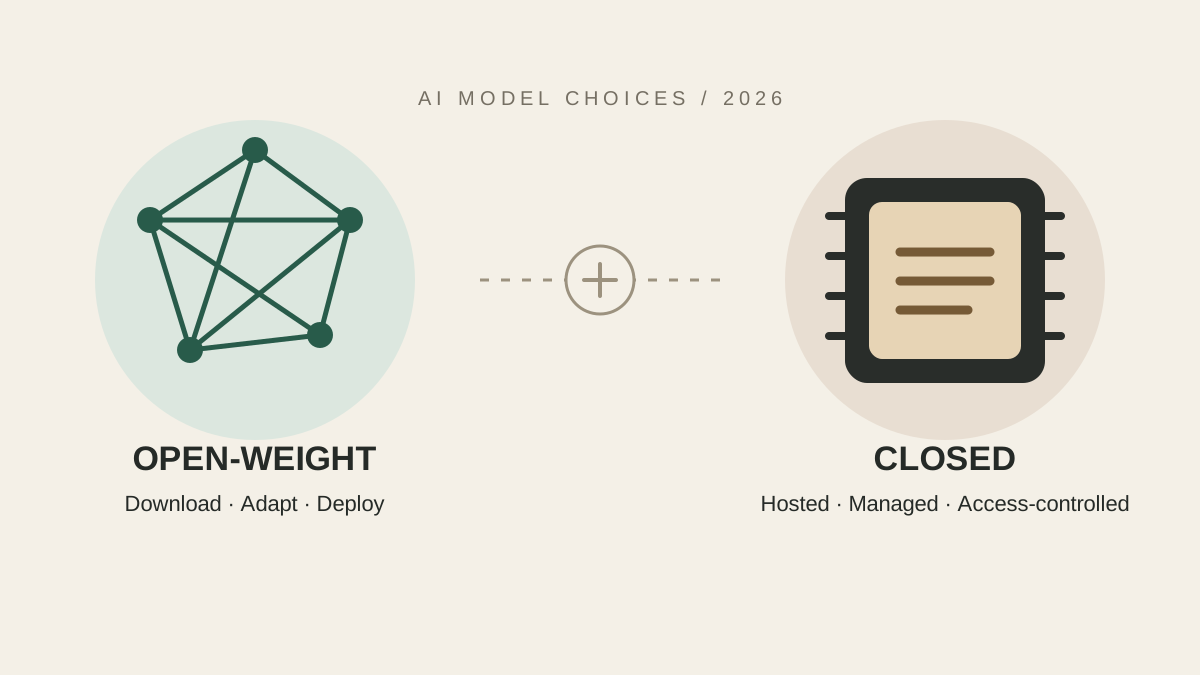
Open-weight models make their trained parameters available for download. Depending on the licence, users may be able to run them on their own computers or servers, adapt them, and integrate them into private applications. GLM-5.3 is listed as open-weight in The Model Index.
Closed models keep their weights private and are generally accessed through a hosted product or API. Claude Opus 5.5 is listed as closed. The provider operates the underlying model and controls which versions and capabilities are available.
Open-weight does not automatically mean fully open source. The weights may be available while training data, training code, or other components remain unavailable; licences can also restrict certain uses. Always read the licence for the specific model before deploying it commercially.
The access model affects more than transparency. It changes who manages infrastructure, where data is processed, how updates are applied, and what ongoing costs a team must account for.
What do recent independent comparisons show?
The Model Index snapshot updated on October 13, 2026 lists these leading models and scores:
| Model | Weight access | Index score |
|---|---|---|
| Claude Opus 5.5 | Closed | 199 |
| GPT-6 Astra | Closed | 198 |
| Gemini 4 Argon | Closed | 198 |
| GLM-5.3 | Open-weight | 171 |
Source: The Model Index.
These are index scores, not percentages or scores from one shared test. The index says it combines published results from third-party evaluators and uses a statistical model to estimate general ability across tests of differing difficulty. It also reports a 90% uncertainty band for each score. Its methodology requires results from multiple third-party testers before a model receives a ranked score.
The comparison therefore supports a limited conclusion: on this particular aggregated measure, the leading closed models score above the highest-listed open-weight model. It does not establish that every closed model outperforms every open-weight model, or that the same ordering holds for coding, writing, mathematics, local deployment, or any other single use case.
Independent evaluation platforms also measure different things. Artificial Analysis, for example, describes an Intelligence Index built from evaluations covering agents, coding, general capabilities, and scientific reasoning. Its methodology explains the tasks and weights, and it separately reports cost per task. A model can rank well overall yet perform differently on a specific benchmark or at a different reasoning setting.
Why a single leaderboard can mislead you
A leaderboard is a useful screening tool, not a substitute for evaluating the work you need to do.
- Different tasks produce different rankings. A model that excels at scientific reasoning may not be the best choice for editing a large codebase or completing a multi-step browser workflow.
- A composite score hides trade-offs. Combining multiple evaluations makes it easier to scan the field, but it can hide weaknesses in a particular capability.
- Test conditions matter. Model version, reasoning effort, tool access, prompt, time limits, and evaluation harness can all affect results. Comparisons are strongest when models are tested under equivalent conditions.
- Scores have uncertainty. Small differences should not automatically be treated as meaningful wins, especially when a benchmark has limited coverage or noisy results.
- A benchmark is not a guarantee. A high score on a public test does not guarantee reliable performance on your own data or production workflow.
Look for the original benchmark, its date, the tested model version, and whether results were independently reproduced. Treat a vendor’s own launch numbers as claims from the model developer unless an independent evaluator has confirmed them under comparable conditions.
Which type should you choose?
Choose a closed model when convenience and managed performance matter most
A hosted model is often the simpler starting point when you want strong general capabilities without managing GPUs, inference servers, updates, or model deployment. It can be a good fit for teams using AI for research, writing, analysis, or coding through a ready-made product or API.
Before committing, compare the provider’s actual pricing, rate limits, data-handling terms, available tools, and performance on your own tasks. A top benchmark score does not by itself make a service the best value.
Choose an open-weight model when control and deployment flexibility matter
Open-weight models are worth evaluating when you need to run inference in your own environment, customize a model, control version changes, or reduce dependence on a single hosted provider. They can also be attractive when a suitable smaller model handles a repetitive workload at acceptable quality.
But self-hosting is not automatically cheaper or more private. Hardware, engineering time, monitoring, security, updates, and electricity all carry costs. A model running on your own server also needs appropriate access controls and operational safeguards.
Test both against the same work
For a fair comparison, create a small evaluation set from real tasks. Use the same input data and success criteria for each model, and record:
- Task success: Did the output meet your requirements, and how much correction was needed?
- Total cost: Include API charges or the full cost of operating local infrastructure.
- Latency: Measure the time to a usable result, not just a provider’s advertised speed.
- Privacy and governance: Confirm where data goes, who can access it, and which licence or service terms apply.
- Reliability: Repeat representative tasks and check how often the model fails, invents details, or needs human intervention.
For coding agents and other multi-step tools, evaluate the complete workflow—including the agent harness and tools—not just the underlying language model. Our guide to evaluating AI agent reliability covers practical checks for multi-step systems.
A practical decision guide
| Your priority | What to evaluate first |
|---|---|
| Fast setup and minimal maintenance | A hosted closed model |
| Local or controlled deployment | An open-weight model and its licence |
| Lowest cost at scale | Total cost per successful task |
| Software engineering | Real repository tasks, tests, and review effort |
| Sensitive business data | Data handling, access controls, and deployment options |
| Best general-purpose results | Several independent benchmarks plus your own test set |
If you are choosing a tool for programming, compare the whole workflow rather than assuming that a model leaderboard settles the decision. Our comparison of Claude Code, Codex, and Gemini CLI examines the practical tool layer as well as model capabilities. For general assistant use, see our guide to ChatGPT vs. Google Gemini.
What the evidence does—and does not—say
The October 13 snapshot shows a clear difference between the highest-scoring closed model and the highest-listed open-weight model on The Model Index. It is useful evidence of the current state of that index, not a universal verdict on which approach is best.
The same methodology offers reasons to be cautious: it combines multiple tests, assigns an estimated score, and acknowledges uncertainty. Other evaluation systems use different benchmark mixes and weights, so their rankings may not match. Cost, local control, licensing, and operational effort are separate considerations that a capability score cannot fully capture.
The most defensible choice is therefore task-specific. Start with recent independent results to narrow the options, then run a controlled evaluation on representative work and compare total cost, reliability, privacy, and maintenance. If a closed model consistently delivers better outcomes and the service terms fit your needs, use it. If an open-weight model meets your quality threshold and control is important, it may be the better fit.
Sources and further reading
- The Model Index: current model rankings — a snapshot of model scores and weight access.
- The Model Index: data and methodology — explains its use of third-party results, scoring approach, and uncertainty.
- Artificial Analysis: Intelligence Index v4.3 — describes the evaluations, weighting, and cost-per-task comparisons used by another evaluation platform.
- Artificial Analysis: latest leaderboards — consult the live results before making a purchase or deployment decision.
Benchmark data and rankings change as models and evaluation methods are updated. Check the linked sources for the latest snapshot before making a decision.