
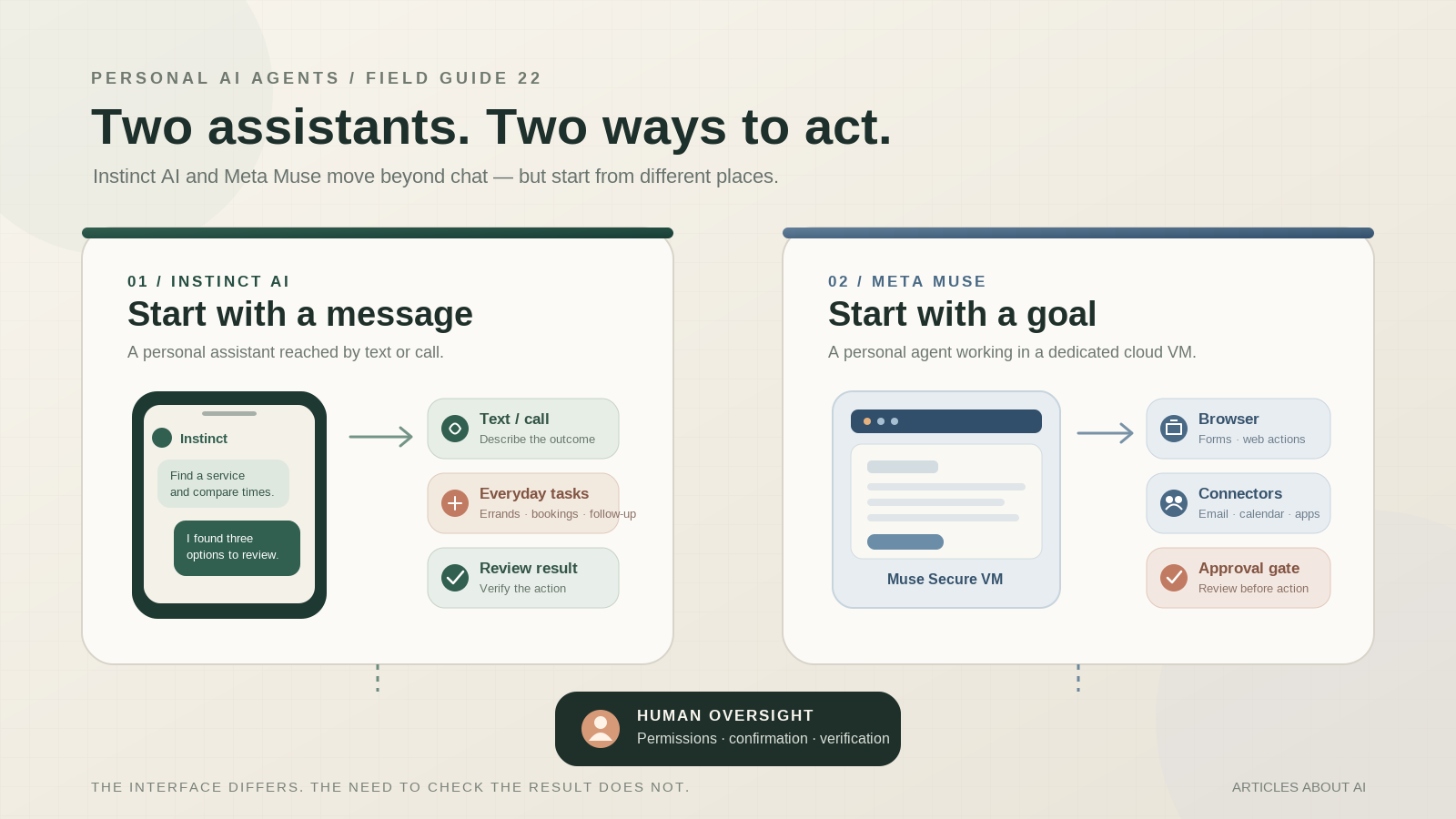
Instinct AI and Meta Muse are competing for a similar role: a personal agent that can take everyday work off a user’s hands. Both are designed to move beyond answering questions. They can work with connected services, use a browser, and help with tasks such as arranging travel, handling messages, shopping, or coordinating plans. Their differences are in the interaction model, the public architecture, the way permissions are presented, and the maturity of their published feature documentation.
The short answer is that Meta Muse has the more explicitly documented cloud-agent environment and a broader visible connector story, while Instinct offers a simpler text-or-call interface focused on personal delegation. Muse is not simply the Meta AI chatbot renamed: it is a personal agent powered by Meta’s Muse model family. Instinct is a separate assistant from Spear Street Technology. Neither product is guaranteed to complete every task on every service, and neither should be given unrestricted authority over important accounts.
Instinct AI vs Meta Muse: quick comparison
| Area | Instinct AI | Meta Muse |
|---|---|---|
| Product focus | Personal assistant for practical tasks and errands | Personal agent for goals, projects, and everyday work |
| Main interaction | Text or phone call; the official site says it can use a phone and computer | Muse app on mobile and desktop, web, and WhatsApp; voice mode is available in supported markets |
| Agent environment | Public materials describe phone, computer, browser, and connected-service actions; a detailed infrastructure specification is not published | Dedicated, persistent, isolated Muse Secure VM with a full browser |
| Everyday tasks | Groceries, train bookings, flowers, reservations, services, and other errands | Email, travel, shopping, price checks, refunds, calendars, research, and multi-step goals |
| Connected services | Google Workspace and other services the user connects; browser interaction may reach other third-party sites | Connectors for email, calendar, Instagram, and a growing range of apps and brand partners |
| Background work | Personal task delegation and proactive messages; public documentation does not provide a complete scheduler specification | Can continue working after the app is closed and return when something changes or approval is needed |
| Human control | User-directed tasks, safeguards, and meaningful human oversight required by the Terms | Per-connector permissions, activity history, approval before sensitive actions, and a separate security agent |
| Privacy disclosures | Google Workspace API data is excluded from model training; other service data has separate opt-out and Vault rules | Meta says VM conversations are not shared with ad systems; model-improvement use can be switched off in Data controls |
| Current pricing | Terms say Instinct is currently available without charge, with notice required before future fees | Free usage limit plus optional paid subscriptions; Meta does not publish a single global price in its public product overview |
| Availability | Operated in the United States; users elsewhere access it on their own initiative, subject to local law and account access | Confirmed launches include the US, Canada, Mexico, and UK; availability and connectors vary by market |
| Best fit | People who want to delegate personal errands through a direct message or call | People who want a persistent agent, a dedicated cloud workspace, and a wider connector-led workflow |
This is a comparison of documented product capabilities, not a controlled performance test. A feature may be unavailable to a particular account, country, connected service, or website. Check the controls shown in the product before relying on any capability.
1. Two products with different starting points
Instinct’s official homepage describes it as a personal assistant that understands what the user is working on and what matters to them. Its interface is deliberately familiar: users can text or call it. The examples are practical rather than abstract—ordering ingredients, booking a train, sending flowers, or finding a court for the weekend.
That makes Instinct a communication-first assistant. The user describes an outcome in ordinary language, supplies relevant details, and delegates the steps needed to reach it. The product’s appeal is that the user does not have to think first about which app or website should handle the task.
Meta Muse starts from a similar ambition but makes its agent environment more explicit. Meta describes Muse as a personal AI agent that can plan around a goal, work across connected apps and websites, and continue tasks in the background. It can be reached through the Muse app, the web, and WhatsApp, with voice interaction in supported locations.
One naming distinction matters. Muse is the personal agent; Muse Spark is the model that initially powers it. Meta announced Muse Spark as the first model in its Muse family in April 2026. The personal Muse product followed in September. The model name and the agent product should not be treated as interchangeable.
The products also communicate their ambitions differently. Instinct presents a single assistant that can use a phone and computer. Meta describes a persistent cloud computer, a browser, connectors, a permission system, and a separate security layer. That extra public detail makes Muse’s architecture easier to evaluate from documentation, although it does not prove that Muse will complete a particular task more reliably.
2. Everyday errands: both can act, but the workflow differs
Instinct is strongly oriented toward personal logistics. Its homepage gives examples such as ordering groceries, buying ingredients for a recipe, booking a train, sending flowers, and finding a local sports court. Its Privacy Policy also describes scheduling appointments, researching and booking travel, and managing subscriptions.
A typical Instinct request might be:
- Find three nearby repair services and ask about their availability.
- Compare train options for Friday evening and prepare the best choice.
- Arrange a restaurant reservation for a specified date and party size.
- Review a renewal message and remind me before the subscription is charged.
Meta Muse covers much of the same territory. Meta’s current Muse product page lists web browsing, purchases, reminders, goal tracking, document creation, image generation, and connections to apps and services. Its November 23, 2026 UK launch announcement describes tasks such as booking travel, chasing a refund, searching for a cheaper energy deal, organizing a school calendar, and turning a saved travel Reel into an itinerary.
The difference is not that one can perform errands and the other cannot. Both products are intended to move from an instruction to a sequence of actions. Muse’s public materials show a more elaborate goal-and-project workflow: it can create a plan, coordinate resources, continue working after the app is closed, and return when something changes or when approval is required. Instinct’s public positioning is more concise and conversational.
For practical examples of Instinct’s approach, see How to Use Instinct AI to Manage Everyday Tasks, How to Use Instinct AI to Find Services and Contact Businesses, and How to Use Instinct AI to Handle Personal Errands.
3. Browser actions and the cloud-computer difference
A personal agent needs somewhere to perform work. It may have to open a website, read a page, fill in a form, compare options, or prepare a transaction. The public descriptions of Instinct and Muse are noticeably different here.
Instinct’s homepage says it can use a phone and computer in the same way a person does. Its Terms and Privacy Policy describe actions through connected third-party services and browser interaction with other websites and applications. The policy gives examples such as booking a restaurant reservation or writing an email. However, the public documentation does not provide a detailed infrastructure specification showing exactly where every action runs or how the execution environment is isolated.
Meta is more explicit. Its Muse product page describes Muse Secure VM as a persistent, isolated Linux computer with a full browser shared by the user and the agent. Meta says the user can intervene in that environment while Muse completes tasks. The design article adds that Muse has its own computer, file system, terminal, and browser, and can build tools needed for a task.
This is a meaningful architectural distinction in the public record. It gives Muse a clearly described working environment for browser-based tasks and persistent activity. It does not mean that every website will cooperate, that every form can be submitted, or that a transaction will succeed. Sites can block automation, require identity checks, or introduce steps that need the user.
Practical verdict: Muse has the clearer published cloud-computer model. Instinct’s public materials describe the ability to use a phone, computer, and browser, but do not disclose an equivalent technical specification. That is a difference in transparency, not proof that one system is inherently safer or more capable.
4. Connected apps and services
The value of an AI agent depends heavily on what it can access. A model cannot update a calendar it cannot reach, and a browser cannot complete a purchase if the store blocks the workflow or requires a step the agent cannot perform.
Instinct’s Privacy Policy explains that users can connect Google Workspace. Depending on the permissions granted, this can give the service access to Gmail, Google Calendar, related message metadata, event details, and other content shared through Google Workspace APIs. Instinct also says its browser functionality may interact with third-party websites and services that the user has not separately connected.
Meta Muse uses a connector model. Meta’s product overview identifies email, calendar, Instagram, and other apps as services users can connect. Its November UK announcement named global partners such as Spotify and OpenTable, along with UK services including Marks & Spencer, ASOS, Currys, Ocado Retail, Trainline, Argos, Sainsbury’s, and easyJet. Some connectors allow access to a user’s own account; others let Muse navigate a partner’s website.
Meta has also announced a separate Muse for Small Business expansion, with connectors for tools such as Asana, Box, Canva, Dropbox, Figma, QuickBooks, Notion, Shopify, Slack, Stripe, and Zoom. That is relevant to the wider Muse platform, but business connectors should not be assumed to be available in every personal Muse account.
The practical difference is that Instinct combines connected services with browser-based interaction, while Meta is building a more visible connector and partner ecosystem around Muse. In both cases, the user should check the actual connector list and permission scopes shown in the account.
5. Background work, memory, and proactive assistance
A personal agent becomes more useful when it can keep track of a goal instead of waiting for a new prompt after every step.
Meta says Muse can continue working after the app is closed. It can monitor a task, respond to relevant changes, and return when it needs approval or has something meaningful to report. The design article describes persistent memory, side chats for separating projects, and proactive messages that can be adjusted or turned off.
Instinct’s product description also emphasizes understanding what the user is working on and what matters to them. Its terms allow the assistant to send proactive text messages and task updates, and its homepage describes an assistant that can be contacted by text or call. However, the public documentation does not provide a complete specification of a recurring scheduler, background event system, or memory controls comparable to Meta’s published Muse materials.
This means Muse currently has a more detailed public description of persistent background work. Instinct may still be useful for ongoing personal delegation, but users should confirm the scheduling and memory controls actually available in their account rather than assume that every task can run indefinitely.
6. Privacy and security: the policies are not equivalent
Both assistants can handle sensitive information. The relevant question is not which company uses the word “secure” more often; it is what data the product can access, where it is stored, how it is used, and what controls the user receives.
Instinct’s published commitments
Instinct’s Privacy Policy, revised November 17, 2026, makes a specific distinction for information received directly through Google Workspace APIs. It says that this data is not used to evaluate, fine-tune, train, or improve AI models, and is not used for advertising. The policy also says that data from Google Workspace is processed under Google’s User Data Policy and Limited Use requirements.
Other information has different rules. Instinct says some information collected through the service may be used to develop and improve its products, including model training, unless the user opts out in settings. Material added to the Instinct Vault is treated separately and is not used to train AI models. The Workspace commitment should therefore not be generalized to every message, file, or other connected service.
Meta Muse’s published controls
Meta says each Muse user has a separate virtual machine in the cloud and that one user’s agent cannot access another user’s VM. The Muse product page describes a Secure Credentials Store: the agent can use authorized credentials without the model seeing the actual password. Meta also says Muse asks for approval before important actions such as sending an email or making a purchase, and that a separate security agent checks actions against the permissions granted.
Meta’s November 23 privacy guidance says conversations and VM data are not shared with Meta’s advertising systems. It also says the setting for using Muse interactions to improve Meta AI is on initially and can be switched off in Data controls. Meta says interactions containing private messages such as emails and Instagram Direct Messages are not used to develop and improve its AI models.
The same guidance says users can inspect and edit memory, disconnect services, and review an activity history. Meta’s Help Center describes Muse Confidential VM as a future option, not a currently available default. It would be inaccurate to imply that Meta is already unable to access the standard Muse VM.
What this means for users
The privacy approaches are different, not directly interchangeable. Instinct makes a particularly explicit no-training commitment for Google Workspace API data. Meta describes an isolated VM, a credential store, permission checks, and a user control for model-improvement use. Neither description removes the need to review access, retention, and approval settings.
For a connected email account, start with read-only access if that is sufficient. Do not provide passwords in ordinary prompts. Require confirmation before sending a message, buying something, changing account settings, or sharing personal information. Check the original service after the agent reports that an action is complete.
For related practical examples, see How to Use Instinct AI to Manage Emails and Follow-Ups and How to Use Instinct AI to Organize Your Calendar and Appointments.
7. Pricing and availability as of November 26, 2026
Pricing and access need careful wording because both products are changing and their public pages do not provide the same level of detail.
Instinct: Its Terms of Service, last revised November 17, 2026, say that Instinct is currently available without charge. The same section reserves the right to introduce fees for access or particular features, with notice before those fees become payable. The Terms say the service is operated in the United States and that people accessing it from other locations do so on their own initiative and are responsible for local-law compliance. The homepage offers login and an invite-a-friend route, while the Terms refer to waitlist-status messages. The public documentation does not provide a complete country-by-country access table or a guaranteed wait time.
Meta Muse: Meta’s official product page says Muse has a free usage limit. Users who reach that limit can wait for it to refresh or upgrade to a paid subscription. Meta’s November 23 UK announcement says Muse is free for most needs, with optional subscriptions for higher usage. Meta does not publish one global price in the public product overview; plan availability and prices should be checked in the app or on the subscription screen for the user’s region.
Availability is also staged. Meta’s announcements confirm Muse in the United States and Canada, a Mexico rollout announced on November 5, and a UK launch on November 23 for people aged 18 and over through iOS, Android, muse.ai, and WhatsApp. These announcements do not establish universal availability. Connectors, voice features, and subscriptions may differ by country.
The comparison is therefore not simply “free versus paid.” Instinct’s current Terms say no charge, but allow future fees after notice. Muse has a free allowance and optional paid usage, but its public product page does not state a single worldwide subscription price. Check the current account-specific offer before deciding.
Which personal AI agent should you choose?
Choose Instinct if:
- You prefer to delegate through a text message or phone call.
- Your main use cases are errands, reservations, travel, shopping, and contacting services.
- You want a simple interaction model rather than a visible cloud workspace.
- The service and the required features are available to your account.
Choose Meta Muse if:
- You want a persistent cloud computer and browser for longer tasks.
- You value a visible connector ecosystem for email, calendars, social apps, and partner services.
- You want background work, goal tracking, side chats, and proactive updates.
- You prefer explicit permission controls, an activity history, and approval prompts before sensitive actions.
Final verdict
Meta Muse currently offers the more fully documented agent environment; Instinct offers the more minimal communication-first experience. Muse’s dedicated Secure VM, published connector ecosystem, persistent background work, and detailed permission model give it a broader visible feature set. Instinct’s appeal is the simplicity of handing a personal task to an assistant by text or call, without making the user think about the underlying workflow.
That does not establish a universal winner. A wider feature list does not prove higher task success, and a simpler interface does not guarantee that a service can complete a transaction. The right choice depends on the task, the country, the connected services, the price shown to the account, and the level of access the user is prepared to grant.
Frequently asked questions
Is Meta Muse the same as Meta AI?
No. Meta AI is the broader assistant experience across Meta products. Muse is a personal AI agent designed to take multi-step actions across a dedicated cloud environment and connected services. Muse Spark is the model family that powers the agent.
Is Instinct AI better than Meta Muse?
Neither is universally better. Instinct is more directly centered on text- and call-based personal delegation. Muse has a more explicitly documented cloud computer, connectors, persistent background work, and permission controls. The better fit depends on the user’s workflow and regional access.
Is Meta Muse free?
Meta says Muse is free with a usage limit. Users can wait for the allowance to refresh or subscribe for more usage. The public product page does not state one global subscription price.
Is Instinct AI free?
Instinct’s Terms of Service, revised November 17, 2026, say it is currently available without charge. They also reserve the right to introduce fees after giving notice, so the current terms should be checked before relying on its price.
Can Meta Muse keep working after I close the app?
Meta says Muse can continue working in the background after the app is closed and return when something changes or it needs approval. The exact task and connector still determine what it can complete.
Does Meta Muse ask before making purchases or sending emails?
Meta says Muse asks for approval before important actions such as sending an email or making a purchase. Users can configure permissions for connected services, but they should still review the proposed action and final result.
Is Meta Muse available worldwide?
No universal availability claim is supported by Meta’s current announcements. Meta has confirmed launches in the United States, Canada, Mexico, and the United Kingdom, but access, connectors, voice features, and subscriptions vary by market.
Sources and further reading
- Instinct — Official website
- Instinct — Terms of Service, revised November 17, 2026
- Instinct — Privacy Policy, revised November 17, 2026
- Meta — Introducing Muse: The World’s First Personal AI Agent Built for Everyone, September 8, 2026
- Meta AI — Muse: Features, capabilities, and FAQs
- Meta — Muse Does the Work, You Stay in Control, November 23, 2026
- Meta — Introducing Muse in the UK, November 23, 2026
- Meta — The Future Is for Everyone: Muse for Small Business, September 29, 2026
- Meta — How We Built Safety Into Muse
- Meta — How We Designed Muse
- Meta Help Center — How Muse handles your privacy, safety and security
- Meta — Introducing Muse Spark, April 8, 2026