
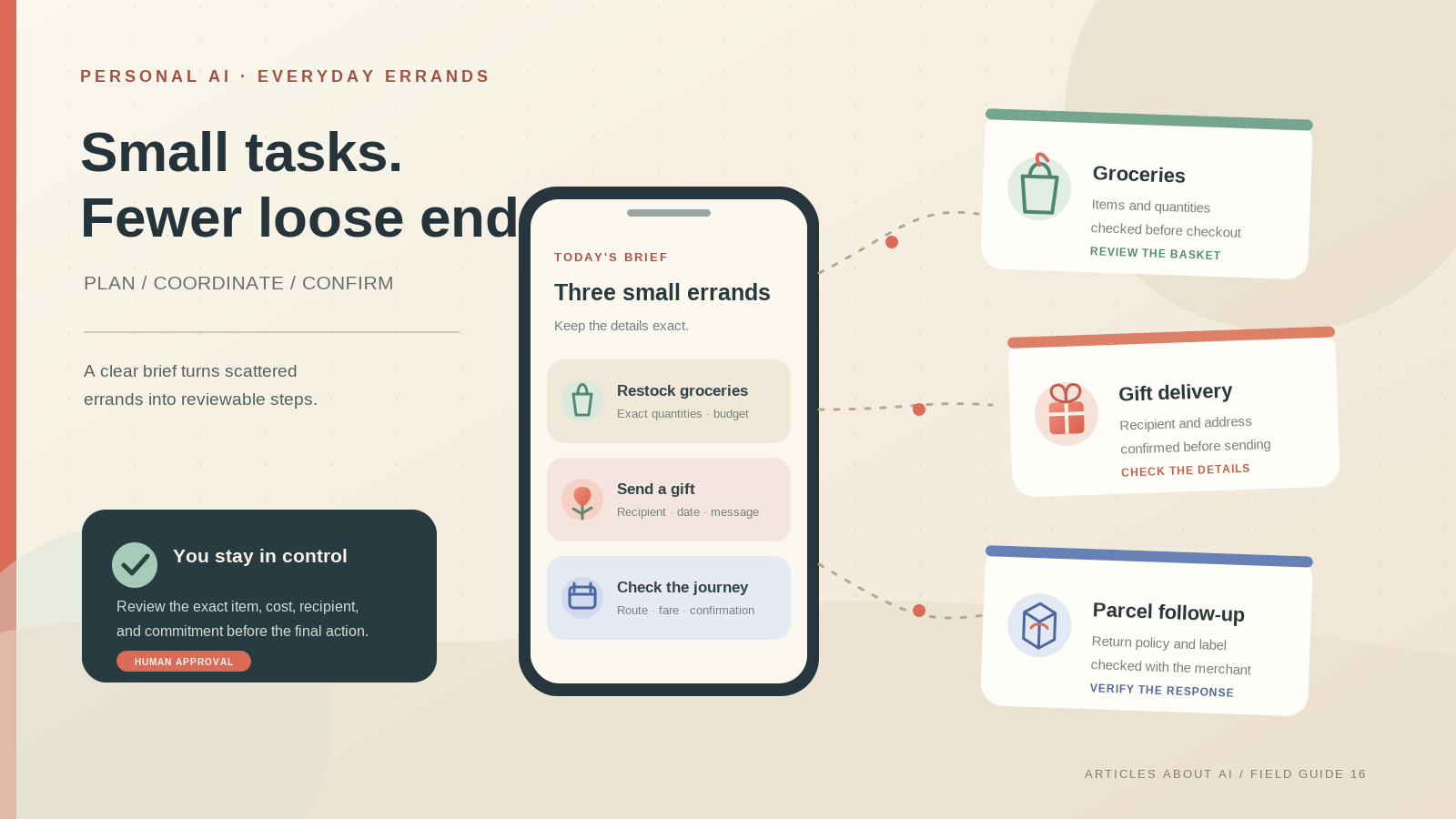
Personal errands are rarely difficult because of one complicated decision. They become time-consuming because several small steps have to line up: remembering what is needed, checking availability, choosing a provider, sharing the right details, arranging delivery or collection, and following up when something changes.
Instinct is designed to take on parts of that coordination as a personal AI assistant. You can text or call it, and its official website says it can use a phone and computer to help with tasks such as ordering groceries, arranging recipe ingredients, booking a train, sending flowers, and finding a place to play a sport. The useful distinction is that Instinct can help organize and carry out supported digital actions; it cannot physically collect a parcel, carry shopping, repair an appliance, or attend an appointment for you.
This guide explains how to use Instinct AI for personal errands, which examples are documented by the company, how to write precise requests, and how to keep control of purchases, messages, bookings, and location information.
What personal errands can Instinct AI help with?
Instinct’s official website describes a text- or call-based assistant that can use a phone and computer. Its public examples include ordering groceries and ingredients, booking a train, sending flowers, and finding a court for a recreational activity. The company’s Privacy Policy, last revised November 17, 2026, also describes everyday tasks such as scheduling appointments, researching and booking travel, and managing subscriptions.
Those examples point to several practical categories:
| Errand | What the public evidence supports | What still needs checking |
|---|---|---|
| Groceries and ingredients | The official homepage explicitly shows ordering groceries and ingredients for a recipe | Exact quantities, substitutions, delivery address, fees, and the final basket |
| Flowers and gifts | Sending flowers to a friend is an official example | Recipient details, delivery date, card wording, substitutions, and total price |
| Transport | Booking a train home for the weekend is an official example | Passenger details, route, departure time, fare rules, and confirmation |
| Location-related reminders | Instinct has described location sharing and examples such as reminders that become relevant when you arrive somewhere | Whether location sharing is enabled, what location data is shared, and whether the reminder feature is available to your account |
| Returns and follow-ups | TechCrunch reported that a user could forward an order confirmation so Instinct could contact support about a return or replacement and obtain a return label | Merchant policy, eligibility, deadlines, shipping costs, and whether the merchant actually accepts the request |
| Appointments and recurring tasks | The Privacy Policy names appointment scheduling and subscription management as task examples | Provider access, account permissions, cancellation conditions, and the status of the requested change |
The table separates documented examples from the checks that remain the user’s responsibility. It is not a promise that every merchant, transport provider, location feature, or workflow will work for every account.
For a broader overview, see How to Use Instinct AI to Manage Everyday Tasks. That guide covers the wider daily routine; this article focuses on the small errands that need coordination across a store, service, delivery, or third-party account.
1. Start with a clear errand brief
A short instruction such as “sort out my groceries” leaves important decisions unstated. Instinct may need to infer quantities, brands, delivery times, substitutions, or the amount you are willing to spend. Those are precisely the details that should not be left to guesswork.
Before delegating, define:
- The outcome: what you want delivered, booked, sent, returned, or arranged.
- The people and place: recipient, delivery address, pickup point, or the area in which the errand must happen.
- The timing: a specific date and a realistic delivery or appointment window.
- The exact details: quantities, sizes, model numbers, names, spelling, and other information that cannot be guessed safely.
- The budget: a maximum total, including delivery, service fees, taxes, and tips where relevant.
- Acceptable alternatives: whether substitutions are allowed and which ones are acceptable.
- The action boundary: whether Instinct may research only, prepare an order, contact a provider, or complete a specific action after approval.
A useful first message is:
Help me handle this errand: [describe the result]. The relevant location is [area or address], and the deadline is [date and time]. My budget is [maximum total, including fees]. Use only these preferences: [details]. First research the options and tell me what information is missing. Do not order, book, send, cancel, or pay until I approve the exact action.
This makes the task measurable. It also gives the assistant a reason to stop and ask for missing information instead of filling gaps with assumptions.
2. Use Instinct for grocery and household restocking
Grocery ordering is one of the clearest examples on Instinct’s official homepage. It can be useful when you already know what you need but do not want to repeat the process of finding items, comparing available options, and arranging delivery.
Give the assistant a structured list rather than a broad description. Include the number of people, quantity, preferred brand or acceptable equivalent, dietary restrictions, and delivery window. If a product has a size or unit that matters, state it explicitly.
Try this prompt:
Prepare a grocery order for [number] people. Add exactly [quantity and unit] of [item], [quantity and unit] of [item], and [quantity and unit] of [item]. Use [preferred brands] where available. Do not substitute fresh, dietary, or allergy-sensitive items without asking me. Keep the full total, including delivery and service fees, below [amount]. Show me the basket and final total before checkout.
Review the basket item by item. Check package size, weight, quantity, substitutions, delivery address, delivery window, and the final amount. A product name can refer to several sizes, and a store may substitute a different brand or pack size when stock is low.
This is not a theoretical concern. In an October 10, 2026 report, Business Insider described an Instinct user who asked for chicken wings and drumsticks without specifying a quantity and received 20 pounds. The user believed the assistant had inferred the quantity from earlier shopping history. The lesson is straightforward: specify the amount and require a final basket review before an order is placed.
For a deeper look at product discovery and price comparisons, read How to Use Instinct AI for Online Shopping and Product Research.
3. Arrange a gift or flower delivery
Sending flowers is another example shown on Instinct’s official website. A gift order involves more than selecting an item: the recipient’s address, delivery date, availability, budget, and message all matter.
A practical request is:
Find flower arrangements that can be delivered to [recipient’s area] on [date]. My maximum total is [amount], including delivery and taxes. The style should be [description]. Use this card message exactly: “[message].” Do not choose a substitute, change the message, or place the order until I review the item, recipient address, delivery window, and final price.
Check the recipient’s name and address carefully. Confirm whether the delivery date is guaranteed or only estimated, whether the arrangement may differ from the photograph, and what happens if the recipient is unavailable. If the seller proposes a substitute, review it before accepting.
The same approach can be adapted to a birthday gift or another small purchase, but a suggested prompt is not proof that every retailer or product category is supported.
4. Book a train or arrange a simple journey
Instinct’s homepage gives booking a train as an example. For a transport errand, provide the exact route and travel requirements rather than asking for “the cheapest ticket.”
Include the departure and arrival stations, date, acceptable departure window, passenger count, luggage needs, and whether a flexible or refundable fare is important.
For example:
Find train options from [origin station] to [destination station] on [date]. I need to arrive by [time]. Compare the full fare, departure and arrival times, journey duration, changes, luggage rules, and cancellation conditions. Do not buy a ticket yet. Show me the exact service and final price first.
Before purchase, verify the passenger name, date, stations, time zone if relevant, fare class, seat choice, and refund rules. After the transaction, ask for the booking reference and confirm it on the transport provider’s own service.
For a complete travel workflow, including flights, accommodation, and itinerary planning, see How to Use Instinct AI to Plan Trips and Organize Travel.
5. Use email to move a return or delivery problem forward
Some errands begin after a purchase. A parcel may be delayed, an item may be unsuitable, or a merchant may need an order number before it can explain the return process.
Instinct’s own email address was described in a September 9, 2026 TechCrunch report. The report said users could forward an order confirmation so the assistant could contact customer support about a return or replacement, ask what information was needed, and obtain a return label to print. Treat this as a reported workflow, not a guarantee that every retailer accepts agent correspondence or that every return will be approved.
A careful prompt would be:
I am forwarding the order confirmation for [merchant and order]. Check the merchant’s published return policy and the return deadline. If a question is necessary, contact support using the order details I provided. Ask whether the item is eligible for a return or replacement and whether there are shipping or restocking fees. Do not accept store credit, pay a fee, choose a replacement, or agree to a new delivery date without asking me. Send me the merchant’s response and any return instructions.
Do not forward more information than the task requires. Remove unrelated order details or personal information where possible. If a return label is produced, check the destination, carrier, expiry date, and whether the merchant expects the original packaging.
6. Make location-aware reminders more useful
Instinct has also described location sharing. In a September 9 report, TechCrunch said the feature could help the assistant understand where a user is, find nearby businesses, and provide context for routes and itineraries. In a September 5, 2026 post from founder Noah Shinn, he described location-triggered assistance, including a reminder to pick up a package after arriving home.
A location-aware reminder can be useful when an errand depends on being somewhere: remembering a parcel when you return home, preparing travel information near an airport, or prompting you about an item when you reach a particular place. However, a location signal is not proof that a shop is open, a parcel is ready, or a task has been completed.
If the feature is available to you, give the reminder a precise trigger and a clear action:
If I arrive at [place], remind me to [specific errand]. Do not contact anyone, place an order, or change my calendar. If you cannot determine that I have arrived reliably, ask me instead of guessing.
Location information is sensitive. Share it only when the feature is useful, review device permissions, and avoid enabling continuous location access merely for a one-time reminder. Instinct’s Privacy Policy says it may collect approximate location and, if the user chooses to share it, precise geolocation.
7. Combine errands into a plan without giving away every decision
Several small tasks can sometimes be organized into one practical plan: collect a parcel, buy a few items, send a gift, and arrive at an appointment on time. Instinct can help gather information and prepare a proposed sequence, but you should not assume it can physically complete the stops or that every business has current opening hours and availability.
Ask for a plan first:
Help me organize these errands for [date]: [list]. The starting area is [location], and I need to finish by [time]. Consider the stated opening hours, appointment windows, delivery cutoffs, and travel time. Separate tasks that can be handled online from tasks that require me to visit a place. Show the proposed order, missing information, estimated costs, and anything that needs a phone call. Do not book, buy, cancel, or send messages yet.
Review the plan for unrealistic travel times and dependencies. A parcel collection may require a pickup code; a return may require a printed label; a shop may close before the appointment ends. Ask Instinct to identify these prerequisites rather than treating every item as a simple stop.
For local providers and business outreach, the related guide How to Use Instinct AI to Find Services and Contact Businesses explains how to compare providers, prepare questions, and review replies.
A practical prompt formula for personal errands
The most reliable errands prompt contains five elements:
- Goal: the exact outcome you want.
- Context: names, locations, dates, order details, or relevant preferences.
- Constraints: budget, timing, acceptable alternatives, and information that must not be shared.
- Permission: what the assistant may research, contact, book, buy, or change.
- Proof of completion: the receipt, reference number, confirmation, reply, or other evidence you expect.
For example:
Complete the research for [errand] using [details]. Keep the total below [amount] and use [location and date]. You may compare options and prepare the next step, but do not make a purchase or commitment until I approve the exact item, provider, and total. When finished, give me the source, the status, any fees or conditions, and the confirmation reference if an action was completed.
This structure is more useful than “take care of it.” It makes the scope clear and gives you a way to verify the result.
What Instinct cannot do for a physical errand
Instinct can interact with digital services and communicate with people, but it is not a person who can leave the house. It cannot physically pick up a parcel, carry groceries, inspect a damaged product, repair a device, sign a paper form, or guarantee that a courier or business will do what it promised.
Some tasks also depend on third-party systems. A checkout may require a CAPTCHA, a merchant may refuse an automated interaction, a transport provider may change availability, or a support representative may require the account holder to verify their identity. The assistant may be able to prepare the next step, but you may still need to complete it yourself.
The service’s own Terms of Service, revised November 17, 2026, say that third-party services control their own terms and that purchases made through Instinct remain the user’s transactions. The terms also say actions may contain errors or be difficult to reverse, and require meaningful human oversight. These limits matter more when an errand involves money, another person’s information, a deadline, or a binding commitment.
Safety, cost, and availability checks
Instinct’s Terms say the service is currently available without charge, while reserving the right to introduce fees with notice. That does not make the errands themselves free: a store, delivery company, transport provider, or service professional can charge its own price, taxes, delivery fees, deposits, or cancellation costs. Your mobile provider may also charge for messages or data.
Availability is not universal. The Terms say Instinct does not guarantee that every feature will work on every device or in every geographic location, and describe some capabilities as early-access offerings. A task that works for one user may not be available to another.
Before you delegate an errand:
- Confirm the exact item, quantity, address, date, and recipient.
- Set a maximum total that includes delivery, tax, tips, and service fees.
- Tell Instinct which substitutions or changes are unacceptable.
- Require review before a purchase, cancellation, or binding agreement.
- Check the merchant’s or provider’s own terms and confirmation.
- Share only the account, location, and personal details needed for the task.
- Keep receipts and reference numbers until the errand is genuinely complete.
Instinct’s Privacy Policy explains what information may be collected through connected services and location sharing. Its Terms of Service explain the user’s responsibility for actions taken on third-party services. Read both before connecting sensitive accounts or allowing ongoing autonomous actions.
Frequently asked questions
Can Instinct AI run personal errands for me?
It can help coordinate supported digital tasks, such as ordering groceries, sending flowers, booking a train, arranging appointments, and contacting services. It cannot physically perform an errand that requires a person to travel, carry, inspect, or repair something.
Can Instinct AI order groceries?
Ordering groceries is one of the examples shown on Instinct’s official website. Give exact quantities, preferred products, acceptable substitutions, delivery details, and a maximum total. Review the basket before checkout.
Can Instinct AI remind me to pick up a package?
Instinct’s location-sharing feature has been described with arrival-related reminders, including a package pickup reminder when a user gets home. Check whether location sharing and the relevant reminder capability are enabled for your account, and verify that the package is actually ready for collection.
Can Instinct AI return an online order?
TechCrunch reported that a user could forward an order confirmation and ask Instinct to contact support about a return or replacement. The merchant still decides whether the return is eligible and what fees or conditions apply. Review the response and return label before sending anything back.
Is Instinct AI free to use for errands?
Instinct’s Terms of Service state that the service is currently available without charge, but allow the company to introduce fees with notice. Purchases, delivery, transport, and third-party services can still cost money.
Does Instinct AI work everywhere?
No universal geographic or device availability is guaranteed in the Terms. Third-party services, local merchants, payment methods, and early-access features can all affect whether a particular errand can be completed.
Sources and further reading
- Instinct — Official website
- Instinct — Terms of Service, revised November 17, 2026
- Instinct — Privacy Policy, revised November 17, 2026
- TechCrunch — Instinct now has its own email address, September 9, 2026
- Reuters — Instinct raises $1 billion and describes its everyday-task assistant, September 28, 2026
- Business Insider — Shoppers find AI agents need a short leash, October 10, 2026