
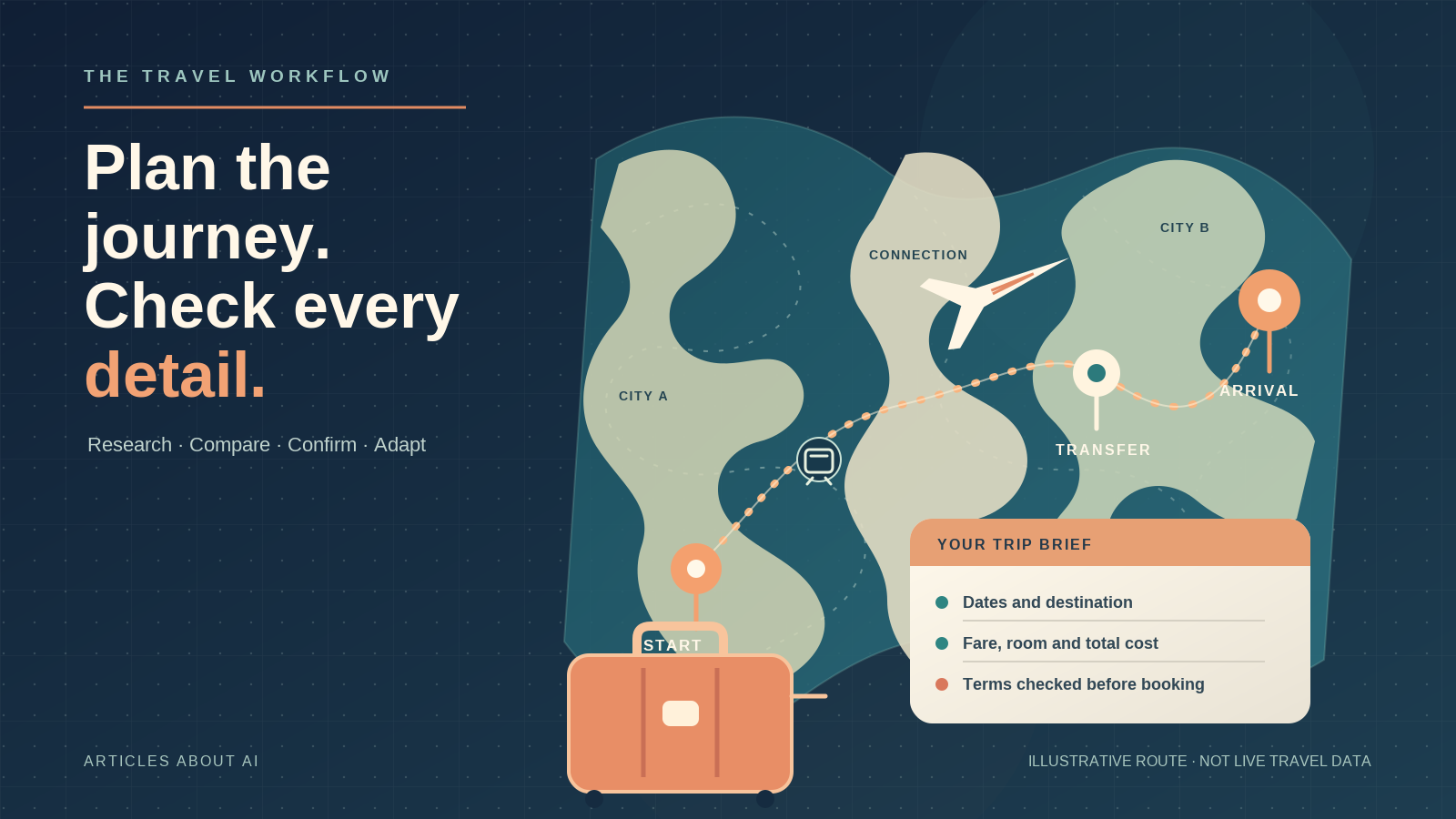
Planning a trip means coordinating more than a destination and a departure date. A useful plan has to account for flights or trains, accommodation, local transport, opening hours, reservations, budgets, time zones, and the terms attached to every booking. When one part changes, the rest of the itinerary may need to change with it.
Instinct is designed to help with that coordination as a personal AI assistant that you can text or call. It can use a phone and computer to work through tasks, and its current privacy policy explicitly lists researching and booking travel among the everyday tasks it supports. The practical opportunity is not simply asking an AI to suggest a holiday. It is asking an agent to research options, organize the details, and—where the relevant service and account access allow—help carry out parts of the booking process.
This guide explains how to use Instinct AI to plan trips, compare travel options, organize an itinerary, and respond to changes. It also separates publicly documented capabilities from assumptions, and shows how to verify the details before authorizing a purchase.
Can Instinct AI plan and book travel?
Instinct’s public materials establish travel as a core use case. Its official website says the assistant can be contacted by text or phone and can use a phone and computer in the way a person does. The homepage gives booking a train home for the weekend as an example.
The Instinct Privacy Policy, last revised November 17, 2026, is more explicit: it names “researching and booking travel” as an everyday task and explains that Instinct may interact with third-party websites, applications, and services to complete requests. It also describes processing information that a user makes available, such as messages, emails, documents, and location information where relevant.
Flight search has received a more specific product announcement. On October 7, 2026, founder Noah Shinn said that more than 20% of Instinct users had used it for flight-related help in the previous month. He announced a rebuilt flight-search and booking experience, describing deal discovery, one-tap booking, and help with lost baggage, missed connections, and cancellations. These are the founder’s product claims, not an independent guarantee that every airline, itinerary, or disruption can be handled. The announcement is available in Shinn’s original X post.
TechCrunch had earlier reported, on September 29, that Shinn said more than half of Instinct’s platform transactions were travel-related. That figure is founder-reported and the article notes that the calculation was not specified. It is evidence that travel is an important use case for the product, not an independently audited measure of booking success.
The distinction matters: Instinct can help with travel research and transactions, but a recommendation is not a ticket, a displayed fare is not a guaranteed price, and a booking attempt is not proof of confirmation. Access to individual features and third-party services can vary. Check the current Instinct website and your account before relying on a specific workflow.
What parts of a trip can you delegate?
It is more useful to divide travel into smaller tasks than to ask an agent to “organize everything.” Each stage has different information requirements and different consequences if something goes wrong.
| Travel task | What Instinct may help organize | What you must verify |
|---|---|---|
| Destination research | Compare places, neighborhoods, activities, and practical information | Official advisories, opening hours, local rules, and current conditions |
| Flights | Search options, compare fares, and assist with booking where supported | Passenger names, airports, dates, baggage, fare rules, and final ticket |
| Trains and ground transport | Research routes and help arrange transport | Stations, departure times, transfers, operator terms, and ticket status |
| Accommodation | Research stays and work through booking steps where supported | Exact property, room, occupancy, taxes, fees, and cancellation terms |
| Itinerary | Arrange activities and travel legs into a realistic sequence | Distances, local time, opening hours, and realistic transfer buffers |
| Trip changes | Help investigate delays, missed connections, cancellations, or baggage problems | The carrier’s live status, eligibility, available alternatives, and any extra cost |
| Trip administration | Organize confirmation details and reminders using information you provide or connect | That every booking is confirmed and the saved record matches the provider’s record |
The table describes potential workflows, not a promise that every feature is enabled for every account or route. Instinct’s public documentation does not provide a complete, permanent directory of supported airlines, hotels, rail operators, or countries.
Step 1: Give Instinct a complete travel brief
Start with a concise brief that describes the trip before asking the assistant to search or book. A vague request such as “Plan a trip to Italy” leaves important decisions unresolved.
Include:
- Origin and destination: Give the departure city or airport, destination, and any nearby airports or towns you would consider.
- Dates: State departure and return dates. Say whether you can leave a day earlier, return later, or travel at different times.
- Travelers: Specify the number of adults and children. Use passenger names exactly as they appear on the travel document only when needed for a booking.
- Budget: Set a total trip budget or separate limits for transport, accommodation, and activities. Say which currency you mean.
- Travel style: Explain whether you prefer direct flights, rail, economy or premium cabins, central accommodation, a slower pace, or fewer changes.
- Constraints: Mention accessibility needs, mobility limitations, dietary requirements, luggage, work commitments, or other relevant constraints.
- Must-do activities: List the places, events, people, or experiences that make the trip worthwhile.
- Booking preferences: Say whether refundable options, a named airline, a hotel loyalty program, or direct booking matters to you.
A useful first prompt is:
Help me plan a trip from [origin] to [destination] between [dates] for [number of travelers]. My total budget is [amount and currency]. I prefer [travel style and transport preferences]. I need [important constraints]. First prepare a research brief and identify the information you still need. Do not book, pay, cancel, or contact a provider. Show source links for time-sensitive details.
This first stage should produce a plan for research, not an irreversible action.
Step 2: Research the destination using current sources
Ask Instinct to build a destination overview before it starts filling each day with activities. Useful categories include:
- Neighborhoods and the practical differences between them
- Airport, rail, and local public-transport connections
- Attractions, museums, events, and their official opening hours
- Seasonal conditions and likely weather considerations
- Local payment methods and transport passes
- Accessibility and mobility information
- Local rules that visitors should understand
- Official travel advisories and entry requirements
For every important claim, ask for the original source and the date it was checked. Prefer government travel advice, immigration authorities, transport operators, official attraction websites, and the destination’s tourism authority. Reviews and travel blogs can add context, but they are not authoritative sources for visa eligibility, entry rules, or a carrier’s current schedule.
Try this prompt:
Research [destination] for travel between [dates]. Organize the results into neighborhoods, transport, attractions, local rules, and practical visitor information. For every time-sensitive claim, give me the original source URL and the date checked. Separate official information from traveler opinions. Mark anything you cannot verify as unconfirmed; do not fill gaps by guessing.
Do not treat an AI-generated summary as permission to enter a country. Visa and passport requirements depend on nationality, passport type, destination, transit route, purpose, and length of stay. Confirm them with the relevant government’s official immigration or embassy source before purchasing non-refundable travel.
Step 3: Compare flights by total journey value
The cheapest displayed fare is not always the best flight. Ask Instinct to compare the details that determine the actual journey:
- Operating airline and flight numbers
- Departure and arrival airports, not just city names
- Local departure and arrival times
- Direct flight or connection, including layover duration
- Whether a connection requires changing airports or terminals
- Cabin and fare class
- Carry-on and checked-baggage allowance
- Seat-selection and other optional charges
- Change, cancellation, and refund conditions
- Final amount and currency at checkout
A focused flight-search prompt might be:
Find flight options from [origin airport] to [destination airport] on [date], returning [date]. I prefer [departure window] and [direct flights or acceptable connections]. Compare the complete fare, baggage allowance, layover, arrival time, and change or cancellation terms. Show the airline or booking provider for each option. Do not purchase a ticket yet, and do not describe a fare as confirmed until the provider verifies it at checkout.
The October 7 flight update announced by Instinct’s founder is relevant here: the company says it rebuilt flight search and booking and can assist with some disruption tasks. If your account has that experience, you can ask it to compare flights and explain what it will do next. Still inspect the airline, itinerary, passenger details, and final fare before authorizing the transaction.
Step 4: Compare accommodation carefully
Hotel searches can conceal important differences between rates. Two listings for the same property may refer to different room types, payment schedules, or cancellation policies.
Ask Instinct to compare:
- Property name and full address
- Check-in and check-out dates
- Room type, bed configuration, and occupancy
- Total price for the entire stay
- Taxes, resort fees, cleaning fees, or other mandatory charges
- Breakfast, Wi-Fi, parking, and accessibility
- Prepayment, deposit, and payment-at-property requirements
- Cancellation deadline and refund conditions
- Distance from the places you plan to visit
Use this prompt:
Compare accommodation for [dates] in [area]. My maximum total budget is [amount and currency]. I need [room and accessibility requirements]. Show the property address, exact room type, total price including mandatory taxes and fees, breakfast details, payment schedule, and cancellation deadline. Link to the provider’s listing. Do not book until I approve one exact option.
If direct booking matters, say so explicitly and ask Instinct to identify who will actually take payment and issue the confirmation. A booking interface can route a transaction through an intermediary rather than the airline or hotel itself.
That is not a theoretical distinction. A November 13 report by Travel Weekly Asia summarized a Propellic study of 176 scripted travel-booking requests involving Instinct and Meta Muse. The study found that the agents often routed bookings through an intermediary, even when a traveler named a particular airline. In the accompanying user survey, many travelers stopped at research or shortlisting rather than completing the purchase through an agent. The study is an early sample of two products, not a universal measure of all AI travel bookings. Read the report and its research scope.
Step 5: Turn research into a realistic itinerary
Once the transport and accommodation options are understood, ask Instinct to arrange the activities into a day-by-day plan. A good itinerary respects geography and time, not just a list of popular attractions.
For each day, request:
- Morning, afternoon, and evening activities
- Exact addresses and official websites
- Current published opening hours, if verified
- Ticket or reservation requirements
- Estimated travel time between stops
- Meal breaks and unstructured time
- A backup option for closures or bad weather
- Any activity that needs advance confirmation
A useful prompt is:
Build a day-by-day itinerary for [destination] from [date] to [date]. Use these priorities: [list]. Group nearby activities to reduce unnecessary travel. Include addresses, official links, published opening hours where verified, ticket requirements, and estimated travel time between stops. Leave realistic breaks and a backup option each day. Mark unverified details clearly.
Check the local time zone for every flight, train, event, and reservation. Overnight journeys can arrive on a different calendar date, and a tight connection may look possible in a text itinerary while being impractical in a real terminal. Leave enough time for immigration, baggage collection, airport transfers, and station changes.
A day with fewer, geographically coherent activities is usually more resilient than an overfilled schedule.
Step 6: Ask for a booking review before you authorize payment
When you are ready to book, separate the research request from the purchase instruction. Name the exact option and require the assistant to show the final details.
For a flight:
Prepare the booking for [airline and flight numbers] from [origin] to [destination] on [date] for [passenger names]. Before submitting, show the full itinerary, passenger details, baggage allowance, fare class, final amount, currency, and change or cancellation rules. Stop and wait for my approval before payment.
For a hotel:
Prepare the booking at [property and address] for [dates], [number of guests], and [room type]. Show the complete price, mandatory fees, payment schedule, refund conditions, and cancellation deadline. Do not submit payment or accept a non-refundable condition until I approve the exact booking.
For a train or transfer:
Prepare the [rail or transfer] booking for [date and route]. Show the operator, station or pickup point, local departure time, arrival time, passenger details, luggage rules, total price, and change conditions. Wait for approval before purchase.
A one-tap or otherwise streamlined checkout does not remove the need to review what is being purchased. Confirm the merchant, the total amount, and the booking conditions. If the assistant cannot show a clear final summary, complete the transaction directly with the provider instead.
Step 7: Keep a reliable record of the trip
After a booking, ask Instinct to organize the confirmation details into a single trip summary. If you have connected an eligible email or calendar service, it may be able to use that context to help organize confirmations and appointments. The current privacy policy explains that connecting Google Workspace can provide access to calendar and email information through Google Workspace APIs; this is optional and should be granted only if it is useful for the task.
A practical trip record should contain:
- Booking provider and confirmation reference
- Passenger or guest names as shown on the booking
- Dates and local times
- Airport, station, hotel, and transfer addresses
- Amount paid and any remaining balance
- Baggage, check-in, and room details
- Cancellation and change deadlines
- Contact details for the provider
- Outstanding tasks that still need direct confirmation
Keep the original confirmation emails, tickets, and travel documents. An AI-generated summary is convenient, but it should not be the only record you rely on at an airport, border, hotel desk, or station.
Step 8: Use Instinct to investigate disruptions
Travel is not finished when the ticket is issued. A delayed flight, missed connection, cancellation, or lost bag can create a chain of tasks involving the airline, hotel, ground transport, and other reservations.
Instinct’s founder said the redesigned flight experience is intended to help with lost baggage, missed connections, and canceled flights. If you encounter a problem, provide the flight number, date, booking reference, and the message you received from the carrier. Ask the assistant to identify the official carrier instructions and possible next steps.
For example:
My flight [number] on [date] has been [delayed/canceled]. Review the airline’s latest official update and my itinerary. Explain which connections or reservations may be affected, identify the airline’s official options, and show any change in price or conditions. Do not cancel, rebook, accept a voucher, or pay a fee without showing me the exact terms and receiving my approval.
Ask whether the assistant can monitor a specific issue, how long it will monitor it, and how it will notify you. Do not assume that a one-time request automatically creates continuous flight tracking or guarantees a rebooking. The airline or travel provider remains the source of truth for operational status and the options available on your ticket.
How reliable is Instinct for travel planning?
Travel is a strong use case for an agent because it combines research, comparison, transactions, and follow-up. But it is also a demanding test: prices and inventory change quickly, and a small mistake can have a financial consequence.
A September 23, 2026 first-person report in Business Insider described a traveler who tested several agents while planning a European trip. The writer said Instinct offered useful ideas and produced an itinerary, but found the process less transparent than another assistant and was unsure which earlier details had informed some personalized suggestions. That is one user’s account, not a controlled reliability benchmark, but it highlights why the user should ask for sources and inspect the agent’s work.
The November Propellic study reported by Travel Weekly Asia offers another caution: reaching a payment step is not the same as completing a successful booking, and the booking channel may not be the one a traveler expects. These findings do not make Instinct unsuitable for travel. They show why it is best treated as a coordinator whose research and actions need proportionate checks.
For more on the underlying agent capabilities, see Instinct AI Features Explained and How Instinct AI Works. For restaurant reservations, see How to Use Instinct AI to Book Restaurants and Make Reservations.
Common mistakes to avoid
Treating a suggested itinerary as a reservation. A plan is not a ticket or hotel confirmation. Verify each booking with the provider.
Comparing headline prices only. Include taxes, baggage, seat fees, resort fees, transfers, deposits, and cancellation costs.
Ignoring the booking channel. Check whether the airline or hotel, or an intermediary, will issue the booking and handle changes or refunds.
Relying on unverified entry information. Confirm passport, visa, transit, and entry requirements with official government sources.
Allowing a broad instruction to trigger multiple purchases. Ask for research first, then authorize one exact booking at a time.
Assuming every feature is available. Product rollouts, account access, region, and third-party site restrictions can affect what the assistant can do.
Sharing more personal information than the task needs. Passport details, precise location, travel dates, and account access can be sensitive. Review the permissions you grant and the information you send.
Frequently asked questions
Can Instinct AI plan a complete trip?
Instinct’s official privacy policy lists researching and booking travel as supported task examples, and its website demonstrates a train-booking use case. It can help coordinate parts of a trip, but public documentation does not guarantee that every transport, hotel, or activity provider is supported.
Can Instinct AI book flights?
The founder announced a redesigned flight-search and booking experience on October 7, 2026, describing deal discovery, one-tap booking, and assistance with certain flight disruptions. Whether a particular itinerary can be completed depends on current product access, route, provider, and the details of the booking.
Can Instinct AI book hotels and trains?
Instinct’s public materials describe travel research and booking generally, and the official homepage gives booking a train as an example. Hotel and other provider workflows depend on the sites and services Instinct can access for the particular request. Confirm the property, room, price, and terms directly before payment.
Can Instinct AI change a flight after a cancellation?
The founder has described help with missed connections and canceled flights as part of the redesigned flight experience. The available options still depend on the airline, ticket conditions, inventory, and the cause of the disruption. Check the airline’s own status and rebooking terms.
Does Instinct automatically monitor flight prices or delays?
Do not assume that it does. Ask the assistant to confirm exactly what it can monitor, for how long, and what notification or action it will provide. A one-time search is not proof of an ongoing alert.
Is Instinct available to every traveler?
The official website provides an account and invitation flow, but it does not publish a universal feature-availability matrix for every country, account, or provider. Check the current official site and your account before planning around a specific capability.
Should I let Instinct pay for a trip without reviewing it?
For high-value travel purchases, review the exact itinerary, passenger details, total cost, booking channel, and cancellation terms before authorizing payment. Keep the provider’s confirmation and use the provider’s official support channel if a booking is unclear.
Sources and further reading
- Instinct official website — product description and train-booking example.
- Instinct Privacy Policy — last revised November 17, 2026; describes travel research and booking, third-party interactions, and relevant data handling.
- Instinct Terms of Service — third-party services, user responsibilities, and actions.
- Noah Shinn’s October 7, 2026 flight-search announcement on X — founder’s description of the redesigned flight experience.
- TechCrunch, September 29, 2026: Instinct founder said more than 50% of transactions on the platform are travel-related.
- Business Insider, September 23, 2026: I used Muse, Instinct, and Grok Bot to plan my European vacation.
- Travel Weekly Asia, November 13, 2026: AI bookings don’t necessarily mean direct bookings.
For another perspective on using a personal AI agent to organize a journey, read our guide to planning a trip with Meta Muse AI and verifying travel details. For everyday delegation beyond travel, continue with How to Use Instinct AI to Manage Everyday Tasks.