
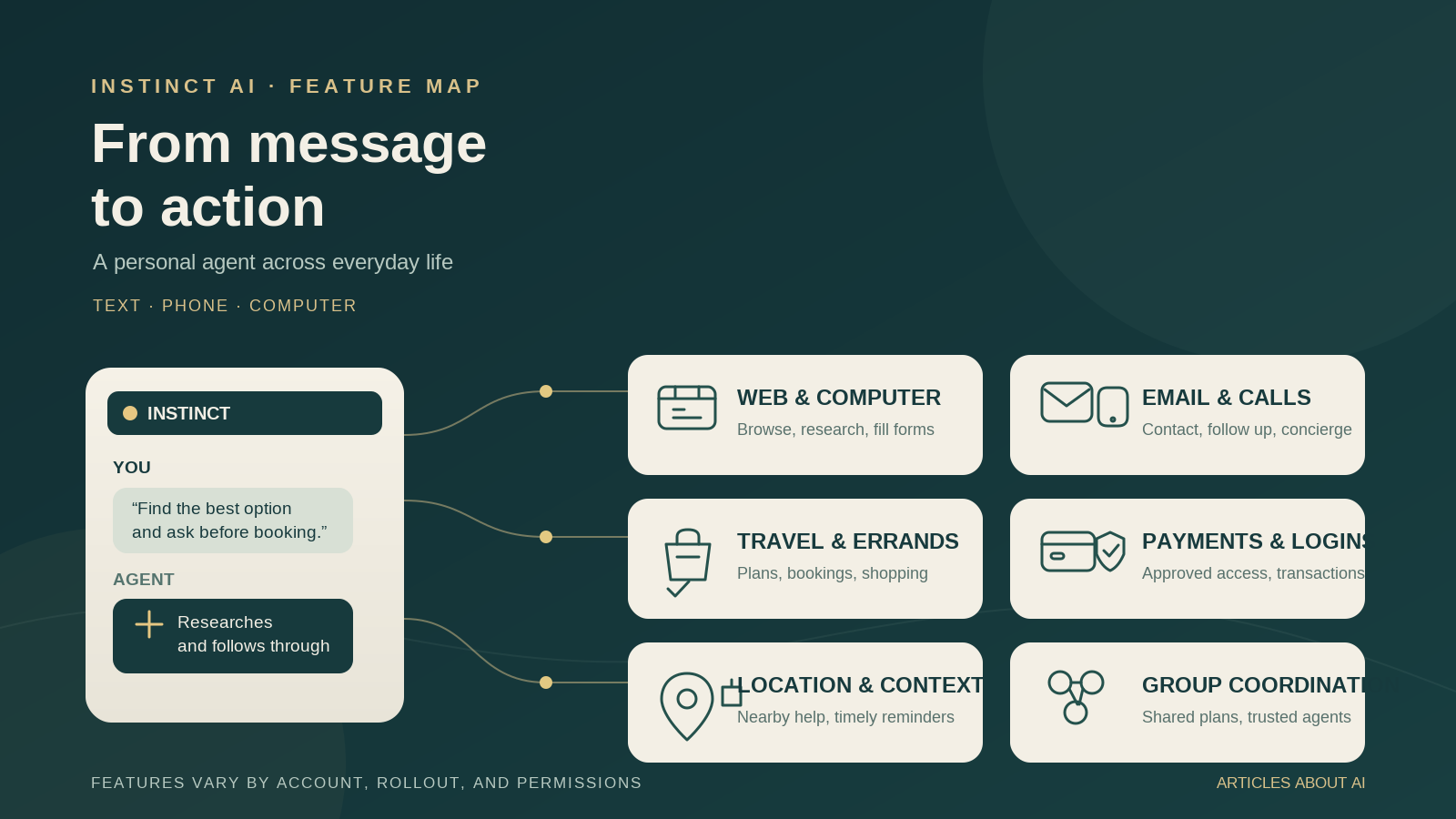
Instinct is designed to do more than answer questions: it is a personal AI agent that can use a phone and computer to work through tasks on a user’s behalf. Its public feature set spans everyday research and errands, web interactions, communications, account sign-ins, purchases, location-aware assistance, and coordination with other people.
The important distinction is between a feature that Instinct has announced, one that has been reported in use, and one that is available to every account. The service is still in private beta, and some capabilities have been introduced through limited or early-access rollouts. This guide separates the capabilities that have been publicly documented from what users should verify in their own account.
For the basic overview, see What Is Instinct AI? How the Personal AI Agent Works. This article focuses on the features themselves.
Instinct AI features at a glance
| Feature | What it is intended to do | What to check |
|---|---|---|
| Text and voice interaction | Receive requests by message or call | Which contact channels your account supports |
| Phone and computer use | Work through browser and phone tasks | Site compatibility, authentication, and action limits |
| Everyday task delegation | Research, bookings, shopping, errands, and follow-ups | Whether the specific task and region are supported |
| Email identity and follow-up | Contact services, sign up where needed, and manage task-related correspondence | What messages it sends and which account it uses |
| Concierge calls | Call businesses for tasks such as appointments | Whether the feature is enabled for your account |
| Location context | Use shared location for nearby recommendations and location-related reminders | Location permissions and retention settings |
| Credential assistance | Sign in using approved 1Password logins | Supported vaults, login types, and approval prompts |
| Purchases and payments | Complete transactions through supported payment flows | Total price, payment authorization, and merchant terms |
| Trusted-person coordination | Coordinate plans with other Instinct agents or group chats | Rollout status, group permissions, and information sharing |
This is a practical map, not a guarantee of availability. Instinct’s official website currently describes a text-or-call assistant that can use a phone and computer, while recent coverage describes a private beta and rolling feature releases.
1. Text and voice: a familiar way to delegate
Instinct’s main interface is communication rather than a traditional chatbot dashboard. Its website says there are no new interfaces to learn: users can text or call the assistant.
That design means a request can be phrased like a message to a human assistant. You can state a goal, provide constraints, and add follow-up details as the task progresses. Depending on the supported channel and account, voice may be another way to give instructions or interact with the service.
The advantage is convenience: you do not need to open a separate task-management tool or learn an automation builder for every request. The trade-off is that important task details can become buried in a conversation. For anything consequential, ask Instinct to restate the goal, constraints, and action it intends to take before it proceeds.
Example prompt:
Find three restaurants for Saturday evening near the theater. Compare menus, distance, and approximate cost. Do not contact or book any restaurant until I approve one.
2. Phone and computer use
Instinct’s public description says it can use a phone and computer in a similar way to a person. Reporting from TechCrunch describes it using its own phone number and computer to complete tasks.
This is the foundation for many other features. Rather than only returning a list of instructions, an agent can attempt to navigate a website, fill a form, interact with a service, or communicate with a business. A task may require several steps, and the agent can report back when it needs more information or when it reaches a barrier.
Computer use is not universal compatibility. A website may change its layout, block automated activity, require a CAPTCHA, or ask for authentication the agent cannot complete. A workflow can also fail after some steps have succeeded. Review the result instead of treating a completion message as proof that every detail is correct.
For a broader framework for testing agent reliability, use our AI agent reliability checklist.
3. Everyday errands, research, and bookings
Instinct is positioned as a general-purpose personal assistant, rather than a tool for one narrow job. Public reporting describes tasks such as:
- Researching travel options and arranging trips.
- Finding restaurants and making reservation requests.
- Ordering groceries and other products.
- Buying tickets or other items.
- Paying bills or contacting service providers.
- Cancelling subscriptions.
- Researching options and comparing information.
- Coordinating appointments and follow-up tasks.
The value is in attempting to carry a task through multiple steps. For example, planning a trip could involve comparing dates, checking prices, reviewing baggage rules, and preparing a booking. The agent may be able to take further steps when the user grants access and approves the relevant action.
These examples come from public product descriptions and reporting, not from our hands-on testing. The exact result depends on the website, merchant, location, account access, and the instructions given.
Related guides in this series:
- How to Use Instinct AI: A Complete Beginner’s Guide
- How to Get Started with Instinct AI: Access, Setup, and First Tasks
4. Email, its own address, and follow-ups
Instinct has been reported to provide its agent with a dedicated email address. The idea is to let it handle task-related correspondence without routing every signup, confirmation, or business inquiry through the user’s personal inbox.
In a September 9, 2026 report, TechCrunch described the agent’s email identity being used to contact businesses, ask about availability, register for services needed to complete a task, and follow up. The same report described forwarding an order confirmation so the agent could contact customer support about a return or replacement.
This can be useful when a task does not end with the first message. An agent may need to wait for a response, ask a follow-up question, or keep track of a thread.
However, an email sent by an agent is still an external communication. Before delegating, specify the recipient, what it may disclose, and whether it can send messages without showing you the final draft. For sensitive, legal, financial, or personal correspondence, review the content before sending.
Read the Instinct Privacy Policy to understand how connected services and communication data are handled.
5. Instinct Concierge: phone calls to businesses
Instinct has also introduced a concierge capability that can make phone calls for users. TechCrunch reported examples such as calling a business that does not offer online booking or helping arrange an appointment.
Phone calls can extend automation beyond websites. A business may only accept reservations by phone, a service provider may need clarification, or an appointment may depend on a cancellation list. The agent can attempt the conversation and return with the outcome.
Do not assume every call will succeed or that every business accepts AI callers. A call may be transferred, require identity verification, involve a fee, or create a commitment. Give the agent a clear boundary—for example, “ask about availability, but do not book or agree to a fee without my approval.”
Concierge availability has been described as a rollout or early-access feature; check your account before relying on it.
6. Location-aware assistance
Instinct has announced location sharing that can give it context about where the user is. Founder Noah Shinn described examples including finding nearby places, helping with an itinerary in a new city, figuring out a route home, and responding to questions about recent locations.
Location can also make a reminder more contextual. For example, a user could request a reminder when arriving home or ask the assistant to prepare relevant information when reaching an airport.
Location access is sensitive. Enable it only if the feature is available and useful to you. Review the permission on your device and the settings in Instinct, and avoid sharing location history unnecessarily. A location-based result can also be wrong or outdated; verify directions, opening hours, and transport details before acting.
The feature was introduced through a public announcement from the founder, with rollout details changing over time. It should not be assumed to be enabled for every account.
7. Sign-ins through 1Password
Some tasks cannot be completed without logging in. Instinct’s integration with 1Password for Agents is designed to let a user approve a login without sending the password directly to the AI agent.
According to 1Password’s official support guide, the process involves connecting the services, reviewing a login request in 1Password, and approving the suggested login. 1Password then fills the approved credential so Instinct can continue.
The documented limitations matter:
- The integration currently supports eligible Individual or Family accounts on 1Password.com; other account regions and business/team accounts may not be supported.
- Login items must be in supported Personal or Private vaults.
- Passkeys and some third-party sign-in methods are not supported.
- Approval expires after 30 days, and some sites may still require additional verification or block automated access.
This is a more controlled way to delegate a sign-in than sending a password in a chat. Still, only approve the login needed for the task, and disconnect the integration if you no longer want it available.
See our guide to 1Password for Agents and secure AI-agent logins.
8. Purchases and payments
Instinct’s shopping capabilities can involve finding an item, comparing options, and attempting checkout. Stripe’s public materials confirm that its Link agent wallet supports payments for Instinct, alongside other personal agents.
Payment infrastructure is an important feature because it changes what an agent can do: a shopping task may move from research to a transaction. But payment support does not mean every purchase is automatic or that the same approval flow applies to every merchant.
Before authorizing a purchase, confirm:
- The exact product, quantity, seller, and shipping destination.
- The total price, including taxes, delivery, and fees.
- Whether the order is refundable or cancellable.
- Whether the agent is allowed to complete payment or must stop for approval.
Never interpret a vague instruction such as “buy the best one” as permission to spend without a defined budget. Set a spending limit and approval boundary.
Stripe explains its agent-payment infrastructure in its official overview of agentic commerce. Stripe also identifies Instinct among agents supported by Link’s agent wallet in its public materials.
9. Trusted-person network and group chats
Instinct has announced agent-to-agent coordination through a Trusted Person network, and it has also introduced group-chat functionality. These features aim to reduce the back-and-forth involved in coordinating plans with friends, family, or colleagues.
Reported examples include coordinating a trip, finding a time that works for several people, organizing carpools, or managing shared plans. A group-specific agent can participate in a thread even when some participants do not have their own Instinct account.
The privacy model described by Instinct’s founder and reported by TechCrunch is intended to separate the group agent from members’ personal accounts. Personal agents are supposed to request permission before connecting or sharing information, and users can choose which groups they trust.
Because these features have been rolled out in stages, their availability may differ. Before adding an agent to a group, make sure everyone understands what it can see, what information may be shared, and whether it can take actions such as booking or buying.
10. Recommendations and curated suggestions
Instinct has also experimented with personalized recommendations, including curated suggestions for dining, travel, and shopping. TechCrunch reported the introduction of Instinct Selections, which was described as bringing recommendations from human curators such as local chefs or guides.
Recommendations can save research time, but they are not the same as neutral search results. Some users criticized unsolicited product suggestions during the feature’s rollout. If you use recommendations, ask for the reason behind each suggestion, request alternatives, and compare the result with independent sources.
What these features do not guarantee
Instinct’s feature list is impressive, but the agent remains software operating through services that can change or fail. It may:
- Misunderstand an instruction or infer a preference incorrectly.
- Return an inaccurate price, time, availability, or business detail.
- Fail at a login, verification step, CAPTCHA, or website interaction.
- Send a message that needs correction.
- Make a booking or purchase that has cancellation restrictions.
- Have a feature unavailable in your region or account.
- Need additional information or approval partway through a task.
For this reason, the safest workflow is to begin with research-only requests, connect accounts gradually, and require approval for purchases, bookings, account changes, and external messages.
How to get more value from Instinct’s features
A good request tells the agent the goal, relevant context, constraints, and what it must not do. For example:
Find two refundable hotel options near the conference venue for May 12–15. Compare the total price, distance, and cancellation terms. Use my travel preferences if they are available, but do not sign in, contact the hotel, or book anything. Send me the official links and a short recommendation.
When you are ready to delegate a real action, add a specific approval boundary:
Prepare the booking using the option I selected. Before submitting, show me the final price, cancellation policy, and details you will send. Wait for my approval.
This makes it easier to evaluate whether the feature worked and reduces the chance of an unwanted action.
Instinct AI feature availability
As of November 23, 2026, Instinct’s official website presents a text-or-call assistant and an invite option. Recent TechCrunch coverage describes the product as remaining in private beta. Some capabilities—including concierge calls and group coordination—have been introduced through early-access or staged rollouts.
There is no single public feature matrix that guarantees every feature to every user. Availability can change with account access, rollout, region, connected services, and task requirements. Check the official Instinct website and your account before planning around a feature.
Frequently asked questions
Can Instinct AI make phone calls?
Instinct has announced a concierge capability for calls to businesses. Public reporting describes tasks such as appointments and reservations, but access may depend on the rollout.
Can Instinct AI buy things online?
Instinct has been reported to support shopping and payment workflows, including payment infrastructure through Stripe Link. Always verify the purchase details and approval flow before allowing a transaction.
Can Instinct AI log in to my accounts?
Some sign-in tasks can use 1Password for Agents, where the user approves a specific login. Supported account types and login methods are limited; not every site works.
Can Instinct AI work with my friends?
Instinct has introduced group-chat and trusted-person coordination features. Rollout and permissions may vary, so review the group setup before sharing personal information.
Are all Instinct AI features available now?
No. Instinct remains in private beta, and some features have been introduced to early-access users or rolled out gradually. Verify the current availability in your own account.
Bottom line
Instinct’s most important features are not isolated buttons. They combine messaging, computer use, communications, account access, payments, location context, and coordination into a personal AI agent that can attempt to complete everyday workflows.
The practical question is not simply whether Instinct can do a task, but whether it can do it reliably, with the right permissions, and within the limits you set. Treat it as a capable assistant that needs oversight—not as an infallible substitute for checking the details.
Sources and further reading
- Instinct — official website
- Instinct Privacy Policy (revised November 17, 2026)
- 1Password Support: Connect 1Password to Instinct
- TechCrunch: Instinct raises $1B Series C at a $10B valuation
- TechCrunch: Instinct now has its own email address
- TechCrunch: Instinct brings its AI agent to group chats
- TechCrunch: Instinct Selections and product recommendations
- Stripe: Agentic commerce
- Instinct location-sharing announcement from Noah Shinn