
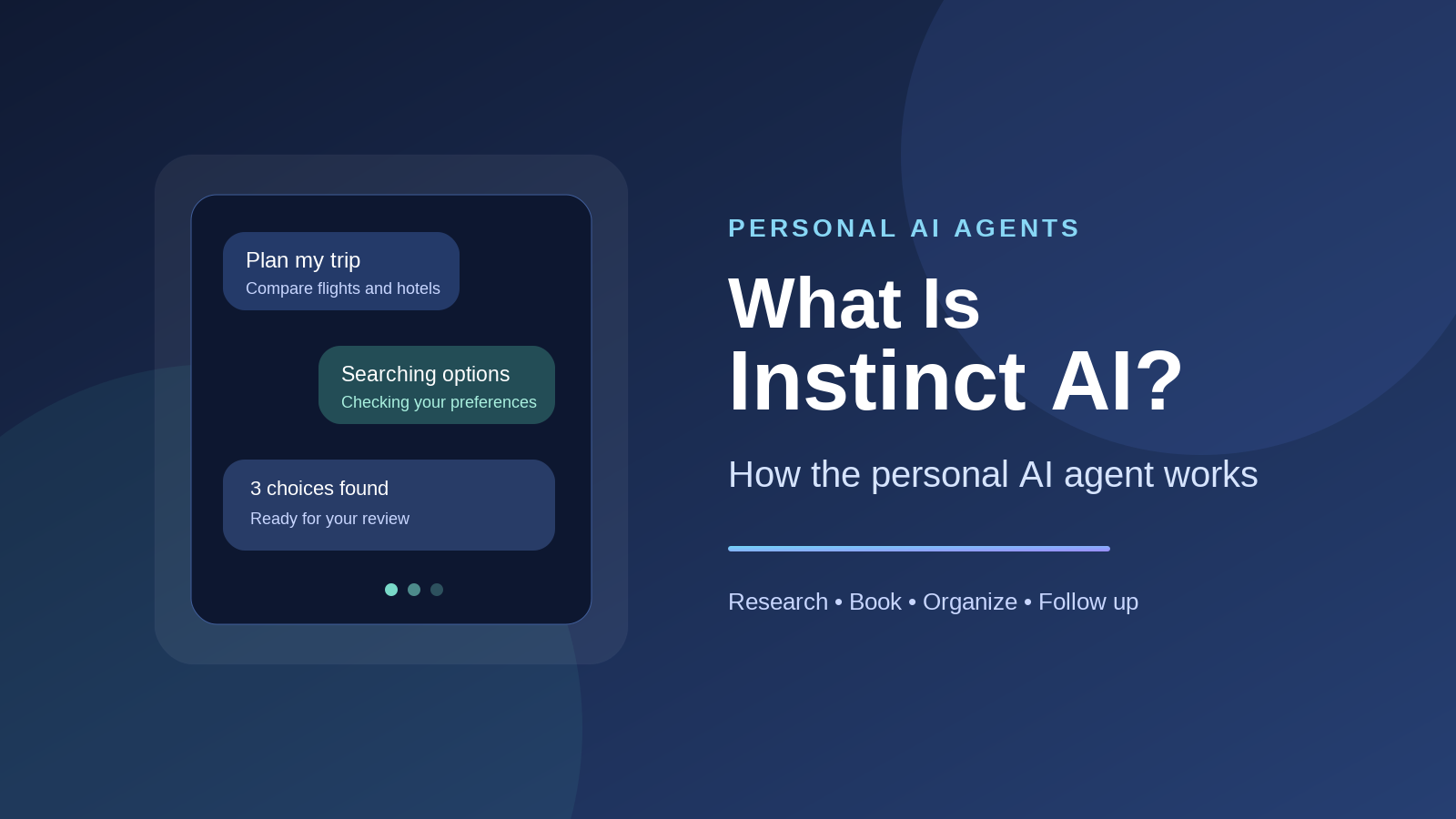
Instinct AI is a personal AI agent designed to carry out everyday tasks on a user’s behalf, rather than only answer questions. Its interface is built around familiar communication—texting or calling the assistant—while the agent uses a phone and computer to work through tasks such as researching options, contacting businesses, arranging bookings, and following up.
That makes Instinct part of a broader shift from conversational AI to agentic AI: software that can take actions across digital services. The distinction is important, because an agent that acts for you may need access to accounts, personal information, and payment tools—and its actions can have real-world consequences.
What is Instinct AI?
Instinct is a personal AI assistant developed by Spear Street Technology. The company describes the product as an assistant that can use a phone and computer in ways similar to a human, with text and calls as its primary interface. The service has attracted attention for delegating everyday errands, including travel planning, reservations, shopping, and account-related tasks.
Unlike a conventional chatbot, Instinct is intended to move beyond generating instructions. Depending on the task and the access it has been granted, it can attempt to complete steps in websites, communicate with people or businesses, and return to the user with updates or questions.
For current access information, start with the official Instinct website. Availability and onboarding can change, so check the official site rather than relying on older invitations or screenshots.
How Instinct AI works
A personal agent typically needs four elements to complete a task:
- An instruction: You describe the goal in ordinary language, including constraints such as budget, date, location, or preferences.
- Context and permissions: The agent uses information and accounts made available to it. The exact access depends on the product’s current setup and the permissions you grant.
- Action tools: It can interact with digital services through a browser, phone, email, or other supported tools rather than merely suggesting what you should click.
- Follow-up: It reports progress, asks for clarification when needed, or returns the outcome for your review.
Instinct’s approach is designed to make these steps feel like delegating to an assistant through messages or a call. The user does not necessarily need to learn a separate automation interface.
What can Instinct AI do?
Public reporting and product descriptions have highlighted tasks such as:
- Travel planning: Researching options and helping arrange flights, itineraries, or other travel details.
- Restaurant reservations: Finding businesses, contacting them, and coordinating booking requests.
- Shopping and errands: Comparing products and helping with purchases or grocery orders.
- Email and follow-ups: Working through messages, contacting businesses, and keeping track of replies.
- Appointments and services: Finding providers and coordinating availability.
- Subscription management: Helping users locate and cancel recurring services.
These are examples of reported capabilities, not a guarantee that every task will work in every region or with every service. Websites may require authentication, verification, payment confirmation, or human intervention. An agent can also misunderstand instructions or fail midway through a workflow.
Instinct AI vs. a traditional chatbot
| Traditional chatbot | Personal AI agent such as Instinct |
|---|---|
| Answers questions and drafts text | Attempts to carry out tasks |
| Usually returns instructions for the user | Can interact with websites, accounts, or people |
| Primarily works within the conversation | May operate across multiple services |
| User performs most external actions | User delegates some actions and reviews results |
| Mistakes mainly affect the answer | Mistakes can affect bookings, purchases, accounts, or communications |
This does not mean agents are always more capable or reliable. For complex or high-stakes actions, human review remains essential.
How people interact with Instinct
Instinct’s public positioning emphasizes communicating through text or calls instead of learning a new app workflow. The exact supported channels, onboarding process, and features may evolve. Consult the official website for the latest access instructions.
A useful task request should include the outcome and the constraints. For example:
Find three restaurants near my hotel for Friday evening. Compare their menus and recent reviews, keep the estimated cost below $60 per person, and ask me before making a reservation.
Or:
Find a refundable flight arriving before 5 p.m. on Tuesday. Compare the total price and baggage rules, and do not purchase anything without my approval.
Clear boundaries reduce the risk of an agent taking an action that the user did not intend.
Is Instinct AI available to everyone?
Instinct’s access has been described in reporting as limited or invite-based during its rollout. Access policies can change, and availability may depend on the country, waitlist, or onboarding method. Check Instinct’s official website for the current status.
Do not assume that an older article’s invitation process, pricing, or feature list is still accurate.
Privacy and safety considerations
An agent that handles personal errands may need access to sensitive information. Before connecting accounts or delegating tasks, review the current privacy policy and terms, and understand:
- Which accounts and data the agent can access.
- Whether it can send messages or make bookings without asking first.
- What approval is required for purchases or other consequential actions.
- How stored information is retained and deleted.
- Whether data may be used to improve or train AI models.
- How to disconnect accounts and revoke permissions.
For a first test, use a low-risk task and explicitly require confirmation before spending money, making a binding booking, changing an account, or sharing sensitive information.
Why Instinct matters in the AI agent trend
Instinct reflects a wider change in AI products: the goal is increasingly to connect reasoning with action. Instead of asking an assistant how to cancel a subscription, a user may ask it to find the subscription, contact the provider, and complete the cancellation.
This model could save time, but it also introduces new questions about trust, permissions, accountability, and reliability. A useful agent is not simply one that can act; it must also communicate what it did, respect limits, and make it easy for the user to verify important outcomes.
For a broader look at agent reliability, see our guide to evaluating AI agents with a reliability checklist. Readers interested in another personal-assistant approach can also explore our guide to Meta Muse AI and how it works.
Bottom line
Instinct AI is a personal agent built around delegating everyday tasks through familiar communication. Its promise is to do more than provide answers: it aims to research, interact with services, and handle parts of real-world digital workflows. The practical value depends on current availability, supported services, permissions, and how reliably it completes each task.
Treat it as a capable but fallible assistant. Start with low-risk requests, set clear constraints, and keep approval in the loop for purchases, bookings, account changes, and other consequential actions.