
Instinct AI is built around a different idea from a conventional chatbot: instead of giving you instructions and leaving the work to you, it is designed to use a phone and computer to carry out tasks on your behalf. You can describe a goal by text or call, and the assistant may interact with websites, connected services, or other people to work toward the result.
That is the visible product behavior. The exact internal architecture of Instinct has not been publicly documented in enough detail to reconstruct its model stack, planner, memory system, or execution controller. This guide therefore separates what Instinct’s own documentation confirms from the general engineering concepts that explain how personal AI agents can work.
For the product overview, start with What Is Instinct AI? How the Personal AI Agent Works. Here, we focus on the process behind an agentic task: interpreting a request, using context, planning, taking actions, observing results, and checking whether the goal was actually achieved.
How Instinct AI works at a high level
Instinct’s official website describes an assistant that can be contacted by text or phone and use a phone and computer in a way similar to a person. Its Terms of Service say the service uses AI and machine-learning tools to generate responses and may take actions on a user’s behalf. The terms also describe interactions with connected services and third-party websites, apps, and platforms.
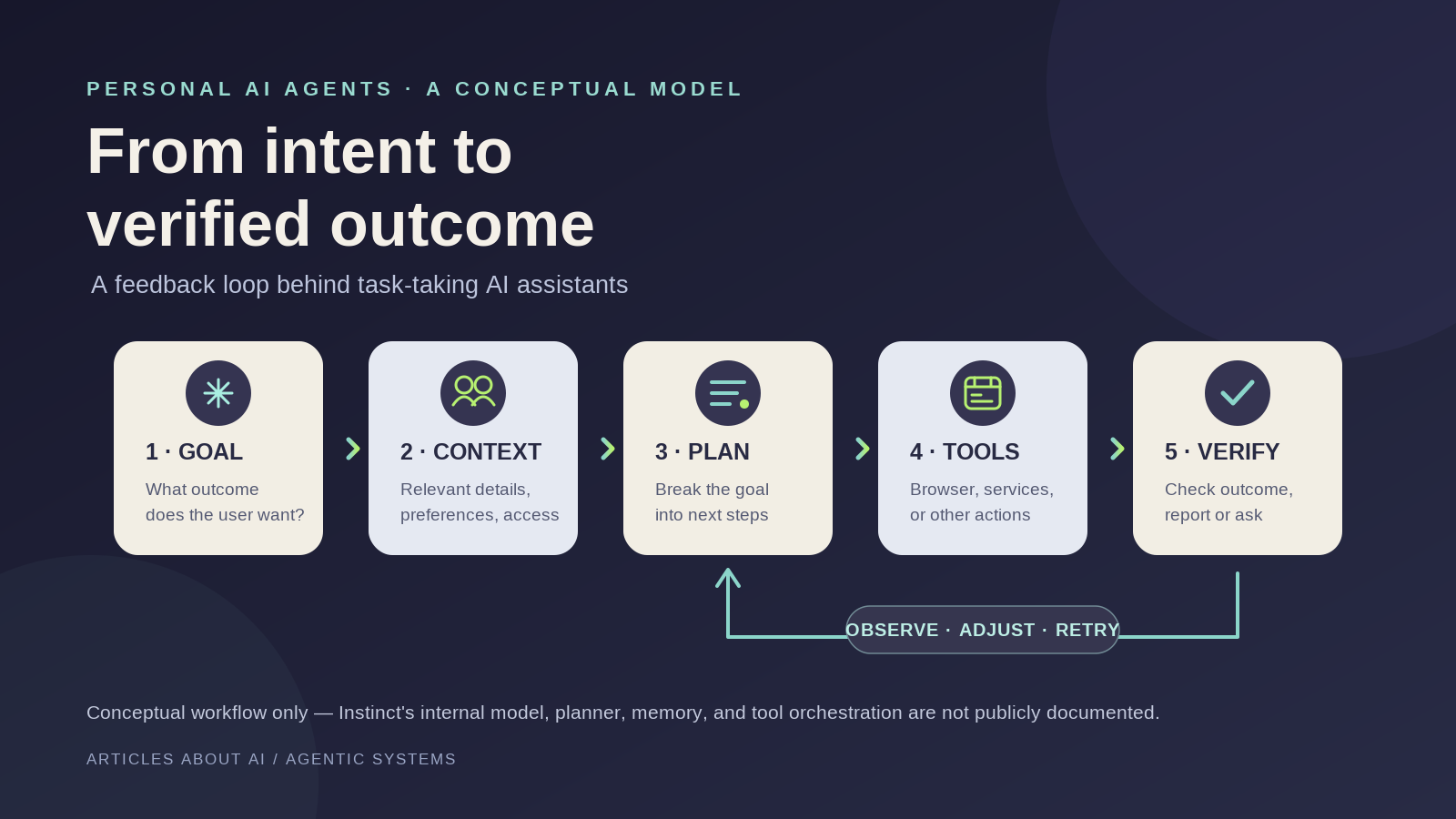
Those statements establish the product’s broad operating model—but they do not disclose every technical step. A useful conceptual model for understanding a personal AI agent is the following loop:
- Receive a goal: Interpret the request and its constraints.
- Gather context: Use relevant conversation details and information the user has made available.
- Plan: Break a multi-step goal into smaller actions and decide what information or tools are needed.
- Act: Use an appropriate tool or external service to perform a step.
- Observe: Read the response from the environment and determine what happened.
- Verify and adapt: Check the result, revise the plan if necessary, and report completion—or ask the user for help.
This is a general agent workflow, not a diagram of Instinct’s proprietary implementation.
1. The user gives the agent a goal
A task begins with a request in natural language. Unlike a chatbot prompt that asks for an explanation, an agent request usually describes an outcome.
For example:
Find a table for two this Friday around 7:30 p.m. at an Italian restaurant near the theater. Keep the price moderate, check whether outdoor seating is available, and ask me before confirming a reservation.
The request contains several pieces of information: the date, party size, time, location, cuisine, budget preference, a seating preference, and an approval boundary. A useful agent must interpret those details rather than treat the message as a single keyword.
The more important the task, the more important it is to make the desired outcome explicit. If a request is ambiguous—such as “book something nice”—the agent may need to ask about budget, timing, location, or preferences before acting.
Instinct’s public documentation confirms that it responds to user prompts and can complete tasks on the user’s behalf. It does not publish a complete specification of how prompts are parsed or how task priorities are calculated.
2. Context helps the agent understand what the user means
A request often depends on information beyond the latest message. Context can include details supplied in the conversation, relevant previous interactions, or information from services the user has connected.
Instinct’s Privacy Policy, revised November 17, 2026, describes processing prompts, planning and completing tasks, remembering past context, and accessing connected platforms. It also explains that the information available to Instinct depends on what users provide or allow it to access.
Context can help resolve ordinary ambiguities:
- “Near the theater” may refer to a location mentioned earlier.
- “Use my usual preference” may depend on a previously shared choice.
- “Move the appointment” may require the current calendar entry.
- “Reply to that message” requires identifying the relevant conversation.
This is useful, but it creates a reliability challenge. Context may be incomplete, outdated, or incorrectly interpreted. An agent should not silently turn an uncertain detail into a consequential decision. When the task depends on a date, identity, price, address, or other critical fact, the user should be able to review the assumption.
For more on why stored information can become unreliable, see Why AI Agents Degrade Over Time: Testing and Maintaining Long-Term Memory.
3. Planning turns a broad request into steps
Many everyday tasks cannot be completed with one action. An agent may need to search, compare, select, fill in information, and then confirm a result.
A conceptual plan for the restaurant request could look like this:
- Identify the theater and the requested Friday date.
- Search for suitable Italian restaurants nearby.
- Compare distance, menus, price range, and availability.
- Narrow the options to a small shortlist.
- Ask the user which option to choose—or request approval for a specific reservation.
- Complete the booking only within the approved limits.
- Check for a confirmation and report the details.
Planning is not simply writing a checklist. The agent needs to decide which step should happen next based on what it has learned. If a restaurant is closed, it should choose another. If the requested time is unavailable, it should ask whether a different time is acceptable rather than inventing a booking.
Researchers have studied approaches that combine reasoning and action. The ReAct paper describes a research framework in which a language model interleaves reasoning with actions and observations from an external environment. This helps explain a general design pattern for agents: use the information returned by actions to update the next step.
ReAct is background research on agent design. It is not evidence that Instinct uses the ReAct algorithm or any particular planning method.
4. Tools allow the agent to do more than generate text
A language model can describe how to book a restaurant, but an agent needs an action mechanism to attempt the booking itself. In agent systems, tools can include web browsing, APIs, computer interfaces, messaging, calendars, or other services.
Instinct’s official materials describe its ability to use a phone and computer. Its Terms of Service say it may access and interact with third-party platforms, including services the user connects and certain platforms accessed through browser functionality. The features guide covers the publicly described capabilities in more detail.
A tool-enabled workflow might involve:
- Opening a search page and collecting options.
- Reading a restaurant’s menu or booking page.
- Entering a date and party size into a form.
- Sending a message or email to a business.
- Reading a response and updating the task.
- Returning a confirmation or asking the user to make a decision.
The tool is the bridge between the agent’s language-based decision-making and the outside world. That bridge can fail. A page may change, a site may block automated interaction, a login may expire, or a service may return an error. The agent’s next decision should depend on the actual observation—not on an assumption that the action succeeded.
5. The agent observes what happened and adjusts
An action is not the same thing as a successful outcome.
If an agent submits a reservation form, the form may display an error, reject the time, or require a further confirmation. If it sends a message, the recipient may not respond. If it searches for a product, the item may be out of stock or the price may change before checkout.
A general agent loop therefore needs feedback:
Request → action → observation → next decision
This loop can repeat several times. A successful agent should keep track of what remains unfinished, avoid repeating completed steps unnecessarily, and recognize when it has reached a blocker.
The loop is also a way to recover from failure. A tool response may reveal that a preferred option is unavailable, so the agent can look for an alternative. But retries need limits: repeatedly submitting a form or sending the same message can create duplicate bookings, purchases, or communications.
A useful task report should distinguish:
- Completed: the external service returned evidence of the requested result.
- Partially completed: some steps succeeded, but others remain.
- Awaiting approval: the agent has prepared an action but needs the user’s decision.
- Blocked: the agent cannot proceed without new information or access.
- Unverified: it attempted an action but could not confirm the outcome.
That distinction is more meaningful than a confident “Done” message.
6. Memory and personalization can improve future tasks
An agent may use context from the current conversation or information it has retained to personalize later interactions. The Instinct Privacy Policy says it may remember past context to assist with a request and use information to personalize the service.
In a personal assistant, useful context might include a preferred departure time, a dietary preference, a usual neighborhood, or a recurring scheduling constraint. Such context can reduce the number of questions required for familiar tasks.
However, memory is not automatically correct. Preferences can change, a past instruction may have applied only once, and a stored detail can be misinterpreted. Personalization should not override a new instruction. For consequential tasks, the agent should surface the relevant assumption so the user can correct it.
The public documentation does not reveal the precise storage design, retrieval algorithm, retention duration for every type of memory, or whether Instinct uses a particular memory architecture. Those details should not be inferred from the behavior of other AI-agent products.
7. Verification and human oversight are part of the process
An agent that can interact with accounts, businesses, and transactions needs more than a plan. It needs appropriate safeguards and a way for the user to inspect its actions.
Instinct’s Terms of Service explicitly say that the service may make errors, that actions may not always be reversible, and that users must maintain meaningful human oversight. The terms recommend reviewing actions and maintaining approval workflows appropriate to their consequences.
For a task involving money, personal information, an external message, or a binding commitment, a practical workflow should include:
- Confirm the target and the key details before the action.
- Review the final price, recipient, date, or terms.
- Require approval when the action could be costly or difficult to reverse.
- Verify the external confirmation afterward.
- Keep a record of what was actually done.
Human oversight does not mean the user must manually perform every step. It means the agent’s autonomy should be bounded by clear permissions, and the user should retain meaningful control over consequential actions.
A complete example: how an agent could arrange a reservation
Consider a request to arrange dinner. The user specifies a date, location, budget, cuisine, and party size, and asks the agent to get approval before booking.
Step 1 — Interpret the goal. The agent identifies the date, number of guests, time window, and preferences. If “this Friday” is ambiguous because of timezone or date context, it should resolve that before searching.
Step 2 — Gather information. It searches for restaurants and reads available details. It may use a website, maps, or other supported service, depending on its access.
Step 3 — Compare. It filters out options that do not meet the constraints and presents a shortlist. It should separate verified facts from estimates or missing information.
Step 4 — Request a decision. The user chooses a restaurant and confirms the intended time. The agent should not treat a shortlist as permission to book any option.
Step 5 — Execute the approved action. It enters the reservation details through the supported booking flow. If the site requires a new choice, extra payment, or a change to the approved details, it stops and asks.
Step 6 — Verify. It checks the booking response and returns the confirmation details. If no confirmation is received, it reports that the reservation is unverified rather than claiming success.
This illustrates why agentic AI is a workflow, not just a better answer. The final result depends on multiple interactions with an environment, and each interaction can change what the agent should do next.
How personal AI agents differ from chatbots
| Traditional AI chatbot | Personal AI agent |
|---|---|
| Responds mainly with text, explanations, or generated content | Can use tools to attempt external actions |
| Usually completes a request within the conversation | May work through a multi-step workflow |
| User applies the answer in another service | Agent may interact with that service itself |
| Context often centers on the current conversation | May use connected information or past context |
| Success is often judged by answer quality | Success also depends on task completion, action correctness, and verification |
The distinction is not absolute. Chatbots can use tools, and some agents still rely heavily on conversational responses. The important difference is the system’s ability to take action, observe the result, and continue toward a goal.
What is not publicly known about Instinct’s architecture?
Instinct’s public website and legal documents describe its user-facing behavior and data processing, but they do not provide a full technical architecture. Public documentation does not establish:
- Which foundation models are used for each task.
- How its internal planner or task scheduler is implemented.
- Which memory databases or retrieval methods it uses.
- How its internal tool orchestration is structured.
- The exact technical design of its execution environment.
- The complete verification or retry logic behind every feature.
It is tempting to map familiar research architectures onto the product. That would be speculation. The ReAct and Reflexion papers are useful for understanding research directions in tool-using agents, but neither paper documents Instinct’s production architecture.
How to evaluate whether Instinct is working well
A task-taking assistant should be evaluated on outcomes, not only on how fluent its final message sounds. Useful questions include:
- Did it achieve the requested result?
- Did it use the correct information and respect the constraints?
- Did it take only actions that were authorized?
- Did it detect and recover from tool failures?
- Did it avoid duplicate or unintended actions?
- Did it report uncertainty and blockers accurately?
- Did it verify the final outcome?
For a structured approach, see How to Evaluate AI Agents: A Practical Reliability Checklist Beyond Benchmarks and AI Agent Observability in Production: Traces, Metrics, Logs, and Privacy.
How to give Instinct AI better instructions
A clear request can make a multi-step agent workflow easier to evaluate. Use this pattern:
Goal + constraints + permitted actions + approval boundary + verification request
For example:
Find three train options for my trip next Saturday. Compare departure times, total prices, and refund conditions. Use my stated budget of $100. Do not purchase a ticket. Give me the exact option and total cost, and wait for my approval.
The prompt states what success looks like, which constraints matter, what the agent may do, and where it must stop. For more practical examples, see How to Use Instinct AI: A Complete Beginner’s Guide.
The bottom line
Instinct AI is designed to turn natural-language requests into real-world tasks by using a phone, computer, and supported services. The general mechanism behind personal AI agents is a feedback loop: understand the goal, gather context, plan, use tools, observe what happens, and adapt or verify the result.
That loop explains the promise of agentic AI—and its limitations. External actions introduce uncertainty, permissions, and consequences that a text-only answer does not. A useful personal agent should therefore be judged not by whether it sounds capable, but by whether it completes tasks reliably, respects the user’s instructions, and makes its actions and uncertainties clear.
Instinct’s public materials confirm the broad task-taking model, but its detailed internal architecture remains undisclosed. Understanding that boundary is essential when evaluating claims about how the product works.