
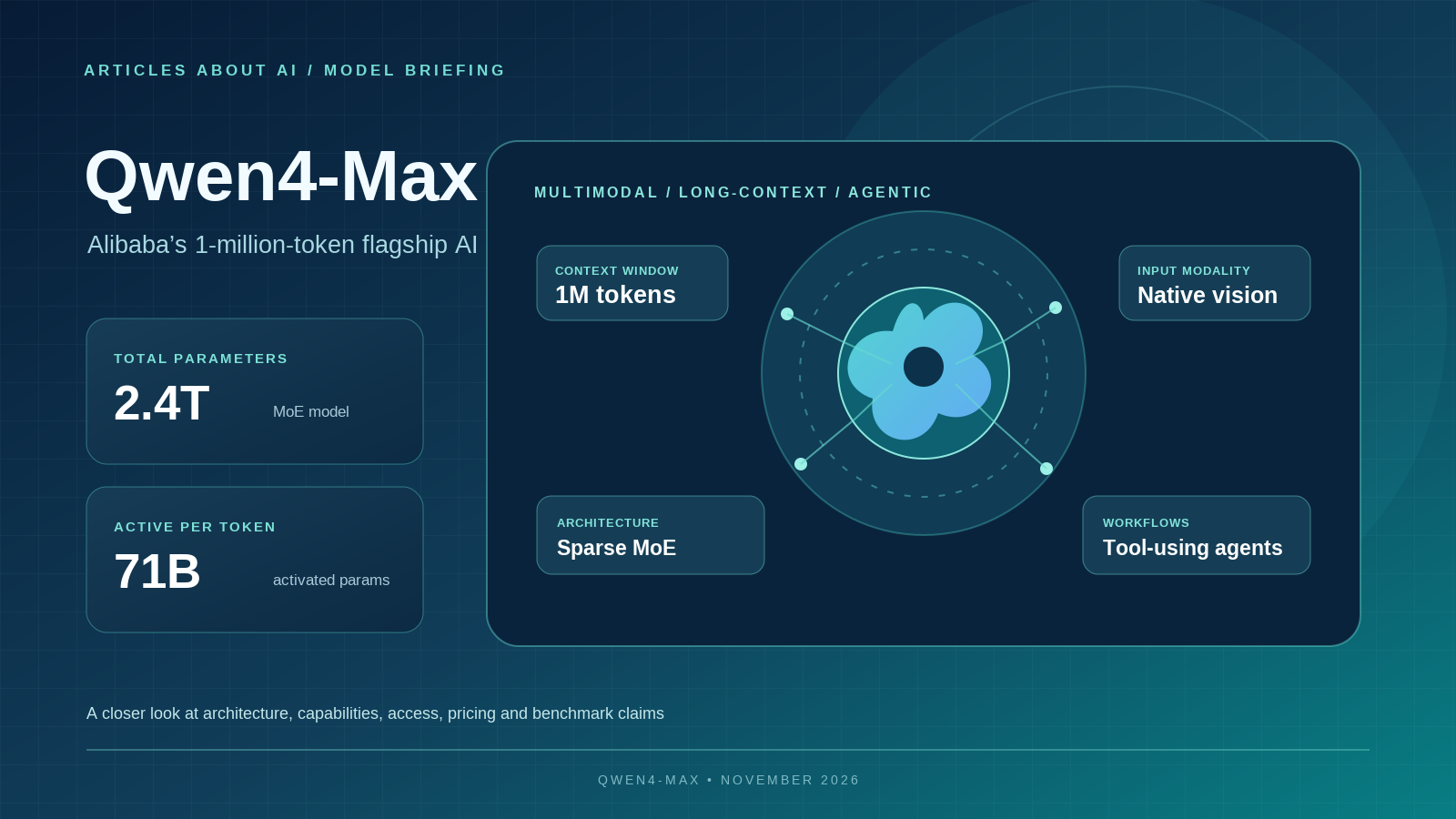
Alibaba released Qwen4-Max on November 16, 2026, introducing a new flagship model built for long-context reasoning, multimodal understanding, coding, and tool-assisted professional work. The launch is notable for its scale: Alibaba describes Qwen4-Max as a 2.4-trillion-parameter Mixture-of-Experts (MoE) model that activates 71 billion parameters per token and supports a context window of up to one million tokens.
The announcement also puts efficiency at the center of the product story. Alibaba says Qwen4-Max performs better than its predecessor, Qwen3.8-Max, on the company’s Work360 evaluation while using fewer tokens and reducing average task cost. Those are company-reported results, so they should be read as vendor benchmark claims rather than independent proof that Qwen4-Max is better than every competing model.
This guide explains what Qwen4-Max is, how its architecture works at a high level, what the one-million-token context means, where developers can access it, what is known about pricing and open weights, and how to interpret the launch benchmarks.
What is Qwen4-Max?
Qwen4-Max is the flagship model in Alibaba’s Qwen4 family. It is designed for complex knowledge work and tasks that may require a model to interpret information, use software tools, and continue through multiple stages before delivering a finished result.
Alibaba lists several capabilities in its launch announcement:
- Long-context processing: a context window of up to one million tokens.
- Native vision: the model can process visual input rather than relying only on text.
- Coding and agentic workflows: support for tasks that involve software tools and multiple steps.
- Professional and creative work: examples include 3D modeling, game development, manufacturing workflows, financial research, and legal document analysis.
- Scientific workflows: Alibaba describes long-running experiments that combine planning, tool use, and evaluation.
The company positions Qwen4-Max as more than a conversational chatbot. Its intended role is to help complete extended workflows in which the model must work with substantial context and external tools. Actual results will depend on the application, the tools connected to it, the quality of the source material, and the level of human review.
Qwen4-Max architecture: 2.4 trillion parameters and 71 billion active per token
Alibaba says Qwen4-Max contains 2.4 trillion total parameters, with 71 billion parameters activated per token. It uses a sparse Mixture-of-Experts architecture.
In a conventional dense model, the same broad set of model parameters participates in processing each token. A sparse MoE model instead routes tokens through selected expert components. This allows a model to have a very large total parameter count without activating every parameter for every token.
The distinction between total and active parameters matters:
- 2.4 trillion total parameters describes the model’s overall parameter scale.
- 71 billion active parameters per token describes the subset activated for an individual token.
- Sparse routing selects which expert components participate in processing.
Alibaba says the Qwen4 architecture updates the MoE design across attention, residual connections, and embeddings. Its November 17 enterprise overview also describes Gated DeltaNet layers and Qwen Sparse Attention, alongside additional N-gram embedding parameters. These are architectural details reported by Alibaba; they do not by themselves establish a universal performance advantage.
A large total parameter count should not be treated as a direct quality ranking. Real-world usefulness also depends on training, inference efficiency, context handling, tool reliability, latency, and the task being evaluated.
What does the one-million-token context window mean?
A context window of one million tokens gives Qwen4-Max room to process a much larger body of input in a single model interaction than systems with shorter context limits.
Depending on the task and the product interface, that capacity can be useful for:
- Reviewing lengthy technical documentation.
- Searching across large collections of reports.
- Comparing contracts or policy documents.
- Analyzing long codebases and related technical notes.
- Combining research material from multiple sources.
- Maintaining more background information during an extended workflow.
A token is a unit of text processing, not exactly the same as a word or a character. The number of pages that fit into a million tokens varies with language, formatting, tables, code, and other content types.
A large context window also does not guarantee that every detail will be retrieved or reasoned about correctly. Important claims should still be linked to their source passages, and long-document workflows should be tested for omissions, contradictions, and unsupported conclusions.
For practical document workflows with other AI assistants, see our guides to using Claude to extract evidence from a collection of documents and using Perplexity to find primary sources for a news story.
Native vision and multimodal capabilities
Qwen4-Max includes native vision capabilities, which means visual input is part of the model’s supported workload. This is relevant when a task depends on charts, diagrams, screenshots, layouts, or other visual material rather than text alone.
Alibaba’s launch materials describe use cases involving 3D production-line layouts, part design, machining verification, and visual reasoning. Its enterprise announcement also presents examples in which the model interprets engineering layouts and works with tools to produce or check outputs.
Multimodal support should not be confused with guaranteed visual accuracy. A model can misread small labels, overlook details in dense diagrams, or infer information that is not present. For high-impact engineering, financial, legal, or medical work, users should verify extracted values and decisions against the original material and qualified review.
Qwen4-Max benchmarks: what Alibaba has reported
Alibaba’s November 16 announcement highlights several benchmark results. It says Qwen4-Max ranked sixth on Code Arena and performed strongly on evaluations covering agent workflows, workplace productivity, and visual reasoning.
The company also reports results on Work360, its proprietary evaluation of challenging industry tasks across 721 specialized fields. According to Alibaba:
- Qwen4-Max scored 52.69 on the Work360 evaluation, compared with 47.74 for Qwen3.8-Max, in the November 17 enterprise overview.
- At the High reasoning-effort setting, Qwen4-Max used about 35% fewer tokens than Qwen3.8-Max on Work360.
- Alibaba reports an average cost per Work360 task around 58% lower than its predecessor in the enterprise overview; the launch announcement rounds the reduction to around 60%.
- The company also reports improvements on its secure-code evaluation.
These figures are useful for understanding Alibaba’s product claims, but Work360 is an Alibaba-developed benchmark. Its results should not be treated as a neutral comparison with every model from OpenAI, Anthropic, Google, or other providers.
Benchmark rankings can also change as evaluation sets, model versions, and leaderboard methodologies change. Before choosing a model for production, run representative tests using your own prompts, documents, tools, and success criteria.
Qwen4-Max pricing and API access
Alibaba says Qwen4-Max is available through QwenCloud via its Token Plan and API, and through Alibaba’s QwenWork and QwenStudio products. The launch announcement specifically lists an implicit-cache-hit input price of $0.075 per one million tokens.
That figure is a cache-hit price, not a complete statement of the standard input and output rates. Pricing can vary by region, usage tier, caching status, and product. Check the live QwenCloud pricing page and the model’s API entry before estimating production costs or comparing it with another provider.
For developers, the key checks before integrating Qwen4-Max are:
- Confirm the exact model identifier currently listed in QwenCloud.
- Check whether the account and region have access to the production model.
- Review input, output, and cached-input pricing separately.
- Confirm context and output limits for the selected endpoint.
- Test the API’s supported multimodal inputs and tool-calling behavior.
- Measure latency and token consumption using representative requests.
Do not assume that preview identifiers, production model names, or API capabilities are interchangeable. Follow the current documentation for the endpoint and SDK version you plan to use.
Is Qwen4-Max open source or available with open weights?
The Qwen family has included models released with downloadable weights, but Alibaba’s Qwen4-Max launch announcement does not say that the flagship model’s weights are available for download. Instead, Alibaba says that smaller-scale open-weight models from the Qwen4 series will be released to developers worldwide.
That distinction is important for developers evaluating deployment options:
- Qwen4-Max is being offered through Alibaba’s cloud and product ecosystem.
- Smaller Qwen4 models are the models Alibaba says it plans to release with open weights.
- The availability, license, hardware requirements, and supported formats of those smaller models need to be checked when their release details are published.
Until Alibaba publishes the relevant weights and license terms, do not describe Qwen4-Max itself as an open-weight model or assume it can be self-hosted.
Qwen4-Max safety and cybersecurity safeguards
Alibaba says it incorporated software-security checks into training and filtered cybersecurity material to retain defensive knowledge useful for finding and fixing vulnerabilities while excluding material intended to improve offensive hacking.
Reuters reported on November 16 that Alibaba described improvements in secure-code generation and additional safeguards for chemical, biological, radiological, and nuclear risks. Reuters also noted that the company’s internal safety findings had not been independently verified.
The distinction between vendor claims and independent evaluation is important. Security performance should be assessed with external testing, clear evaluation methods, and ongoing monitoring. A model’s stated safeguards do not remove the need for access controls, code review, sandboxing, and human approval in sensitive workflows.
Qwen4-Max vs Qwen3.8-Max
Qwen3.8-Max is the predecessor used in Alibaba’s launch comparisons. The company says Qwen4-Max improves its Work360 score, uses fewer tokens on selected tasks, and reduces average task cost.
| Area | Qwen4-Max launch information | What it means |
|---|---|---|
| Total parameters | 2.4 trillion | Very large overall model scale |
| Active parameters | 71 billion per token | Sparse expert activation |
| Context window | Up to 1 million tokens | Supports very long inputs |
| Vision | Native vision capabilities | Can work with visual input |
| Work360 score | 52.69 vs 47.74 reported for Qwen3.8-Max | Improvement on Alibaba’s own evaluation |
| Task cost | About 58% lower on Work360, according to Alibaba’s enterprise overview | Vendor-reported efficiency gain |
| Open weights | Smaller Qwen4 models planned | Do not assume Qwen4-Max weights are downloadable |
The strongest supported conclusion is that Alibaba is presenting Qwen4-Max as a more capable and more efficient flagship than Qwen3.8-Max on its own evaluations. A broader comparison requires independent, task-matched testing.
Qwen4-Max vs GPT-6, Claude, and Gemini
It is tempting to rank Qwen4-Max against GPT-6, Claude, and Gemini based on a single benchmark or parameter count. That would be misleading without comparable test conditions.
A useful model comparison should measure:
- Accuracy on the same task set.
- Long-context retrieval and citation quality.
- Coding performance on the same repository and test suite.
- Tool-use reliability and completion rate.
- Multimodal accuracy on the same images or documents.
- Latency, token consumption, and total cost.
- Data handling, deployment requirements, and regional availability.
Qwen4-Max’s one-million-token context and MoE architecture make it an important model to evaluate, particularly for long-document and agentic workloads. They do not establish that it is universally better than GPT-6, Claude, or Gemini.
For a fair evaluation, use the same prompts, source documents, tool permissions, and scoring rules across all candidate models. Our Qwen algorithm walkthrough provides an example of turning a model response into a trace that can be checked rather than accepted at face value.
Who should evaluate Qwen4-Max?
Qwen4-Max is worth testing if you are a developer or organization working with:
- Long technical or business documents.
- Multi-step tasks that use external tools.
- Coding and software engineering workflows.
- Visual information such as diagrams and engineering layouts.
- Research processes that require collecting and checking evidence.
- Workloads where token use and task-level cost are important.
It may be less suitable when your requirements depend on downloadable flagship weights, a particular regional service, a strict data-residency policy, or independently validated performance on a specialized task. Check those requirements before moving a production workflow.
Frequently asked questions
When was Qwen4-Max released?
Alibaba announced Qwen4-Max on November 16, 2026. Alibaba Cloud published a further enterprise-focused overview on November 17, 2026.
How many parameters does Qwen4-Max have?
Alibaba says Qwen4-Max has 2.4 trillion total parameters and activates 71 billion parameters per token.
Does Qwen4-Max support a one-million-token context window?
Yes. Alibaba lists a context window of up to one million tokens. The actual limits available to a user can depend on the product, endpoint, and request configuration.
Does Qwen4-Max support images?
Yes. Alibaba describes native vision capabilities and multimodal use cases involving visual reasoning and engineering material.
What is the Qwen4-Max API price?
Alibaba’s launch announcement lists $0.075 per one million input tokens for an implicit cache hit. This is not the full standard input-and-output price schedule. Check QwenCloud’s live pricing for the applicable region and usage tier.
Is Qwen4-Max open source?
Alibaba has announced plans to release smaller open-weight models from the Qwen4 family. The Qwen4-Max flagship itself is offered through Alibaba’s cloud and product services in the launch materials; do not assume its weights are downloadable.
Is Qwen4-Max better than GPT-6 or Claude?
The available launch results do not establish a universal winner. Alibaba reports improvements over Qwen3.8-Max on its Work360 evaluation, but independent, task-matched comparisons are needed to assess Qwen4-Max against GPT-6, Claude, and Gemini.
What is Work360?
Work360 is an Alibaba-developed benchmark that the company says evaluates challenging industry tasks across 721 specialized fields. Its results are vendor-reported and should be interpreted separately from independent leaderboards.
Official sources and further reading
- Alibaba Cloud: Qwen4-Max launch announcement, November 16, 2026
- Alibaba Cloud: Qwen4-Max enterprise overview, November 17, 2026
- Reuters: Alibaba details new AI safeguards as Chinese developers step up test disclosures, November 16, 2026
- TechNode: Alibaba launches Qwen4-Max with lower API prices and a million-token context window, November 16, 2026
- QwenCloud
Qwen4-Max is a significant new entry in the long-context and agentic AI market. Its 2.4-trillion-parameter MoE design, one-million-token context, native vision, and Alibaba-reported efficiency gains make it worth evaluating. The practical decision, however, should come from current API terms and independent tests on the work you actually need the model to perform.