Google announced Gemini for government services on October 20, 2026, introducing an AI agent platform designed for the complex workflows of federal, state, and local government agencies in the United States. The service is intended to help public-sector teams work with regulations, review documents, support procurement, and improve communications with residents. Google says the product is initially available in preview to eligible US government agencies, and that selected agencies—including the State of Missouri and the US Department of Health and Human Services—are already using it.
The announcement is notable because it takes Google’s agent-based AI approach into government operations, where information access, auditability, confidentiality, and regulatory compliance are especially important. It is not simply a general chatbot with a government label: Google describes specialized workflow skills, connectors to enterprise and government information systems, third-party agents, and centralized governance controls.
This article explains what Google announced, the tasks the system is designed to support, what is known about availability, and what public agencies should verify before relying on it.
What Is Gemini for Government Services?
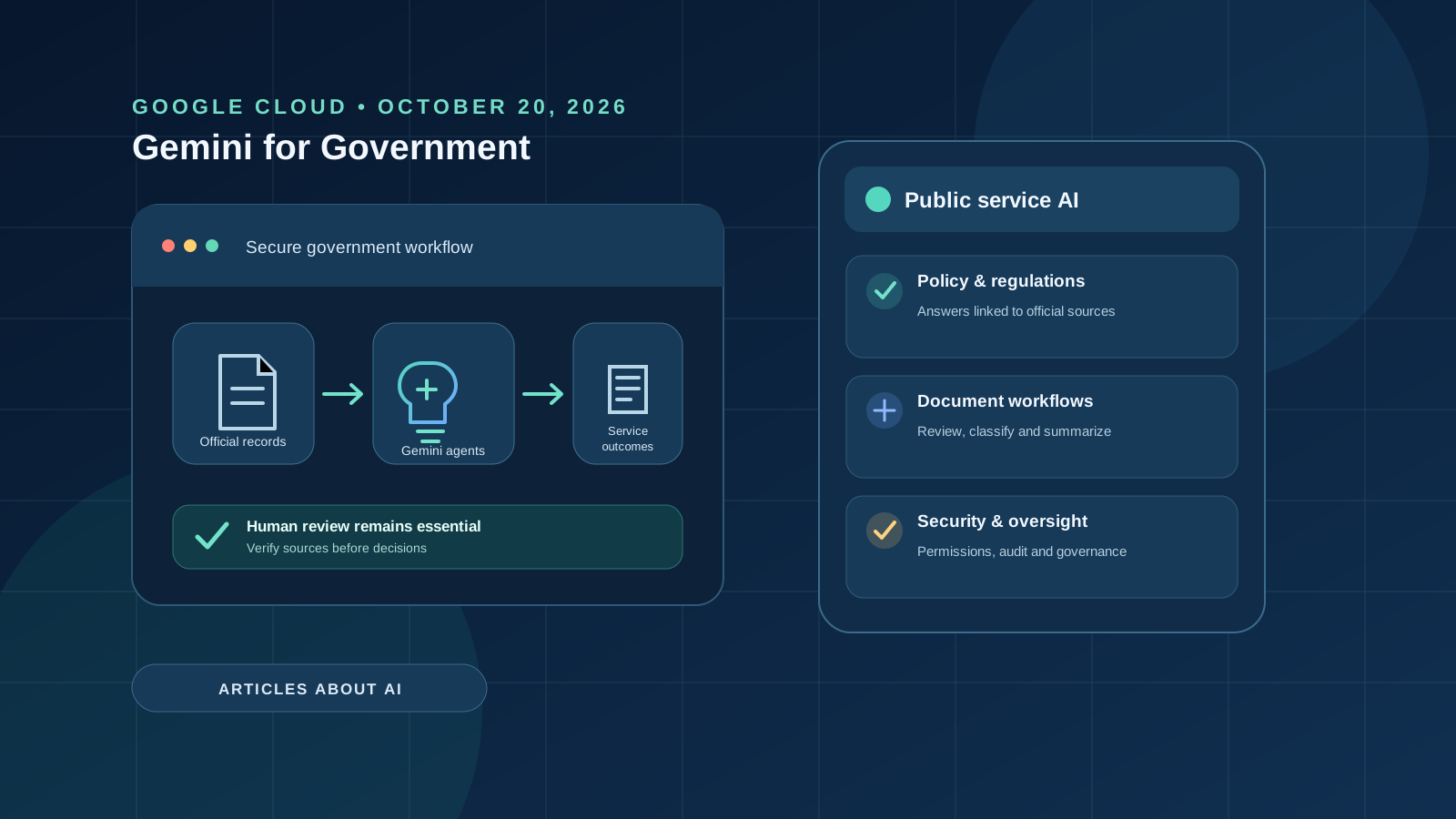
Gemini for government services is an industry-specific AI solution built on Google’s Gemini platform for public-sector workflows. According to Google’s announcement, it combines four main elements:
- Purpose-built agent skills: Preconfigured capabilities for tasks such as interpreting regulations, reviewing procurement requirements, and evaluating vendor qualifications.
- Connectors to existing systems: Integrations with commonly used collaboration, customer-management, service-management, and government information systems.
- Third-party agents and partners: A partner ecosystem intended to extend the platform with specialized public-sector workflows.
- Security and governance controls: Administrative oversight, audit logging, risk management, and access controls intended for regulated environments.
The goal is to help employees delegate structured, multi-step work rather than manually searching across disconnected documents and systems. As with other agentic AI products, the practical result will depend on the data an agency makes available, the permissions it configures, and the safeguards applied to each workflow.
For background on Google’s broader enterprise direction, see our coverage of Google Cloud’s Gemini agent and enterprise workflows.
What Can Government AI Agents Help With?
Google highlights several possible use cases. These are the workflows described by the company; actual results and availability should be verified in a pilot rather than assumed from a product announcement.
1. Policy research and regulatory interpretation
Government employees often need to locate and interpret statutes, administrative rules, agency guidance, and internal policy documents. Google says Gemini for government services can retrieve and synthesize answers from official regulations and an agency’s own files, with links to specific source material so staff can check the evidence.
Source-linked answers are important in public administration. A summary can speed up research, but it should not replace review of the controlling regulation or the agency’s approved interpretation. Agencies should test whether citations are precise, whether the system handles conflicting documents appropriately, and whether it clearly signals when evidence is missing.
2. Procurement and vendor compliance
Government procurement involves lengthy bids, requests for proposals, eligibility rules, and detailed evaluation criteria. Google says the service can help compare vendor submissions with procurement requirements, identify missing qualifications, assess submissions against standardized rubrics, and prepare decision justifications.
These tasks can be time-consuming and repetitive, making them potential candidates for assistance. However, AI-generated scoring or summaries should not become an unreviewed substitute for the procurement officer’s responsibilities. Agencies should preserve the original evidence, document the evaluation method, and require qualified staff to approve consequential decisions.
3. Document intake and public communication
The announcement also describes support for classifying submitted documents, validating information in common forms, and translating complex regulatory language into clearer notices for residents. Such capabilities could help agencies manage backlogs and communicate requirements in more accessible language.
Document processing is not error-free. Scanned files, unusual layouts, incomplete applications, and ambiguous information can lead to incorrect classifications or extracted values. Agencies should measure error rates across representative documents and provide a clear route for human review, corrections, and appeals.
4. Connections to agency systems
Google lists connectors for tools such as Google Workspace, Microsoft SharePoint, Outlook 365, Salesforce, and ServiceNow, as well as selected government regulatory resources and Oracle enterprise applications. The actual set of connectors available to an agency may depend on its configuration and the product’s rollout.
Integrations can reduce repetitive copying between systems, but they also make permission design critical. Agencies should check exactly which records an agent can read, what actions it can perform, whether it can change a system of record, and how every action is logged.
Security, Privacy, and Accountability
Government information can include personal records, confidential case material, procurement submissions, and sensitive operational data. Google says Gemini for government services is designed to meet government security and compliance requirements. It also states that agency and constituent data remain within the organization’s cloud perimeter, and that base models are not trained on customer data without customer consent.
Those are important statements about the product’s intended controls, but agencies should review the applicable contract, configuration, technical documentation, and compliance commitments before deployment. A general security statement is not a substitute for verifying how a particular agency’s data will be handled.
Before using an AI agent in production, a government team should establish:
- Least-privilege access: Give each agent only the access required for its assigned work.
- Human approval: Require staff approval for consequential actions, including final eligibility, procurement, or policy decisions.
- Audit trails: Confirm that prompts, sources, tool calls, changes, and outputs can be inspected when necessary.
- Data retention rules: Determine what information is retained, where it is stored, and how retention and deletion requirements are enforced.
- Accuracy testing: Test citations, extracted values, summaries, and recommendations against trusted source documents.
- Incident procedures: Define how to pause an agent, correct an error, investigate a failure, and notify the appropriate teams.
The most responsible starting point is a limited pilot with low-risk tasks, clear success criteria, and a human reviewer. Broader automation should follow only after the agency has evidence that the system performs reliably within its security and governance requirements.
Is Gemini for Government Services Available Now?
Google announced the solution on October 20, 2026, and says it is initially available in preview for US federal, state, and local government agencies. The company named the State of Missouri and the US Department of Health and Human Services among the early users.
A preview announcement does not mean that every government organization—or users outside the United States—can sign up immediately. Eligibility, regional scope, procurement arrangements, licensing, supported integrations, and service commitments may vary. Agencies should consult Google’s official product information and their Google Cloud representative for current access requirements.
The announcement does not establish general consumer availability, nor does it provide a single public price that applies to every deployment. Organizations should obtain current commercial terms and confirm whether the capabilities they need are included in their intended configuration.
For a wider comparison of assistant ecosystems and practical use cases, read our guide to ChatGPT vs. Google Gemini.
What This Announcement Means for Public-Sector AI
The launch reflects a broader shift from generative AI that mainly drafts text toward AI agents that can work across connected systems and perform sequences of tasks. For government agencies, the potential value is not just faster writing. It is the possibility of reducing manual document handling, helping employees find authoritative information, and making complex administrative processes easier to manage.
The risks also become more concrete when a system can access records or initiate actions. Incorrect summaries, weak source grounding, overbroad permissions, or unclear accountability can affect real people and public funds. Human oversight, source verification, access controls, and measurable evaluation therefore need to be part of the workflow from the beginning.
The relevant question for each agency is not whether an AI demonstration looks impressive. It is whether the tool can complete a defined task accurately, securely, transparently, and at an acceptable cost under the agency’s real operating conditions.
Key Facts at a Glance
- Announcement date: October 20, 2026.
- Product: Gemini for government services.
- Provider: Google Public Sector / Google Cloud.
- Initial availability: Preview for eligible US federal, state, and local government agencies.
- Named early users: The State of Missouri and the US Department of Health and Human Services.
- Designed use cases: Regulatory research, procurement support, document intake, public communication, and connected agency workflows.
- Important limitation: Preview status and announced capabilities should not be treated as universal availability or a guarantee of error-free performance.