Artificial intelligence tools can explain medical terms, summarize general health information, and help people prepare questions for a doctor. That convenience makes it tempting to ask a chatbot about a headache, a medication, or a new symptom before contacting a healthcare professional.
But a fluent answer is not necessarily a correct one. AI can be useful for understanding general health information, but it should not be treated as a doctor, a definitive diagnostic tool, or the final authority on treatment.
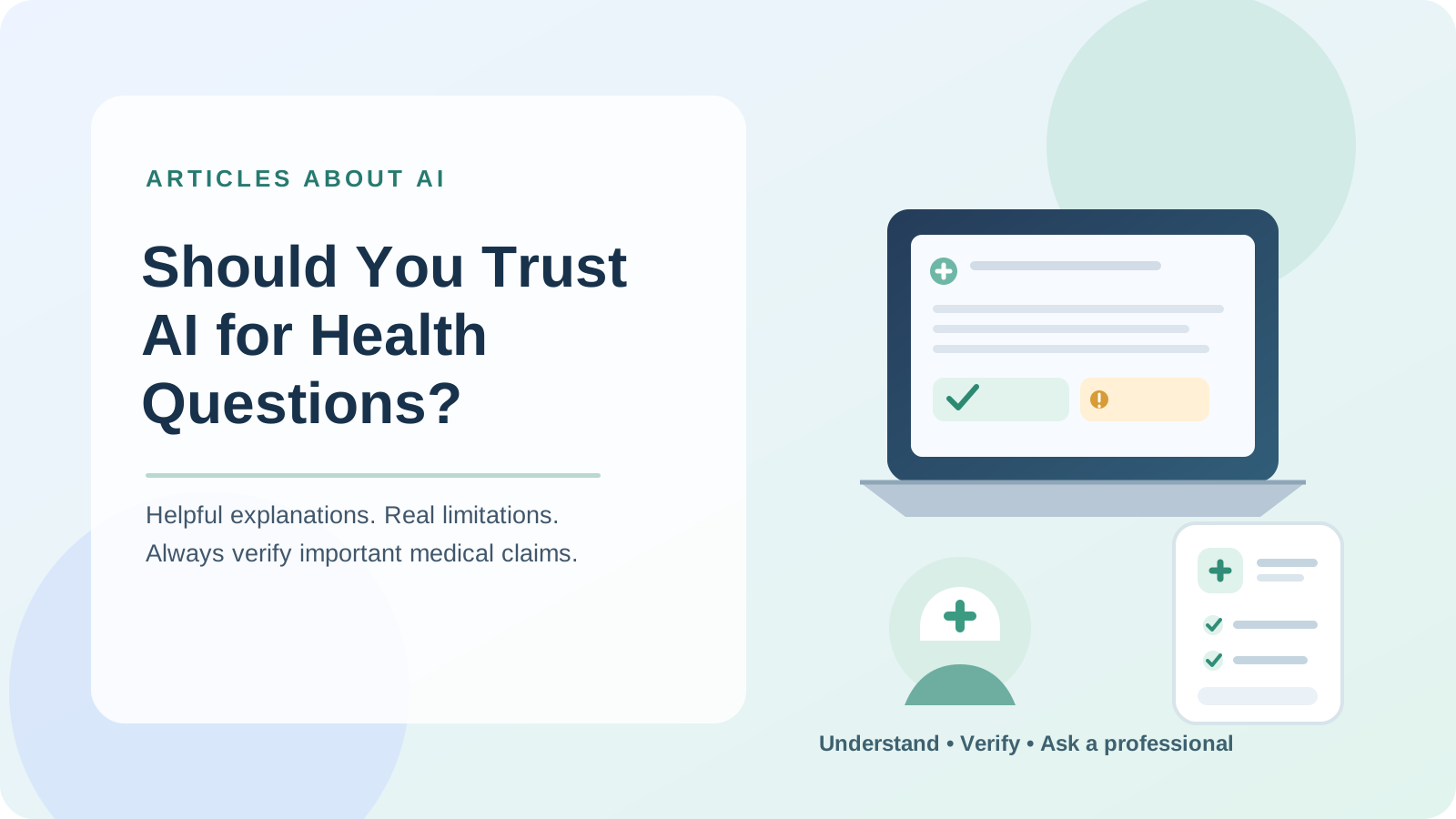
The safest approach is to understand what AI does well, recognize where it can fail, and verify important claims with reliable medical sources or a qualified clinician.
What Can AI Help You Understand?
AI chatbots can be useful for low-risk, educational tasks when their answers are checked against dependable sources. For example, you can ask an AI tool to:
- Explain a common medical term in plain language.
- Summarize general information about a condition from reputable sources.
- Help you understand unfamiliar wording in a medical document, while protecting your personal information.
- Prepare questions to discuss with a doctor or pharmacist.
- Organize symptoms and questions into notes for an appointment.
- Explain the difference between two terms you have already encountered in a trusted medical resource.
These uses focus on explanation and preparation rather than diagnosis or treatment decisions. Harvard Health Publishing’s guide to AI chatbots and medical questions describes a similar distinction: some general-information questions are more appropriate for chatbots than questions that require clinical judgment.
Even for simple questions, check important details. Medical recommendations may depend on a person’s age, medical history, pregnancy status, allergies, current medications, and other factors an AI system may not know.
Why AI Health Answers Can Be Wrong
Generative AI systems produce responses based on patterns learned from data and other system design choices. They do not automatically verify every statement against a current clinical guideline before presenting it.
Several limitations matter when you ask AI health questions.
1. An answer can sound confident and still be inaccurate
Chatbots often produce smooth, well-organized explanations. That style can make an incorrect statement seem authoritative. Confidence, detail, and professional-sounding language are not proof of medical accuracy.
A systematic review of research on large language models and chatbot health advice, published in JAMA Network Open, found substantial variation in how studies evaluated model performance and highlighted gaps in evidence about clinical integration and patient safety. Read the systematic review on PubMed Central.
2. AI may miss important context
A symptom rarely tells the whole story by itself. The same symptom can have different causes depending on its onset, severity, duration, accompanying symptoms, medical history, and other circumstances.
A chatbot may not ask all the questions a clinician would ask. It may also misunderstand a description or fail to recognize that a symptom needs urgent assessment. A plausible list of possible causes should not be mistaken for a reliable diagnosis.
3. Information may be incomplete or outdated
Medical recommendations change as new evidence emerges. A chatbot may omit a warning, confuse recommendations for different groups, or present information that is no longer current. If an answer makes a specific claim about a drug, treatment, screening schedule, or clinical guideline, verify it using an up-to-date authoritative source.
4. The answer may not fit your circumstances
General medical information is not necessarily suitable for an individual. Advice that is reasonable for one adult may be inappropriate for a child, an older person, someone who is pregnant, or someone taking certain medicines.
Do not use an AI-generated answer alone to start, stop, change, or combine medications or to decide that professional care is unnecessary.
How to Check Whether an AI Health Answer Is Trustworthy
Use this checklist whenever an AI tool gives you information about health.
- Identify the exact claim. Separate factual statements from suggestions, guesses, and general explanations.
- Look for original, authoritative sources. Check guidance from government health agencies, recognized medical organizations, and established medical institutions.
- Check the date. Make sure the information is current, particularly for medications, treatment recommendations, and public-health guidance.
- Compare sources. If the chatbot’s answer conflicts with a clinician or a reliable medical reference, do not assume the chatbot is right.
- Check what is missing. Look for warnings, exceptions, contraindications, and circumstances in which a person should seek care.
- Ask a qualified professional when a decision affects your health. A doctor or pharmacist can consider personal details that a general chatbot cannot reliably assess.
Useful starting points include the U.S. Food and Drug Administration’s information about health information on the web, which advises consumers to evaluate online information carefully and consult healthcare professionals before acting on medical advice, and MedlinePlus, a health information service of the U.S. National Library of Medicine.
No single website answers every question. Prefer sources that identify their authors or reviewers, explain the evidence behind their recommendations, disclose relevant limitations, and update their content when guidance changes.
Safer Ways to Ask AI About Health
The way you phrase a question can help keep the tool in an educational role. It cannot guarantee that the answer will be correct.
Instead of asking, “What disease do I have?”, you could ask:
“Explain in plain language what this medical term generally means. Identify what information would be needed to interpret it, list the limitations of a general explanation, and point me to reliable medical sources.”
For appointment preparation, you might ask:
“Help me organize these questions for my healthcare appointment. Do not diagnose me or recommend a treatment. Identify any questions I should ask my doctor or pharmacist.”
For information checking, try:
“Summarize the general information available from these reputable sources, distinguish established guidance from uncertainty, and link each important claim to its source.”
Treat any response as a starting point for further checking, not as proof that a diagnosis or treatment is correct.
Protect your health privacy
Before entering information into an AI service, read its privacy policy and understand its data controls. Avoid sharing your full name, address, phone number, account details, medical record number, or identifiable medical documents unless you have confirmed that the service is appropriate for that information and understand how it handles it.
Removing your name alone may not make a record anonymous if it contains other identifying details. Privacy protections and data-use policies differ across AI products, so do not assume every chatbot handles sensitive health information in the same way.
When Should You Contact a Doctor Instead?
Do not rely on a chatbot to decide whether a serious symptom is safe to ignore. Contact a qualified healthcare professional when symptoms are new, persistent, worsening, unexplained, or concerning, or when you need advice about a diagnosis, medication, test result, or treatment plan.
Seek emergency medical help immediately for potentially life-threatening symptoms, such as severe difficulty breathing, signs of a stroke, severe chest pain, or loss of consciousness. Do not delay emergency care to ask an AI system for reassurance or to compare possible diagnoses.
An AI tool may help you prepare for a consultation, but it cannot perform a physical examination, order and interpret tests in full clinical context, or take responsibility for your care.
What Does the Research Say About AI Medical Advice?
Research into AI and health information is developing quickly, and results vary by model, task, question, and evaluation method. Performance on a controlled test does not necessarily show that a chatbot is safe for real-world decisions made by patients.
For example, a 2024 study in JAMA Network Open evaluated responses from large language models to emergency-care questions and identified important limitations in advice about when emergency evaluation was needed. See the published study on PubMed Central.
This does not mean every AI health answer is wrong. It means users should not assume that a chatbot’s overall performance, a convincing explanation, or a disclaimer guarantees that a particular answer is safe. Evidence should be assessed for the specific use case, and high-stakes medical decisions require qualified clinical judgment.
So, Should You Trust AI for Health Questions?
Trust AI as a tool for explanation and preparation—not as the final authority on your health. It can help you understand terminology, organize questions, and find topics to discuss with a professional. Its answers still need verification, and it may miss important context or provide misleading information.
A practical rule is simple: use AI to help you ask better questions, use reliable medical sources to check facts, and use qualified healthcare professionals to guide personal medical decisions.
For more practical AI coverage, explore the Articles About AI homepage, browse our AI guides, and review our site disclaimer. These internal links help readers find related resources without treating AI-generated health information as a substitute for professional care.
Sources and Further Reading
- Harvard Health Publishing — AI in health care: Can a chatbot answer your medical questions?
- JAMA Network Open / PubMed Central — Large Language Models for Chatbot Health Advice Studies: A Systematic Review
- PubMed Central — Accuracy of Prospective Assessments of 4 Large Language Model Chatbot Responses to Patient Questions About Emergency Care
- U.S. Food and Drug Administration — Health Information on the Web
- U.S. National Library of Medicine — MedlinePlus
This article is for general educational purposes only. It is not medical advice and does not replace evaluation, diagnosis, or treatment by a qualified healthcare professional.