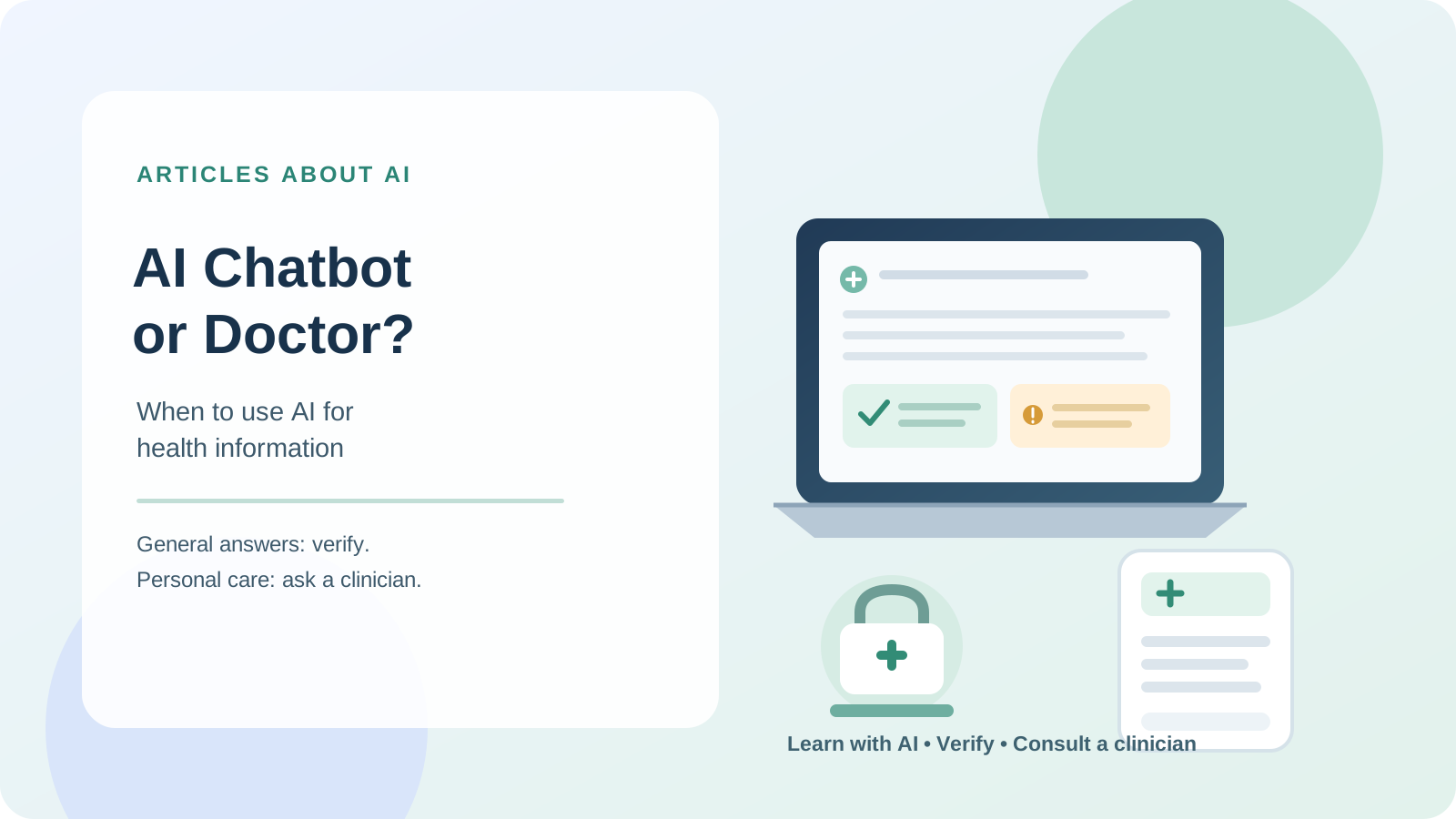
AI chatbots can explain health terms in plain language, summarize general information, and help people prepare for a medical appointment. But when a health question becomes a personal decision about symptoms, diagnosis, medication, or treatment, the difference between an AI chatbot and a doctor matters.
Use AI for general education and preparation. Use a qualified healthcare professional for personal medical assessment and decisions. The distinction is not that every AI answer is wrong or every online source is unreliable. It is that a chatbot does not have the full clinical context, examination, accountability, and professional judgment needed to manage an individual patient’s care.
When an AI Chatbot Can Be Useful
For general, low-risk information, an AI assistant can be a convenient starting point. Appropriate uses may include:
- Explaining unfamiliar medical vocabulary or abbreviations.
- Describing, in general terms, how a common test is usually performed.
- Helping you prepare a list of questions for a doctor or pharmacist.
- Organizing questions and notes before an appointment.
- Summarizing information from reputable sources that you provide.
- Explaining the difference between two health concepts without deciding which condition you have.
For example, if you encounter an unfamiliar term in a health article, you can ask an AI system to explain it and then check the explanation against a trusted medical resource such as MedlinePlus, maintained by the U.S. National Library of Medicine.
The chatbot should support your understanding, not become the final authority. Verify important claims, especially those involving treatment, drug safety, screening, or whether symptoms need urgent attention.
When a Doctor Is the Better Choice
A doctor or other appropriately qualified clinician is essential when an answer depends on your individual circumstances. That includes situations such as:
- New, persistent, worsening, or unexplained symptoms.
- Questions about what a symptom means for you personally.
- Interpreting test results in the context of your medical history.
- Starting, stopping, changing, or combining medicines.
- Deciding between treatment options or assessing possible side effects.
- Managing a chronic condition, pregnancy-related concern, or a child’s health.
- Determining whether a symptom requires urgent or emergency care.
A clinician can ask follow-up questions, examine you when needed, order or interpret tests, consider your medical history, and arrange appropriate follow-up. An AI chatbot may produce a plausible explanation, but it cannot reliably reproduce the complete clinical process.
For a potentially life-threatening emergency—such as severe difficulty breathing, signs of a stroke, severe chest pain, or loss of consciousness—seek emergency medical help immediately. Do not wait for an AI response.
AI vs. Doctor: What Is the Practical Difference?
| Health task | AI chatbot | Doctor or qualified clinician |
|---|---|---|
| Explain a general medical term | Can be a useful starting point; verify the answer | Can explain the term in your specific context |
| Help prepare appointment questions | Useful for organizing notes | Can prioritize questions during consultation |
| Diagnose an individual’s symptoms | Cannot reliably establish a diagnosis | Can assess symptoms using clinical judgment and appropriate examination or tests |
| Interpret a test result for personal decisions | May explain terminology but can miss context | Can interpret the result alongside history, examination, and other findings |
| Recommend a personal treatment plan | Should not be the sole basis for treatment decisions | Can assess options, benefits, risks, and individual factors |
| Decide whether an emergency is safe to ignore | Not appropriate | Emergency services or clinicians can assess urgency; do not delay emergency help |
This is a practical guide, not a claim that every clinician or AI tool performs identically. Capabilities and quality vary. The important question is whether the task requires individualized clinical judgment.
Why AI Is Not a Substitute for Clinical Judgment
It may not know the details that change the answer
Age, existing conditions, allergies, pregnancy, medicines, symptom duration, and severity can change what advice is appropriate. A short prompt rarely contains everything a clinician needs.
It can give misleading or incomplete information
Generative AI can produce a confident-sounding response that contains errors, leaves out important warnings, or mixes reliable information with unsupported claims. A polished explanation is not proof that the answer is accurate.
It may not recognize the urgency of a situation
A chatbot can misunderstand a symptom description or fail to ask the right follow-up questions. Do not use it to rule out a serious condition or reassure yourself that urgent care is unnecessary.
It does not take responsibility for your care
A clinician’s role includes professional duties, individualized assessment, documentation, follow-up, and coordination with other healthcare services. An AI response does not provide that same care relationship.
The World Health Organization discusses both the potential and the risks of large multimodal models in health, including inaccurate outputs, bias, and the need for governance and human oversight. Read the WHO’s guidance on ethics and governance of AI for health.
How to Use AI Alongside a Healthcare Professional
You do not necessarily have to choose between AI and a doctor. For many people, the safer approach is to use AI to prepare for a conversation with a professional.
- Start with a clear educational question. Ask for a plain-language explanation, not a definitive diagnosis.
- Request reliable references. Ask for links to recognized medical organizations or government health agencies, then open and verify those sources yourself.
- Write down what remains unclear. Use the chatbot to organize questions for your appointment.
- Keep important personal details private. Do not paste identifiable medical records or sensitive information into a service unless you have checked its privacy protections and understand how the data may be used.
- Discuss personal decisions with a professional. Confirm medication, diagnosis, and treatment questions with a qualified clinician or pharmacist.
- Do not delay care. If symptoms are serious or worsening, contact a healthcare professional rather than continuing a chatbot conversation.
A useful prompt for preparation is:
Help me prepare questions for a healthcare appointment about this general topic. Explain unfamiliar terms, identify what needs confirmation from a qualified professional, and provide links to reliable medical sources. Do not diagnose me or recommend a personal treatment.
This wording helps establish a sensible boundary, but no prompt can guarantee that an AI response will be complete or correct.
How to Verify AI Health Information
When a chatbot gives a factual health answer, check whether the claim can be traced to a credible, current source. Prefer government health agencies, established medical institutions, professional medical organizations, and research published in reputable journals.
Useful starting points include:
- MedlinePlus — consumer-focused health information from the U.S. National Library of Medicine.
- U.S. Food and Drug Administration — consumer information on medicines, medical products, and safety.
- World Health Organization — information about digital health and related public-health issues.
- National Institute of Diabetes and Digestive and Kidney Diseases — reliable information on a range of health conditions.
Check publication or review dates, read beyond a search snippet, and look for warnings or exceptions that a chatbot may have omitted. If reputable sources disagree or the information affects a personal medical decision, ask a healthcare professional to help interpret it.
The FDA also explains that some clinical decision support software is subject to specific regulatory considerations, while other functions may be treated differently. Its Clinical Decision Support Software guidance is a useful reminder that medical software should be assessed according to its intended use and risks—not simply because it uses AI.
Protect Your Privacy When Asking Health Questions
Health information is sensitive. Before using an AI service, review its privacy policy and data controls. Avoid including names, addresses, contact details, medical record numbers, or identifiable documents unless you have established that the service is suitable and understand its handling of the information.
Do not assume that every chatbot stores, reviews, or protects health conversations in the same way. Privacy practices vary by provider, product, account type, and settings.
So, Should You Ask AI or a Doctor?
For a general explanation, an AI chatbot may save time and help you understand unfamiliar terms. For a personal diagnosis, treatment decision, medication concern, or question about serious symptoms, a qualified healthcare professional is the safer choice. For emergencies, contact emergency services immediately.
The most responsible approach is to use AI to become better informed, verify claims with dependable medical sources, and involve a clinician whenever the answer could affect your health.
For related reading, see our AI health questions guide, explore more AI guides, visit the Articles About AI homepage, and review our site disclaimer.
Sources and Further Reading
- World Health Organization — Ethics and governance of artificial intelligence for health
- U.S. Food and Drug Administration — Clinical Decision Support Software guidance
- U.S. National Library of Medicine — MedlinePlus
- U.S. Food and Drug Administration — Consumer Updates
- World Health Organization — Digital health
- National Institute of Diabetes and Digestive and Kidney Diseases — Health Information
This article is for general educational purposes only. It is not medical advice and does not replace evaluation, diagnosis, or treatment by a qualified healthcare professional.