
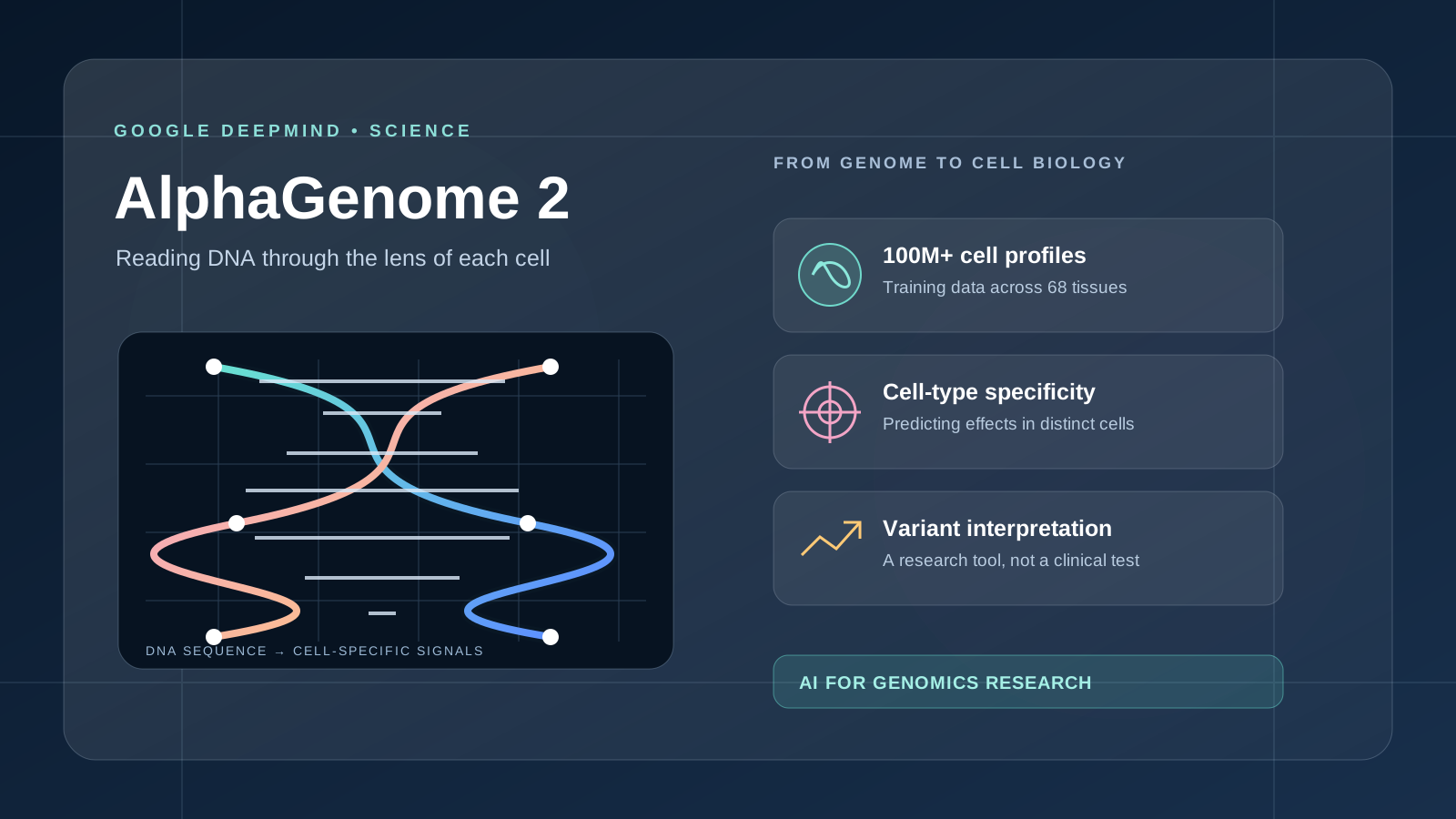
Google DeepMind has introduced AlphaGenome 2, a next-generation artificial intelligence model designed to predict how DNA sequences and genetic variants influence biological activity in specific cell types. Announced on November 11, 2026, the system aims to help researchers connect genetic changes with the cells and biological states in which those changes matter.
The release addresses a major challenge in human genetics: a DNA variant may have a measurable effect in one cell type but little or no effect in another. By combining DNA sequence analysis with single-cell data, AlphaGenome 2 is designed to make those differences easier to investigate.
Google DeepMind says the model was trained on more than 107 million individual cell profiles across 68 tissues. In the company’s reported evaluation on the TenK10K dataset, AlphaGenome 2 identified nearly twice as many causal variants and directional gene effects as the previous model used for comparison.
The system is being made available for non-commercial research through the AlphaGenome API, while commercial research access is in private preview. It is a research tool, not a clinical diagnostic system.
What is Google DeepMind’s AlphaGenome 2?
AlphaGenome 2 is an AI model that studies how DNA sequence changes affect molecular processes inside cells. It builds on the original AlphaGenome, which was introduced to predict the functional effects of genetic variants across a broad range of biological measurements.
The important change is its focus on cell-type-specific prediction. Rather than treating a tissue as a single broad measurement, AlphaGenome 2 can condition its predictions on a particular tissue, cell type, or cellular state.
That distinction matters because the same DNA sequence can be interpreted differently by different cells. A regulatory DNA region might influence gene activity in an immune cell while having a different effect in a heart cell. A model that averages signals across many cell types can miss some of these specialized effects.
AlphaGenome 2 is intended to help researchers examine those differences computationally and prioritize which genetic variants deserve closer experimental investigation.
What is new in AlphaGenome 2?
Google DeepMind describes several advances over the original model.
1. More precise predictions for individual cell types
The original AlphaGenome generated predictions across multiple tissues and cell lines in parallel from a long DNA sequence. AlphaGenome 2 uses a conditional approach: researchers provide the DNA sequence together with the biological condition they want to study.
That condition can come from a reference catalog of cell types or from a researcher’s own single-cell experiment. The model then predicts how the DNA sequence and its variants may behave in that selected context.
This design is intended to capture regulatory effects that may be diluted or hidden when measurements from different cell populations are combined.
2. Training on more than 107 million cell profiles
The model was trained using bulk and single-cell measurements from human and mouse samples. Google DeepMind reports more than 107 million individual cell profiles spanning 68 tissues.
The scale and resolution of this training data are central to the model’s cell-specific approach. Instead of relying only on average measurements from mixed populations, the model can learn patterns associated with more specialized cell types and states.
3. Predictions for new cell states without retraining
One notable capability is the ability to work with single-cell experiments that were not part of the model’s original training set.
Researchers can provide a single-cell RNA sequencing snapshot containing gene-activity measurements from a new biological condition. AlphaGenome 2 converts this information into a representation of the cell state and uses it to condition its predictions.
According to DeepMind, this can allow the model to analyze unfamiliar states without first fine-tuning or retraining the full model on that dataset. The company describes potential applications involving disease progression, vaccination responses, and drug treatment research.
4. A broader range of molecular readouts
AlphaGenome 2 predicts core measurements associated with DNA function, including:
- Gene expression.
- Histone modifications.
- Chromatin accessibility.
- DNA methylation.
DNA methylation is an additional readout highlighted in the announcement. Together, these measurements can help researchers investigate how regulatory DNA influences gene activity and how genetic changes may alter that regulation.
AlphaGenome 2 performance: what do the reported results show?
Google DeepMind reports improvements in variant-effect prediction, particularly when the goal is to identify the cell types in which genetic changes influence gene expression.
In its comparison using the TenK10K dataset, which maps 28 primary immune cell types, the company reports the following results:
| Evaluation measure | Previous comparison model | AlphaGenome 2 |
|---|---|---|
| Causal variants identified | 16% | 30% |
| Directional gene effects identified | 23% | 43% |
These figures are the results reported by Google DeepMind for the stated evaluation. They should not be interpreted as universal accuracy rates across every disease, tissue, population, or genetic dataset.
The results nevertheless illustrate the intended benefit of cell-specific modeling: researchers may be able to identify more candidate variants and understand whether those variants increase or decrease gene activity in a particular cell context.
How AlphaGenome 2 could help researchers understand disease
Many genetic studies identify DNA variants associated with a disease or trait, but an association does not automatically explain the biological mechanism. Researchers still need to determine which variant is responsible, which gene it affects, and where in the body the effect occurs.
AlphaGenome 2 is designed to help investigate those questions.
Identifying the cells involved in genetic disease
A variant associated with a condition may act primarily in a specialized immune cell, a brain cell, or another population. Identifying that context can help researchers develop a more specific hypothesis about the biological process involved.
This is particularly relevant to non-coding DNA. Much of the genome does not directly encode proteins, but regulatory regions can influence when and where genes are activated. Variants in these regions can therefore have important effects even when they do not change a protein’s sequence.
Connecting distant regulatory regions to target genes
Some regulatory elements, including enhancers, can influence genes located far away along the DNA sequence. Determining which enhancer controls which gene in a particular cell type is a difficult experimental problem.
DeepMind says AlphaGenome 2 extends enhancer-to-gene predictions to primary human cell types. This could help researchers connect disease-associated variants with the genes and cells most likely to be involved.
Prioritizing variants for follow-up experiments
Genome-wide association studies can identify large groups of variants linked to a trait, but many candidates may not be causal. AlphaGenome 2 predictions can help narrow the list by estimating which variants are most likely to alter molecular activity in relevant cells.
That does not replace laboratory validation. Instead, it can help research teams decide which hypotheses and experiments to investigate first.
The ETS2 and inflammatory bowel disease example
Google DeepMind highlights a case involving a genetic variant associated with inflammatory bowel disease (IBD) and the ETS2 gene in gut macrophages.
Earlier experimental research had identified a regulatory mechanism in which a distant DNA variant increases ETS2 activity in macrophages, a type of immune cell found in tissues including the gut.
DeepMind reports that AlphaGenome 2 reproduced key aspects of this finding computationally. Its predictions identified the variant and indicated that the effect was concentrated in gut macrophages rather than appearing uniformly across other cell types.
The example is important because it illustrates the model’s intended use: connecting a non-coding genetic variant to a particular gene and the specific cells in which its regulatory effect may occur.
However, reproducing an established finding computationally is not the same as independently proving a disease mechanism. Experimental evidence remains essential when establishing causality.
AlphaGenome vs. AlphaGenome 2: key differences
| Feature | Original AlphaGenome | AlphaGenome 2 |
|---|---|---|
| Main focus | Broad prediction of DNA variant effects | Cell-type- and cell-state-specific variant effects |
| Biological context | Broad tissues and cell lines | A selected tissue, cell type, or state |
| Prediction design | Parallel outputs across conditions | Conditional predictions for a chosen condition |
| Single-cell data | Not the central conditioning mechanism | Can use researcher-provided single-cell data |
| Unseen cell states | More limited cell-specific adaptation | Designed to generalize to new states without full retraining |
| Molecular readouts | Gene expression, chromatin and other regulatory signals | Core readouts plus DNA methylation |
| Intended users | Genomics and molecular biology researchers | Researchers needing finer cell-level interpretation |
The two systems address related but different research needs. AlphaGenome remains useful for broad analysis, while AlphaGenome 2 is designed for questions where the identity or state of a cell is central to understanding a genetic variant.
Who can access AlphaGenome 2?
Google DeepMind says AlphaGenome 2 is available through the AlphaGenome API for non-commercial research. Access for commercial research is currently offered through a private preview.
The company’s announcement also points researchers to interactive Colab tutorials for expression conditioning and a community forum. Availability, quotas, and access conditions may depend on the research use case and the current API terms.
Researchers can start with the official resources:
- Google DeepMind: AlphaGenome 2 announcement
- AlphaGenome research platform
- Nature’s independent coverage of AlphaGenome 2
Limitations: what AlphaGenome 2 cannot establish
Despite the reported improvements, AlphaGenome 2 should be understood as a predictive research model rather than a definitive source of biological truth.
First, a computational prediction does not establish that a genetic variant causes a disease. Predictions need to be evaluated alongside experimental evidence, clinical observations where relevant, and independent research.
Second, model performance can vary by dataset, cell type, biological condition, and the quality of the input measurements. Results from one benchmark should not be generalized to every research setting.
Third, predictions for an unfamiliar cell state do not mean the model has directly observed every biological mechanism in that state. Generalization is useful, but it still requires careful interpretation and validation.
Finally, Google DeepMind explicitly states that AlphaGenome and AlphaGenome 2 have not been validated or approved for clinical or diagnostic use. They should not be used to diagnose patients, make treatment decisions, or replace professional medical evaluation.
Why AlphaGenome 2 matters for the future of AI in biology
The broader direction is a shift from predicting biological activity at the level of broad tissues toward modeling the differences between individual cell types and states.
That shift could make AI tools more useful in human genetics, especially when researchers need to connect non-coding DNA variants with specific regulatory mechanisms. It may also help prioritize experiments, identify candidate disease pathways, and generate more precise hypotheses for drug discovery research.
AlphaGenome 2 does not solve the problem of interpreting the human genome, and it does not remove the need for laboratory science. Its significance is that it offers researchers a more detailed computational way to ask where and under what cellular conditions a genetic variant may matter.
For readers interested in AI-assisted research workflows, see our guide to organizing university research with Claude Projects.
Frequently asked questions about AlphaGenome 2
What is AlphaGenome 2?
AlphaGenome 2 is a Google DeepMind AI model that predicts how DNA sequences and genetic variants affect molecular activity in specific cell types and biological states.
How is AlphaGenome 2 different from AlphaGenome?
The original model predicts DNA effects across broad tissues and cell lines. AlphaGenome 2 uses a conditional architecture to focus predictions on a selected cell type or state and can use new single-cell data to analyze unfamiliar conditions.
How much data was AlphaGenome 2 trained on?
Google DeepMind reports that it was trained on more than 107 million individual cell profiles across 68 tissues, using human and mouse data.
Can AlphaGenome 2 identify disease-causing mutations?
It can help researchers prioritize candidate variants and predict their possible molecular effects. Its predictions do not, by themselves, prove that a variant causes a disease.
Is AlphaGenome 2 available to the public?
It is available through the AlphaGenome API for non-commercial research. Commercial research access is in private preview, according to Google DeepMind’s announcement.
Can AlphaGenome 2 be used for medical diagnosis?
No. Google DeepMind states that AlphaGenome and AlphaGenome 2 have not been validated or approved for clinical or diagnostic purposes.
Final thoughts
AlphaGenome 2 represents a meaningful advance in AI-powered genomics because it brings cell-specific context into the prediction of genetic variant effects. Its training scale, ability to condition predictions on new single-cell data, and reported improvements on an immune-cell benchmark make it a significant research development.
Its real-world value will depend on how independent research groups test the model, validate its predictions, and integrate it with experimental biology. For now, AlphaGenome 2 is best viewed as a promising research tool that can help scientists generate more precise hypotheses about how DNA variation influences human cells.