An AI health answer can sound clear, confident, and reassuring. That does not make it accurate, complete, current, or appropriate for your circumstances. A chatbot may summarize general medical information usefully, but it can also omit important context, misstate evidence, or produce references that do not support its claims.
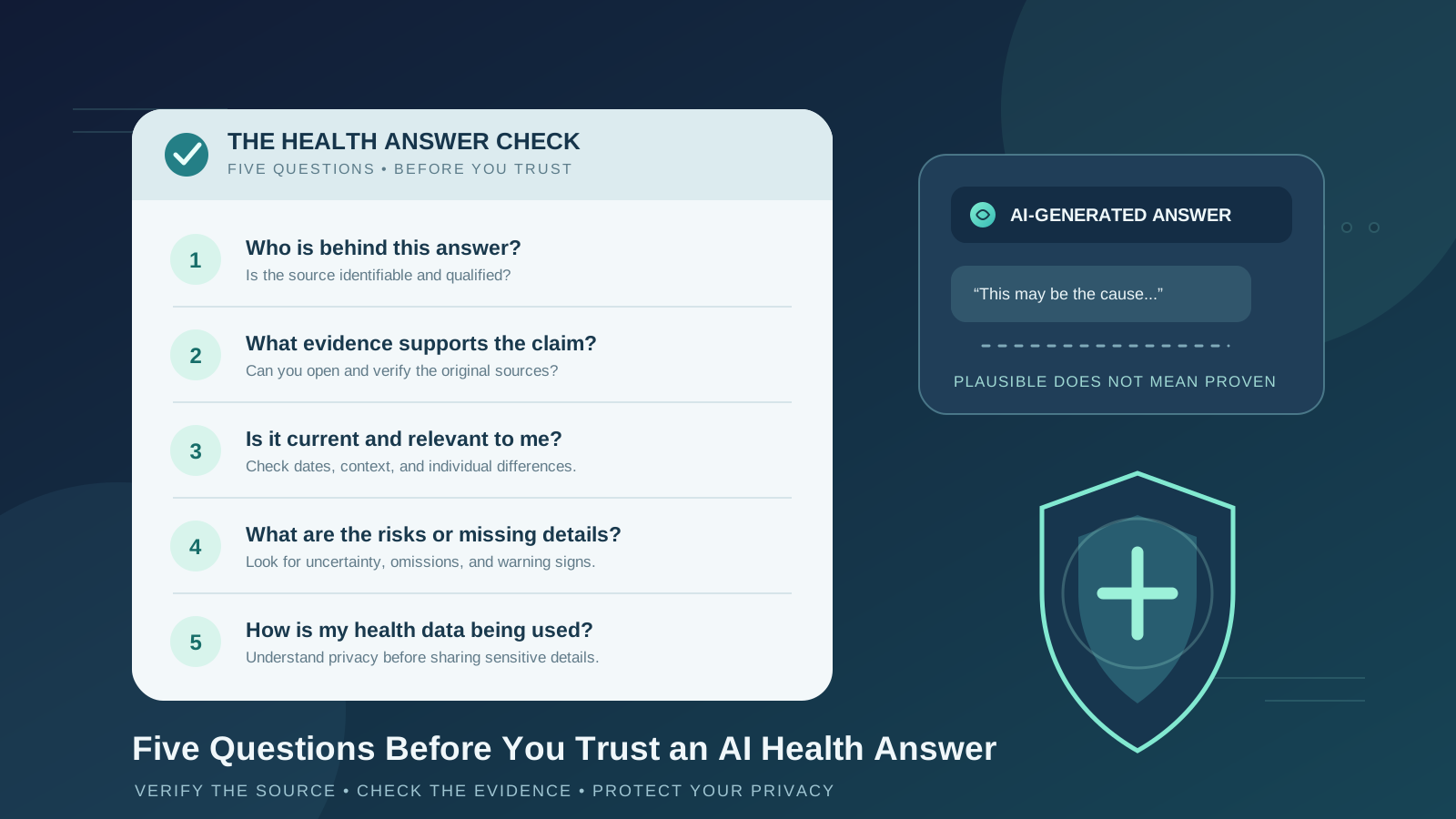
Before using an AI-generated answer to inform a health decision, pause and ask five questions: Who is behind the answer? What evidence supports it? Is it current and relevant? What uncertainty or risk is missing? And how will your health information be handled?
These questions provide a practical way to evaluate AI-generated medical information without treating a chatbot as a doctor or a substitute for professional care.
Health and safety note: This article is for general education, not diagnosis or personalized medical advice. Do not use an AI chatbot to decide whether an emergency can wait. If symptoms are severe, sudden, rapidly worsening, or potentially life-threatening, contact your local emergency number or seek emergency care.
1. Who is behind this answer, and what is the tool designed to do?
Start by identifying the AI product and the source of the information it presents. Is the answer generated by a general-purpose chatbot, a search engine summary, a health-focused application, or a medical device intended for a defined clinical task? These are not interchangeable.
A general AI assistant may explain medical vocabulary or summarize publicly available information. That does not mean it has been clinically validated to diagnose a condition, recommend treatment, or assess an emergency. A specialized health product may have a narrower intended purpose, but you should still check what it is designed and authorized to do.
Ask:
- Which company or organization provides the tool?
- Does it explain whether the answer comes from its model, a live search, or a cited medical source?
- Does the product state its intended use and limitations?
- Is the tool designed for general education, or is it a regulated medical product for a specific task?
- Does it clearly distinguish information from diagnosis or treatment advice?
The World Health Organization (WHO) warns that large multimodal models used in health-related contexts can produce false, inaccurate, biased, or incomplete statements. Its guidance emphasizes appropriate governance, transparency, and risk management. Read the WHO guidance on ethics and governance of AI for health.
What should make you cautious: vague claims that an AI is a “medical expert,” unclear product ownership, or marketing that promises reliable diagnosis without explaining the evidence and intended use.
2. What evidence supports the answer—and can you verify the original source?
A trustworthy medical claim should be traceable to credible evidence. If an AI answer says that a treatment is effective, a symptom is harmless, or a health risk has changed, ask where that statement comes from.
Do not stop at a list of citations. Open each source and check whether it exists, whether it is authoritative, and whether it actually supports the specific claim. A real source can still be misquoted, taken out of context, or used to support a conclusion it never reached.
Look for:
- Clinical guidelines from recognized health authorities or professional organizations.
- Peer-reviewed research relevant to the claim.
- Systematic reviews that explain how the evidence was assessed.
- Official medicine and medical-device information from relevant regulators.
- Clear distinctions between established findings, preliminary research, and expert opinion.
Be especially careful with claims based on a single small study, animal research presented as proven human benefit, testimonials, or an abstract without the full research context.
For a useful source-checking framework, the U.S. National Library of Medicine’s MedlinePlus guide to evaluating health information recommends checking who runs a source, its purpose and funding, the quality and references of its content, its review process, update dates, and privacy practices. The National Institutes of Health Office of Dietary Supplements also provides a detailed guide to evaluating health information online.
What should make you cautious: citations that lead nowhere, sources that do not support the statement, unsupported statistics, or a confident conclusion with no verifiable evidence.
3. Is the information current—and does it apply to my situation?
Medical guidance changes as research develops, medicines receive updated safety information, and public health recommendations are revised. An answer may accurately describe an older recommendation while failing to reflect current guidance.
Check the publication or review date of the source, not just the date on which the chatbot generated its response. If the AI has a web-search feature, confirm that it actually retrieved current information and that the links lead to the original documents.
Then consider whether the information applies to the person and situation involved. Health recommendations can depend on factors such as:
- Age and stage of life.
- Pregnancy or breastfeeding.
- Existing medical conditions and medical history.
- Medicines, supplements, and known allergies.
- Symptom severity, duration, and changes over time.
- Local medical guidance and availability of care.
A general answer cannot reliably account for all these factors unless they are assessed appropriately. Even if you provide personal details, a chatbot cannot replace a clinical history, examination, or tests when those are needed.
Ask the AI to identify the date and jurisdiction of the guidance it is summarizing. Then verify those details directly with the issuing organization. For consumer health information, MedlinePlus is a service of the U.S. National Library of Medicine; use relevant national health authorities when local recommendations differ.
What should make you cautious: undated advice, references to old guidance without context, or recommendations presented as universal despite important differences between patients.
4. What uncertainty, missing context, or safety risk could change the answer?
A useful health explanation should acknowledge what is not known. Symptoms can have multiple causes, and the same symptom may require different responses depending on its severity, timing, associated symptoms, and a person’s medical history.
AI systems can produce fluent answers while overlooking missing information. They may also fail to communicate uncertainty clearly. Ask the tool to separate what is directly supported by the information you provided from what it is only suggesting.
Useful follow-up questions include:
- What important information is missing from my description?
- Which parts of this answer are established facts, and which are possibilities?
- What evidence would change this explanation?
- Are there important limitations or alternative explanations?
- What warning signs require prompt or emergency medical attention?
- Which claims should I confirm with a healthcare professional?
Do not use these questions to obtain reassurance that a serious condition has been ruled out. A chatbot cannot safely exclude every urgent cause of a symptom through conversation.
If a health answer recommends a medicine, stopping a prescribed treatment, delaying care, or trying an intervention, verify it with a qualified healthcare professional. Do not change prescribed medication based solely on an AI response.
For more detail on the limits of symptom interpretation, read What AI Can and Cannot Tell You About Your Symptoms. It explains why a symptom list or chatbot response is not the same as a clinical assessment.
What should make you cautious: absolute certainty, a diagnosis based on limited details, dismissal of worsening symptoms, or treatment instructions without a clear clinical basis.
5. How will the tool use my health information?
Health questions can reveal sensitive information, including symptoms, diagnoses, medicines, test results, and details about family members. Before entering those details, understand how the service handles conversations and uploaded files.
Review the provider’s privacy policy and settings. Look for clear information about:
- Whether conversations are stored and for how long.
- Whether human reviewers may access submitted content.
- Whether conversations may be used to improve or train models.
- Whether you can control data use or delete conversation history.
- Whether uploaded files are retained separately from chat messages.
- Whether the service offers protections appropriate for the information you plan to share.
Do not assume that a consumer chatbot has the same confidentiality obligations or protections as your doctor, hospital, or approved patient portal. Privacy rules vary by service and jurisdiction.
Practical steps can reduce unnecessary exposure:
- Do not enter your full name, home address, identification numbers, account credentials, or other identifiers unless truly necessary.
- Remove identifying details from documents before uploading them, where appropriate.
- Avoid sharing another person’s medical information without permission.
- Use an approved healthcare channel for sensitive communication with your care team.
- Check the provider’s current privacy terms rather than relying on a general statement about AI privacy.
The WHO’s AI-for-health guidance treats privacy, human rights, transparency, and accountability as important governance considerations. These concerns matter even when a tool is used only for general health information.
What should make you cautious: unclear data retention, vague training-use disclosures, no meaningful privacy controls, or requests for personal details that are unnecessary for the question.
A quick checklist before relying on an AI health answer
Use this table to review an answer before you act on it.
| Question | What to check | If the answer is unclear |
|---|---|---|
| Who is behind it? | Provider, product purpose, and limitations | Treat it as general, unverified information |
| What evidence supports it? | Original sources and whether they support the claim | Do not rely on the unsupported claim |
| Is it current and relevant? | Source date, location, and individual context | Check current official guidance |
| What could be missing? | Uncertainty, alternatives, and warning signs | Ask a clinician when the issue affects care |
| How is my data used? | Storage, review, training use, and privacy controls | Do not submit sensitive details |
A simple rule helps: if a claim could change a health decision, verify it through an authoritative source or a qualified healthcare professional. If the situation may be urgent, seek care rather than spending time checking an AI answer.
How to ask an AI chatbot for a more verifiable health explanation
You can make a general-information request more useful by asking the chatbot to show its reasoning limits and provide sources you can inspect. This does not guarantee accuracy, but it makes unsupported claims easier to identify.
Try this prompt for a non-urgent educational question:
I want general health information, not a diagnosis or personalized treatment.

Please explain the topic below in plain language:
[Enter a general health question without unnecessary personal details.]

For your answer:
1. Separate established information from uncertainty.
2. Identify important context that could change the answer.
3. Cite authoritative sources and link to the original pages.
4. Do not invent studies, guidelines, quotations, or citations.
5. Include publication or review dates when available.
6. Explain what you cannot determine from the information provided.
7. Identify when a person should contact a healthcare professional.

Do not tell me that a serious condition has been ruled out.
Do not recommend starting, stopping, or changing prescribed medication.
After receiving the response, open the cited sources and compare them with the claims. If a citation cannot be verified, treat the associated claim as unsupported. Do not use this prompt for emergencies or as a substitute for a medical appointment.
What to do when an AI health answer fails one of the five checks
You do not need to reject every AI-generated health explanation automatically. Instead, match your response to the problem:
- Unclear provider or intended use: use the tool only for low-risk general education, if at all.
- Missing or weak evidence: do not rely on the claim; look for an authoritative original source.
- Outdated information: check current guidance from a recognized health authority.
- Uncertainty or safety concerns: ask a qualified healthcare professional rather than prompting repeatedly for reassurance.
- Unclear privacy practices: do not submit sensitive medical information.
If the answer conflicts with advice from your healthcare professional, do not resolve the disagreement by asking the chatbot to choose a side. Share the information with your clinician and ask them to explain whether it applies to your circumstances.
Frequently asked questions
Can I trust ChatGPT for medical information?
ChatGPT and other general-purpose AI assistants can help explain medical terms and summarize general information, but their responses can be inaccurate or incomplete. Verify important claims with original, authoritative sources and consult a healthcare professional before making decisions about your care.
What are the signs of an unreliable AI health answer?
Warning signs include missing or unverifiable citations, outdated sources, exaggerated promises, unsupported certainty, failure to acknowledge missing context, and advice to ignore professional care. A polished writing style is not evidence of medical accuracy.
Should an AI health answer always include sources?
For consequential medical claims, sources are important because they allow you to check where the information came from. However, citations alone do not prove that an answer is correct. Open the original source and confirm that it supports the specific statement.
Is AI-generated health information private?
Privacy depends on the provider, product, account settings, and applicable rules. Read the current privacy policy and data controls before sharing health details. Do not assume that a consumer chatbot offers the same protections as a healthcare provider’s approved system.
Can AI tell me whether a symptom is dangerous?
A general-purpose chatbot cannot reliably rule out an emergency. If symptoms are severe, sudden, rapidly worsening, or potentially life-threatening, contact your local emergency number or seek emergency care. Do not wait for an AI response.
What is the safest way to use AI for health questions?
Use AI for general explanations and appointment preparation, verify consequential claims with authoritative sources, protect sensitive information, and involve a qualified healthcare professional in decisions about diagnosis and treatment.
The bottom line
Before trusting an AI health answer, check who produced it, what evidence supports it, whether the information is current and relevant, what uncertainty or safety risks may be missing, and how your personal information will be used. These five questions will not turn a chatbot into a medical professional, but they can help you recognize weak information and make safer decisions about when to verify, when to ask a clinician, and when to seek urgent care.
Sources and further reading
- World Health Organization: Ethics and governance of artificial intelligence for health — WHO guidance on the benefits, risks, and governance of large multimodal models in health.
- MedlinePlus: Evaluating Health Information — National Library of Medicine guidance on checking providers, purpose, evidence, review, dates, and privacy.
- NIH Office of Dietary Supplements: How to Evaluate Health Information on the Internet — questions about source ownership, funding, evidence, expert review, currency, and privacy.
- National Institute on Aging: How to Find Reliable Health Information Online — practical guidance on checking online health information and discussing it with a healthcare provider.