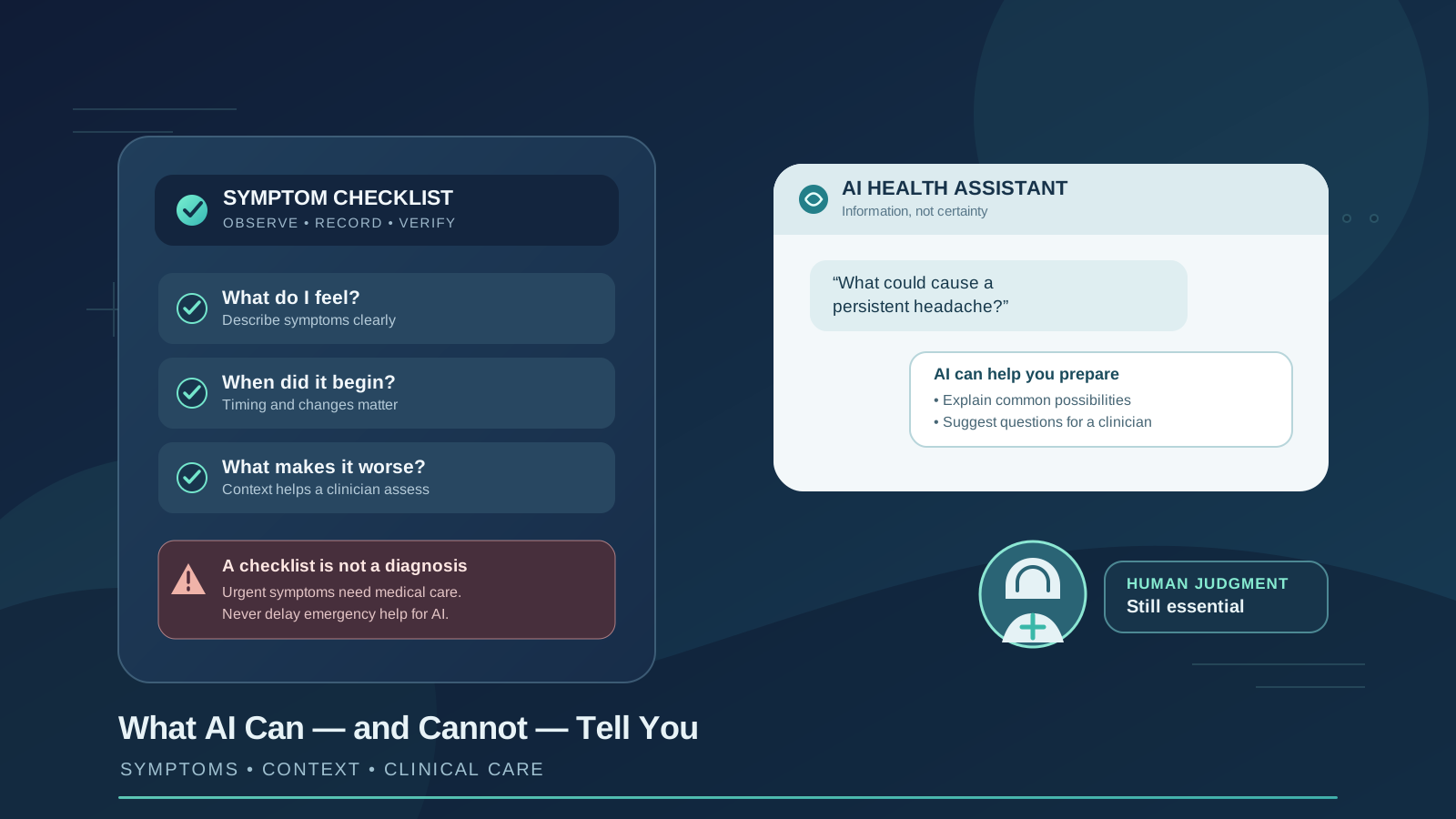
AI can help you understand unfamiliar medical terms, organize symptoms, and prepare questions for a healthcare professional. But an AI chatbot cannot reliably determine what is causing your symptoms from a short description alone. It may overlook an important detail, present an unlikely explanation too confidently, or fail to recognize when a problem needs urgent attention.
The safest way to use AI for symptoms is as an information and preparation tool—not as a diagnosis, a substitute for a clinician, or a reason to delay care. This guide explains what AI symptom checkers can do, what they cannot establish, how to verify their answers, and when to seek medical help.
Important: This article provides general health information, not a diagnosis or personalized medical advice. If you think you may be experiencing a medical emergency, contact your local emergency number or seek emergency care now. Do not wait for an AI response.
What AI can help you understand about symptoms
A general-purpose chatbot can explain common medical terms and help you organize the information you want to share with a clinician. The value depends on the tool, the information you provide, and whether you verify the answer against reliable sources.
1. Explain medical language in plain English
You can ask an AI assistant to explain terms you encountered in a patient portal, discharge summary, or reputable health article. For example, it might explain the difference between a symptom and a sign, or define terms such as inflammation, dehydration, or dizziness.
Ask for a plain-language explanation and a link to a trusted source. Do not treat a fluent explanation as proof that the information is correct, and do not paste personal medical records into a service unless you understand its privacy terms and are permitted to share that information.
2. Help you record a symptom timeline
AI can help turn a scattered description into a structured note. Useful details to record include:
- What the symptom feels like and where it occurs.
- When it started and whether it is getting better, worse, or changing.
- How often it happens and how long each episode lasts.
- What seems to trigger or relieve it.
- Other symptoms that appeared at the same time.
- Relevant medicines, allergies, existing conditions, or recent changes to discuss with a clinician.
A timeline can make a medical appointment more productive. The clinician—not the chatbot—must decide which details matter for assessment.
3. Suggest questions to ask a healthcare professional
You can ask AI to help prepare neutral questions, such as:
- What possible causes should we consider based on my history and examination?
- Are there symptoms that should prompt urgent care?
- Do I need an examination or tests?
- Could a medicine or an existing condition be relevant?
- What should I monitor, and when should I follow up?
These questions help you participate in a conversation with a qualified professional. They do not establish which condition you have.
4. Help you find reliable health resources
AI may point you toward official health information, but links and citations still need checking. Prefer resources from public health agencies, established medical institutions, and professional organizations. Confirm that the page actually supports the claim being made and that it applies to your age group and situation.
For more background on the broader question of trust, see our guide Should You Trust AI for Health Questions?.
What AI cannot reliably tell you about your symptoms
1. It cannot confirm a diagnosis from a chat alone
Many conditions share symptoms. A headache, for example, can have a range of causes, and the right interpretation depends on factors that may not be visible in a text conversation. A clinician may need a medical history, physical examination, vital signs, laboratory tests, imaging, or follow-up observations.
A chatbot can list possibilities, but a list is not a diagnosis. Even when an answer sounds specific, it may not be based on enough information to distinguish between conditions that require different care.
2. It may miss context or ask too few questions
An answer can change significantly depending on age, pregnancy, medical history, medicines, symptom severity, how quickly symptoms began, and other circumstances. If a tool does not ask about a relevant factor—or if the user does not mention it—the result may be misleading.
Providing more information does not guarantee a correct answer. It can help a tool produce a more relevant explanation, but it cannot replace a clinical assessment.
3. It can sound confident while being wrong
Generative AI systems produce plausible language, not guaranteed truth. They can give inaccurate explanations, omit important caveats, invent references, or make an uncertain conclusion sound settled. A disclaimer at the bottom of an answer does not make the answer reliable.
Check consequential claims against an authoritative source. If the AI cites a study or guideline, open the original source and confirm that it exists and says what the answer claims.
4. It cannot safely rule out every serious condition
A chatbot may reassure you that a symptom is probably minor. That reassurance is not a medical clearance. Serious conditions do not always present in the same way, and symptoms can change over time.
Do not use an AI tool to decide that emergency warning signs can be ignored. If you are worried that a symptom is severe, sudden, rapidly worsening, or potentially life-threatening, seek appropriate medical help rather than continuing to prompt a chatbot.
5. It may not know the latest or locally relevant guidance
AI tools differ in how they access current information. Some responses may rely on outdated knowledge, while others may retrieve web pages that are incomplete or unsuitable for your circumstances. Recommendations can also differ by country, available services, and individual medical history.
For current advice, consult an appropriate healthcare professional or a recognized health authority. Do not assume that an answer is up to date just because the chatbot presents it in the present tense.
AI symptom checker vs. a healthcare professional
| Task | What AI may contribute | What a healthcare professional can do |
|---|---|---|
| Explain medical terms | Summarize and simplify general information | Explain terms in the context of your history and findings |
| Organize symptoms | Create a timeline or appointment notes | Ask follow-up questions and assess clinical relevance |
| Explore possible causes | Suggest general possibilities, with limitations | Evaluate possibilities using history, examination, and appropriate tests |
| Assess urgency | Offer general information, but may miss danger signs | Triage your situation using clinical judgment and established protocols |
| Recommend treatment | Explain general treatment concepts | Recommend care tailored to your diagnosis, risks, and circumstances |
| Monitor a condition | Help organize observations you record | Interpret changes and decide whether further assessment is needed |
Some purpose-built AI-enabled medical devices are designed for specific clinical tasks and are evaluated within regulatory frameworks. That is different from using a general-purpose chatbot to interpret symptoms. The U.S. Food and Drug Administration explains how it approaches AI-enabled medical devices. The existence of authorized AI medical devices does not mean every AI chatbot is a medical device or has been validated to diagnose your symptoms.
How to check an AI answer about your health
Use this practical process whenever you ask AI a non-urgent health question.
Step 1: Ask for general information, not a definitive diagnosis
Instead of asking, “Tell me exactly what disease I have,” ask, “What are some general reasons a person might experience this symptom, and what information would a clinician need to assess it?”
This wording makes the limits of the task clearer. Do not let the conversation replace medical care if you need an examination or urgent assessment.
Step 2: Ask what information is missing
Prompt the tool to identify important uncertainties and the context that could change a general explanation. Treat its response as a checklist for a conversation with a professional—not as a complete medical intake or proof that all risks have been considered.
Step 3: Verify claims using authoritative sources
Check important information against resources such as:
- MedlinePlus, the U.S. National Library of Medicine’s health information service.
- The U.S. Centers for Disease Control and Prevention (CDC) for relevant public health guidance.
- The U.S. Food and Drug Administration (FDA) for information about medicines, medical products, and device-related topics.
Use health authorities appropriate to your country when local guidance or services differ. Be cautious with search snippets, social media posts, anonymous forums, and pages that sell a product while making medical claims.
Step 4: Keep a clear record of symptoms and changes
Write down when symptoms began, how they have changed, and any other relevant observations. Record the actual details rather than relying on an AI-generated summary that might introduce assumptions. If symptoms worsen or new warning signs appear, reassess the need for care instead of continuing the chat.
Step 5: Use a clinician to make care decisions
Discuss persistent, worsening, unexplained, or concerning symptoms with a qualified healthcare professional. Ask what to do next, which warning signs to watch for, and when to seek follow-up. Do not start, stop, or change prescribed medication solely because an AI chatbot recommended it.
When to stop asking AI and seek medical help
Some symptoms require urgent assessment. MedlinePlus advises calling 911 or the local emergency number for emergencies such as severe chest pain or pressure, severe shortness of breath, choking, or sudden inability to speak, see, walk, or move. See its guidance on when to use the emergency room.
Seek emergency help immediately if you believe you or someone else may be in immediate danger. Do not delay while asking AI to interpret the symptoms, compare possible diagnoses, or confirm that the situation is serious enough.
For symptoms that are not clearly an emergency but are persistent, worsening, or worrying, contact a healthcare professional or an appropriate medical advice service. The right next step depends on the symptoms and the person’s circumstances.
Protect your health information when using AI
Health questions can include sensitive personal information. Before using a chatbot, check the service’s privacy policy and understand how conversations may be stored, reviewed, or used. Do not assume that a consumer AI chat has the same confidentiality protections as communication with your healthcare provider.
Practical precautions include:
- Avoid entering your full name, address, identification numbers, account details, or other unnecessary identifiers.
- Remove personal details from documents before sharing them, when appropriate.
- Never paste passwords, account credentials, or access tokens into a chatbot.
- Review workplace, school, and healthcare privacy rules before sharing information belonging to someone else.
- Use official patient portals and approved clinical systems for sensitive communication with your care team.
Removing identifying details can reduce exposure, but it does not guarantee anonymity. Consider whether the information is necessary to ask the question at all.
A safer prompt for non-urgent symptom research
If you choose to use a general AI chatbot for educational information, a prompt like this can help keep the task appropriately limited:
I am looking for general health information, not a diagnosis.

Explain in plain language what is generally known about this symptom:
[describe the symptom without unnecessary identifying details]

Please:
1. Explain the limits of what can be inferred from this description.
2. Identify important context a healthcare professional may need.
3. Link to relevant official health sources and do not invent citations.
4. Explain general warning signs that warrant urgent medical attention.
5. Separate well-established information from uncertainty.

Do not tell me that a serious condition has been ruled out.
Do not recommend starting, stopping, or changing medication.
This prompt does not make an AI answer medically reliable, and it is not appropriate for emergencies. Verify the sources and seek professional advice when needed.
Frequently asked questions
Can AI diagnose symptoms accurately?
A general-purpose chatbot should not be treated as a diagnostic authority. It may explain possibilities, but symptoms often overlap and a reliable assessment may require clinical history, examination, or tests. Purpose-built medical tools have different intended uses and evidence requirements.
Should I use ChatGPT or another chatbot when I feel sick?
You can use a chatbot to understand general terminology, organize symptom notes, or prepare questions for a clinician. Do not rely on it to rule out a serious condition, prescribe treatment, or decide whether urgent symptoms can wait.
Are AI symptom checkers always wrong?
No. Some tools may provide useful general information or support specific, validated tasks. Performance depends on the product, its intended use, the evidence behind it, and the situation. Neither a helpful answer nor a correct answer once proves that a tool is dependable for every case.
Can AI tell me whether I need to go to the hospital?
Do not rely on a general chatbot to rule out an emergency. If symptoms are severe, sudden, rapidly worsening, or potentially life-threatening, contact your local emergency number or seek emergency care. For other concerning symptoms, contact a qualified healthcare professional for advice.
Is it safe to share symptoms with an AI chatbot?
It depends on the service, its privacy settings, its data practices, and what you share. Avoid unnecessary identifying information and review the provider’s privacy terms. For sensitive medical details, use communication channels approved by your healthcare provider.
What is the safest way to use AI for health questions?
Use it for education and preparation, verify important claims through reputable health sources, protect personal information, and consult a qualified professional for decisions about your care. Never let an AI response delay emergency treatment.
The bottom line
AI can help explain symptoms in plain language, organize information, and prepare you for a medical conversation. It cannot reliably diagnose every cause, assess your full clinical context, or guarantee that a dangerous condition has been ruled out. Treat AI-generated health information as a starting point to verify—not a final medical answer—and seek appropriate professional care when symptoms are concerning.
Sources and further reading
- FDA: Artificial Intelligence-Enabled Medical Devices — explains the FDA’s risk-based approach to AI-enabled medical devices and examples of their clinical uses.
- MedlinePlus: When to Use the Emergency Room — lists examples of symptoms that may require immediate emergency help.
- MedlinePlus: Recognizing Medical Emergencies — describes warning signs of medical emergencies.
- CDC — official public health information and guidance.
- MedlinePlus — health information from the U.S. National Library of Medicine.