
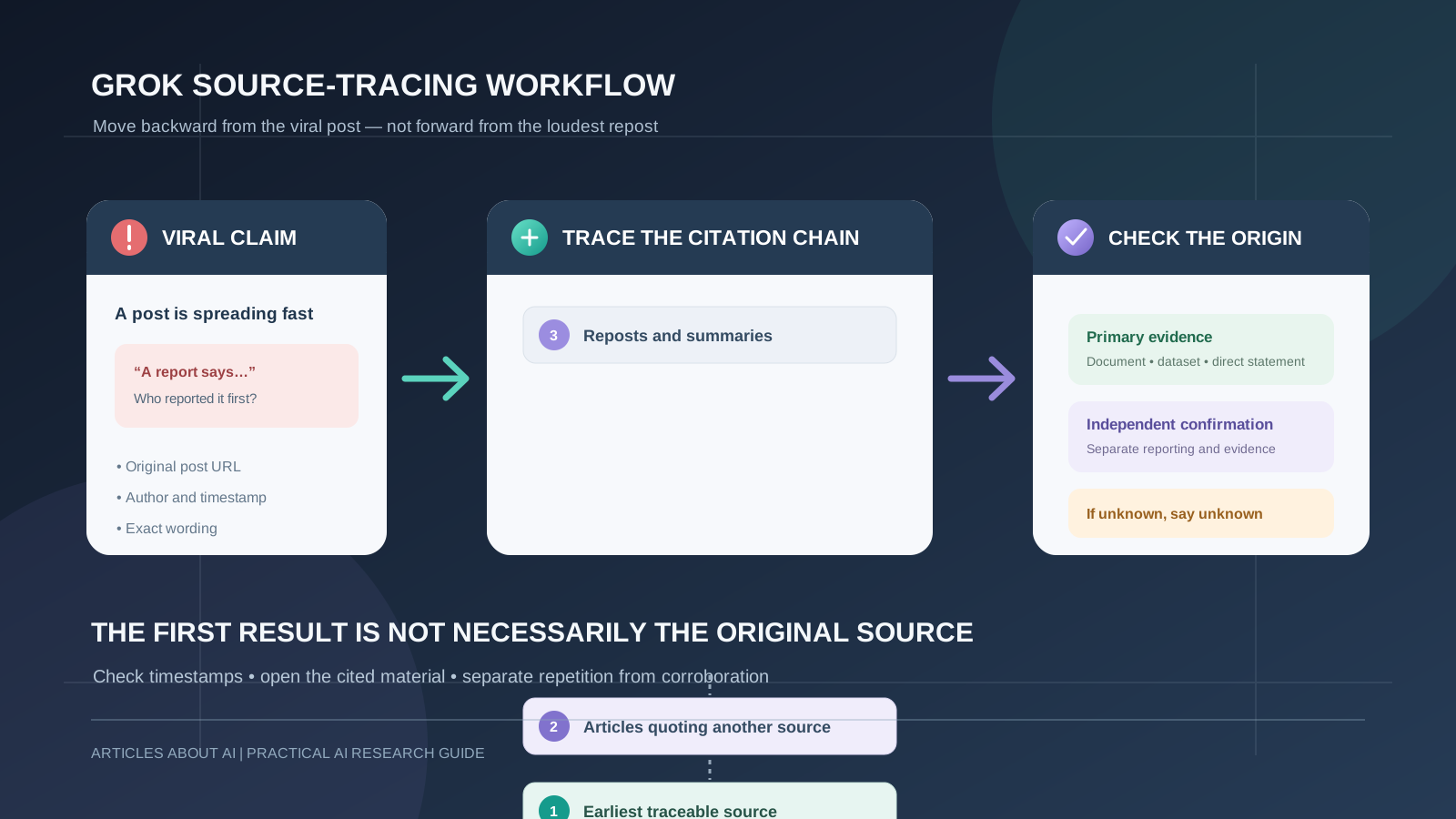
A viral claim can appear to have dozens of sources when, in reality, every post and article may be repeating the same unverified statement. The first result in a search is not necessarily the original report, and the account with the most followers may not have direct knowledge of the event.
The goal of source tracing is to move backward through the chain of references until you reach the earliest identifiable source—and then establish whether that source provides direct evidence. Grok can help search public posts on X and the wider web, organize links, and compare dates. It cannot guarantee that the earliest result it finds is the true origin.
This guide shows how to use Grok to investigate a viral claim systematically. It focuses on source provenance: who first made the claim, which later accounts repeated it, what evidence the original source supplied, and whether the chain ends at a primary document, direct witness, official statement, or an unsupported assertion.
If you want a broader workflow for assessing a developing story, see How to Use Grok to Verify a Breaking News Claim. This guide goes deeper into tracing where the claim came from.
What Grok can do for source tracing
X says Grok can decide whether to search public X posts and conduct real-time web searches when responding to a question. xAI’s developer documentation describes X Search capabilities including keyword search, semantic search, user search, and fetching a post with its thread. Its Web Search tool can search the web and browse pages.
These capabilities can help you:
- Search for distinctive phrases from a viral post.
- Find earlier posts that use the same wording.
- Identify articles that cite or quote another publication.
- Locate official statements, original documents, and named sources.
- Compare publication dates and identify gaps in a citation chain.
- Build a source map showing which reports depend on the same original item.
The exact search options available depend on whether you are using the consumer Grok experience or building with xAI’s API. The API documentation describes developer tools and parameters; it should not be treated as a promise that every control appears in every Grok interface.
Start with the official explanations: X Help Center: About Grok, xAI: X Search, and xAI: Web Search.
Step 1: Capture the claim and preserve the starting point
Before searching, save the exact post or article that brought the claim to your attention. Record:
- The original URL you encountered.
- The exact wording of the claim, including numbers and quoted phrases.
- The account or publisher name.
- The visible publication date and time.
- Any links, screenshots, images, or documents attached to it.
- Whether the post says it is reporting firsthand information or citing someone else.
Do not rewrite the claim in a way that changes its meaning. A statement such as “officials are investigating” is not equivalent to “officials confirmed.” Small wording differences can reveal how an uncertain claim became more definite as it spread.
Prompt for Grok:
Analyze this viral post: [paste the original URL]. Extract the exact factual claims without strengthening or simplifying them. Identify every named person, organization, location, date, number, quotation, and cited link. Tell me which parts appear to be firsthand statements and which parts are attributed to another source. Do not assess whether the claims are true yet.
Keep this first record unchanged. It is your reference point for comparing later versions of the claim.
Step 2: Search for the earliest use of the wording
Choose a distinctive phrase from the post—ideally a short quotation, unusual combination of words, specific number, or named entity. Search for that phrase in quotation marks and then try meaningful variations.
Ask Grok to search both public X posts and the wider web:
Search for the exact phrase “[insert distinctive phrase]” and close wording variations related to this claim: [paste claim]. Find the earliest dated posts and web pages you can identify. Return direct URLs, author or publisher names, visible publication dates, and the exact matching wording. Separate exact matches from similar discussions. Do not assume the oldest result you find is the original source.
Run more than one search. The original wording may have been edited, translated, shortened, or paraphrased. Search for key names, figures, and quoted fragments separately rather than relying on one broad query.
A useful manual check is X Advanced Search. X’s help page explains that users can filter posts by words, accounts, places, and date ranges. It is available when logged in at X.com. See How to use Advanced Search. This can help you inspect posts from a particular date range or account when Grok’s results are incomplete.
Important: the earliest post you can locate is only the earliest available trace. It may quote a deleted post, refer to a private conversation, or repeat a source that was published elsewhere first.
Step 3: Follow every citation backward
A viral claim often travels through a chain:
- A social media account posts a claim.
- Another account reposts it with a stronger headline.
- A blog or news aggregator repeats the second account.
- Other posts cite the blog as if it were the original report.
Open each link and inspect what it actually cites. If an article says “according to reports,” find out which reports. If it links to another article, follow that link. Continue until you reach a source that provides direct evidence—or until the trail stops.
Use this prompt:
Build a backward citation chain for this claim: [paste URL]. For every post or article, identify the source it cites, quotes, embeds, or appears to rely on. Follow those references backward as far as the available links allow. Show the chain in chronological order with direct URLs, publication dates, and the relationship between each item. Mark broken, deleted, inaccessible, or uncited references. Do not invent missing links or claim that two sources are independent without evidence.
When reading the results, distinguish these relationships:
- Original reporting: the publisher says it obtained information through its own reporting, interviews, documents, or direct observation.
- Direct source: an official statement, original dataset, research paper, court filing, recording, or firsthand account.
- Attribution: an article explicitly says it is relying on another outlet, agency, person, or document.
- Repetition: a post repeats the claim but supplies no new evidence.
- Commentary: an author interprets the claim without independently establishing it.
A citation chain is useful only when you can see where information came from. A list of links without these relationships can make repeated claims look like independent confirmation.
Step 4: Identify the primary source behind the claim
The right primary source depends on what the claim is about. Look for the material closest to the event or fact being described.
| Claim type | Primary source to look for |
|---|---|
| Government announcement | Original agency statement, briefing, public record, or official document |
| Company news | Company newsroom post, regulatory filing, or named executive statement |
| Scientific finding | Original research paper, dataset, or research institution release |
| Public statistic | Original dataset, methodology, or statistical agency |
| Court or legal development | Court filing, judgment, or official docket |
| A quotation | Full speech, interview, transcript, recording, or original post |
| Eyewitness claim | Original uploader, unedited media, and corroborating location and time evidence |
| Product feature | Official documentation, release notes, or product announcement |
Ask Grok to locate the primary material:
For each factual statement in this claim, identify the most direct primary source available. Search for the original document, dataset, official statement, recording, transcript, or firsthand account. Provide the source URL and the exact section or passage relevant to the claim. Explain whether the source directly establishes the statement or merely repeats someone else’s description. If no primary source can be located, say so.
Do not confuse an official source with independent verification. A company announcement is primary evidence of what the company announced; it is not necessarily independent proof that every performance claim in the announcement is accurate. Attribute statements to the organization that made them.
Step 5: Check dates, edits, and the order of publication
Dates are central to source tracing, but they can be misleading. A page may show an updated date rather than its original publication date. A social post may be edited, deleted, reposted, or quoted later by another account.
Ask Grok:
Create a timeline for these source URLs: [paste URLs]. For each item, report the displayed publication date, any separately displayed update date, the earliest date supported by the page itself, and what the item cites. Do not infer an exact publication time when none is shown. Flag date conflicts, undated pages, and pages that may have been updated after publication.
Then check the pages yourself:
- Look for “published” and “updated” labels separately.
- Open the linked original post rather than relying on a screenshot.
- Check whether a quoted post predates the article that cites it.
- Compare the wording across versions to see whether the claim changed.
- Treat search-engine dates as clues, not conclusive proof of first publication.
- Record time zones when comparing posts from different countries.
If a source has no reliable date, mark the date as unknown. Do not assign a precise chronology based only on search-result ordering.
Step 6: Find out whether the sources are genuinely independent
Ten websites repeating one press release are not ten independent confirmations. The same problem occurs when several social accounts copy one post, or when multiple articles cite the same anonymous source.
Use Grok to map source dependence:
Compare these sources: [paste URLs]. Identify which ones provide original reporting or direct evidence, which ones cite another item in this list, and which ones repeat the same underlying source. Draw a source-dependency table. Do not count two sources as independent merely because they appear on different websites. Explain what new evidence, if any, each source contributes.
Look for evidence of independent work: separate interviews, distinct documents, original data, direct observation, or independently authenticated media. If two outlets both cite the same agency statement, they may independently report that the statement exists, but they do not independently verify every factual detail in it.
For a practical approach to checking a developing claim with Grok, see How to Use Grok to Verify a Breaking News Claim. For another AI-assisted research workflow, read How to Use Perplexity to Verify a Scientific Claim.
Step 7: Verify the original media when the claim includes a photo or video
A photograph or clip may be authentic but unrelated to the claim. It may be old, recorded somewhere else, or cropped to remove important context. Grok can help describe visible details and find related posts, but visual analysis alone does not establish when or where a recording was made.
Ask:
Trace this image or video to its earliest available online appearance: [paste original media URL]. Search for earlier copies, identify the earliest uploader you can find, and list any posts or articles that reused it. Describe visible clues that may help verify the location and date. Clearly distinguish what you observed from what you inferred. Do not claim that the first result is the original recording unless there is evidence.
Then conduct separate checks:
- Use reverse-image search for photographs and key video frames.
- Compare landmarks, signs, road layouts, language, and weather with reliable references.
- Look for a longer or unedited version of the clip.
- Contact the original creator when practical and verify authorship.
- Check whether the media appeared online before the event it is claimed to show.
The Associated Press describes a verification process that includes reverse-image searches, geolocation, comparing visible details, checking footage for manipulation, and contacting the original filmer. See Verification at AP. Its approach is a useful reminder that identifying an upload is not the same as authenticating the content.
Step 8: Ask Grok for a source-tracing report—not a simple verdict
Once you have collected the evidence, ask Grok to summarize the chain without filling gaps:
Prepare a source-tracing report for this viral claim using only the URLs and material identified in this investigation.
Include:
- The exact claim as it first appeared in the material I supplied.
- The earliest traceable occurrence you found, with URL and date.
- The original source or primary evidence, if located.
- A chronological citation chain showing how the claim spread.
- Which sources add independent evidence and which repeat earlier material.
- Any changes in wording, numbers, attribution, or certainty.
- What the primary evidence actually establishes.
- What remains unknown or unsupported.
Label the result as “primary source located,” “earliest trace found but origin unconfirmed,” or “source trail unresolved.” Cite each statement with a direct URL. Never invent a source, date, quotation, or link. If a page is inaccessible, mark it as inaccessible rather than guessing its contents.
These labels describe the state of the investigation, not whether the claim itself is true. Finding the original author does not prove that the author was correct. Likewise, failing to find an original source does not automatically prove that the claim is false.
A source-tracing checklist
Before sharing the result, confirm that you have:
- Saved the exact viral post and its URL.
- Extracted the factual claim without changing its wording.
- Searched distinctive phrases and variations.
- Checked relevant X posts across more than one date range.
- Followed citations and quoted references backward.
- Identified the earliest traceable item without automatically calling it the origin.
- Located primary evidence where available.
- Distinguished original reporting from repetition and commentary.
- Compared dates, edits, and changes in wording.
- Checked whether apparently separate sources rely on the same material.
- Verified original photos or videos separately.
- Recorded what remains unknown.
Common mistakes when tracing a viral claim
Assuming the oldest search result is the original
Search engines and social search tools do not provide a complete historical archive. The earliest result you find may simply be the oldest item still indexed or accessible.
Treating a repost as a source
A repost can help establish that a claim circulated at a particular time. Unless it includes firsthand evidence, it does not establish the underlying event.
Stopping at the first article
An article may cite another outlet, an anonymous account, or a document. Follow the reference and inspect the material it points to.
Counting copied stories as corroboration
Different domains do not necessarily mean independent reporting. Map the citations and identify the underlying source each publisher used.
Confusing a primary source with proof of every detail
A primary source is closest to the information being examined, but it still needs interpretation and context. A statement proves that someone made the statement; further evidence may be needed to establish its contents.
Letting Grok fill gaps in the source chain
If a link is missing, deleted, or inaccessible, preserve that uncertainty. Ask Grok to identify the gap, not to reconstruct a URL or source from guesswork.
Frequently asked questions
Can Grok find the original source of a viral post?
Grok can search public X posts and the web to help locate earlier mentions and cited material. It may identify an original source, but search coverage is not complete and the earliest result it finds is not automatically the true origin.
How do I find the first post about a viral claim on X?
Start with a distinctive phrase, then use X search and Advanced Search to filter by wording, account, and date range. Compare several variations and inspect the original post pages. X documents these filters in its Advanced Search guide.
Does Grok show whether two news sources are independent?
You can ask Grok to compare their citations and identify shared references. You should still open the articles and check whether they provide separate evidence or repeat the same statement.
What is the difference between an original source and a primary source?
An original source is the earliest identifiable publication or account in the trail. A primary source is direct evidence relevant to the claim, such as an original document, dataset, recording, official statement, or firsthand account. The earliest post may simply repeat information from an earlier source that is not visible.
What if the original source has been deleted?
Record the deleted link, any preserved quotations or archive references you can independently inspect, and the limits of what remains available. Do not treat a screenshot or another account’s description as equivalent to the original page.
Can a viral claim be verified if no primary source is available?
Sometimes independent reporting can establish a claim through interviews, documents, or other evidence. But if the source trail is incomplete, state that limitation clearly and avoid presenting an unverified origin as established fact.
Final thoughts
Tracing a viral claim is not a race to find the oldest timestamp. It is a process of reconstructing how information moved, identifying the evidence behind each version, and distinguishing direct knowledge from repetition.
Grok can make that investigation faster by searching X and the web and organizing a source trail. The decisive work still happens when you open the links, follow citations backward, inspect original material, compare independent evidence, and preserve uncertainty where the trail ends.
The most useful result is not always a definitive answer. Sometimes it is a clear record showing exactly where the evidence stops.
Sources
- X Help Center: About Grok
- xAI Documentation: X Search
- xAI Documentation: Web Search
- X Help Center: How to Use Advanced Search
- X Help Center: How to Use X Search
- xAI Cookbook: AI Fact-Checker for X Posts
- Associated Press: Verification at AP
Editorial note: This article describes a practical research workflow. It is not a controlled accuracy test of Grok, and it does not claim that Grok can always identify the first publication or authenticate a source.