
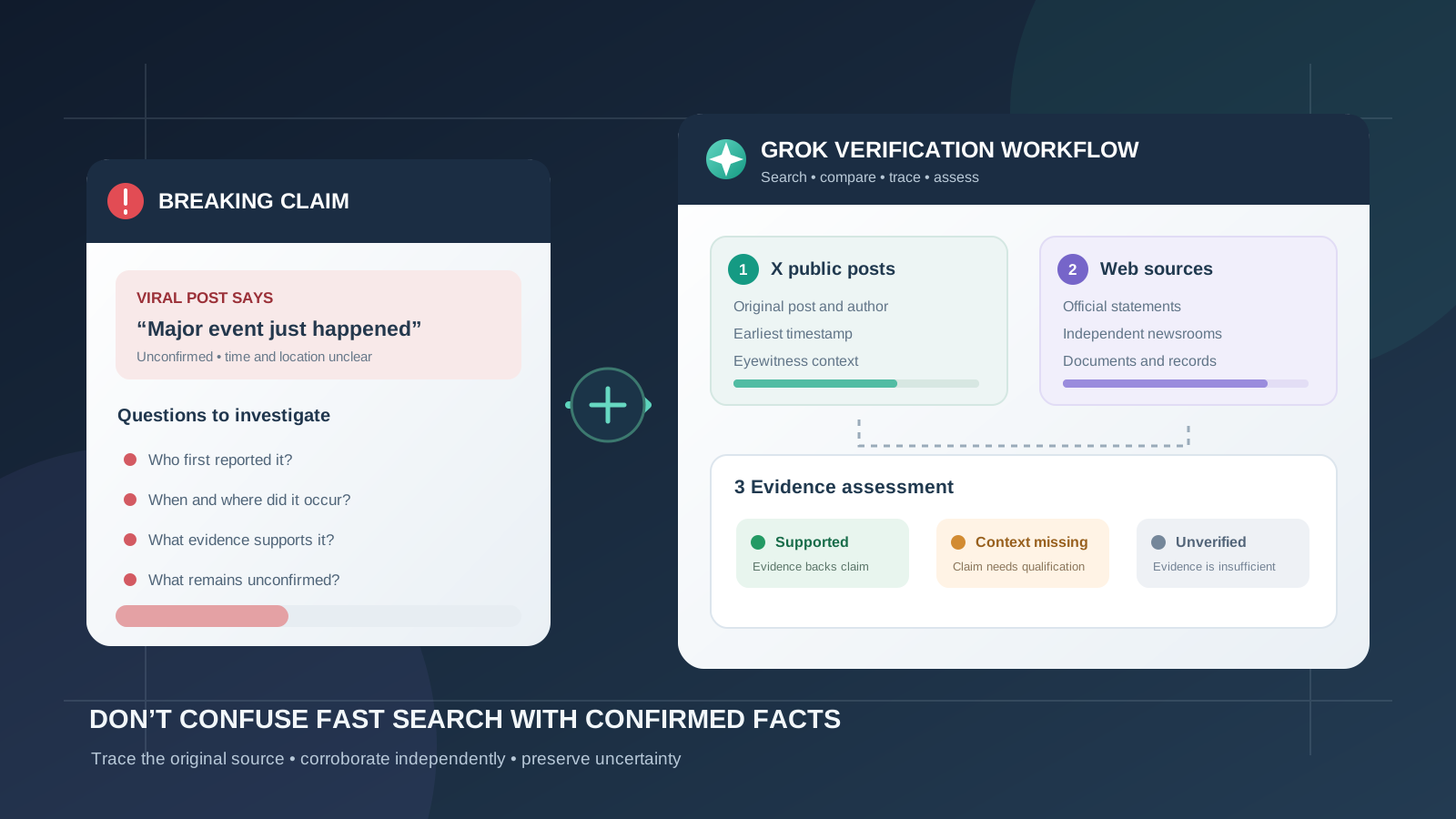
A breaking news claim can spread across social media before journalists, officials, or eyewitnesses have confirmed what happened. A post may contain an accurate detail, an outdated image, an incorrect location, or a conclusion that goes beyond the available evidence. Grok can help investigate these claims by searching public posts on X and the wider web, collecting relevant sources, and organizing information for review. It cannot guarantee that a claim is true.
This guide explains how to use Grok as part of a practical breaking news verification workflow. You will learn how to identify the exact claim, find the earliest available source, compare independent reporting, inspect images and videos, and label what is confirmed, disputed, or still unknown.
The central rule is simple: use Grok to accelerate the search, but verify important facts against original evidence and reliable independent sources before sharing them. For a related workflow using another AI assistant, see How to Fact-Check a News Story with Meta Muse AI. For a more research-focused approach to checking citations and evidence, read How to Use Perplexity to Verify a Scientific Claim and How to Research a Topic with Meta Muse AI and Verify Every Source.
What Grok can do when checking breaking news
According to the X Help Center’s explanation of Grok, Grok can decide whether to search public X posts and conduct a real-time web search when answering a question. This can help when a developing story is being discussed by eyewitnesses, journalists, organizations, and public agencies.
The xAI documentation also describes dedicated search tools for public X content and the web. Its X Search documentation explains that the tool can perform keyword and semantic searches, search for users, and fetch X threads.
In a news verification workflow, these capabilities can help you:
- Find public posts discussing a developing event.
- Locate statements from authorities, companies, emergency services, or other organizations.
- Discover reporting from established newsrooms.
- Compare the timing and wording of different reports.
- Identify details that need further confirmation.
- Organize claims and sources into a reviewable evidence summary.
However, search results are not proof. A widely shared post can be false, several accounts can repeat the same unverified report, and a search may not return every relevant source. X itself notes that its search system filters content and that not all posts necessarily appear in results. See X’s search rules and restrictions.
Step 1: Isolate the exact claim before searching
Do not begin with a broad prompt such as “Is this breaking news true?” First, rewrite the post as one or more specific statements that can be checked.
For example, a viral post might say:
- An explosion happened at a named facility.
- The incident occurred at a particular time.
- A named organization confirmed casualties.
- A photograph shows the incident.
These are four separate claims. Evidence supporting one does not automatically prove the others. A photograph may show an actual explosion but be from a different year or location.
Copy the original post’s text and URL, and record its visible publication time. If the post contains an image or video, keep the original media link as well.
Prompt for Grok:
Analyze this breaking news post: [paste the X post URL]. Extract each factual claim separately. For every claim, identify the location, event, people or organizations involved, and the time being asserted. Do not decide whether it is true yet. List the information that would be needed to verify each claim.
This first step prevents a vague headline from becoming an equally vague fact-check.
Step 2: Ask Grok to search X and the wider web
Once the claims are separated, ask Grok to investigate them. Be explicit that you want both public X posts and web sources, and request direct source links.
Prompt:
Investigate the following breaking news claim: [paste the exact claim]. Search relevant public posts on X and the wider web. Find the earliest available reports, relevant eyewitness posts, official statements, and reporting from established news organizations. Provide direct links, publication times where available, and a short explanation of what each source actually confirms. Separate original sources from accounts that are repeating another report. If evidence is insufficient, say so.
Grok may decide to search X and the web automatically, but the exact behavior and available controls can vary by product experience. If the response does not show useful source links, ask a follow-up question requesting the direct URLs and the specific statement each source supports.
Do not treat a list of search results as a list of independent confirmations. Several websites may be republishing the same wire report, quoting the same anonymous source, or repeating one original social media post.
Step 3: Find the original source, not just the most popular post
The first result in a search is not necessarily the first report. Look for the earliest traceable source and establish what that source knows directly.
Ask Grok:
For each important detail in this story, trace the information to its earliest identifiable source. Is it an eyewitness account, an official statement, a document, a journalist’s direct reporting, or a repost? Show the original link when available. Do not describe repeated copies of the same report as independent confirmation.
Prioritize sources according to the claim being checked:
- Official records and statements: useful for confirming what an agency or organization has formally announced. They do not automatically establish every interpretation of an event.
- Direct eyewitness material: potentially valuable, but the author’s identity, location, timing, and original recording should be checked.
- Established news organizations: useful for independently reported details, named sources, on-the-record comments, and updates.
- Documents, data, and direct recordings: often provide stronger evidence for specific factual details than commentary or reposts.
If the claim concerns a company, check its official newsroom or filing. If it concerns a public authority, find the relevant agency’s own statement. If it concerns a court decision, look for the actual court document rather than a social media description of it.
Step 4: Compare independent reports and identify contradictions
A reliable check should compare sources that have obtained information independently. Do not count five articles as five confirmations if they all cite the same original post.
Use this prompt:
Compare the strongest sources you found about this event. Create a table with the claim, supporting source, contradicting or qualifying source, whether the sources are independent, and what remains unknown. Identify details that are consistent across independent reporting and details that are still disputed. Do not force a definitive verdict when the evidence is incomplete.
Pay particular attention to:
- Differences in the reported time or location.
- Conflicting casualty or damage figures.
- Whether a statement is confirmed by the organization named in the post.
- Whether a headline is stronger than the evidence in the article.
- Whether a report has been corrected or updated.
- Whether a source is quoting another outlet rather than reporting independently.
Breaking news changes quickly. A figure described as confirmed in an early post may later be corrected. Record when each source was published or updated, and distinguish the time an event allegedly happened from the time it was reported.
Step 5: Verify photos and videos separately
Visual evidence needs its own verification process. A genuine image can be misleading if it is old, taken in another country, or unrelated to the event described in a post. An AI-generated or manipulated image can also be presented as eyewitness evidence.
Ask Grok to describe what it can observe, but do not use its visual interpretation as authentication.
Prompt:
Examine the image or video linked here: [paste the original media URL]. Describe only the visible details. Identify any readable signs, landmarks, uniforms, vehicles, weather clues, or other details that could help establish the location and context. Do not assume the media is recent or authentic. Suggest specific ways to check its original publication date and source.
Then conduct separate checks:
- Find earlier appearances. Use reverse-image search or key video frames to see whether the media appeared online before the alleged event.
- Locate the original upload. Identify the earliest available uploader and, where possible, contact the person who recorded it.
- Check the location. Compare landmarks, road layouts, signs, buildings, and other visible details with maps or independent images.
- Check the time. Compare the claimed date with the original post, weather, daylight, and other verifiable details.
- Look for edits or missing context. Check whether the clip is shortened, rearranged, or taken from a longer recording.
The Associated Press explains that its verification work includes reverse-image searches, geolocation, comparing landmarks and other details, examining footage frame by frame, and contacting original creators. See Verification at AP. Reuters also describes checking the original creator, metadata, location, timing, and other corroborating evidence in its report on visual verification.
Step 6: Ask Grok for an evidence-based assessment
After collecting the sources, request a structured assessment. Avoid asking Grok for a simple true-or-false label without requiring evidence.
Prompt:
Assess each claim using only the sources linked in this conversation. For every claim, provide:
- The exact claim.
- The strongest supporting evidence.
- Any credible contradictory evidence or missing context.
- Whether the sources are independent.
- A provisional status: supported, contradicted, missing context, or not enough evidence.
- What additional evidence would change the assessment.
Link each source directly and explain which part of the claim it supports. Do not invent citations or infer confirmation from repetition. If the evidence does not support a verdict, use “not enough evidence.”
Treat these labels as a working editorial framework, not as an official Grok rating or a guarantee of accuracy. A claim can be partly supported while its location, timing, scale, or attribution remains unverified.
For a technical example, xAI publishes an AI fact-checker cookbook for X posts. It demonstrates a workflow that separates a post into individual claims, searches X and the web for each claim, and restricts conclusions to sources actually returned by the search tools. The example also explicitly allows an “not enough evidence” outcome. It is an API implementation example for developers, not a claim that every step is available as a one-click feature in the consumer Grok interface.
Step 7: Keep a verification record
Before sharing a conclusion, save a short record of what you checked. This makes it easier to revisit the story when new information appears.
| Field | What to record |
|---|---|
| Original claim | Exact wording and original post URL |
| First traceable source | Earliest source identified and its publication time |
| Official confirmation | Direct statement or document, if available |
| Independent reporting | Reports that provide separate evidence |
| Visual evidence | Original image or video, uploader, date, and location checks |
| Contradictions | Conflicting facts, corrections, or missing context |
| Current assessment | Supported, contradicted, missing context, or not enough evidence |
| Last checked | Date and time of the latest review |
If the story is still developing, mark the assessment as provisional and revisit the original sources. Do not turn an early, incomplete check into a permanent conclusion.
A complete Grok prompt for breaking news verification
You can use the following prompt when you need to investigate a post from beginning to end:
Act as a careful research assistant helping me verify a breaking news claim. Investigate this original post: [paste URL].
First, extract every factual claim separately. Then search relevant public X posts and the wider web for the earliest available source, official statements, direct evidence, and independent reporting.
For each source, provide its direct URL, publisher or author, publication time if available, whether it is an original source or a repost, and exactly what it confirms.
Compare independent sources and identify contradictions, missing context, outdated information, and details that remain unconfirmed. If the post includes an image or video, describe visible details and suggest checks for its original source, date, and location. Do not claim that visual inspection alone proves authenticity.
Finish with a claim-by-claim table using these provisional labels: supported, contradicted, missing context, or not enough evidence. Cite only sources that you actually found. Never invent a source, quote, timestamp, or confirmation. If the evidence is incomplete, clearly state what is still unknown.
Common mistakes to avoid when using Grok for news verification
Treating trending posts as confirmation
A large number of reposts can reflect rapid circulation rather than independent evidence. Trace the claim back to its earliest source.
Trusting a confident answer without opening the citations
Open the linked source and check that it actually supports the sentence Grok attached to it. A source can be real but irrelevant, outdated, or misrepresented.
Confusing an official response with independent confirmation
An official statement confirms what that organization has said. It may not independently establish every detail of the event.
Using an old photo as proof of a new event
Check earlier appearances, original upload dates, landmarks, and the recording context. A real image can still be attached to a false claim.
Ignoring updates and corrections
Breaking news reports can change as more evidence becomes available. Check timestamps and updated versions before repeating a figure or conclusion.
Asking Grok to decide whether a source is trustworthy without evidence
Ask it to explain the source’s identity, original reporting, named sources, documents, and relationship to other reports. Then inspect those materials yourself.
Frequently asked questions
Can Grok verify breaking news in real time?
Grok can search public X posts and the web for current information, according to X’s help documentation. This can help locate developing reports, but search access does not guarantee complete coverage or confirm that a claim is true.
Can Grok check whether a viral post on X is true?
It can help extract the post’s claims, search for related posts and web sources, and compare evidence. You should still trace important details to original sources and independent reporting.
Does Grok always provide reliable citations?
No. X warns that Grok can provide factually incorrect answers or miss context and encourages independent verification. Open every important citation and confirm that it supports the specific claim.
Can Grok verify a photo or video from breaking news?
Grok may help describe visual content and identify details worth investigating. Authenticating the media requires additional checks, such as reverse-image search, geolocation, original-source tracing, and comparison with independent evidence.
Is Grok enough to fact-check a major news event?
No. Use it as a research assistant, not as the final authority. For consequential claims, compare original documents and official statements with independent reporting and verified visual evidence.
What should I do if Grok cannot find confirmation?
Keep the status as “not enough evidence.” Search for the relevant authority or original source, check reputable news organizations, and revisit the claim when more information becomes available. Do not fill an evidence gap with speculation.
Final thoughts
Grok can make breaking news research faster by searching public X posts and the web, finding relevant sources, and helping organize competing claims. Its value is in accelerating the investigation—not replacing it.
The strongest workflow separates a viral post into checkable claims, traces each detail to its original source, compares independent evidence, verifies visual material separately, and preserves uncertainty when facts are not yet established. If a claim cannot be confirmed, say that it remains unverified rather than sharing it as fact.