
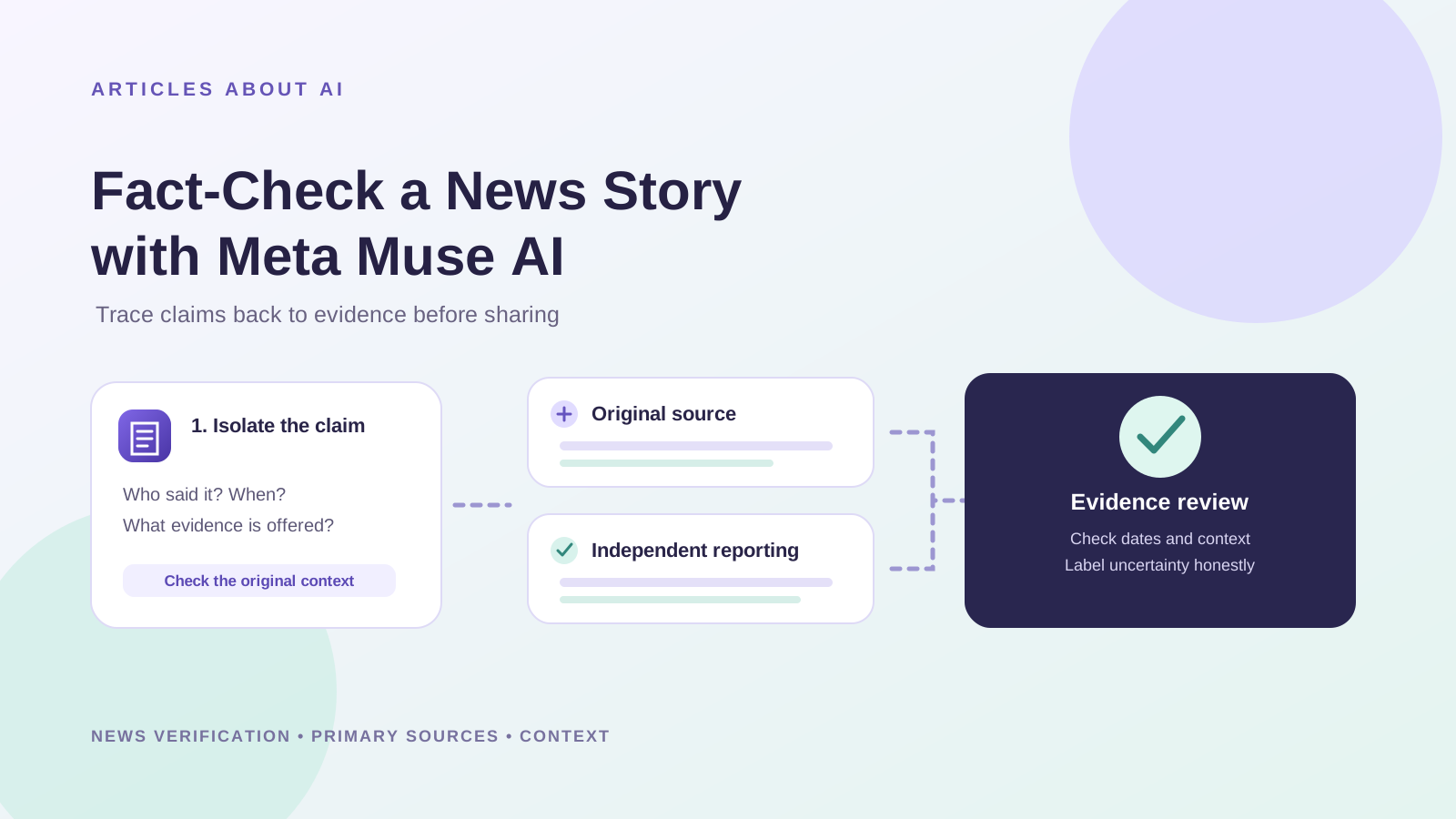
A breaking news post can spread before key details are confirmed. An AI agent may help you collect links, compare reports, and organize evidence, but a fluent answer is not proof that a claim is true. Use Meta Muse AI to support the fact-checking process—not to replace the sources or your judgment.
Meta describes Muse as a personal AI agent that can browse the web and work through multi-step tasks. That makes it a potential assistant for gathering material about a news claim. It does not guarantee that Muse will find every relevant source, interpret a page correctly, or distinguish confirmed facts from speculation. This guide provides a repeatable workflow for checking a news story before you share or publish it.
Can Meta Muse AI fact-check news?
Meta’s official Muse product page says Muse can browse the web, research topics, and carry out multi-step tasks under user direction. The product can help organize a source list and compare claims, depending on access and available features.
However, fact-checking requires evidence review. A link may be broken, outdated, unrelated to the claim, or simply repeat another publisher’s wording. Even multiple articles are not independent confirmation if they all rely on the same original post or press release.
For a general introduction, read our guide to what Meta Muse AI is, its features, and how it works. For a broader source-verification workflow, see how to research a topic with Meta Muse AI and verify every source. If a viral claim concerns a product or purchase, our guide to comparing products with Meta Muse AI using real prices and specifications explains how to verify details against original listings.
Step 1: Reduce the story to a checkable claim
Do not begin with a broad prompt such as “Is this news true?” First, identify the precise factual claim. A story may contain several claims, and each may require different evidence.
Record:
- Who is said to have done or said something?
- What exactly happened or was announced?
- When did it supposedly happen?
- Where did it happen?
- What evidence does the post or article provide?
- What is still unknown or disputed?
A headline can exaggerate the body text, omit a qualification, or turn a proposal into a confirmed decision. Separate the headline from the factual statements in the article.
Prompt to use with Muse
Help me fact-check this specific news claim: [paste the claim and original URL].
First, break it into individual factual statements. Find the earliest available original source for each statement, such as an official announcement, full transcript, public record, dataset, or original research. Then find reputable independent reporting that checks the same facts.
For every source, provide its exact title, publisher, URL, date, and the precise claim it supports. Distinguish direct evidence from interpretation, allegations, predictions, and unconfirmed reports. Identify conflicting evidence and missing context. Do not invent sources or quotations. If a page cannot be opened or a claim cannot be confirmed, say so. Do not give a definitive verdict unless the evidence supports it.
Treat this as a research request, not a guarantee. Check the returned links yourself.
Step 2: Trace the claim to its original source
The strongest first step is often to locate the source closest to the event. Depending on the story, that may be:
- An official announcement or complete statement
- A government notice, court filing, or public record
- An original research paper or dataset
- A full interview, speech, or transcript
- A company’s release notes or official product documentation
- The original post or video, if the claim began on social media
Ask Muse to distinguish the original source from articles that merely describe it. If a news report says “the company announced,” look for the company’s actual announcement. If a viral post quotes a public figure, look for the full statement rather than another post repeating the quote.
An original source can establish what an organization said, but it may not independently establish whether every statement it made is true. For example, a company announcement is primary evidence of the company’s announcement—not necessarily independent proof of its performance claims.
Step 3: Compare independent reporting
After locating the original source, compare it with reputable reporting from independent news organizations. Look for evidence that reporters checked the facts rather than simply repeating a press release or social-media post.
The Associated Press describes verification as part of every stage of journalism, including corroborating facts with documents and on-the-record sources. Reuters Fact Check explains that its process can include tracing the origin of a claim, examining supporting and contradictory evidence, and consulting multiple experts.
Use these reports as examples of verification standards, not as a requirement that every outlet will reach the same conclusion. If several articles all cite one source, record that shared dependency rather than counting them as separate confirmations.
Ask Muse to create a table with these columns:
| Field | What to record |
|---|---|
| Claim | The exact statement being checked |
| Original source | Earliest credible source located |
| Independent reports | Reporting that checks the same statement |
| Supporting evidence | Documents, data, transcript, or direct quotation |
| Contradictory evidence | Evidence that challenges the claim |
| Publication dates | When each source was published or updated |
| Status | Confirmed, contradicted, misleading, or unresolved—with a reason |
Use “unresolved” when the evidence is incomplete. A forced yes-or-no answer is not a reliable fact-check.
Step 4: Check dates and context
A real image, quote, or article can still be used to make a false claim if it is old or taken out of context.
Check the publication date and, where possible, the date of the event itself. Open the full article or statement and compare the headline with the body. Look for words such as “may,” “plans to,” “could,” “reportedly,” and “according to,” which can materially change the meaning.
For quotations, locate the original speech, interview, transcript, or recording. Check the surrounding sentences and whether the speaker was discussing the same subject. A quote that is accurate in isolation may be misleading without its context.
For a developing story, record what was known at the time of each update. A report can be accurate when first published and later require correction as new evidence appears.
Step 5: Verify photos and videos separately
Visuals need their own verification process. A genuine photo may show a different event, place, or year from the one claimed in a post. An AI-generated or edited image may also be presented as documentary evidence.
When the story relies on an image or video:
- Find the earliest available upload and identify who posted it.
- Use reverse-image search where available to look for older appearances.
- Compare visible landmarks, signs, weather, language, and other details with the claimed location.
- Check whether reputable outlets or the original source have verified the footage.
- Look for edits, missing frames, or other signs that could change the meaning.
- If the origin cannot be established, describe the visual as unverified.
The Associated Press describes checking metadata, timing, location, and possible manipulation when verifying user-generated visuals. Muse may help collect pages or summarize context, but do not treat its description of an image as proof of where or when it was captured.
Step 6: Watch for common misinformation patterns
Ask Muse to test for these specific issues rather than simply asking whether a story “looks fake”:
- Old information presented as new: an older event or article is recirculated.
- Misleading headline: the headline makes a stronger claim than the evidence supports.
- False attribution: a quote or statement is attributed to the wrong person or organization.
- Missing context: a real statistic or quotation is presented without important qualifications.
- Unsupported causal claim: two events occurring together are described as cause and effect without evidence.
- Unverified numbers: estimates, projections, and confirmed measurements are treated as interchangeable.
- Circular sourcing: several pages repeat the same unsupported original claim.
- Impersonation: a page or account looks official but is not controlled by the named organization.
- Manipulated or miscaptioned media: an image or video is edited, synthetic, or described as showing a different event.
These are warning signs to investigate, not automatic proof that a claim is false.
Step 7: Keep a transparent evidence record
Before reaching a conclusion, keep a record of the sources you opened and what each source actually established. Save the source title, URL, date checked, relevant passage, and any limitation.
Do not let Muse invent missing publication dates, create quotations that do not appear on the page, or label a source “verified” merely because a link was returned. If a source cannot be accessed, mark it as inaccessible and seek another source.
Use cautious verdict language:
- Supported by the available evidence: the claim matches reliable evidence checked.
- Contradicted by the available evidence: reliable evidence directly conflicts with the claim.
- Misleading or missing context: some details are accurate, but the presentation creates a false impression.
- Unverified: the available evidence is insufficient to confirm the claim.
- False: use only when strong evidence demonstrates that the specific claim is false.
A fact-check should explain why the evidence supports the verdict. Avoid assigning numerical confidence scores unless there is a transparent and defensible method behind them.
Step 8: Ask Muse to challenge the first conclusion
AI research can miss counterevidence. After collecting sources, ask Muse to look specifically for material that could change the initial assessment.
Review the evidence table again as a skeptical editor. Look for the strongest credible evidence against the current conclusion, sources that rely on the same original report, dates that do not match, and quotations missing context. Identify any claim that goes beyond what the cited source proves. Revise the verdict if the evidence requires it, and leave unresolved points clearly marked.
Then open the new sources and verify them. A second AI response is not independent corroboration; it is another pass through the same tool-assisted process.
Example: How to check a viral AI announcement
Suppose a social-media post claims that an AI company has released a new feature worldwide. Do not assume the claim is true because several accounts repeat it.
A careful check would:
- Search for the official announcement or release notes.
- Check whether the announcement says “released,” “testing,” “rolling out,” or “planned.”
- Verify the announcement date and supported countries or platforms.
- Compare reputable independent reporting.
- Check whether screenshots are from the same product version and date.
- Report any remaining uncertainty, such as a feature that is available only to selected users.
The result may be that the feature is real but not available worldwide. That is more useful than a simple true-or-false label that hides important conditions.
Reusable checklist before sharing a story
- The exact claim has been separated from opinion and prediction.
- The original source has been located where possible.
- Links open and support the statements attributed to them.
- Dates, numbers, names, and quotations match the original material.
- Independent reporting has been checked where appropriate.
- Images and videos have been verified separately.
- Contradictory evidence and missing context have been considered.
- Unresolved claims are labeled honestly.
- The final explanation links to evidence instead of asking readers to trust an AI verdict.
What Meta Muse AI cannot guarantee
Muse can help with browsing and organizing a multi-step research task, but it may miss relevant sources, misunderstand a page, or summarize evidence incorrectly. Search results may be incomplete, some pages may be inaccessible, and rapidly changing stories may outdate earlier information.
Meta’s own description of Muse’s safety approach discusses the challenges of building an agent that can use tools and act on a user’s behalf. That is one reason to keep a human review step. For a serious allegation, public-safety issue, health claim, financial claim, or legal matter, seek strong original evidence and relevant expert sources rather than relying on a generated verdict.
Frequently asked questions
Can Meta Muse AI verify breaking news?
Muse can browse websites and help collect information for a fact-check, according to Meta’s product description. It cannot guarantee that a breaking claim is true. Confirm important details with original sources and independent reporting.
Is one official source enough?
It depends on the claim. An official statement can confirm what an organization announced, but independent evidence may be needed to assess whether the organization’s claims are accurate. For disputed or high-impact claims, look for multiple genuinely independent sources.
Can AI detect fake photos and videos?
An AI tool may help analyze or research visual material, but its answer is not conclusive proof of authenticity. Trace the original upload, compare contextual clues, and consult reliable verification where available.
What should I do when sources disagree?
Identify exactly what each source says, compare their dates and evidence, and check whether they are relying on the same underlying material. If the disagreement cannot be resolved, explain it and mark the claim as unresolved.
Should I share a story while it is still being checked?
If the central claim has not been verified, avoid presenting it as fact. If you need to discuss it, clearly label what is confirmed and what remains unverified, and link to the original material where appropriate.
Does this article report a live accuracy test of Muse?
No. This article is a practical fact-checking workflow based on Meta’s published description of Muse and established verification guidance from news and public-information organizations. It does not claim that a controlled test of Muse’s accuracy was conducted.
Conclusion
Meta Muse AI can be useful for gathering sources and organizing a news investigation, but reliable fact-checking depends on what the evidence actually shows. Trace claims to their origins, compare independent reporting, verify dates and visuals, and document uncertainty. Use the agent to support the process—not as the final authority.
Sources and further reading
- Meta AI — Muse: Official product features and capabilities
- Meta Newsroom — Introducing Muse: The World’s First Personal AI Agent Built for Everyone
- Associated Press — Verification at AP
- Reuters Fact Check — About and methodology
- UK House of Commons Library — How to check facts
Editorial note: Meta’s pages describe the company’s own product and capabilities. The verification steps in this guide draw on published guidance from AP, Reuters, and the UK House of Commons Library. This article does not claim a live benchmark of Muse’s fact-checking accuracy.