
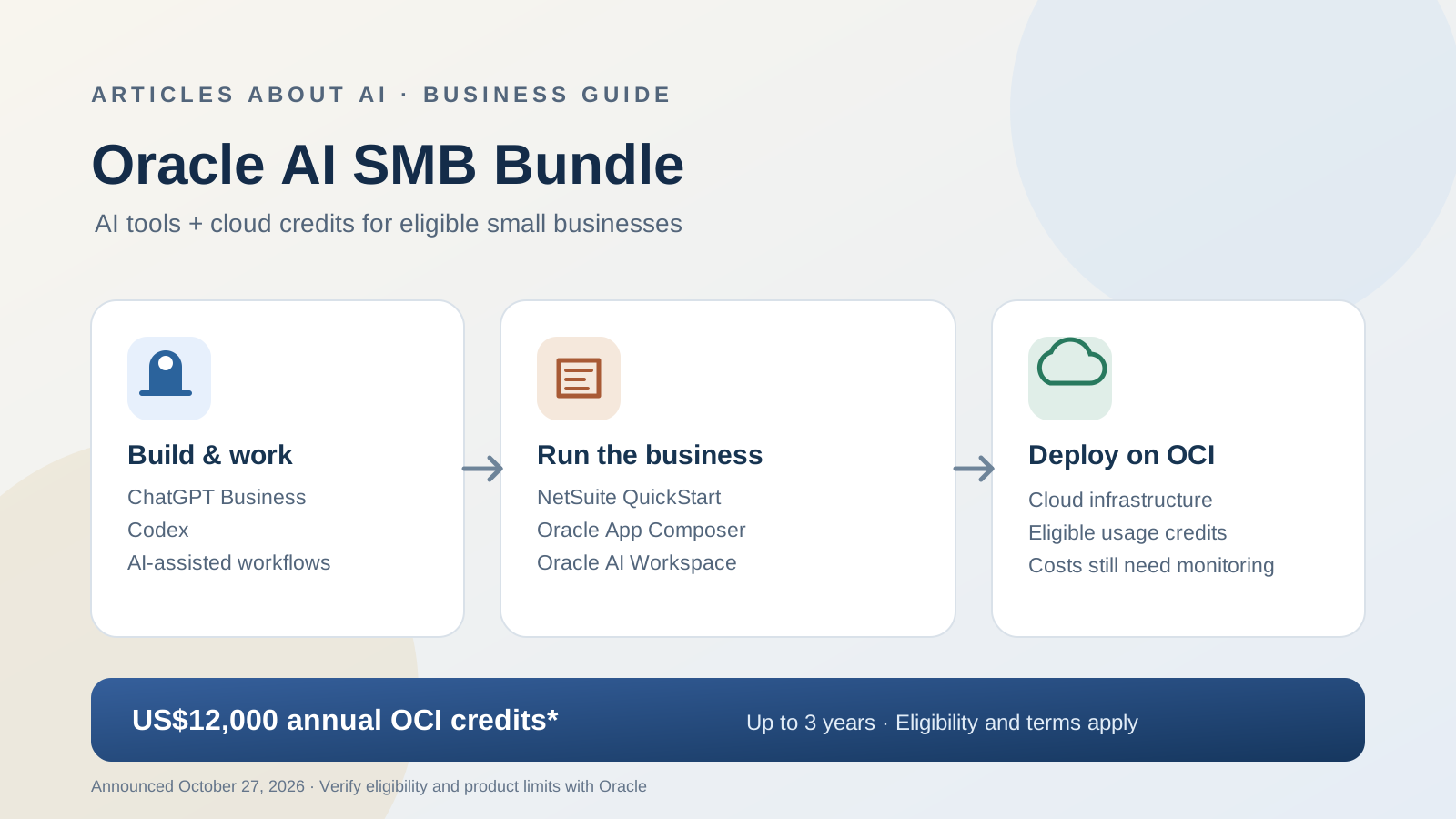
Oracle and OpenAI announced the Oracle AI SMB Bundle on October 27, 2026, describing it as a free-to-start package intended to help eligible small businesses build products and manage day-to-day operations with AI. The headline benefit is US$12,000 in Oracle Cloud Infrastructure (OCI) credits per year, for up to three years, subject to eligibility review and renewal conditions. The package brings together business AI tools, application development capabilities, and cloud infrastructure rather than offering a cash grant.
The announcement is notable for founders who need more than a chatbot: they may need tools to draft and analyze work, help write software, manage invoices and cash flow, and deploy applications. However, the bundle is not universally available worldwide, and the advertised credits are not unlimited free cloud usage. Oracle’s official terms say applicants must be qualifying U.S. businesses and pass business verification. This guide explains what has been announced, what is included, who may qualify, and the checks to make before applying.
For the primary announcement, consult Oracle’s official Oracle AI SMB Bundle and OpenAI partnership page and OpenAI’s announcement of its expanded partnership with Oracle.
What Is the Oracle AI SMB Bundle?
Oracle AI SMB Bundle is a packaged offering built around the needs of small businesses and founders. It combines selected OpenAI products with Oracle business software and Oracle Cloud Infrastructure. The intended workflow is to use AI to help with everyday work and product development, use business applications to support operations, and run approved applications on cloud infrastructure.
Oracle describes the bundle as free to start, not as an unconditional promise that every included product will remain free for every user. Each component has its own access rights, usage limits, availability, and terms. Applicants should review those details before relying on the package for production systems or budgeting.
What is included?
The official Oracle description identifies several components:
- US$12,000 in annual OCI credits: Credits can offset eligible Oracle Cloud Infrastructure consumption. Oracle says the allocation is annual and may continue for up to three years, subject to review and renewal conditions.
- ChatGPT Business: A business-oriented ChatGPT offering for team productivity and everyday knowledge work, subject to its own product terms and access rules.
- Codex: OpenAI’s coding agent and software-development capabilities can help eligible teams work on code and build products.
- Oracle App Composer: Oracle’s AI-assisted application-building offering is intended to help teams create and publish business apps, with Oracle managing deployment and operations on OCI.
- Oracle AI Workspace: A developing unified experience designed to connect Oracle applications, enterprise data, and cloud services with OpenAI models through ChatGPT, subject to availability and permissions.
- NetSuite QuickStart: A foundation for core business operations, including invoicing and cash-flow management. Oracle also describes a free tier for this component.
Oracle’s blog additionally describes a possible one-time US$50 usage credit for each eligible team member who installs the NetSuite QuickStart plugin in ChatGPT Business and uses it within seven days. Up to five people may qualify, for a maximum of US$250 per workspace, subject to the published conditions. Treat this as a conditional incentive, not as guaranteed cash or a substitute for reading the offer terms.
How the $12,000 in OCI Credits Works
The annual cloud-credit allocation is the most prominent financial element, but it is important to understand what it does and does not mean.
First, cloud credits are not cash. They are intended to offset eligible consumption of Oracle Cloud Infrastructure services. They should not be treated as money that can be withdrawn, transferred freely, or spent on unrelated expenses.
Second, Oracle states that the US$12,000 allocation is annual, for up to three years in total. That is not the same as an unconditional US$36,000 award at enrollment. Continued allocations depend on eligibility review and renewal conditions. Oracle says renewal requires an active, independent business that is building or running its product on OCI, has used previous credits for approved business purposes, keeps its information current, and maintains an account in good standing.
Third, usage beyond the awarded credits is billable. A team that deploys production services, stores large datasets, or runs resource-intensive workloads can incur charges once credits are exhausted or when consumption is outside the covered terms. Before launching a workload, estimate expected usage, configure budgets and alerts where available, and confirm which services and regions qualify.
Finally, the bundle does not guarantee unlimited access to ChatGPT Business, Codex, NetSuite QuickStart, App Composer, or every other component. Each product retains its own terms, access limits, and availability. Confirm current entitlements in the official offer before planning a launch around a particular feature.
Who Is Eligible to Apply?
Oracle’s published eligibility rules are specific. Applicants must pass business verification and be U.S.-based, privately held, for-profit businesses that are independent of a larger company. The program allows only one enrollment per startup.
The application process may require business information, credit-card information, and OCI tenancy details where applicable. Having a business idea or being an individual developer does not by itself establish eligibility. Applicants should use the official Oracle page to check the exact definition of a qualifying business and the verification steps in force when they apply.
Oracle lists exclusions that include:
- Government entities.
- Nonprofit organizations.
- Cryptocurrency businesses.
- Service-only consultancies.
- Blocked companies.
- Existing Oracle customers that have received or consumed more than US$250,000 in Oracle Universal Credits.
These exclusions mean the offer should not be described as a universal free AI bundle for every startup. In particular, businesses located outside the United States should not assume they qualify. The official terms are the source of truth if a business has a complex ownership structure, operates across borders, or falls into a category that may be excluded.
How a Small Business Could Use the Bundle
For a qualifying business, the value depends on whether the components fit a real workflow. Potential use cases include:
Product development: A small software team could use Codex to assist with code, testing, and development tasks, then evaluate whether OCI is an appropriate place to deploy the resulting application. AI-generated code still requires review, testing, security checks, and maintenance.
Internal business applications: A team might explore Oracle App Composer to build a simple operational tool, such as an internal request tracker or a launch coordination app. Before relying on it, verify availability for the account, data-access rules, publishing options, and any usage restrictions. Our separate guide, How to Use Oracle App Composer, covers its announced app-building and governance approach.
Finance and administration: NetSuite QuickStart is positioned as a starting point for tasks such as invoicing and cash-flow visibility. Businesses should confirm the functions included in the relevant tier and whether any accounting, tax, integration, or migration work requires additional products or professional support.
Team productivity: ChatGPT Business may help staff summarize documents, draft communications, organize research, and work through routine knowledge tasks. Businesses should establish data-handling rules and review workspace settings before employees share sensitive customer, financial, or confidential company information.
Cloud-hosted services: OCI credits can help eligible businesses test and run infrastructure, but the right architecture depends on workload, security, availability, storage, network traffic, and operating costs. Credits do not remove the need to monitor consumption or plan for costs after the allocation is used.
These are practical examples, not a promise that every workflow is preconfigured or included at no additional cost. Availability and integration details should be confirmed with Oracle and OpenAI.
How to Check the Offer and Apply
Use this cautious sequence before enrolling:
- Start with Oracle’s official bundle page. Read the eligibility criteria and current offer terms at Oracle and OpenAI.
- Verify the business qualifies. Confirm U.S. location, private ownership, for-profit status, independence from a larger company, and whether any exclusions apply.
- Prepare accurate business details. Oracle says business information, credit-card information, and OCI tenancy details may be required. Do not submit false information or assume approval is automatic.
- Read the terms for each component. Check which products are available to the account, usage limits, renewal requirements, and any conditions attached to promotional credits.
- Plan the cloud budget. Estimate expected OCI consumption and decide how the business will respond if credits run out or a service is not covered.
- Protect company data. Review permissions, workspace administration, data access, and internal AI-use policies before connecting business systems.
- Keep records for renewal. If the company relies on continued annual credits, maintain accurate business information, use credits for approved purposes, and keep the OCI account in good standing as specified by Oracle.
Only apply through official Oracle channels. Avoid third-party pages that promise guaranteed approval, cash payouts, or unlimited cloud services unless those claims are explicitly supported by the current official terms.
Is the Oracle AI SMB Bundle Worth It?
For an eligible U.S. business that already expects to use Oracle Cloud Infrastructure, the bundle could reduce early infrastructure costs while bringing several business and development tools into one package. It may be especially relevant to founders who are building and operating a product rather than only seeking a general-purpose AI chatbot.
It may be less useful for a business that cannot meet the eligibility requirements, does not want to build or run a product on OCI, or needs a specific feature that is not yet available to its account. The value also depends on the real cost of the workload, how much of the allocation can be used for eligible services, and what happens when promotional credits end.
Do not compare the offer with cash funding on a dollar-for-dollar basis. The credits have restrictions, require eligible consumption, and may be renewed only if conditions are met. Evaluate the bundle against your existing software stack, expected cloud costs, security requirements, and the effort required to adopt new systems.
Oracle AI SMB Bundle vs. Other Oracle–OpenAI Offerings
The bundle is one part of the wider Oracle–OpenAI announcement, not the name for every new product in the partnership.
- Oracle AI SMB Bundle focuses on helping eligible small businesses start building products and managing operations with a packaged set of tools and cloud credits.
- Oracle App Composer focuses on building, publishing, and governing AI-assisted business applications. See our Oracle App Composer guide.
- Oracle AI Workspace is intended to connect Oracle applications and data with AI in a unified experience, allowing approved workflows under organizational permissions.
- Oracle AI Security Mesh is designed to help organizations find and validate security vulnerabilities with AI-assisted testing and controlled scope.
These offerings serve related but distinct needs. A small business should not assume that access to one automatically provides unrestricted access to all the others.
Key Takeaways
The Oracle AI SMB Bundle announced on October 27, 2026, combines ChatGPT Business, Codex, Oracle App Composer, Oracle AI Workspace, NetSuite QuickStart, and Oracle Cloud Infrastructure credits in a package aimed at qualifying small businesses. The headline allocation is US$12,000 per year for up to three years, subject to eligibility review and renewal requirements.
The critical caveats are equally important: the published eligibility rules specify U.S. businesses that are privately held, for-profit, and independent; some categories are excluded; each product has separate terms and limits; and OCI consumption beyond awarded credits is billable. Check Oracle’s current official terms before applying or making purchasing decisions.