
Rime launched Prism, a speech-to-speech AI model aimed at enterprise voice agents, on October 28, 2026. The announcement focuses on a specific tension in conversational AI: businesses want natural, low-latency spoken interactions, but they also need to inspect responses, enforce policies, connect tools, and adapt a system to their own calls.
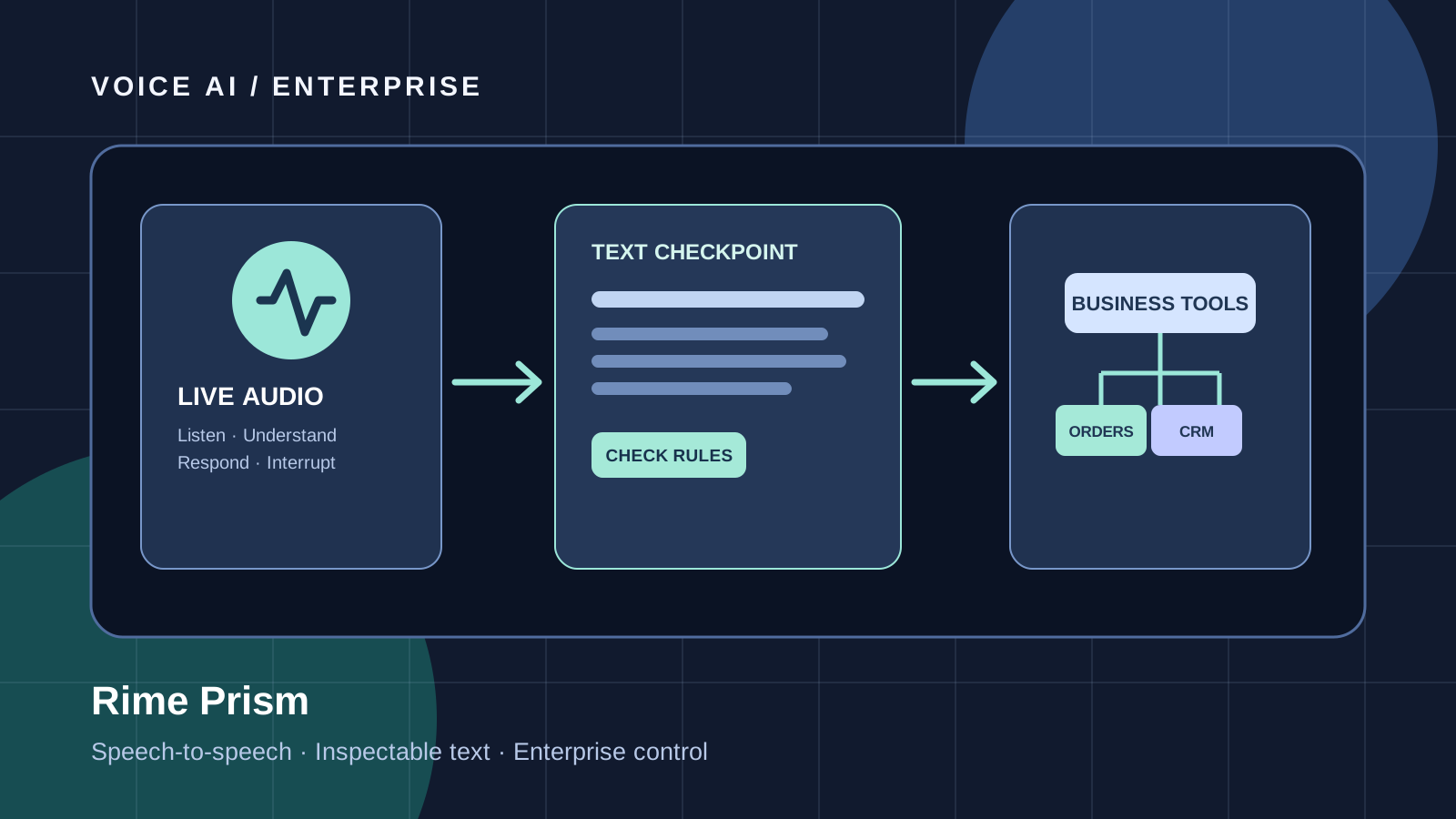
Prism’s proposed answer is to generate a text version of a response before it is spoken. That text checkpoint gives an application a place to inspect or apply rules to the words before audio reaches a caller, while the model is designed to retain audio cues such as hesitation, laughter, frustration, or background sounds. Rime also says Prism can be fine-tuned and deployed in a customer’s own environment.
This article separates the product’s announced architecture from performance claims reported by Rime, explains what is and is not publicly established, and reviews the pricing and implementation details developers should confirm before adopting it.
What is Rime Prism?
Prism is a speech-to-speech model: it receives audio and produces spoken responses without requiring a developer to assemble the entire experience from separate speech recognition, text-model, and text-to-speech services. Rime describes Prism as an end-to-end system that listens, prepares the text it intends to say, and continues listening while it speaks.
A conventional cascaded voice agent typically uses three stages:
- Speech recognition converts the caller’s audio into text.
- A language model decides what to say or do.
- Text-to-speech converts the response into audio.
That architecture is modular and makes it straightforward to inspect the text passed between components. But every stage can add latency, and a text transcript may omit information conveyed by tone, interruption, or environmental audio.
Prism attempts to combine speech-native interaction with a visible text checkpoint. Its main pitch is not simply that it can sound natural; it is that an enterprise can put its own rules, tool calls, and training process around the model. See our related guides to Mistral Voxtral 3 and real-time transcription voice agents and Grok Voice 3.0 features and API access for other recent approaches to voice AI.
Why the inspectable text checkpoint matters
Rime says Prism generates text before that response is spoken. An application can use the text checkpoint to check for disallowed content, validate a proposed action, apply business rules, or record what the agent intended to say. The model’s text layer is also intended to support pronunciation control for names and account terms, plus action and content tags used in agent workflows.
For example, a voice agent handling a delivery order might need to confirm the address and total, then ask the customer for approval before placing the order. A business can define a rule that a purchase must not be submitted until the caller explicitly agrees. A reviewable text layer creates a practical point at which the application can inspect the proposed response or action.
That is a useful design feature, but it is not a complete safety guarantee. The application still needs to decide what to inspect, how to interpret the result, what to do when checks fail, and whether a tool call requires explicit confirmation. A text checkpoint cannot by itself prove that every policy is correctly enforced or that every action is safe.
For teams evaluating voice automation, the relevant question is therefore not only whether the model responds quickly. It is whether the entire system can reliably enforce approval rules, handle interruptions, keep an audit trail, and recover when speech recognition or tool execution goes wrong.
Rime Prism benchmarks: what the company reports
In its launch post, Rime says it evaluated Prism using a test harness similar to the one Artificial Analysis uses for its speech-to-speech leaderboard. The company reports a 56.6 score on τ-Voice and a 0.57-second time to first audio when Prism speaks without an additional reasoning step before responding.
Rime also reports a 82.5 result on a telecom subset, compared with 45.6 for GPT-Live-1 under the comparison described in its announcement. Rime says the models that scored above Prism on τ-Voice used an extra reasoning step and took longer to begin speaking.
These numbers need context. The launch post is a vendor announcement describing Rime’s own run of the benchmark harness; it is not a claim that we independently reproduced the results. TSN’s launch coverage noted that Prism was not listed on Artificial Analysis’s public leaderboard as of October 28, 2026. That means readers should treat the figures as company-reported measurements until a public, independently inspectable result makes direct reproduction and comparison easier.
| Metric | Rime’s reported result | How to interpret it |
|---|---|---|
| τ-Voice | 56.6 | Vendor-reported run using a similar benchmark harness |
| Telecom subset | 82.5 | Vendor-reported result for a specific domain |
| GPT-Live-1 telecom comparison | 45.6 | Comparator cited by Rime; not an independent test by this publication |
| Time to first audio | 0.57 seconds | Reported latency under the stated setup |
Do not treat these values as a universal ranking of every voice model. Benchmark configurations, model versions, reasoning settings, prompts, tool environments, and test distributions can affect outcomes. A fair procurement test should use the same tasks, hardware or hosting conditions, interruption patterns, and success criteria for each candidate.
What the Revmo customer trial claims—and what remains unknown
Rime also describes a trial with Revmo, an ordering-agent provider. According to Rime, it used ten hours of production calls, tool traces, and transcripts to train a customized Prism model. Rime says 94% of orders were placed only after the caller explicitly agreed to a confirmation question, compared with 57% in the OpenAI-based system used in the comparison.
In a separate launch announcement distributed through PR Newswire, Rime reported that order confirmations and pickup-method completions rose from 68% to 100%, and calls without dead air rose from 66% to 88%. These are figures reported by the company, not independently audited results.
The public material does not provide enough detail to determine the full sample size, confidence intervals, all configuration differences, or whether the same result would generalize to another business. The comparison is best understood as a promising case study from one customer workflow—not proof that Prism outperforms every OpenAI voice model in every deployment.
For a business considering the model, the strongest next step would be a controlled pilot on its own calls. Measure task completion, correct confirmations, interruption handling, latency, escalation rate, and policy violations. Define the test before deployment and include a baseline model under the same conditions.
Fine-tuning and deployment options
A central part of Rime’s positioning is customization. The company says Prism can be adapted to an organization’s calls, terminology, and tool traces rather than relying only on general prompts. Its launch material describes supervised fine-tuning and reinforcement-learning APIs as being developed with beta customers; the self-service fine-tuning workflow should not be assumed to be generally available today.
Rime also says Prism can run on a customer’s infrastructure or in a private cloud. That may matter to organizations with strict data-handling requirements, but deployment claims should be checked against the specific contract, configuration, and compliance evidence offered to each customer. A vendor’s statement about supporting an on-premises or private-cloud deployment does not automatically certify every deployment as compliant.
Before selecting Prism, ask Rime or its documentation team to confirm:
- Whether access is open, invitation-only, or limited to enterprise customers.
- Which regions and deployment modes are available.
- What audio, transcript, and tool-call data are retained.
- Which fine-tuning APIs are available now versus planned.
- What latency and concurrency guarantees are contractual.
- How model updates, rollback, and evaluation are handled.
- What security reports and compliance documents are available for the proposed setup.
Rime Prism pricing: what is publicly confirmed?
A dedicated, publicly verifiable Prism price per minute was not established by the sources reviewed for this article. Rime’s general pricing page lists prices for its existing text-to-speech offerings, including Coda and Mist, but those rates should not be presented as Prism pricing. Prism has a separate launch and deployment proposition, so buyers should request current terms directly.
The cost of a production voice agent also extends beyond model usage. Total cost may include audio infrastructure, telephony, tool execution, storage, monitoring, fine-tuning, concurrency, and human escalation. If a vendor quotes a per-minute rate, ask whether it includes input audio, output audio, idle time, retries, and any minimum monthly commitment.
For a fair comparison, estimate cost per successfully completed task—not only cost per minute. A faster model may reduce silence and abandonment, but those benefits need to be measured in the actual workflow. Likewise, a lower usage rate can be outweighed by higher failure rates or more human handoffs.
Rime Prism vs. other real-time voice models
Prism is entering a crowded field that includes OpenAI’s real-time voice systems, Google’s Gemini Live models, xAI’s Grok Voice offerings, and speech-focused tools such as Mistral Voxtral. They are not all identical product categories: some focus on real-time conversational speech, while others emphasize transcription, speech recognition, or voice-agent infrastructure.
The useful distinctions to test are:
- Control: Can the application inspect text before speech and enforce its own action rules?
- Latency: How long does the user wait for the first audio, and how does latency change under load?
- Audio understanding: Does the system respond appropriately to interruptions, emotional cues, and noisy calls?
- Tool use: Can it call business tools reliably, and does it wait for required approval?
- Customization: Can the model be fine-tuned on domain data, and is that feature available to your account?
- Deployment and privacy: Can the system run in the required region or environment under acceptable data terms?
- Cost: What is the all-in cost per completed task at realistic traffic volumes?
Our guides to Grok Voice 3.0, Mistral Voxtral 3, and ChatGPT Voice Mode provide context for different voice experiences. They should not be treated as a controlled benchmark against Prism. No head-to-head test was conducted for this article.
Limitations and availability to verify
The independent launch coverage available on October 28 reported that Prism was English-only, offered four built-in voices, and had SDKs for Python, Node.js, Go, and Rust in alpha. It also noted that self-service fine-tuning was still being developed with beta customers. Because product documentation can change during a launch, developers should check the current Prism documentation before building around these details.
Other implementation details worth checking include supported audio formats, phone-system bridging, session limits, maximum turn duration, interruption behavior, supported regions, and the compatibility of existing agent frameworks. These operational constraints can matter as much as benchmark scores in a live call center.
If your use case needs multilingual service today, verify language support before committing. If your organization requires EU-only processing, confirm regional availability in writing. If you need a production fine-tuning pipeline, distinguish the capabilities available in the current account from APIs described as in development.
Who should evaluate Prism?
Prism is most relevant to enterprise teams building voice agents for ordering, customer support, appointment handling, or other workflows where both natural conversation and policy enforcement matter. Its text checkpoint may be attractive when a company needs to inspect responses before they are spoken, while its customization pitch may appeal to organizations with distinctive terminology and call patterns.
It may be less suitable for teams that need broad multilingual support immediately, require a fully self-service fine-tuning API on day one, or cannot validate a new model in a controlled pilot. Teams with simple text-to-speech needs should also compare Prism with conventional TTS products rather than assuming a speech-to-speech model is automatically the most economical option.
Frequently asked questions
What is Rime Prism?
Rime Prism is an enterprise-oriented speech-to-speech AI model designed to listen to callers and generate spoken replies, with a text checkpoint that applications can inspect before the reply is spoken.
Is Rime Prism faster than OpenAI’s voice models?
Rime reports 0.57 seconds to first audio in its stated setup. This is a vendor-reported result, not an independent benchmark conducted by this publication. Compare models using the same test configuration before drawing a conclusion.
Can businesses fine-tune Prism?
Rime says Prism is designed for fine-tuning on an organization’s own calls. Its launch post describes self-service supervised fine-tuning and reinforcement-learning APIs as being developed with beta customers, so availability should be confirmed directly.
How much does Rime Prism cost?
A separate public Prism price was not confirmed in the sources reviewed. Rime’s general pricing page includes other voice models, but those rates should not be assumed to apply to Prism. Ask Rime for a current Prism quote and usage terms.
Is Prism on the Artificial Analysis leaderboard?
TSN reported on October 28, 2026, that Prism was not listed on Artificial Analysis’s public leaderboard at that time. Rime says it ran Prism using a similar benchmark harness. Check the leaderboard for later updates.
Is Prism suitable for regulated industries?
Rime positions Prism for enterprise use and describes private-cloud and customer-infrastructure deployment options. Suitability for healthcare, finance, or other regulated workloads depends on the actual deployment, contractual terms, security controls, and compliance documentation.
Verdict
Rime Prism’s most distinctive announced feature is the combination of speech-to-speech interaction with a text checkpoint that businesses can inspect before audio is delivered. That design could help developers build more controlled voice agents, especially where a system must confirm an order or apply policies before taking action.
The performance figures and Revmo results are promising but remain vendor-reported, and the available public evidence does not yet establish a universal lead over competing models. Prism’s public pricing and the availability of self-service fine-tuning also require direct confirmation. Businesses should evaluate it through a controlled pilot with consistent tasks, clear safety criteria, and measured cost per successful outcome.
Sources and further reading
- Rime: Introducing Prism, the first composable speech-to-speech model — October 28, 2026
- Rime’s Prism product page
- Rime AI pricing — general pricing page; not a confirmed Prism rate card.
- PR Newswire: Rime launches Prism — October 28, 2026, 16:05 ET — vendor-distributed press release.
- TSN: Rime launches Prism speech-to-speech model — October 28, 2026 — independent coverage of benchmarks, availability, and limitations.
- The AI Insider: Rime launches customizable speech-to-speech AI model — October 28, 2026 — additional independent reporting.