
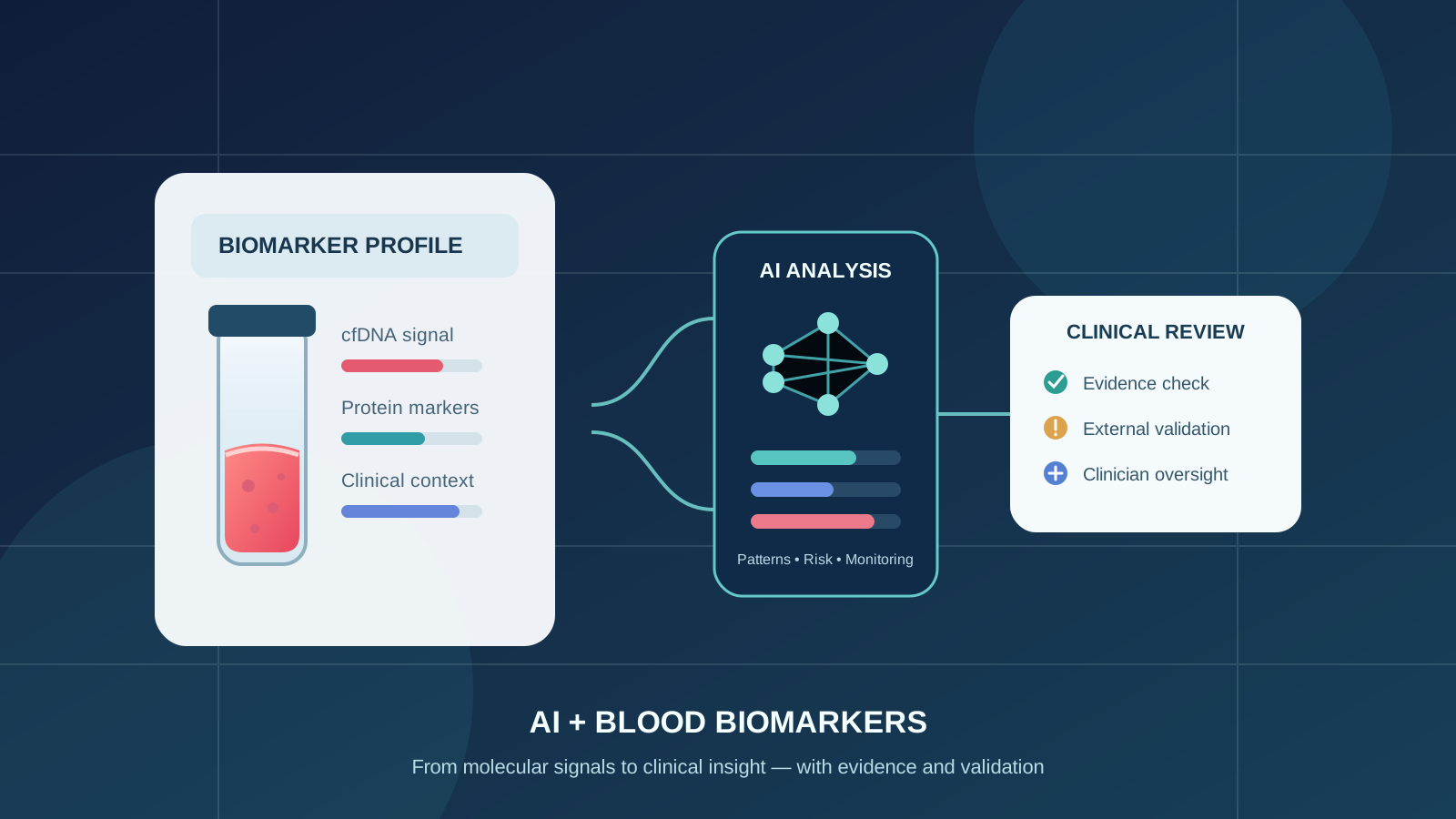
A review published on October 27, 2026, examines how artificial intelligence (AI) and machine learning could help researchers interpret blood-based biomarkers for disease risk assessment, molecular analysis, and treatment monitoring. The paper, published in Therapeutics and Clinical Risk Management, focuses particularly on circulating biomarkers such as cell-free DNA (cfDNA) and circulating tumor DNA (ctDNA).
The research is relevant to the growing field of AI in healthcare, but it is important to understand what the publication does—and does not—show. It is a narrative review of existing research, not a new clinical trial proving that one AI system can diagnose diseases with a specific accuracy rate. The authors discuss potential applications alongside substantial barriers to routine clinical use, including inconsistent sample handling, model bias, limited external validation, and the need for prospective studies.
What the new review says about AI and blood biomarkers
The paper, by Wenyuan Wei, Rui Zhang, and Zhiying Zhang, was published online on October 27, 2026, in Therapeutics and Clinical Risk Management. Its full title is “Circulating Biomarkers with Artificial Intelligence for Clinical Risk Assessment and Therapeutic Monitoring: Evidence, Limitations, and Translation”.
The review examines how AI models may combine biomarker measurements with other information—such as clinical variables, molecular profiles, and imaging features—to identify patterns that could be difficult to interpret from individual measurements alone. These patterns may help researchers investigate disease detection, risk stratification, and changes during treatment.
The authors also emphasize a key distinction: a promising signal in a research dataset is not automatically a clinically useful test. A model must be shown to work reliably in relevant patient populations and, ultimately, to improve decisions or outcomes before its use can be justified in routine care.
What are circulating biomarkers?
A biomarker is a measurable biological feature that can provide information about a physiological process, disease, or response to treatment. Circulating biomarkers are measured in blood or other accessible body fluids. Depending on the test, they may include DNA fragments, proteins, cells, metabolites, or other molecular signals.
One focus of the review is cell-free DNA (cfDNA)—small DNA fragments that circulate outside cells in body fluids. Some cfDNA originates from normal tissue, while a fraction may come from tumors or other sources of tissue injury. Circulating tumor DNA (ctDNA) is the tumor-derived fraction of cfDNA.
These measurements are studied because blood sampling can be less invasive than obtaining a tissue biopsy and can be repeated over time. However, the presence or amount of a biomarker does not automatically identify a disease, its location, or the best treatment. Interpretation depends on the marker, the assay, the clinical context, and the question being asked.
How AI could help interpret biomarker data
Blood-based tests can generate complex datasets. AI and machine learning methods may help combine several types of information and identify patterns associated with a clinical outcome. The review discusses several potential uses.
1. Supporting research into earlier disease detection
Researchers are investigating whether AI can interpret combinations of DNA mutations, methylation patterns, DNA-fragment characteristics, proteins, and clinical information to detect disease-related signals. In cancer research, for example, liquid biopsy approaches examine whether circulating molecular material can provide clues about a tumor.
The important qualification is that early detection is not the same as proven screening benefit. A model that separates selected patient samples from control samples may perform differently in a real screening population, where disease prevalence, coexisting conditions, and biological variation affect results. Prospective validation is needed before claims about routine screening performance can be made.
2. Monitoring changes during treatment
Repeated biomarker measurements may help researchers study whether a disease-related signal changes over time. In oncology, ctDNA is being investigated for monitoring molecular changes, recurrence risk, and treatment response. Other circulating markers are studied in areas such as transplantation, cardiovascular conditions, infection, and inflammation.
AI could potentially combine these measurements with clinical history and other test results to help identify patterns. But a change in a biomarker is not, by itself, proof that a treatment is working or failing. Clinical decisions require validated thresholds, appropriate comparison data, and professional interpretation.
3. Estimating clinical risk
A model could integrate biomarker values with established clinical factors to estimate the likelihood of an outcome, such as disease progression or complications. Such risk estimates might eventually support clinical decision-making, provided the model is properly calibrated and tested in populations resembling the patients for whom it is intended.
A model’s discrimination score alone is not enough. Researchers also need to examine calibration, false-positive and false-negative results, performance across patient groups, and whether using the model changes care in a beneficial way.
Which areas of medicine could be affected?
The review discusses circulating biomarkers across several clinical and research settings. The maturity of evidence varies by biomarker and disease, so these should be understood as areas of investigation—not as proof that one AI-powered blood test is ready for all of them.
- Cancer research: ctDNA and other circulating signals are being investigated for molecular characterization, monitoring, and recurrence-risk assessment.
- Cardiovascular medicine: researchers are studying circulating markers associated with tissue injury and clinical outcomes. Such signals may be nonspecific and must be interpreted alongside established assessments.
- Transplant medicine: donor-derived cfDNA is being studied as a potential indicator of graft injury. Results can have multiple explanations and need to be considered with other clinical findings.
- Infectious diseases and inflammation: researchers are examining pathogen-derived and host-derived molecular signals. These measurements do not replace appropriate microbiological tests or clinical assessment.
These applications differ substantially. Evidence for one marker in a specific clinical setting should not be generalized to unrelated diseases or to all AI biomarker tools.
Why the review does not establish a new clinical accuracy record
The paper is a narrative review, meaning that it discusses and synthesizes existing literature rather than reporting a new controlled clinical trial of a single diagnostic product. It does not establish one new, universally applicable accuracy figure for AI-assisted blood biomarker analysis.
Several technical and clinical issues can affect real-world performance:
Sample quality and laboratory variation
Blood collection, storage, processing, DNA extraction, and laboratory workflows can influence measurements. If a model is trained on data produced under one set of conditions, it may not transfer reliably to another laboratory or platform.
Confounding biological signals
Circulating DNA can originate from different tissues and biological processes. In cancer testing, for example, not every DNA alteration detected in plasma necessarily originates from a tumor. Models need methods and validation strategies that account for these confounders.
Bias and generalizability
AI models can learn patterns specific to their training datasets. If the data underrepresent particular ages, populations, disease stages, or healthcare settings, performance may be weaker for those groups. Independent validation is therefore essential.
Evidence of clinical utility
A model may predict an outcome without improving patient care. Researchers must establish whether adding its results to existing clinical practice improves decisions or patient outcomes, and whether potential benefits outweigh harms such as unnecessary follow-up tests or missed disease.
For readers interested in the broader safety implications, our guide on what AI can and cannot tell you about your symptoms explains why a plausible AI-generated medical answer should not be treated as a confirmed diagnosis.
What needs to happen before wider clinical adoption?
The review identifies several requirements for translating AI-assisted biomarker analysis into clinical practice:
- Standardized laboratory methods: consistent sample collection, processing, measurement, and quality control.
- Independent external validation: testing models on data from different institutions and representative patient populations.
- Prospective clinical studies: evaluating performance under real-world conditions rather than relying only on retrospective datasets.
- Meaningful clinical comparisons: assessing whether AI adds value beyond established biomarkers, clinical scores, and standard diagnostic pathways.
- Transparent reporting: explaining uncertainty, calibration, limitations, and performance across relevant patient groups.
- Evidence of patient benefit: determining whether using the model leads to better clinical decisions or outcomes.
These safeguards are not merely technical details. They help determine whether a promising research tool is reliable and useful enough for clinical decisions.
What this development means for healthcare AI
The new review illustrates a broader direction in medical AI: combining computational analysis with biological measurements to extract information from complex clinical data. Rather than replacing clinicians, these tools are being investigated as possible components of evidence-based diagnostic and monitoring workflows.
However, the publication should not be interpreted as an announcement that hospitals have broadly adopted a new AI blood test, or that AI has already demonstrated high clinical accuracy across these disease areas. It is a review of research, applications, and translation challenges.
For more context on evaluating health-related AI answers, read our guide to whether you should trust AI for health questions. The same principle applies to AI-assisted biomarker analysis: a compelling result needs to be checked against the underlying evidence and the intended clinical use.
Frequently asked questions
Can AI detect diseases from a blood test?
AI can analyze patterns in blood-test and biomarker data, and researchers are evaluating these methods for specific diagnostic and monitoring tasks. Whether a particular system can reliably detect a disease depends on the biomarker, intended use, study design, and independent clinical validation.
What is cfDNA?
Cell-free DNA, or cfDNA, refers to DNA fragments found outside cells in body fluids such as blood plasma. These fragments can come from different tissues and biological processes. Their interpretation depends on the clinical setting and the methods used to measure them.
What is the difference between cfDNA and ctDNA?
cfDNA includes circulating DNA fragments from multiple sources. ctDNA refers specifically to the fraction derived from a tumor. Detecting ctDNA can be useful in certain cancer research and clinical contexts, but test performance varies and a result must be interpreted appropriately.
Does this new paper prove that AI improves early diagnosis?
No. It is a narrative review of existing evidence and research directions, not a new prospective trial demonstrating improved early-diagnosis outcomes. The authors discuss potential uses and limitations, including the need for further validation.
Is AI-based biomarker analysis ready for routine healthcare?
Some individual biomarker tests and AI-enabled medical tools may have specific validated uses, but readiness cannot be generalized across all AI biomarker systems. Each tool needs evidence appropriate to its intended clinical purpose and the population in which it will be used.
Conclusion
The October 27, 2026, review explores how AI could help interpret circulating biomarkers—including cfDNA and ctDNA—for clinical risk assessment and therapeutic monitoring. It describes a promising research direction, but it also makes clear why technical standardization, independent validation, and prospective studies matter.
The most accurate takeaway is not that AI blood tests have already achieved a new level of clinical accuracy across healthcare. It is that researchers are investigating ways to combine molecular measurements and AI while working to establish when these methods are reliable enough to inform patient care.
Sources
- Wei W, Zhang R, Zhang Z. Circulating Biomarkers with Artificial Intelligence for Clinical Risk Assessment and Therapeutic Monitoring: Evidence, Limitations, and Translation. Therapeutics and Clinical Risk Management. Published October 27, 2026.
- Dove Medical Press: Full article and publication details.
- Dove Medical Press: Journal issue and publication listing.