
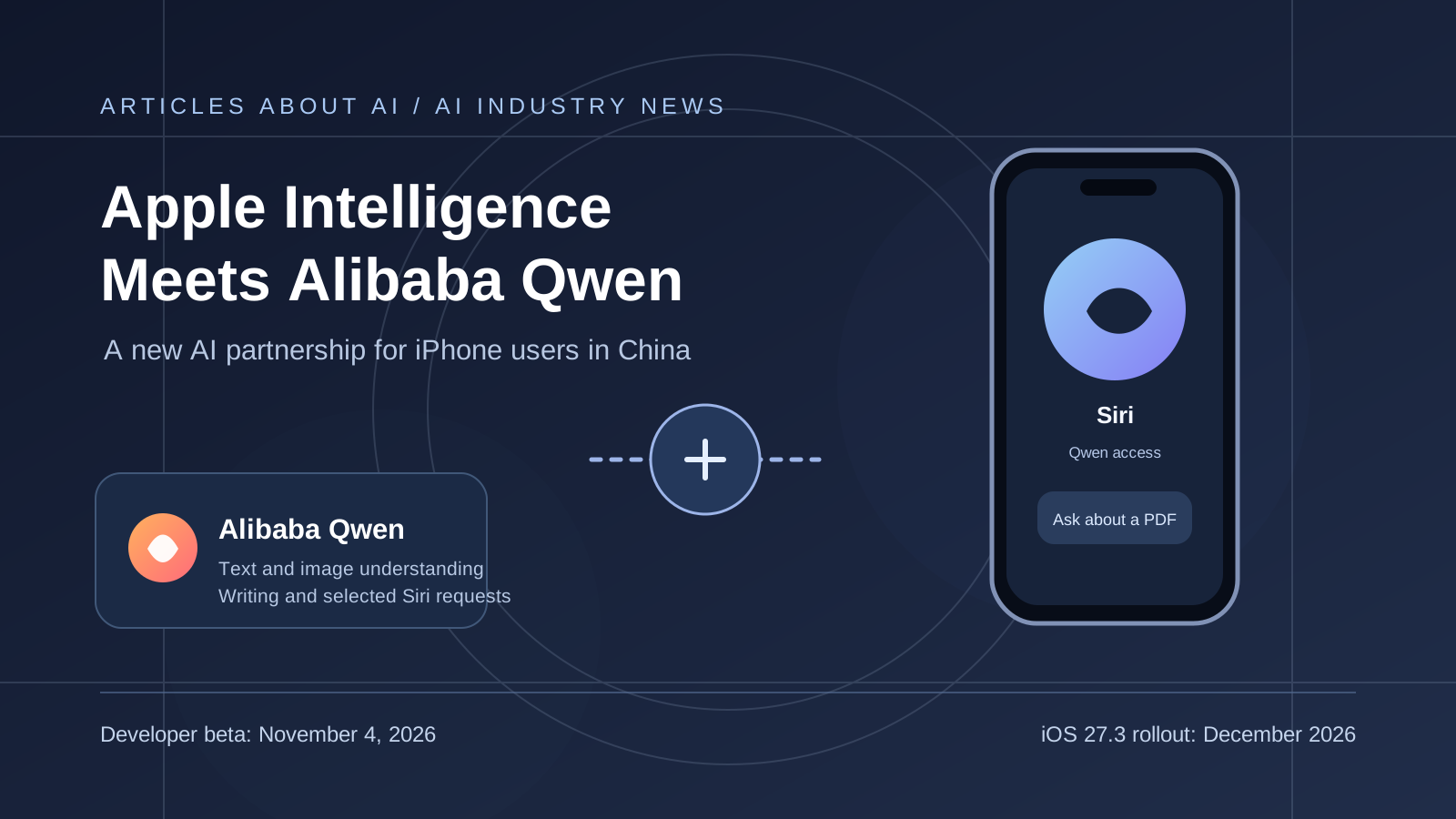
Apple is preparing to bring its first Apple Intelligence features to users in mainland China, with Alibaba’s Qwen model available inside selected experiences across Siri, Writing Tools, and Visual Intelligence. The announcement gives the long-awaited China rollout a defined testing window and consumer release target: developer testing begins on November 4, 2026, while the first public features are scheduled to arrive with iOS 27.3 in December.
The arrangement is notable because Apple is combining its own generative models with a local AI partner. Qwen will not replace every model behind Apple Intelligence. Instead, Apple says Qwen will be available in selected experiences where users need additional text and image understanding or content generation.
Apple confirms Qwen integration in Apple Intelligence
In a Chinese-language newsroom announcement dated October 31, Apple confirmed that it had partnered with Alibaba to add Qwen support to some Apple Intelligence experiences for users in China. The company specifically named Siri, Writing Tools, and Visual Intelligence.
Apple says its broader Apple Intelligence experience is powered by generative models built by Apple. Qwen is an additional capability within selected features, rather than a statement that Alibaba’s model will run the entire Apple Intelligence system.
The distinction matters. The announcement describes a model integration inside Apple’s software ecosystem, not a wholesale replacement of Apple’s own AI models. Apple has not published a detailed technical architecture explaining how requests are routed between its models and Qwen.
Read the official Apple announcement in the China Newsroom.
What Alibaba Qwen will do on iPhone
Apple identifies several ways users in China will be able to access Qwen through Apple Intelligence.
1. Answer selected requests through Siri
For certain requests, Siri will be able to call on Qwen and use its knowledge to help answer users. Apple also says users will be able to ask questions about photos and documents, including PDFs and presentations.
This could make Siri more useful for requests that involve interpreting information rather than simply performing a device action. However, Apple has not published a complete list of eligible request types or technical limits for the Qwen handoff.
2. Generate original text with Writing Tools
Apple says the Compose capability in Writing Tools will let users ask Qwen to create original content from scratch. Writing Tools will also offer its wider set of text features, including rewriting, proofreading, and summarization.
The Qwen integration therefore extends beyond a standalone chatbot. It is designed to be available within Apple’s system-wide writing experience.
3. Support text and image understanding in Visual Intelligence
Apple lists Visual Intelligence among the experiences that will support Qwen. Its announcement refers to text and image understanding capabilities, and says users can ask questions about photos and supported documents.
The company has not provided a detailed feature-by-feature breakdown showing which visual tasks will be handled by Qwen and which will use Apple-built models. Users should therefore treat the integration as selected Qwen support, not assume that every Visual Intelligence function depends on Alibaba.
When will Apple Intelligence launch in China?
Apple has provided two milestones for the initial rollout:
- November 4, 2026: The first set of features becomes available for testing through the latest iOS developer beta.
- December 2026: Apple plans to release the features to users in China with iOS 27.3.
Apple has not specified an exact December release date. The November 4 date is for developer beta testing, not a general public release.
The initial rollout is for iPhone. Apple says support for other platforms will follow after the necessary approvals are obtained. This means the announcement should not be interpreted as confirmation that the same Qwen-enabled features will arrive simultaneously on iPad, Mac, or Vision Pro in China.
Which iPhones will support the China rollout?
Apple’s announcement lists the following supported iPhone models for the first wave:
- iPhone 15 Pro
- iPhone 15 Pro Max
- iPhone 16 and later models
- iPhone Air
- iPhone Duo
Apple also specifies a language requirement: both Siri and the device language must be set to English or Simplified Chinese. Availability may depend on the supported device and the regional settings described in Apple’s release.
The company says the features are intended for users in China. The announcement does not establish that changing a device’s language alone will make the China-specific integration available in other regions.
What Apple Intelligence features are included?
The initial China release covers more than the Qwen integration. Apple’s announcement lists a range of Apple Intelligence capabilities, including:
- Live Translation in Messages, FaceTime, and Phone, with support for compatible AirPods.
- Writing Tools for rewriting, proofreading, and summarizing text.
- Visual Intelligence for understanding objects and places.
- Clean Up in Photos to remove distracting objects.
- Genmoji for creating custom emoji from text descriptions.
- Natural-language search and memory movies in Photos.
- Priority Messages and email summaries in Mail.
- Smart Reply suggestions in Mail and Messages.
- Notification summaries and Priority Notifications.
- Reduce Interruptions Focus.
- Audio transcription summaries in Notes and summaries of call transcripts.
- The ability to type to Siri and maintain context across a conversation.
- Selected Siri, Writing Tools, and Visual Intelligence experiences powered with Qwen support.
This is Apple’s announced initial feature set. Availability can vary by device, language, and region, and some capabilities may have additional requirements.
What is not included: the newer Siri AI experience
Apple explicitly says the China update does not include Siri AI or the other next-generation Apple Intelligence features announced at WWDC 2026.
That is an important limitation. The rollout brings a collection of Apple Intelligence features to China and adds Qwen support to selected workflows, but it is not the same release as Apple’s newer Siri AI experience.
Users should not interpret the Qwen integration as confirmation that the redesigned Siri AI features are launching in China in December. Apple has not announced a China release date for those next-generation capabilities.
Privacy, account access, and user choice
Apple says users can access Qwen by signing in to a Qwen account or by using Sign in with Apple. Its announcement explains how Qwen can be reached within Apple Intelligence, but does not provide a full technical description of data processing, retention, or the division of responsibilities between Apple and Alibaba.
Xinhua’s report on Alibaba’s announcement says users can choose whether to enable the Qwen integration and what information to share. It also reports Alibaba’s statement that user requests and generated responses will not be used to train its model.
That training statement is attributable to Alibaba as reported by Xinhua; it should not be confused with a complete privacy assessment of every part of Apple Intelligence. Users should review the relevant Apple and Qwen account disclosures and the settings presented when enabling the feature.
Sources: Xinhua’s report on the Apple–Alibaba partnership and Apple’s China Newsroom announcement.
Why Apple is working with Alibaba in China
The partnership reflects the practical differences between launching AI services in different markets. Apple has to account for local regulatory requirements, service availability, language support, and the AI products that users can access in each region.
China’s generative AI rules require relevant services to complete regulatory procedures before public deployment. Reuters reported in July 2026 that Apple’s on-device generative AI service had been registered for use in China and that Alibaba and Baidu technologies were involved in the local arrangement. The October 31 announcement now provides Apple’s own confirmation of Qwen’s role in selected features and a timetable for the first iPhone release.
The partnership also gives Alibaba a route to make Qwen available within a widely used consumer-device ecosystem. For Apple, it provides a local model integration while the company continues to describe Apple Intelligence as powered by models it built.
The exact commercial terms, model-routing design, and longer-term role of other Chinese AI providers have not been disclosed in Apple’s announcement.
What the partnership means for the AI market
The Apple–Alibaba agreement is another example of AI platforms becoming more interconnected. Instead of relying on a single model for every task, consumer technology companies can combine in-house systems with external models for specific capabilities, markets, or use cases.
For users, the practical result will depend on how well the integration works in everyday tasks: answering questions, understanding photos and documents, and drafting text. The developer beta beginning November 4 should provide the first opportunity to assess the experience, while the December release will determine how broadly it reaches eligible iPhone users.
The announcement is also a reminder that AI availability is increasingly regional. A feature available on an iPhone in one market may be delayed, changed, or unavailable in another because of language, regulatory, or product requirements.
For readers interested in practical AI document workflows, see our guides on using Gemini to analyze a PDF and extract important details and summarizing a Google Docs document with Gemini.
Frequently asked questions
Is Alibaba Qwen replacing Apple’s own AI models?
No. Apple says Apple Intelligence is powered by generative models built by Apple, while Qwen is being added to selected experiences in Siri, Writing Tools, and Visual Intelligence.
When can users in China try Qwen inside Apple Intelligence?
Developer testing is scheduled to begin on November 4, 2026, through the latest iOS developer beta. The public rollout is planned for December with iOS 27.3.
Can Siri use Qwen to analyze PDFs and presentations?
Apple says users will be able to ask questions about documents, including PDFs and presentations, through the Qwen integration. The company has not published a complete list of document-analysis limits.
Will the new Siri AI features launch in China in December?
Apple says the initial update does not include Siri AI or the other next-generation Apple Intelligence features announced at WWDC 2026. No China launch date for those features was included in the announcement.
Which iPhone models are eligible?
Apple lists iPhone 15 Pro and iPhone 15 Pro Max, iPhone 16 and later, iPhone Air, and iPhone Duo. Siri and the device language must be set to English or Simplified Chinese.
Will Qwen be available in Apple Intelligence on Mac and iPad?
Not in the initial iPhone rollout. Apple says support for other platforms will follow after the necessary approvals are obtained.
Official and trusted sources
- Apple Newsroom China: Apple Intelligence features are coming to users in China — October 31, 2026
- Xinhua: Alibaba’s Qwen AI model to integrate into Apple Intelligence in landmark partnership — November 1, 2026
- Reuters: Apple Intelligence AI service registered with China’s cyberspace regulator — July 15, 2026
- The Next Web: Apple confirms its AI features reach China in December, with Qwen — October 30, 2026