
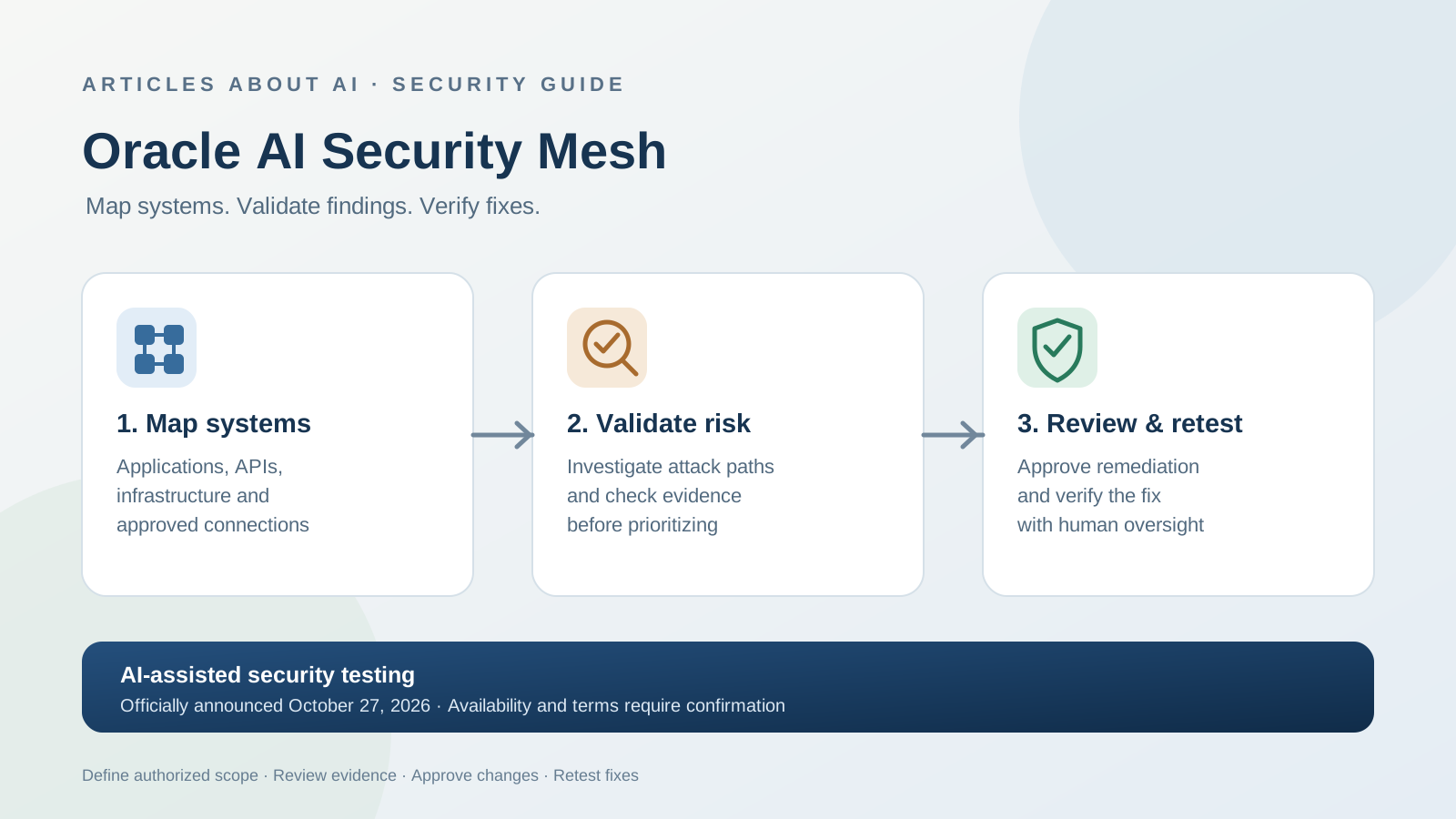
Oracle announced Oracle AI Security Mesh on October 27, 2026, describing it as a managed security platform that combines cybersecurity-focused AI models, including OpenAI Cyber models, with Oracle security expertise and testing tools. Its stated goal is to help organizations discover weaknesses across applications and infrastructure, understand which risks matter most, validate findings with evidence, and check whether proposed fixes address the identified problem.
The announcement is relevant to teams managing complex environments: applications, APIs, legacy systems, cloud services, and on-premises infrastructure can create connections that are difficult to assess one by one. Oracle says AI Security Mesh can map systems and their connections using the context and access customers provide, investigate possible attack paths, and use a separate agent to check whether findings can be reproduced. Teams review recommended fixes, and the platform can retest them within an approved scope.
Important availability caveat: Oracle’s announcement describes the product and its intended capabilities, but it does not establish a generally available self-service product with a public click-by-click setup guide. Oracle also states that product direction and timing may change. This article is therefore a practical preparation and workflow guide based on documented capabilities—not a claim that every reader can sign in and follow a fixed interface today. Confirm access, pricing, supported integrations, and launch status with Oracle before making purchasing decisions.
For the primary sources, see Oracle’s official AI Security Mesh product page and Oracle’s October 27 announcement.
What Is Oracle AI Security Mesh?
Oracle AI Security Mesh is a managed AI-powered security testing platform. Oracle says it combines frontier cybersecurity models with its testing tools and customer-provided context about systems and business priorities. Rather than returning only a list of potential vulnerabilities, its intended workflow connects discovery, investigation, validation, prioritization, remediation review, and retesting.
The official description highlights these capabilities:
- System discovery and mapping: map applications, infrastructure, and connections using the access and context the customer supplies.
- Attack-path investigation: specialized agents investigate how a weakness could connect to other systems or expose sensitive resources.
- Independent finding validation: a separate agent checks whether a reported issue can be reproduced, helping teams distinguish evidence-backed findings from unconfirmed suspicions.
- Risk prioritization: focus attention on confirmed weaknesses that could have the most serious operational consequences.
- Fix review and retesting: coding agents can help prepare proposed code changes; teams review changes, and the platform tests whether the identified issue is addressed while checking expected application behavior.
- Bounded agent activity: Oracle describes distinct agent identities, task scopes, just-in-time permissions, and independent monitoring intended to detect activity outside approved boundaries.
These are vendor-described capabilities, not independent performance benchmarks. The announcement does not establish that every integration, programming language, environment, or vulnerability class is supported in every deployment.
How to Prepare for an Oracle AI Security Mesh Assessment
Because the public announcement does not document a universal setup wizard, the following is a defensible operational checklist based on Oracle’s published workflow. It should not be mistaken for exact interface instructions.
Step 1: Define the Authorized Testing Scope
List the applications, APIs, infrastructure, and environments the organization owns or is explicitly authorized to test. Identify the systems that must remain out of scope, the test window, points of contact, and any production-safety constraints.
Use written authorization and least-privilege access. Do not point an AI security tool at third-party systems or assets without permission. Oracle says the customer supplies system context and access and approves the testing scope; the exact configuration process should be confirmed with Oracle.
Step 2: Gather Useful System Context
Prepare an accurate inventory of the assets in scope, including relevant application boundaries, service connections, APIs, authentication flows, and business-critical data paths. Include context that helps a security team understand impact—for example, whether an endpoint handles customer records, payments, or internal administration.
Avoid sharing secrets unnecessarily. Use approved access mechanisms, restrict credentials to the minimum privileges required, and follow the organization’s data-handling rules. The quality and completeness of system context can influence the usefulness of a security assessment, but Oracle’s public announcement does not quantify a guaranteed accuracy improvement.
Step 3: Review the System Map and Proposed Test Plan
Oracle says AI Security Mesh maps systems and connections and proposes a test plan for customer approval. Before testing, review the proposed scope and check that it matches the authorized assets and the organization’s safety requirements.
Questions to ask include: Are critical dependencies represented? Are sensitive production systems included only when authorized? Are excluded systems clearly excluded? Are test actions compatible with rate limits, monitoring, and incident-response procedures?
Do not assume that discovery automatically grants permission to test every connected system. Confirm that the approved plan and the access configuration align.
Step 4: Investigate Potential Weaknesses and Attack Paths
Oracle describes specialized agents that investigate possible weaknesses and test how those weaknesses might be used. For example, an access-control defect in an ordering application could potentially allow one customer to view another customer’s order.
The relevant question is not merely whether a scanner reports a weakness. It is whether the issue is reachable in the actual environment, what information or capability it could expose, and whether a plausible path connects it to a business-critical asset.
Keep testing within the approved scope. Treat model-generated explanations as hypotheses until supported by reproducible evidence, and follow the organization’s rules for handling sensitive findings.
Step 5: Validate Findings Before Prioritizing Them
Oracle says a separate agent checks whether findings can be reproduced and provides supporting evidence such as reproduction steps and test results. Security teams should review that evidence before treating a finding as confirmed.
For each candidate issue, record the affected asset, the conditions needed to reproduce it, the potential impact, the evidence gathered, and any uncertainty. A reproducible issue with a credible path to sensitive data may deserve more urgent attention than an unverified alert with unclear impact.
Independent validation can help reduce wasted remediation effort, but it is not a guarantee that every false positive or missed vulnerability will be eliminated.
Step 6: Review Proposed Remediation Changes
Oracle says the platform can help teams evaluate proposed fixes and that coding agents may prepare code changes. The organization should review any proposed change for correctness, security implications, maintainability, and unintended effects.
Use normal engineering controls where applicable: code review, tests, change management, version control, and an approved deployment process. Oracle’s announcement says customers approve remediation changes before AI Security Mesh applies them. Do not interpret AI-generated patches as automatically safe or production-ready.
Step 7: Retest the Fix and Check Normal Behavior
After an approved fix is applied, Oracle says AI Security Mesh can test the identified vulnerability again and check the effect on expected application behavior. The goal is to verify both that the security gap is addressed and that legitimate workflows still function.
Capture the retest evidence, the build or version tested, the remaining risks, and the decision to close or reopen the finding. If a test fails, investigate rather than marking the issue resolved simply because a patch was merged.
Step 8: Maintain Controls and Review Future Assessments
Oracle says discoveries can remain in a private business knowledge base to inform future assessments. Organizations should still review access, retention, and internal policies for any security data or system context shared with the service.
Use scoped identities, least privilege, approved test plans, independent monitoring, and explicit human approval for consequential changes. These controls remain important even when an AI platform is designed with safeguards. AI-assisted security testing should complement—not replace—incident response, secure development practices, and expert review.
What Can Oracle AI Security Mesh Help Teams Test?
Oracle’s published materials describe use across applications and infrastructure, including systems running on-premises, on OCI, or in other clouds. Its product page gives examples of business contexts where connected systems and access boundaries matter:
- SaaS applications: test whether one customer might access another customer’s data through an authorization flaw.
- Healthcare systems: examine whether connected portals or applications expose patient information to unauthorized users.
- Financial services: investigate possible paths to account or transaction data.
- Manufacturing: assess connections among supplier portals, inventory systems, and ERP applications that could affect production or fulfillment.
These are examples from Oracle’s product materials, not a guarantee that all systems in those industries are currently supported. Ask Oracle to confirm supported technologies, deployment requirements, and coverage for your specific environment.
Security Controls: What Teams Should Verify
Oracle says each agent operates with a distinct identity, a defined task scope, and just-in-time permissions. It also describes independent monitors that can detect and stop activity outside approved boundaries. These controls are important because security agents may interact with sensitive systems and can potentially cause disruption if given excessive access.
Before adopting the platform, security and procurement teams should confirm:
- Which environments and integrations are supported today.
- How credentials and permissions are configured and revoked.
- How the approved test scope is enforced and audited.
- What monitoring, stop controls, and escalation paths are available.
- How system context, findings, and evidence are stored and retained.
- Which actions require explicit customer approval.
- How pricing, usage limits, service availability, and support are defined.
- How the service fits existing vulnerability-management and incident-response processes.
The public announcement does not provide all these operational and commercial details. They should be treated as due-diligence questions, not as claims that a particular feature is already available.
Oracle AI Security Mesh vs. Traditional Vulnerability Scanning
Traditional vulnerability scanners can identify known weaknesses, configuration problems, and other patterns within their supported scope. Oracle positions AI Security Mesh as a broader workflow that maps connections, investigates possible attack paths, checks whether findings can be reproduced, helps prioritize risks, and retests fixes.
The distinction is about the described workflow, not proof that the new platform outperforms every scanner or penetration-testing service. Tool selection should depend on the organization’s assets, compliance requirements, supported integrations, evidence quality, testing controls, and total cost. AI-assisted testing can be useful alongside established scanners, manual penetration testing, code analysis, and secure software development lifecycle controls.
For teams also exploring AI-assisted application development, see our related guide, How to Use Oracle App Composer. For the broader Oracle–OpenAI business offering, read Oracle AI SMB Bundle Explained. These offerings have different purposes: App Composer focuses on building and governing applications, the SMB Bundle packages business tools and credits for eligible companies, and AI Security Mesh focuses on security testing and remediation workflows.
Availability, Pricing, and Limitations
As of Oracle’s announcement dated October 27, 2026, the public materials describe Oracle AI Security Mesh and invite interested organizations to contact Oracle. The pages reviewed do not establish a universal public sign-up flow, a generally available launch date, published pricing, or a complete list of supported integrations.
Oracle’s enterprise security announcement includes a future-product disclaimer: the description outlines general product direction, is for informational purposes, is not a contractual commitment, and should not be relied upon for purchasing decisions. Release timing, pricing, and functionality may change at Oracle’s discretion.
Before adopting the platform, request current information directly from Oracle. Confirm access eligibility, deployment options, supported systems, data-handling terms, service-level commitments, costs, and the exact scope of any pilot. Do not assume the product is free or available to every account.
Frequently Asked Questions
Is Oracle AI Security Mesh publicly available to everyone?
The official pages reviewed describe the offering but do not confirm unrestricted self-service access for everyone. Contact Oracle to confirm current availability and eligibility.
Does Oracle AI Security Mesh use OpenAI models?
Oracle says the platform combines cybersecurity-focused models, including OpenAI Cyber models, with Oracle’s testing tools and security expertise.
Can it automatically fix vulnerabilities?
Oracle says the platform can help assess fixes and that coding agents may prepare code changes. Oracle’s announcement also says customers approve remediation changes before the platform applies them. This is not a reason to skip engineering review, testing, or change control.
Does it work only with Oracle Cloud Infrastructure?
Oracle describes protection across applications and infrastructure running on-premises, on OCI, or in other clouds. Confirm support for the particular technologies and integrations in your environment.
Does it guarantee that an application is secure?
No security tool can establish that an application has no vulnerabilities under every condition. Oracle describes discovery, validation, prioritization, and retesting capabilities; organizations should continue using layered security practices and expert assessment.
Where can I find the official details?
Start with the Oracle AI Security Mesh product page and the Oracle AI & Data Science announcement. Oracle’s October 27 enterprise security announcement provides additional context on the product’s intended safeguards.
Conclusion
Oracle AI Security Mesh is a newly announced AI-powered security platform designed to help organizations map systems, investigate potential weaknesses, validate findings, prioritize risks, review remediation, and retest fixes. Its promise is a connected workflow rather than an isolated vulnerability alert—but the capabilities and availability described by Oracle should not be mistaken for independent validation or a guarantee of universal access.
Security teams evaluating the platform should define authorized scope, prepare accurate system context, review proposed test plans, validate evidence, approve changes, and retest fixes while preserving least-privilege access and human oversight. Before making a purchasing decision, confirm the latest availability, pricing, integrations, and contractual commitments directly with Oracle.