
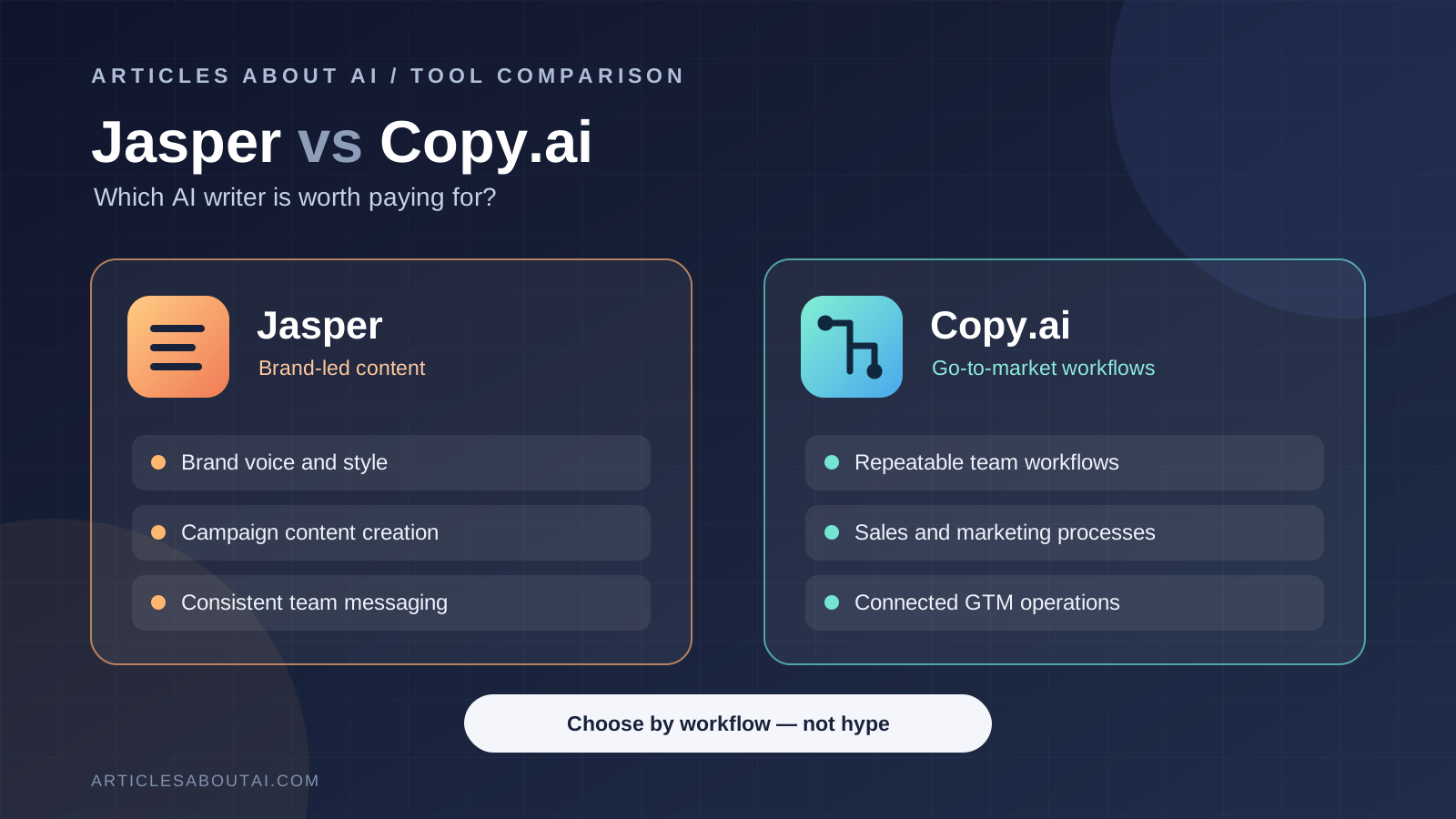
If you are comparing Jasper vs Copy.ai, the most important question is not which tool can generate a catchy headline. Both products can help teams create marketing content, but they are increasingly positioned around different workflows. Jasper emphasizes marketing content operations, brand consistency, and controls that help teams produce on-brand material. Copy.ai has developed from an AI copywriting tool into a go-to-market (GTM) platform built around repeatable workflows for marketing, sales, and revenue teams.
Quick verdict: Jasper is the better starting point for a marketing team whose main need is producing and managing brand-consistent content across campaigns and channels. Copy.ai is worth evaluating when the problem extends beyond writing into repeatable GTM processes, such as account research, outbound messaging, lead handling, and coordinated content workflows. A solo writer who only needs occasional drafts may not need either platform; a general-purpose assistant could be more economical.
This is a product and workflow comparison, not a controlled writing benchmark. We did not run a statistically controlled test of the two platforms, and we do not assign invented accuracy or productivity scores. Product features and pricing can change, so the pricing details below reflect the vendors’ public pages checked on October 26, 2026. Confirm the current offer, billing period, limits, and terms before subscribing.
Jasper vs Copy.ai: quick comparison
| Category | Jasper | Copy.ai |
|---|---|---|
| Main product direction | Marketing content platform with brand controls and campaign workflows | GTM AI platform for content, sales, and operational workflows |
| Strongest fit | Marketing teams producing consistent content across brands, audiences, and channels | Teams standardizing repeatable go-to-market processes across functions |
| Brand context | Jasper IQ includes brand voice, audiences, knowledge, style guidance, and related controls | Copy.ai offers shared company information and workflow-oriented context features; confirm the features available in your chosen plan |
| Content creation | Marketing-focused drafting and production through tools such as Canvas, Agents, and Grid, depending on plan | Chat for ad hoc work plus configurable workflows for repeatable processes |
| Automation | Marketing agents and scaled content workflows, with advanced capabilities tied to plan | Workflow automation is central to the platform’s GTM positioning |
| Public entry pricing | Pro listed at $69 per month, or $59 per month with annual billing | Chat listed at $29 monthly, or $24 per month billed annually |
| Higher-scale use | Business pricing is custom | Growth and higher tiers are substantially more expensive, team-oriented offerings |
| Best buying question | Will brand consistency and marketing-specific production justify the subscription? | Will connected GTM workflows save enough operational effort to justify the platform cost? |
These prices are not a direct like-for-like comparison. Jasper Pro is presented as a marketing content plan for one seat. Copy.ai’s Chat plan is listed for five seats, while its larger plans include workflow credits and substantially more seats. Compare the features and total cost needed for your actual team rather than selecting the lowest headline price.
What is Jasper?
Jasper is an AI platform focused on marketing and brand-led content production. Its value proposition is not simply that it can write a blog introduction or an advertising headline. It aims to help teams generate content that reflects their brand, audience, approved messaging, and style rules more consistently.
Jasper’s official product information describes Jasper IQ as a brand intelligence layer. It can organize information such as Brand Voice, Audiences, Style Guide, Knowledge Base, and Product IQ, with availability depending on the feature and subscription. These inputs are intended to give content generation more context than a one-off prompt.
For example, a marketing team launching a new product might define its audience, approved product claims, tone, terminology, and phrases to avoid. The team can then use that context across different assets instead of copying the same background instructions into every request. This can reduce repetitive setup, but it does not remove the need for editorial review or legal approval.
Jasper’s product lineup includes marketing-oriented creation and workflow features. The exact capabilities available to a user depend on the current plan. Review the official Jasper pricing page and the Jasper IQ documentation before building a process around a particular feature.
Where Jasper can be useful
- Campaign content: Drafting and adapting copy for a coordinated marketing campaign.
- Brand consistency: Reusing a defined tone, approved messaging, and audience context.
- Content operations: Helping a team move from briefs to drafts and revisions within a shared workflow.
- Product marketing: Using structured product information to reduce inconsistencies across descriptions and campaigns.
- Multi-channel production: Creating and adapting marketing assets for different formats while keeping the central message aligned.
Jasper’s trade-offs
Jasper may be more platform than an individual writer needs. If you write a few blog posts each month and are comfortable managing your own prompts, style guide, and fact-checking, the subscription may not deliver enough incremental value. Its specialized controls matter most when content volume, collaboration, brand risk, or repeatability create a real operational problem.
Also, brand settings do not guarantee that every generated sentence is accurate or compliant. A model can misinterpret a brief, invent a claim, or produce generic copy even when supplied with detailed context. Product facts, regulated claims, pricing, testimonials, and comparative statements still require human verification.
What is Copy.ai?
Copy.ai began as an AI copywriting product, but its current positioning is broader. The company describes Copy.ai as a GTM AI platform intended to connect workflows across go-to-market teams. Its public examples include account research, outbound messaging, content operations, lead processing, account-based marketing, and campaign execution.
The distinction matters. A conventional AI writing tool helps someone create an individual asset. A workflow platform aims to standardize a process made of multiple steps—for example, gathering information about a target account, drafting personalized outreach, checking the result, and passing it to the next stage. Copy.ai’s official GTM platform page describes examples across content creation and sales-related processes, while its workflow overview explains how actions can be combined into reusable workflows.
Copy.ai also lists a Chat plan that provides access to models from OpenAI, Anthropic, and Google, according to its current pricing page. Access and limits should be checked against the exact subscription and terms shown at purchase.
Where Copy.ai can be useful
- Repeatable marketing processes: Turning recurring content tasks into a workflow with defined steps.
- Sales enablement: Supporting account research, prospecting, and outreach content.
- Campaign operations: Coordinating research and content tasks rather than treating each draft as a standalone request.
- Team standardization: Encoding approved processes so colleagues do not have to recreate the same steps from scratch.
- Cross-functional GTM work: Connecting tasks that involve marketing, sales, and revenue operations.
Copy.ai’s trade-offs
Copy.ai’s broader positioning may be unnecessary if your only requirement is a polished blog post or a few product descriptions. Workflow automation can create value, but only when the underlying process is clear, repeated often enough, and worth standardizing. Building a complex workflow around an unstable process can add overhead rather than remove it.
Do not assume that every plan includes the same number of workflow credits, integrations, seats, or automation capabilities. The pricing page separates its self-serve Chat offering from higher-scale plans. Confirm how credits are consumed, what integrations are included, and whether the plan’s limits fit your expected workload before committing.
Jasper vs Copy.ai pricing in 2026
Pricing is one of the most visible differences, but the headline numbers need context.
Jasper pricing
Jasper’s public pricing page lists Pro at $69 per month with monthly billing or $59 per month when billed annually. The Pro plan is listed as including one seat, Canvas, Agents for core marketing workflows, and a limited set of brand-context resources. Jasper Business uses custom pricing and adds broader customization, advanced workflows, governance, API access, and support features as described by the vendor.
Because the annual option requires paying on an annual basis, compare the total commitment—not just the monthly equivalent. A team should also check whether it needs additional seats or features available only in Business.
Source: Jasper plans and pricing.
Copy.ai pricing
Copy.ai’s public pricing page lists Chat at $29 per month when billed monthly or $24 per month billed annually. The displayed plan includes five seats and unlimited words in Chat, alongside access to several model providers. Its higher-scale tiers are priced for businesses using workflows: the public page lists Growth at $1,000 per month billed annually, Expansion at $2,000 per month billed annually, and Scale at $3,000 per month billed annually, with differing seat and workflow-credit allocations.
These are substantial jumps from the Chat plan. They signal that Copy.ai’s higher tiers should be evaluated as team workflow infrastructure, not simply as a cheaper or more expensive way to generate text. Check the official Copy.ai pricing page for the current details and confirm whether the listed billing option suits your organization.
Which subscription is better value?
Use the following framework rather than comparing only monthly prices:
- Count the people who will use it. A one-seat plan and a five-seat plan are not directly equivalent.
- List the features you actually need. Avoid paying for automation, governance, or integrations that your workflow will not use.
- Estimate usage. If workflow credits, research actions, or other metered features apply, estimate usage before choosing a tier.
- Calculate the total annual cost. Include seats, required upgrades, implementation, and the time needed to maintain the system.
- Measure time saved. Compare the full process before and after adoption, including setup, revisions, fact-checking, and approval.
A lower subscription fee is not automatically better value. A more expensive tool can be justified if it reduces repeated work across a team, but that benefit should be demonstrated rather than assumed.
Writing quality: which tool creates better copy?
There is no reliable universal winner based on product descriptions alone. Both platforms can generate drafts, and the result depends on the model, instructions, source material, and workflow. A fair comparison should use the same assignment, constraints, and evaluation criteria.
Test both tools on three representative tasks:
- A blog brief: Ask for an outline and a 1,000-word draft using supplied source material. Check whether the structure is useful, the argument is specific, and factual claims are supported.
- A campaign package: Request an email, landing-page section, and three social posts aimed at the same audience. Check consistency across formats and whether each asset suits its channel.
- A brand-sensitive task: Supply a short style guide, approved product facts, and a list of prohibited claims. Check whether the tool respects them without inventing benefits.
Score the output on factual accuracy, relevance, specificity, brand fit, revision effort, and ease of use. Use a simple rubric from 1 to 5 if helpful, but record examples of errors and edits as well as the scores. Have the same reviewer assess each output without knowing which tool created it when practical.
Do not count the number of words generated as the main measure of productivity. A fast draft that requires extensive correction may be slower overall than a more restrained draft that is easier to edit.
For more context on general-purpose assistants, see our comparisons of ChatGPT vs Claude for writing and Claude vs Gemini for long-form content. For a broader shortlist across writing categories, read Best AI Writing Tools in 2026.
Jasper vs Copy.ai for SEO and blog content
Both products may support parts of a content workflow, but neither should be treated as an automatic SEO strategy. Search performance depends on satisfying the reader’s intent, demonstrating first-hand knowledge where relevant, providing reliable information, maintaining a useful site structure, and earning trust. Publishing large volumes of generic AI text is not a substitute for these fundamentals.
For SEO-focused content, evaluate each tool on whether it helps your team:
- Build a clear brief from a real search intent.
- Organize sections around distinct reader questions.
- Incorporate verified facts and original sources.
- Avoid repeating the same information across headings.
- Create useful titles, descriptions, and internal-link suggestions.
- Preserve a recognizable editorial voice.
- Support human editing and fact-checking before publication.
Jasper is a natural candidate to test if your SEO content is part of a larger brand marketing operation and you need repeatable on-brand production. Copy.ai is worth testing if content is one component in a broader workflow that includes research, sales enablement, and campaign execution. For either tool, validate internal links manually and verify every external source. Do not publish generated citations or claims without opening the original source.
Ease of use and team collaboration
The easiest product is not necessarily the one with the shortest learning curve on day one. Consider how well the tool fits the way your team already works.
Jasper’s emphasis on brand context can be valuable when editors, writers, and campaign managers need shared guidance. It is worth evaluating how workspace settings, roles, brand assets, and review steps match your process. Ask who owns the approved brand voice and product facts, and how those details will be maintained.
Copy.ai’s workflow-centered approach is useful when a process involves several repeated steps or handoffs. Before adopting it, map the workflow on paper. Identify the inputs, decisions, review points, output format, and destination for each result. Then test whether the platform can support that process without adding unnecessary complexity.
For both products, run a small pilot with the people who will use the software every week. Check onboarding time, permission controls, collaboration, output review, export options, and how easily a colleague can understand and maintain the workflow. A tool that depends on one person to keep it working may create a new operational bottleneck.
Privacy, accuracy, and governance
Marketing teams often provide AI tools with campaign plans, product details, customer information, and unreleased messaging. Before uploading sensitive material, read the provider’s current privacy, security, retention, and data-processing terms. Confirm whether the selected plan offers the controls required by your organization and whether administrators can manage access appropriately.
Avoid submitting personal data, confidential customer records, credentials, or sensitive business information unless the use is authorized and the service’s terms and configuration have been reviewed. For regulated industries, legal and compliance teams should approve the workflow before it is used in production.
Neither Jasper nor Copy.ai eliminates the need for human accountability. Have a reviewer verify product claims, pricing, statistics, customer quotations, competitor comparisons, and any statements that could create legal or reputational risk. Maintain a record of the approved sources and final edits for high-impact content.
A practical 30-minute buying test
You can make the decision more concrete with a short evaluation before buying an annual plan.
Minutes 1–5: Define the assignment. Choose a real task you perform repeatedly. Write down the audience, purpose, channel, source material, brand requirements, and what a successful output must contain.
Minutes 6–15: Run the same task in both tools. Use the same source material and equivalent instructions. Do not give one platform a much more detailed brief than the other. If a feature is available only in a particular plan, record that fact rather than pretending the test is identical.
Minutes 16–22: Review the outputs. Check accuracy, specificity, tone, structure, and unsupported claims. Mark every change needed before publication. Include the time spent correcting the draft.
Minutes 23–27: Test the workflow. Try the relevant collaboration, brand-context, or automation feature. Ask whether it removes a recurring step or merely moves the work into a different interface.
Minutes 28–30: Calculate the value. Estimate how often the task occurs each month and how much review time each tool saves. Compare the expected benefit with the complete subscription cost and implementation effort.
A 30-minute test will not prove which system is best for every use case, but it can reveal whether the product fits your actual work. If neither option improves the process enough, do not buy one just because AI writing software is popular.
Jasper vs Copy.ai: final verdict
Choose Jasper if your primary challenge is producing marketing content that follows a consistent brand voice, uses approved company context, and can be managed across campaigns and channels. Its marketing-focused controls are most relevant when multiple people create content and consistency matters at scale.
Choose Copy.ai if your primary challenge is coordinating repeatable go-to-market work across marketing and sales. Its broader GTM positioning and workflow emphasis make it worth evaluating when the job includes research, outbound messaging, lead processing, and other connected steps—not just writing an individual asset.
Choose neither yet if you are a solo creator or small business that mainly needs occasional outlines, blog drafts, product descriptions, and email copy. First compare the cost and workflow of a general-purpose assistant with your real needs. Our AI writing tools comparison can help you explore alternatives.
The most defensible purchase is the one that solves a repeated, measurable problem. Test both tools on your own brief, verify the current plan details, and choose based on output quality, total cost, and the amount of work that remains after the AI has finished.