
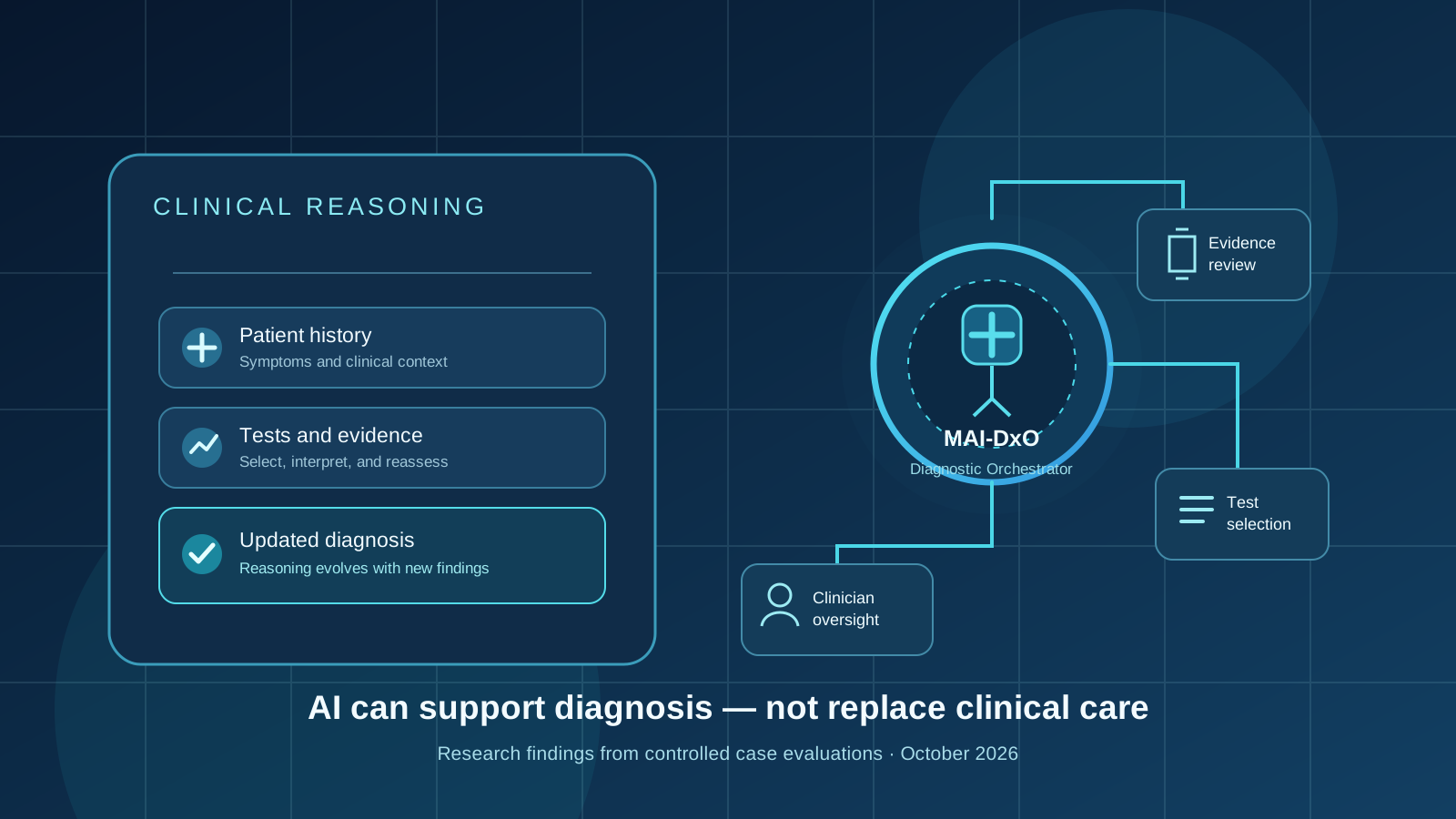
Microsoft researchers have developed an artificial intelligence system that can work through medical cases step by step, asking for relevant information, selecting tests, and revising possible diagnoses as new evidence arrives. The system, called the Microsoft AI Diagnostic Orchestrator (MAI-DxO), achieved higher diagnostic accuracy than generalist physicians in controlled evaluations reported in the journal Science on October 22, 2026.
The result is notable, but it needs careful interpretation. The study tested historical, text-based cases—not live patient care—and compared the system with individual generalist physicians, not specialist teams. MAI-DxO is a research system, and these results do not establish that it can replace doctors.
Microsoft’s announcement is available in its official medical AI research update. Reuters also reported on the diagnostic system and study.
How accurate was Microsoft’s medical AI?
Microsoft reported the following results from its Sequential Diagnosis Benchmark, which includes two different groups of medical cases:
| Evaluation | MAI-DxO | Generalist physicians |
|---|---|---|
| 304 complex cases from The New England Journal of Medicine, with reference tools available to physicians | 83.2% | 36.1% |
| Complex cases, physicians without reference tools | 83.2% | 22.3% |
| Emergency department cases from MIMIC-IV-ED | 80.3% | 46.8% |
These figures describe performance on the benchmark’s specific case sets. They should not be read as a general measure of how accurately the system would diagnose every patient in a hospital, clinic, or home setting.
The study was published in Science under the title “Sequential diagnosis with language models”. Microsoft says the benchmark was designed to evaluate not only whether a system reaches the correct diagnosis, but also which questions and tests it chooses along the way.
What is MAI-DxO?
MAI-DxO is an orchestration system designed to coordinate AI-based clinical reasoning. Rather than producing a single diagnosis immediately from a complete summary, it follows a sequence intended to resemble parts of a clinician’s diagnostic workflow.
The system can begin with an initial presentation, identify which details it needs, request additional information, consider possible tests, interpret the returned findings, and revise its working hypotheses. Its orchestrator coordinates different AI roles that contribute to the diagnostic process.
This approach matters because real diagnostic work is iterative. A clinician rarely has every relevant symptom, laboratory result, and medical-history detail at the first moment. New evidence can strengthen one explanation, weaken another, or reveal that another test is needed.
The method is also different from a simple medical chatbot. A chatbot may respond to a patient’s description with general information, while a diagnostic workflow attempts to manage the order in which information is gathered and tests are considered. Neither approach should be treated as a substitute for professional medical assessment.
Why sequential diagnosis matters
Many AI evaluations present a model with a complete question and ask it to select an answer. Clinical work is more complicated: clinicians must decide what to ask, which findings matter, which tests are justified, and when the available evidence supports a conclusion.
Microsoft created the Sequential Diagnosis Benchmark, or SDBench, to assess this process across 304 complex cases drawn from The New England Journal of Medicine and a separate set of emergency department cases from the MIMIC-IV-ED dataset.
A sequential system can potentially make its reasoning process more deliberate by gathering evidence in stages rather than treating all possible information as equally useful. It can also weigh the likely diagnostic value of a test against its estimated cost.
However, a structured benchmark still simplifies real medicine. Actual patients may provide incomplete or inconsistent histories, have multiple conditions at once, respond unpredictably, or require physical examination and imaging that cannot be fully represented in a text-only evaluation.
Can AI diagnose patients more cheaply?
Microsoft also evaluated the estimated cost of the diagnostic work-up. Its announcement says some configurations maintained strong accuracy while using more cost-effective testing strategies.
That is a promising research direction because diagnostic decisions have consequences beyond the final answer. Unnecessary tests can increase cost and delay care, while omitting an important test can lead to a missed or delayed diagnosis.
Cost figures from a benchmark are not the same as demonstrated savings in a functioning hospital. Real-world costs depend on local prices, clinical protocols, staffing, follow-up tests, false positives, and the consequences of errors. The results therefore need prospective evaluation before they can support broad claims about healthcare savings.
What the study does not prove
The headline numbers are impressive, but several limitations matter:
- The cases were historical and simulated. The benchmark does not by itself show how MAI-DxO performs when interacting with real patients.
- The physician comparison was limited. The reported comparison involved generalist physicians working individually; it did not establish superiority over specialists or multidisciplinary clinical teams.
- Accuracy is only one part of patient safety. A useful clinical system must also handle uncertainty, identify emergencies, avoid harmful recommendations, protect patient data, and communicate limitations appropriately.
- The evaluation needs real-world testing. Performance can change when patient populations, workflows, clinical records, and available tests differ from the benchmark.
- The system is not a replacement for medical care. Patients should not use this research announcement as a basis for self-diagnosis or delaying urgent treatment.
Microsoft has said it plans to work with Beth Israel Deaconess Medical Center in Boston to evaluate the system’s potential role in emergency department triage. That kind of real-world assessment will be important for determining whether benchmark performance translates into safe and useful clinical support.
What this means for the future of healthcare AI
The MAI-DxO results highlight a broader shift in AI research: moving from models that answer a question in one step toward systems that coordinate multiple reasoning tasks, gather evidence, and revise decisions over time.
If validated in clinical settings, such systems could help clinicians organize complex cases, consider alternative explanations, and identify which additional information may be useful. Their appropriate role would depend on evidence of safety, reliability, accountability, privacy protection, and measurable benefit to patients.
For broader context on responsible medical AI, read our guide to what AI can and cannot tell you about your symptoms and our article on whether you should trust AI for health questions. For a related research perspective, see our coverage of how AI could improve blood biomarker analysis and disease monitoring. These contextual guides explore why clinical evidence, intended use, and professional interpretation matter when evaluating AI in healthcare.
Frequently asked questions
What is Microsoft’s MAI-DxO?
MAI-DxO stands for Microsoft AI Diagnostic Orchestrator. It coordinates AI-driven steps in a diagnostic work-up, including gathering information, considering tests, and revising possible diagnoses as evidence changes.
Did Microsoft’s AI outperform doctors in the study?
Yes, on the specific benchmark reported in Science. MAI-DxO achieved 83.2% accuracy on 304 complex cases, compared with 36.1% for generalist physicians who had access to reference tools. On a separate emergency department dataset, the system scored 80.3%, compared with 46.8% for physicians.
Does this prove AI is better than doctors?
No. The results concern selected, controlled case evaluations and a comparison with individual generalist physicians. They do not establish that the system outperforms specialists or clinical teams, or that it is safer or more effective in everyday patient care.
Is MAI-DxO available for patients to use?
The announcement describes a research system and further evaluation plans. It does not establish that MAI-DxO is a generally available diagnostic service for patients.
Could AI reduce medical testing costs?
The study reports promising estimated cost results for some diagnostic work-ups. Whether this leads to actual savings in hospitals will require evaluation in real clinical settings.
Sources
- Microsoft AI: Building Medical Superintelligence
- Science: Sequential diagnosis with language models
- Reuters: Microsoft develops AI tool that can diagnose sequentially like a doctor
Editorial note: This article reports on medical AI research and is not medical advice. Diagnostic decisions should remain under the care of qualified healthcare professionals.