
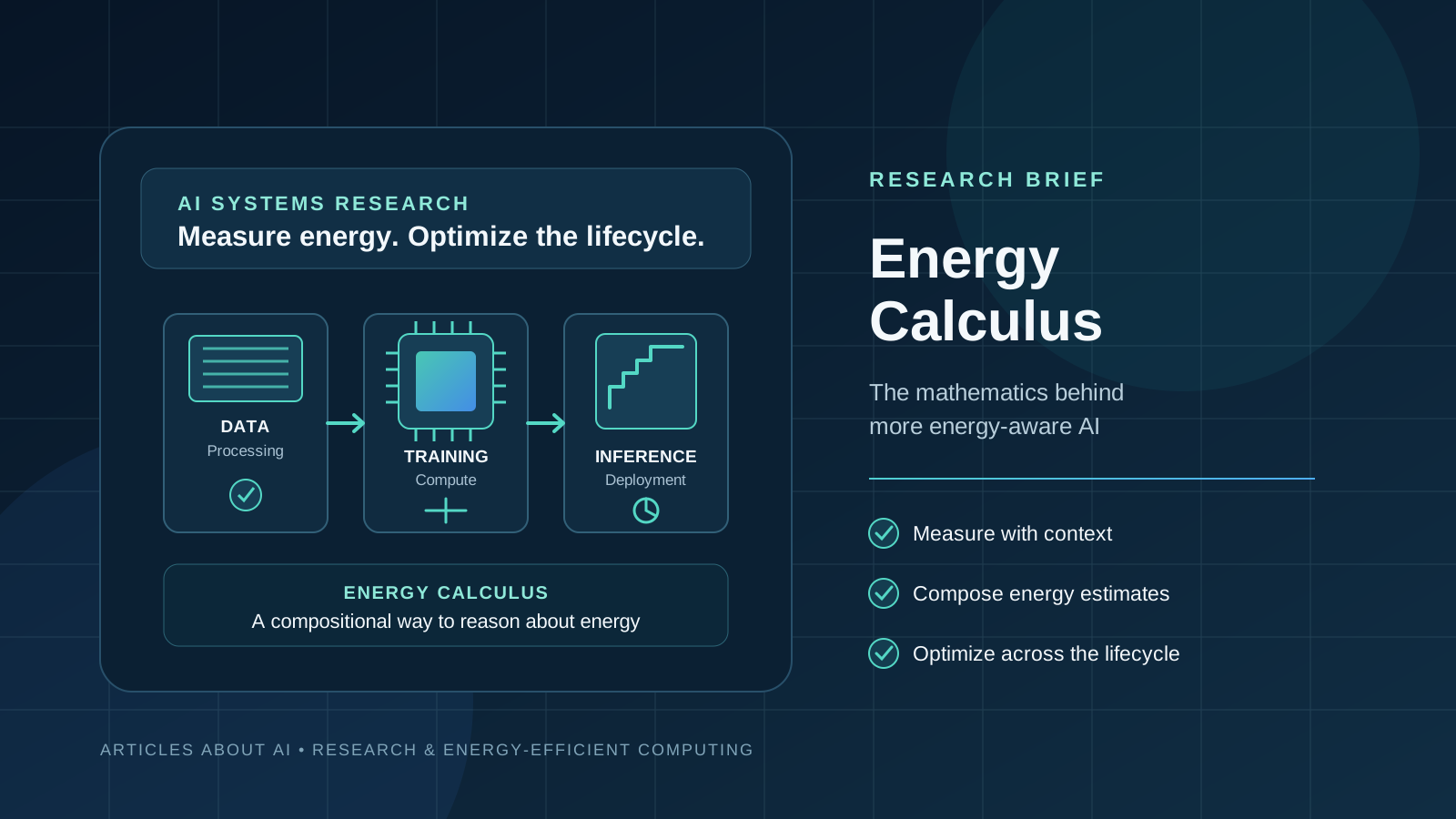
A new research project led by the University of Michigan aims to make artificial intelligence systems more energy-efficient by measuring and optimizing energy use across the full machine-learning lifecycle. Funded by a $1.83 million contract from the U.S. Defense Advanced Research Projects Agency (DARPA), the two-year initiative is called E-CALC: Energy Calculus for ML Lifecycle Optimization. Its goal is to help developers estimate energy consumption across data processing, model training, and deployment—and use those estimates to make better software and hardware decisions.
The project’s proposed mathematical framework is called Energy Calculus. The name is important: Energy Calculus is not a new AI model or a claim that a model has already become 50% more efficient. It is a way to represent and combine energy measurements from different parts of a computing workflow, while accounting for the context in which those measurements were taken.
The University of Michigan announced the project on October 27, 2026. The researchers say more efficient software design could reduce AI energy needs by up to half. That figure is a project target, not a measured final result. The work will need to establish how accurately Energy Calculus predicts energy use and how much energy practical optimizations save across different workloads and hardware configurations.
What is the Energy Calculus project?
E-CALC is designed to address a difficult problem in AI infrastructure: energy consumption depends on more than the number of calculations a model performs. It can also depend on the processor, power settings, software stack, execution order, parallel workloads, and interactions between operations.
When teams optimize AI systems today, they often measure a workload, change a setting, and run it again. That trial-and-error approach can be expensive when there are thousands of possible combinations of model settings, software libraries, accelerators, and power limits. A measurement from one configuration may not predict the result of another configuration reliably.
Energy Calculus is intended to make these measurements more useful and composable. Rather than treating energy as one isolated number collected after a run, the framework describes smaller computational elements with energy signatures and provides rules for combining those signatures according to how the workload executes.
The objective is to help researchers reason about the energy implications of a complete workflow instead of optimizing one component in isolation. In practice, Energy Calculus could give developers a more systematic basis for comparing design choices, locating expensive stages, and evaluating trade-offs between execution time and energy use.
Who is involved in the DARPA-funded research?
The University of Michigan leads E-CALC, with collaborators from the University of Illinois Urbana-Champaign (UIUC) and defense technology company BAE Systems. The project is funded through a $1.83 million DARPA contract over two years.
Mosharaf Chowdhury, an associate professor of computer science and engineering at the University of Michigan, is the principal investigator. The co-principal investigators are Nishil Talati, an assistant professor of electrical and computer engineering at UIUC, and David Nicholson, a principal research engineer at BAE Systems who leads internal research and development on edge AI technologies for defense applications.
The collaboration brings together expertise in computer systems, hardware-software co-design, energy measurement, and AI deployment. Those areas matter because the same AI workload can consume different amounts of energy depending on where and how it runs.
The University of Michigan says the team plans to develop high-precision energy measurement tools that combine physical sensors with software analysis. The project is also expected to release tools and documentation as open source, giving other researchers and developers a way to examine and use the resulting methods.
How does Energy Calculus work?
The academic paper “Energy Calculus: A Compositional Algebra of Energy in Computational Systems” describes the mathematical foundation behind the approach. It introduces the idea of treating energy as a first-class property of computation and composing measurements in a way that reflects the structure of the workload.
The framework starts with measurable units of computation, called energy elements. Each element has an energy signature that can include execution time, static and dynamic energy, the hardware operating point, the execution context, and measurement uncertainty.
That context is essential. A kernel measured on one accelerator, under one power limit, may not have the same energy behavior when it runs beside another workload or under a different hardware configuration. Energy Calculus is designed to preserve relevant context rather than assuming that every energy measurement can be added together without qualification.
The paper describes three composition operators:
- Sequential composition: representing operations that run one after another.
- Parallel execution on the same device: representing operations that overlap on one device and may interact through shared resources.
- Parallel execution across devices: representing work distributed across separate devices.
These operators allow the framework to represent workflows with complex dependency structures, including directed acyclic graphs (DAGs). That matters for modern AI systems, where data preparation, model execution, communication, and post-processing may be arranged as a pipeline or run concurrently.
Another key feature is uncertainty propagation. Energy measurements are not perfectly exact. Energy Calculus aims to carry measurement uncertainty through its calculations so that predictions can include error bounds, rather than presenting every estimate as an unquestionable number.
The paper also discusses time-energy Pareto frontiers: the set of options where improving execution time further may require more energy, or saving more energy may require extra time. This can help teams understand trade-offs rather than treating minimum energy as the only objective.
Why does AI need better energy measurement?
AI energy use is becoming a major infrastructure and cost concern. The University of Michigan announcement notes that data-center electricity consumption was around 420 terawatt-hours in 2024 and is expected to more than double by 2030, with AI contributing to the anticipated growth.
The energy cost of AI is not limited to training large models. Once deployed, a model may answer millions of requests, process documents, generate images, or support software tools. The cumulative energy used during inference can therefore be important, even when an individual request appears small.
Energy efficiency also affects operating budgets, cooling requirements, hardware capacity, and the feasibility of running AI on devices with limited power. In defense and edge-computing environments, power constraints can be particularly strict because equipment may operate remotely or depend on batteries.
Energy Calculus targets a measurement problem that affects all these settings: teams need to know not only how much energy a system used, but why it used that amount and whether an alternative design would perform better.
For more background on the wider infrastructure issue, read our related coverage: AI Data Centers and Electricity Bills. Our broader guide to the biggest AI challenges in 2026 also examines energy use, infrastructure, and the trade-offs involved in scaling AI.
What does “up to 50% lower energy use” actually mean?
The proposed project has attracted attention because the University of Michigan says more efficient software design could reduce AI energy requirements by up to 50%. This is a meaningful ambition, but it needs to be reported accurately.
The announcement does not establish that Energy Calculus has already delivered a 50% reduction across AI models, data centers, or production workloads. Instead, the figure describes the potential reduction the researchers aim to achieve through better energy measurement and optimization over the project.
The final result will depend on the workloads tested, the baseline used for comparison, the hardware and software configurations, and the quality of the optimization. Savings from one workload should not automatically be generalized to every model or data center.
A credible evaluation should report the baseline energy consumption, the workload and hardware used, the measurement method, the quality or latency impact, and the uncertainty around the result. It should also distinguish energy saved during training from energy saved during inference and deployment.
This distinction is especially important for coverage of Energy Calculus. A framework for measuring and predicting energy can make optimization more systematic, but a measurement framework alone does not guarantee a particular saving. The claimed reduction must be demonstrated by experiments.
How is Energy Calculus connected to existing AI optimization work?
The E-CALC initiative builds on related work by Chowdhury’s team. The University of Michigan announcement highlights Zeus, an energy-optimization framework for AI model training that can tune settings such as batch size and power limits, and ML.ENERGY, a benchmark that measures and compares energy consumption across open-weight AI models and open-source software frameworks.
These efforts address connected but distinct problems. A benchmark can help compare energy use under specified conditions. An optimization framework can search for settings that reduce energy consumption for a particular training workload. Energy Calculus aims to provide a more general way to model and combine energy behavior across the different stages and execution structures of a workflow.
Together, such tools could help teams move from isolated measurements toward repeatable energy-aware engineering. However, results from one benchmark or optimization system should not be presented as proof that Energy Calculus itself has achieved the same savings. Each method needs to be evaluated on its own evidence.
What could Energy Calculus mean for AI developers?
If the project produces reliable tools and validated methods, Energy Calculus could be useful in several ways.
First, developers could compare implementation choices before committing to expensive, large-scale runs. Better estimates could narrow the configurations that require full measurements.
Second, teams could identify energy costs across the lifecycle, including preprocessing, training, and inference. This matters because optimizing training alone may miss substantial energy use after a model enters production.
Third, Energy Calculus could help teams reason about parallel workloads and hardware interactions. If energy behavior changes with execution context, a context-aware model is more informative than a simple sum of isolated measurements.
Fourth, uncertainty-aware estimates could help engineers distinguish meaningful improvements from changes that fall within measurement noise. That is important when comparing systems whose energy differences are small.
These are potential applications, not guaranteed outcomes. Their practical value will depend on the accuracy, usability, coverage, and openness of the tools delivered by E-CALC.
What should readers watch for next?
The most useful milestones will be public documentation, released measurement tools, reproducible experiments, and evaluations across different AI workloads and hardware configurations. Readers should look for evidence that the Energy Calculus framework predicts measured energy accurately, that its uncertainty estimates are meaningful, and that optimizations deliver repeatable savings without unacceptable trade-offs in quality or latency.
It will also be important to understand the limits of the approach. Some energy behavior may depend on hardware-specific details or interactions that are difficult to model. A practical framework must balance useful precision with the cost of collecting measurements and maintaining context information.
As E-CALC progresses, the central question is not simply whether Energy Calculus can produce an energy estimate. It is whether the framework helps developers make better decisions than existing measurement and trial-and-error methods, and whether those decisions translate into verified reductions in real workloads.
Energy Calculus: the key takeaway
The University of Michigan’s DARPA-funded E-CALC project puts energy measurement at the center of AI systems design. Its Energy Calculus framework is intended to combine energy signatures across sequential and parallel computation, account for context and uncertainty, and help researchers reason about energy use across an AI workflow.
The project has a two-year timeline and $1.83 million in funding, and its stated ambition is to enable reductions of up to 50% in AI energy needs through more efficient software design. That is a target, not a confirmed result. The real test will be whether the research produces open tools, reproducible measurements, and demonstrated savings across diverse workloads.
For developers, infrastructure teams, and anyone following the environmental and economic costs of AI, Energy Calculus is worth watching because it addresses a foundational question: how can AI systems be designed and optimized with energy treated as a measurable engineering constraint from the start?
Sources
- University of Michigan Engineering News: Optimizing AI energy consumption throughout its entire lifecycle — the primary source for the project announcement, funding, collaborators, scope, and stated energy-reduction target.
- Research paper on arXiv: Energy Calculus: A Compositional Algebra of Energy in Computational Systems — the academic paper describing the framework, its composition operators, energy signatures, and treatment of uncertainty.
- SymbioticLab publications: Research publications — additional context on the research group’s systems and energy-efficiency work.
Editorial note: The 50% figure is presented as a goal or potential reduction described in the University of Michigan announcement. This article does not claim that E-CALC has already demonstrated a 50% energy saving.